














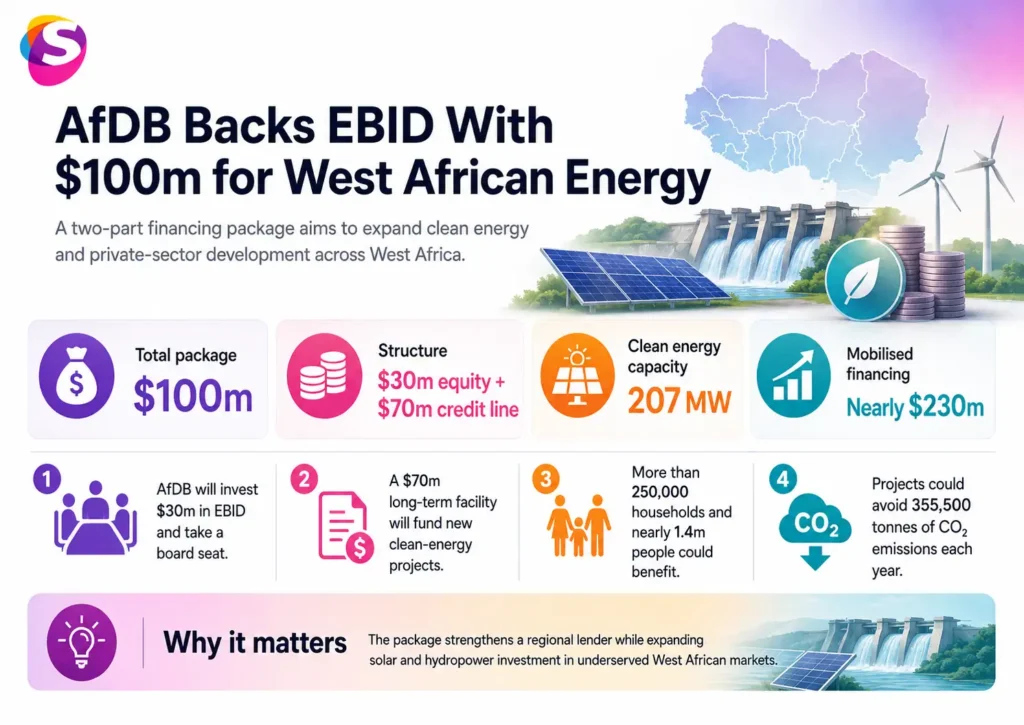
The African Development Bank Group has approved a $100 million financing package for the ECOWAS Bank for Investment and Development to expand clean-energy investment and strengthen private-sector financing across West Africa. The package combines a $30 million equity investment with a $70 million long-term credit facility dedicated to renewable-energy projects.
The financing is expected to support 207 megawatts of new solar and hydropower capacity, improve electricity access for more than 250,000 households and benefit nearly 1.4 million people. It is also projected to avoid about 355,500 tonnes of carbon dioxide emissions annually while creating permanent employment, with young people expected to secure more than 70% of the new jobs.
Key Overview
- AfDB will invest $30 million in EBID’s capital and obtain a seat on its board.
- A separate $70 million credit line will finance new clean-energy projects.
- The facility is expected to mobilise nearly $230 million in total renewable-energy financing.
- Planned projects could add 207 megawatts of solar and hydropower capacity.
- More than 250,000 households and nearly 1.4 million people are expected to gain improved electricity access.
- The operation supports an African-led approach to mobilising long-term development capital.
AfDB Becomes EBID’s First Institutional Shareholder
The approved financing package is divided into two complementary components designed to strengthen EBID’s balance sheet and increase its capacity to fund regional projects.
The first component is a $30 million equity investment. It makes AfDB the first development finance institution to acquire a direct stake in EBID and gives the continental lender representation on the regional bank’s board of directors.
This investment is part of EBID’s wider capital increase and is expected to improve its institutional credibility, governance and ability to raise additional resources from international investors. The participation of a triple-A-rated shareholder may also help EBID access longer-term funding on more favourable terms.
EBID serves as the development finance institution of the Economic Community of West African States. Its mandate includes financing infrastructure, private-sector development and regional economic integration across ECOWAS member countries.
Credit Line Targets Solar and Hydropower Projects
The second component provides EBID with a $70 million long-term credit facility for new renewable-energy investments. The funds will be channelled into projects intended to expand electricity generation and improve access for underserved households and businesses.
AfDB estimates that the credit line could help mobilise nearly $230 million in total financing through additional public and private investment. The expected portfolio will focus mainly on solar and hydroelectric power, adding approximately 207 megawatts of generation capacity across West Africa.
The projected development impact is substantial. More than 250,000 households are expected to receive improved electricity access, benefiting close to 1.4 million people. The funded projects are also expected to prevent around 355,500 tonnes of carbon dioxide emissions each year.
Youth employment is another central objective. More than 70% of the permanent jobs created through the supported projects are expected to go to young people, linking the energy transition to wider efforts to address unemployment and build technical skills.
Context is everything. Stay ahead of shifting trends with today’s market updates, and uncover emerging opportunities using the Serrari Group Market Index and Marketplace. Then, take control of your own financial future by exploring our Money & Life Reset Transformation Blueprint ™ to build stronger habits, create better systems, and design a path toward lasting wealth.
Stronger Energy Access Could Support Regional Growth
Reliable electricity remains essential for industrial development, digital services, healthcare, education and the growth of small and medium-sized businesses. By financing additional generation capacity, the facility could reduce energy constraints that continue to limit productivity and private investment in several West African markets.
The programme also gives EBID greater capacity to finance projects that individual national institutions may struggle to support alone. A stronger regional development bank can pool resources, spread risk across markets and support infrastructure with cross-border economic benefits.
For AfDB, the investment goes beyond funding individual power projects. It strengthens a regional financial institution that can continue mobilising capital and financing development after the original credit line has been deployed.
Financing Supports Africa’s New Development Architecture
The transaction is aligned with the New African Financial Architecture for Development, an initiative intended to improve how African institutions mobilise capital and manage development risk.
The framework seeks to strengthen African development finance institutions so they can attract domestic and international investment, expand lending capacity and reduce reliance on fragmented short-term funding. AfDB’s equity participation in EBID provides a practical example of this strategy by combining institutional strengthening with project-level finance.
EBID officials described the equity investment as an important milestone that should reinforce governance and improve confidence among global investors. The bank expects AfDB’s participation to support its efforts to raise long-term capital for sustainable development and the regional energy transition.
Implementation Will Determine the Final Impact
The announced projections depend on EBID successfully identifying, financing and executing commercially and technically viable projects. Developers will still need to manage regulatory approvals, grid connections, currency exposure, construction risk and power-purchase arrangements in individual markets.
However, the combination of permanent capital, a long-term credit line and AfDB’s institutional involvement gives EBID a stronger platform from which to address those challenges. If the planned leverage is achieved, the initial $100 million commitment could unlock a much larger pool of capital for West Africa’s energy sector.
The facility therefore represents more than a single financing agreement. It is a test of whether stronger African financial institutions can use strategic capital injections to expand clean-energy access, attract private investors and deliver measurable economic and environmental benefits across the region.
Sources: African Development Bank Group / ECOWAS Bank for Investment and Development
Your financial future isn’t something you wait for—it’s something you build.
The real question is: when do you begin?
Move beyond simply staying informed.
Navigate the markets with clarity—track trends through the Serrari Group Market Index, uncover opportunities in the Serrari Marketplace, and build practical knowledge with our Curated Wealth Builder Platform.
Stay connected to what truly matters.
Get daily insights on macro trends and financial movements across Kenya, Africa, and global markets—delivered through the Serrari Newsletter.
Growth opens doors.
Advance your career through professional programs including ACCA, HESI A2, ATI TEAS 7 , HESI EXIT , NCLEX – RN and NCLEX – PN, Financial Literacy!🌟—designed to move you forward with confidence.
See where money is flowing—clearly and in real time.
Track Money Market Funds, Treasury Bills, Treasury Bonds, Green Bonds, and Fixed Deposits, alongside global and African indexes, key economic indicators, and the evolving Crypto and stablecoin landscape—all within Serrari’s Market Index.