CaixaBank has raised €1 billion through a five-year senior preferred green bond, attracting peak investor demand of more than €4.5 billion. The bank’s first ESG-labelled issuance of 2026 benefited from favourable credit and interest rate market conditions and strong investor appetite, allowing it to secure tighter pricing than initially indicated. The proceeds will finance eligible environmental projects under its Sustainable Funding Framework, while supporting its 2026 funding plan and broader sustainable finance ambitions.
Key Takeaways
- CaixaBank raised €1 billion through a five-year senior preferred green bond carrying a 3.875% coupon.
- Investor demand exceeded €4.5 billion, more than 4.5 times the final issue size.
- Strong demand allowed the bank to tighten pricing from an initial spread of 100 to 70 basis points over mid-swaps.
- Proceeds will finance eligible green projects, including renewable energy, energy efficiency, green buildings and clean transport.
- The issuance supports CaixaBank’s funding requirements and its target of mobilising more than €100 billion in sustainable finance between 2025 and 2027.
Why Did CaixaBank Issue a Green Bond Now?
CaixaBank has raised €1 billion through a five-year senior preferred green bond, marking its first ESG-labelled issuance of 2026.
The transaction comes as the bank works to complete its 2026 funding plan, manage upcoming debt maturities and diversify its investor base. It also provides financing for eligible environmental projects within its growing green portfolio.
The bond attracted peak demand of more than €4.5 billion, representing an oversubscription of more than 4.5 times its final issue size. This was the largest order book in CaixaBank’s history for a euro-denominated senior preferred green bond.
The timing was supported by improving financial market conditions. CaixaBank said credit and rate markets improved significantly after the U.S. midterm elections, despite the geopolitical backdrop, creating a favourable window for the transaction.
This combination of market conditions and investor appetite allowed the bank to raise the funds on competitive terms.
Why Was Investor Demand So Strong?
The strength of investor demand enabled CaixaBank to secure more favourable pricing than initially expected.
The bond was initially marketed at approximately 100 basis points over mid-swaps, a benchmark interest rate used in pricing bonds. Strong demand allowed the bank to reduce the spread to 70 basis points over mid-swaps, 30 basis points tighter than the initial indication.
CaixaBank said the transaction was priced very close to the bond’s estimated fair value, making it one of the few recent transactions to price without a material new issue premium.
The bond also carries A2/A+/A+ ratings from Moody’s, S&P and Fitch, respectively. It is the bank’s first senior preferred green bond issued with these ratings, following a series of credit rating upgrades since 2022.
These ratings and the strong order book indicate investor confidence in CaixaBank’s credit profile. For the bank, stronger demand means it can access funding while limiting the additional pricing concession investors may otherwise require.
The transaction was arranged by BNP Paribas, CaixaBank, Goldman Sachs Bank Europe SE, HSBC, Mediobanca and Natixis as joint lead managers.
What Will the €1 Billion Green Bond Finance?
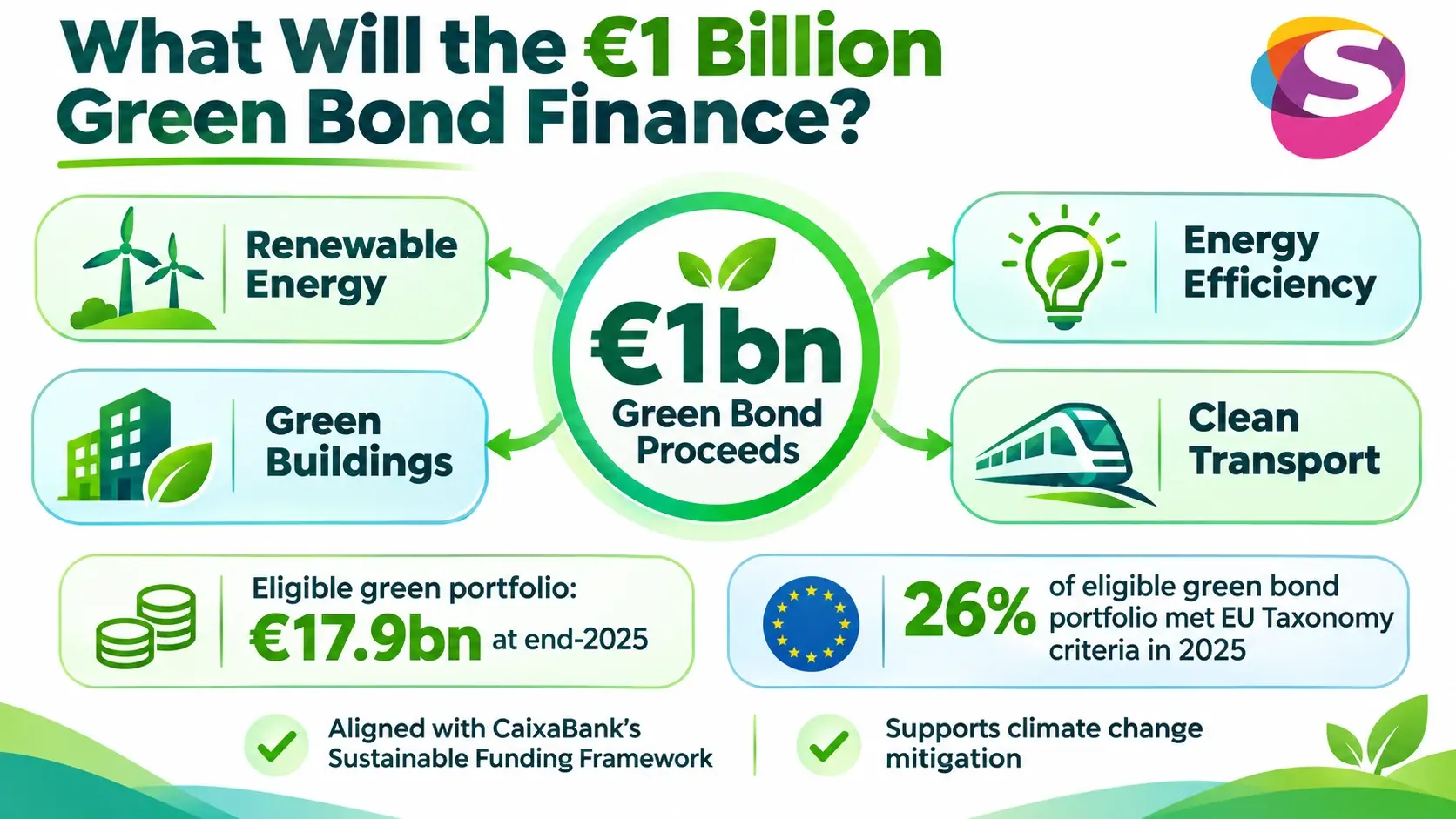
The proceeds will be allocated to eligible environmental projects under CaixaBank’s Sustainable Funding Framework, which is aligned with the International Capital Market Association’s Green Bond Principles.
The bank’s eligible green portfolio reached €17.9 billion at the end of 2025, representing a 33% increase from the previous year.
The portfolio is concentrated in four main areas:
- Renewable energy projects.
- Energy efficiency.
- Green buildings.
- Clean transport.
These investments support climate change mitigation, including projects that help reduce emissions and improve energy performance.
Some assets in the portfolio also meet the criteria of the EU Taxonomy, the European Union’s classification system for determining which economic activities qualify as environmentally sustainable.
CaixaBank reported that 26% of its total green bond eligible portfolio met applicable EU Taxonomy criteria in 2025. However, it did not disclose the proportion of assets financed by this particular bond that meets those criteria.
This distinction matters because a green bond label does not automatically mean every financed project meets the EU Taxonomy’s technical requirements.
Context is everything. Stay ahead of shifting trends with today’s market updates, and uncover emerging opportunities using the Serrari Group Market Index and Marketplace. Then, take control of your own financial future by exploring our Money & Life Reset Transformation Blueprint ™ to build stronger habits, create better systems, and design a path toward lasting wealth.
How Does the Issuance Support CaixaBank’s Wider Sustainability Goals?
The bond builds on CaixaBank’s broader sustainable finance strategy.
Under its 2025–2027 Sustainability Plan, the bank aims to mobilise more than €100 billion in sustainable finance. By June 2026, it had mobilised €81.096 billion, representing more than 81% of the target.
The new issuance supports this direction by providing capital for eligible environmental projects while strengthening the bank’s role in sustainable financing.
It also follows CaixaBank’s previous euro-denominated green bond, a €1 billion ten-year senior preferred issue launched in June 2025.
The growth of its eligible green portfolio from the previous year suggests that the bank has expanded the pool of assets that can support sustainable funding activities.
For businesses seeking financing, this continued activity could support access to capital for renewable energy, energy efficiency improvements, green buildings and cleaner transport. For investors, it provides another opportunity to invest in bank debt linked to environmental financing objectives.
The Bigger Picture: Why Does This Matter for the Green Bond Market?
CaixaBank’s successful issuance reflects the continued role of green bonds in connecting institutional investors with projects that have environmental objectives.
The transaction is significant not only because it raised €1 billion, but also because demand exceeded the final issue size by more than four times. Strong investor appetite allowed the bank to secure tighter pricing, demonstrating the financing advantage that can come with a well-received green bond offering.
For banks, green bonds can diversify funding sources while supporting sustainable lending strategies. For investors, they offer exposure to debt instruments whose proceeds are allocated to defined environmental project categories.
However, transparency remains important. Investors need clear information about how proceeds are allocated, the environmental eligibility of financed assets and the outcomes those projects achieve.
CaixaBank’s transaction also illustrates how sustainable finance is becoming part of mainstream bank funding rather than a separate financing activity. Its growing eligible portfolio and €100 billion sustainability target show that green financing is integrated into its wider business strategy.
The longer-term significance will depend on how effectively the bank allocates the proceeds and demonstrates the environmental impact of the projects financed.
Why Does This Matter Now?
CaixaBank’s bond issuance comes at a time when financial institutions are balancing conventional funding needs with growing demand for capital to support the energy transition.
The bank needed to finance upcoming maturities and complete its 2026 funding programme. At the same time, its expanding green portfolio provided a basis for another ESG-labelled transaction.
Strong investor demand enabled it to raise the funds at tighter pricing than initially indicated, while directing the proceeds towards eligible environmental projects.
For the wider market, the deal demonstrates how banks can use sustainable debt instruments to meet funding requirements and support climate-related investment. Its success also reinforces the importance of investor confidence, transparent project eligibility and credible sustainability commitments.
Frequently Asked Questions
1. What is CaixaBank’s new green bond worth?
CaixaBank raised €1 billion through a five-year senior preferred green bond, its first ESG-labelled issuance of 2026.
2. How much investor demand did the bond attract?
Peak orders exceeded €4.5 billion, representing demand of more than 4.5 times the final €1 billion issue size.
3. What projects will the green bond finance?
The proceeds will support eligible projects in renewable energy, energy efficiency, green buildings and clean transport under CaixaBank’s Sustainable Funding Framework.
4. What is CaixaBank’s sustainable finance target?
CaixaBank aims to mobilise more than €100 billion in sustainable finance between 2025 and 2027. By June 2026, it had mobilised €81.096 billion, or more than 81% of the target.
Sources: ESG News/Dealroom/ESGinsider/CaixaBank
Your financial future isn’t something you wait for—it’s something you build.
The real question is: when do you begin?
Move beyond simply staying informed.
Navigate the markets with clarity—track trends through the Serrari Group Market Index, uncover opportunities in the Serrari Marketplace, and build practical knowledge with our Curated Wealth Builder Platform.
Stay connected to what truly matters.
Get daily insights on macro trends and financial movements across Kenya, Africa, and global markets—delivered through the Serrari Newsletter.
Growth opens doors.
Advance your career through professional programs including ACCA, HESI A2, ATI TEAS 7 , HESI EXIT , NCLEX – RN and NCLEX – PN, Financial Literacy!🌟—designed to move you forward with confidence.
See where money is flowing—clearly and in real time.
Track Money Market Funds, Treasury Bills, Treasury Bonds, Green Bonds, and Fixed Deposits, alongside global and African indexes, key economic indicators, and the evolving Crypto and stablecoin landscape—all within Serrari’s Market Index.