






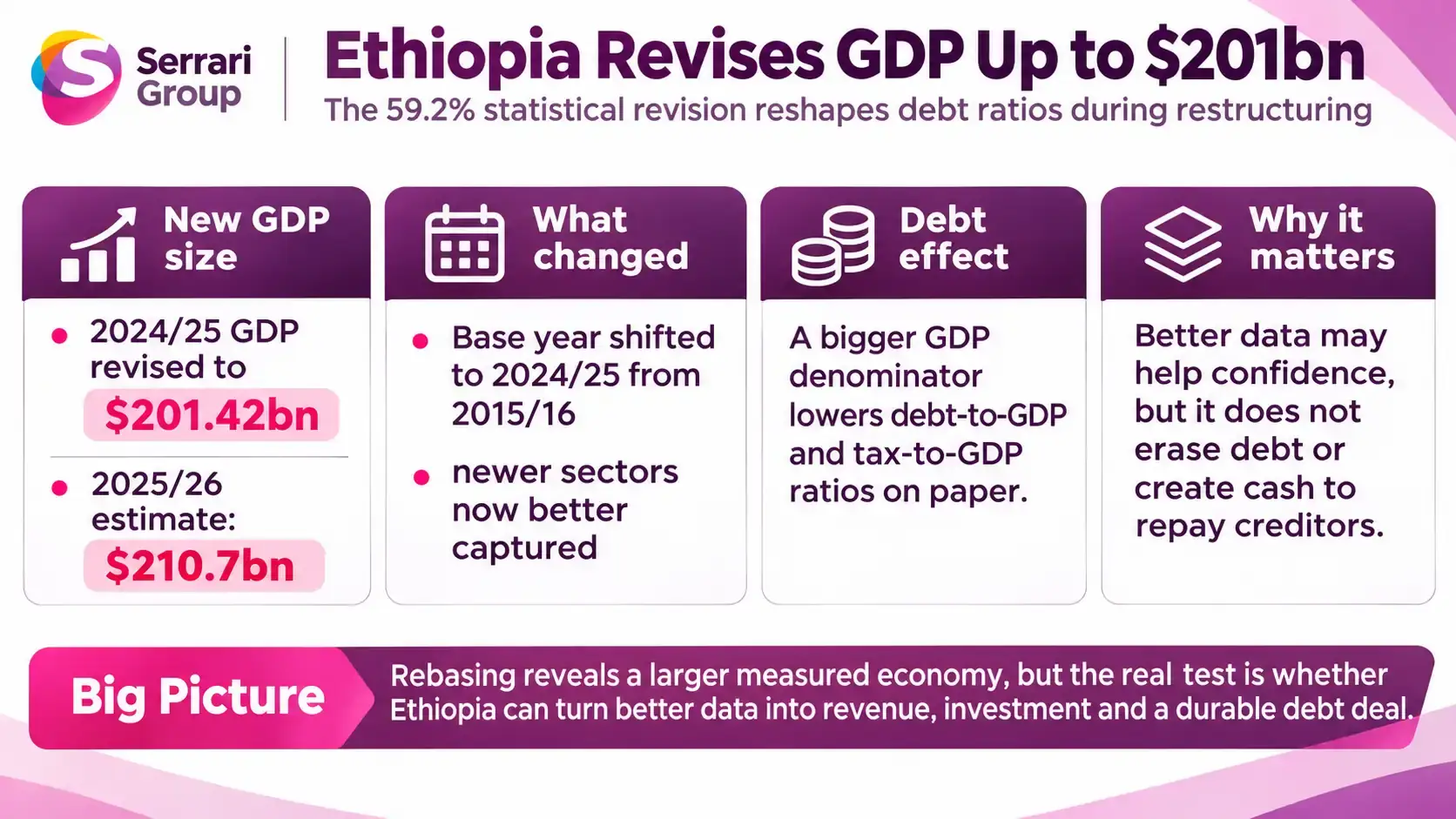
Ethiopia has revised the measured size of its economy upward by 59.2% to $201.42 billion for the 2024/25 fiscal year, after replacing its decade-old national accounts benchmark with a new base year. The government also reported GDP of $210.7 billion for 2025/26, placing the country higher in Africa’s economic rankings and altering the ratios used to assess its public debt, taxation and economic performance.
The change comes at a sensitive moment. Ethiopia is implementing wide-ranging economic reforms and working to conclude a restructuring of external debt that followed its 2023 Eurobond default. A larger GDP denominator makes debt-to-GDP ratios look smaller, but does not reduce the amount creditors are owed or automatically put additional cash into government accounts. The more consequential question is whether more accurate measurement of digital services, agriculture and emerging industries can translate into stronger revenue collection, better investment decisions and renewed lender confidence.
Key Overview
- GDP revised sharply higher: The 2024/25 economy was recalculated at $201.42 billion, approximately 59.2% above the previous estimate for the same period.
- Newer GDP estimate: Authorities put the economy at $210.7 billion in 2025/26, a separate fiscal-year figure that should not be confused with the size of the rebasing revision.
- Base year updated: The statistical benchmark moved from 2015/16 to 2024/25, allowing newer economic activities and updated methods to influence national accounts.
- Debt ratios change: The same outstanding debt, divided by a larger GDP estimate, produces a lower debt-to-GDP ratio, without cancelling any repayments.
- Tax performance looks weaker on paper: Tax-to-GDP ratios also fall unless reported revenue rises, highlighting the challenge of collecting revenue from newly measured activity.
- Debt negotiations remain critical: Ethiopia’s $1 billion Eurobond restructuring advanced in 2026, but statistical revisions cannot replace creditor agreements or actual debt-service capacity.
- Currency comparisons need care: The published dollar figures depend on exchange-rate conversion following the birr’s 2024 liberalisation, and must not be read as a sudden increase in dollar earnings.
Why Ethiopia Rebased Its Economy After a Decade
A country’s gross domestic product is an estimate of the value of goods and services produced over a period, not a direct count of money held by households or government. Statistical agencies use surveys, administrative records, price measures and industry classifications to build that estimate. When the underlying economic structure changes, an old benchmark can miss expanding industries or rely on production patterns that no longer represent the country accurately.
Ethiopia’s previous base year was 2015/16. Since then, digital payments, mobile financial services, ride-hailing platforms, commercial agriculture, solar installations and other activities have developed in ways that can be difficult to capture with older surveys and statistical weights. The government’s rebasing announcement described the exercise as an attempt to improve economic planning, fiscal policy and domestic revenue mobilisation by measuring this changing activity more accurately.
The revision puts GDP for 2024/25 at 24.03 trillion birr, equivalent to the reported $201.42 billion, compared with approximately 15.09 trillion birr under the previous series. That is a substantial change to the estimated level of output, not evidence that factories, farms and service providers suddenly produced nearly 60% more goods and services in one year.
This distinction is essential for households and investors. Statistical rebasing can reveal economic activity previously underrepresented in official data, but it does not by itself create new jobs, raise wages, produce foreign currency or improve living standards. The benefits depend on how the revised information is used and whether it leads to better policy and investment decisions.
Why the Revision Arrives During Debt Restructuring
The timing gives Ethiopia’s new statistics unusual financial significance. The country has been seeking to restore its external finances following a 2023 default on a $1 billion Eurobond, while carrying out reforms supported by the International Monetary Fund and negotiating with different categories of creditors.
The June 2026 restructuring agreement in principle envisaged exchanging the original bond for a new instrument with $880 million in principal, equivalent to a proposed 12% face-value reduction, alongside other settlement terms. The agreement included a separate warrant offering investors possible participation in a future international bond.
The process has not been straightforward. An earlier proposal was considered inconsistent with the principle that different creditor groups should provide comparable debt relief. In August, the official creditor committee’s assessment found that the revised June terms met that principle at that stage, allowing implementation work to proceed. The committee nevertheless flagged the potential implications of the warrant arrangement and said it would monitor the final terms.
That makes it important not to treat the GDP revision as a settlement. A better debt-to-GDP ratio may improve the appearance of Ethiopia’s financial position, but creditors still need to be paid under binding agreements, and the government still requires enough revenue and foreign exchange to service obligations on schedule.
How a 59.2% GDP Revision Changes the Debt Ratios
Debt-to-GDP is calculated by dividing an outstanding debt stock by the annual value of economic output. Raising the denominator while leaving the numerator unchanged mechanically reduces the reported ratio.
For example, a hypothetical debt stock equal to 60% of GDP under Ethiopia’s old estimate would equal approximately 37.7% of GDP after a 59.2% upward revision, assuming the debt stock, reporting period, currency treatment and coverage remain unchanged. This is a mathematical illustration, not a newly reported official Ethiopian debt ratio.
The improvement can matter because lenders, credit analysts and international institutions use debt ratios when considering fiscal risks, although they also examine debt-service payments, interest expenses, government revenue, foreign-exchange availability and the maturity of obligations.
A country can have a relatively moderate debt-to-GDP ratio and still struggle to pay dollar-denominated bonds if exports and reserves are insufficient. Conversely, a country with a larger debt stock can maintain repayments when revenue is stable, maturities are manageable and financial markets remain accessible.
The revised GDP therefore provides context, not proof that Ethiopia’s debt distress has ended. The latest published programme assessment underscores that financing assurances, negotiations and controls on new borrowing remain important parts of the country’s stabilisation effort.
Why the Bigger Economy Could Expose a Tax Collection Problem
The same change that improves debt ratios produces a less flattering result for tax collection. Tax-to-GDP compares the government’s tax receipts with total economic output. If measured output rises sharply but taxes already collected remain the same, the share of GDP captured as government revenue falls.
That can reveal previously understated fiscal capacity or a larger segment of activity not adequately reached by the tax system. But GDP is not itself taxable income: some activities are exempt, some generate low profits, and collecting additional revenue depends on legislation, administration and taxpayers’ ability to comply.
For Ethiopia, the policy implication is that improved statistical records could help authorities identify where economic activity is growing and whether the tax base adequately reflects it. Digital transactions may leave records useful for measurement and administration, while emerging services may require updated classifications and more reliable surveys.
The government could use the information to plan broader tax administration reforms, but mechanically targeting a higher tax-to-GDP ratio through steep new levies may burden households and businesses. Sustainable revenue growth depends on stronger compliance, productive economic activity and a credible tax system—not simply treating a larger statistical economy as available cash.
Context is everything. Stay ahead of shifting trends with today’s market updates, and uncover emerging opportunities using the Serrari Group Market Index and Marketplace. Then, take control of your own financial future by exploring our Money & Life Reset Transformation Blueprint ™ to build stronger habits, create better systems, and design a path toward lasting wealth.
Why the Birr’s Exchange Rate Complicates the Dollar Figures
Ethiopia’s economic figures are also affected by the currency used to express them. The economy produces output largely valued in birr, whereas international comparisons usually convert GDP into dollars using an exchange rate. A change in that rate can alter the dollar value of GDP even when the underlying domestic output is unchanged.
In 2024, Ethiopia moved towards a more market-determined exchange-rate system as part of wider economic reforms. The birr weakened sharply, changing the cost of imported goods and the domestic-currency burden of foreign obligations. The presentation cited in the November 5 report on rebasing did not specify the exact exchange-rate convention used for its dollar equivalents.
This matters for ranking countries by economic size. A revision to birr-denominated GDP and a change in the birr-dollar conversion rate are distinct forces, and both can influence the number shown in international comparisons. Analysts should therefore examine the national-currency series, the period covered and the conversion methodology before drawing conclusions about Ethiopia’s position relative to other African economies.
Nor does GDP measured in dollars equal foreign currency available to the treasury. External repayment capacity depends much more directly on export receipts, reserves, financing flows and debt obligations.
What the New Figures Reveal About Ethiopia’s Changing Economy
The statistical overhaul may be most useful in identifying which parts of Ethiopia’s economy are larger or growing more rapidly than earlier estimates suggested. The official explanation of newly captured activity highlights sectors that older measurement frameworks may not have reflected adequately.
Better recognition of digital services could affect financial-sector policy and the assessment of consumer spending. Improved coverage of agricultural production could influence food-security planning and investment in storage, irrigation and transport. More complete accounting of energy installations could sharpen estimates of electricity investment and industrial activity.
These changes matter to companies evaluating demand and to policymakers deciding where infrastructure funds are needed. Reliable statistics can lower uncertainty around market size, but only if underlying methods are transparent and revisions can be reproduced and compared over time.
The government has also indicated that the revised 2025/26 economic structure includes substantial contributions from services, agriculture and industry. The importance is not simply which sector ranks first, but whether future growth can create productive employment, strengthen exports and generate sufficient tax revenue to finance public needs.
Will the Rebased GDP Improve Credit Ratings and Investment?
Officials argue that more accurate national accounts could strengthen creditworthiness and foreign-investor confidence. There is a reasonable basis for this view: investors need reliable information about economic size, sector composition and public finances before committing capital.
However, a statistical increase does not automatically lead to a rating upgrade or cheaper sovereign borrowing. Credit assessments consider the credibility of institutions, past payment performance, inflation, currency flexibility, external liquidity and debt-service capacity. Ethiopia’s recent default and ongoing negotiations will remain relevant even if ratios improve.
Foreign investors may likewise welcome more realistic market estimates but still assess regulatory predictability, the availability of foreign exchange, security, infrastructure and the ability to repatriate profits. A reported GDP increase can support research and investment planning, but actual capital inflows depend on whether projects can operate profitably under acceptable risks.
That means the headline figure should be judged against subsequent outcomes: improved financing terms, sustainable revenue collection, stronger exports and more stable access to foreign currency.
Why Ethiopia’s Rebasing Matters Beyond Its Borders
GDP rebasing is an accepted statistical practice and has previously changed the reported scale of other African economies. As economies diversify, older benchmarks can underestimate services, digital commerce and changing patterns of production. Ethiopia’s exercise highlights why cross-country comparisons should be based on consistently updated data rather than treating historic rankings as permanent.
For regional investors, more complete estimates can alter perceptions of market opportunities. For development lenders, they may affect metrics used to compare financing needs and fiscal capacity. For neighbouring trading partners, they provide a revised picture of demand in one of the continent’s major population centres.
But rankings alone can mislead. GDP measures aggregate output, not distribution. A larger total says little on its own about per-person incomes, poverty, employment, affordability or the quality of public services. These outcomes must be assessed separately, especially when a statistical change creates a dramatic headline without an equivalent immediate change in living conditions.
Outlook: Better Statistics Are a Starting Point, Not a Recovery
Ethiopia’s 59.2% GDP rebasing changes how its economy is measured at a pivotal stage of fiscal reform. The revision potentially improves the usefulness of national accounts, increases the measured scale of newer industries and lowers some debt ratios on paper. At the same time, it reduces measured tax revenue as a share of GDP and raises questions about the comparability of earlier forecasts and dollar estimates.
The next tests are practical. Authorities will need to publish clear methods, reconcile historic data where possible and demonstrate that better information supports improved policy decisions. Creditors will examine whether debt restructuring is completed on sustainable terms. Investors will assess whether the reform programme produces more stable foreign-exchange access and genuine improvements in the business environment.
The central distinction is that Ethiopia has discovered a larger measured economy, not suddenly acquired the resources of a richer one. What matters now is whether the improved statistical picture helps the country collect revenue fairly, allocate investment more productively and restore confidence while meeting its financial commitments.
Sources: Reuters / Ethiopian News Agency / Ministry of Finance Ethiopia / International Monetary Fund / bne IntelliNews
Your financial future isn’t something you wait for—it’s something you build.
The real question is: when do you begin?
Move beyond simply staying informed.
Navigate the markets with clarity—track trends through the Serrari Group Market Index, uncover opportunities in the Serrari Marketplace, and build practical knowledge with our Curated Wealth Builder Platform.
Stay connected to what truly matters.
Get daily insights on macro trends and financial movements across Kenya, Africa, and global markets—delivered through the Serrari Newsletter.
Growth opens doors.
Advance your career through professional programs including ACCA, HESI A2, ATI TEAS 7 , HESI EXIT , NCLEX – RN and NCLEX – PN, Financial Literacy!🌟—designed to move you forward with confidence.
See where money is flowing—clearly and in real time.
Track Money Market Funds, Treasury Bills, Treasury Bonds, Green Bonds, and Fixed Deposits, alongside global and African indexes, key economic indicators, and the evolving Crypto and stablecoin landscape—all within Serrari’s Market Index.