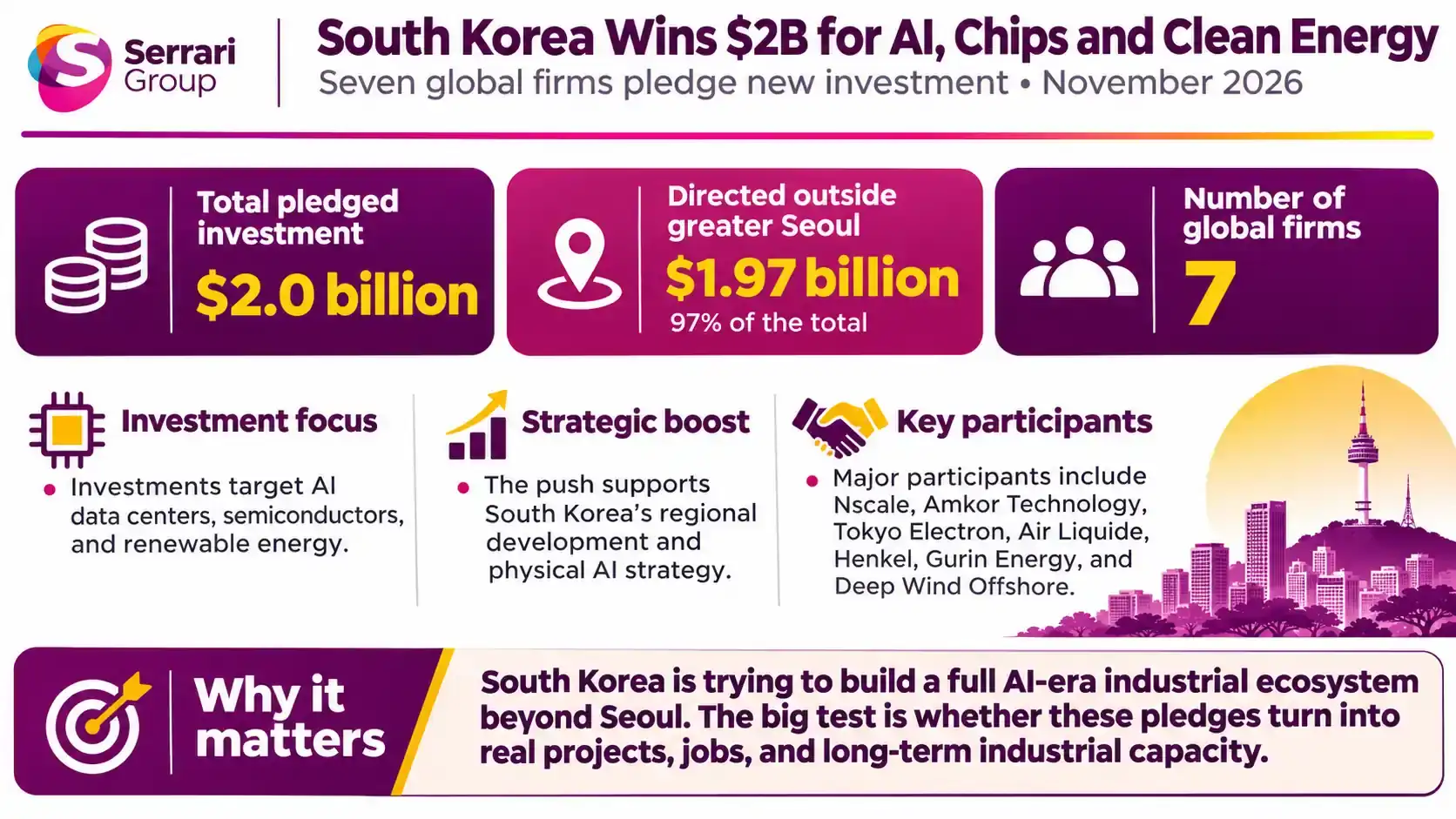
South Korea has secured $2 billion in declared investment commitments from seven international companies targeting artificial intelligence data centers, semiconductor manufacturing and renewable energy. Announced at the Invest Korea Summit on November 4, 2026, the commitments are the largest recorded at the annual event. Approximately $1.97 billion, or 97%, is intended for projects outside the Seoul metropolitan area, making the announcement as much about regional economic restructuring as it is about attracting foreign capital.
The investments bring together companies supplying the interconnected components of a modern AI economy: computing facilities, chips, specialist industrial gases, advanced materials, manufacturing equipment and electricity. They arrive as Seoul tries to convert its established semiconductor strength into a broader advantage in AI-enabled manufacturing, while reducing the concentration of economic opportunity around the capital. But the $2 billion is declared investment, not money already fully deployed. The impact will ultimately depend on construction, permitting, workforce availability and whether the projects become commercially viable.
Key Overview
- Record summit commitments: Seven global firms declared investment plans totaling $2 billion at the November 4 opening of Invest Korea Summit 2026.
- Regional focus: Around $1.97 billion, representing 97% of the total, is earmarked for locations outside greater Seoul.
- Seven participants: Nscale, Air Liquide, Amkor Technology, Gurin Energy, Deep Wind Offshore, Tokyo Electron and Henkel span AI infrastructure, semiconductors, industrial materials and renewable energy.
- Strategic rationale: South Korea wants to strengthen the full supply chain needed for AI computing and bring AI technologies into factories and logistics operations.
- FDI momentum: Foreign direct investment notifications reached $22.9 billion during January–September 2026, up 10.8% year on year, while actual inflows rose 30.6% to $14.9 billion.
- Key uncertainty: Commitments must still translate into operating plants, data centers, energy projects and sustained employment.
Why South Korea Is Attracting These Investments Now
The investment announcement reflects a shift in how countries compete for high-value industrial activity. AI is no longer only a race to develop powerful software or purchase advanced chips. It requires physical infrastructure: data centers to operate models, electricity to power them, and sophisticated manufacturing systems to supply the processors and equipment they consume. Countries that can host several links in that chain may become more attractive to companies seeking reliable production and shorter coordination distances.
South Korea already has substantial semiconductor expertise, major technology manufacturers and a dense network of suppliers. What the country is trying to build is a more complete AI industrial ecosystem that extends from chip production to deployment in factories. The November 4 government investment announcement identifies AI data centers, semiconductors and what policymakers call physical AI as priority areas.
Physical AI describes systems that use artificial intelligence to perceive, decide and act in the real world, including robots, automated logistics equipment and intelligent industrial machinery. The opportunity is especially relevant for South Korea because its manufacturing base offers practical environments in which these technologies can be tested and commercialized. For investors, that creates potential demand not only for software but also for sensors, robotics, chips, networking, electricity and engineering services.
The timing also reflects global competition for production capacity. As companies seek greater resilience in strategically important supply chains, South Korea can market its technical workforce, existing customers and industrial infrastructure. However, attracting a declaration is only the first step. Investors still have to judge construction costs, regulation, energy availability and expected demand before capital turns into productive assets.
What the Seven Companies Plan to Build
The seven investors serve different parts of the same industrial system. Britain’s Nscale plans an AI data-center investment, adding the computing facilities needed to run increasingly demanding AI applications. Such projects can support cloud and AI services, but they also place considerable demands on power networks, cooling capacity and local infrastructure.
In semiconductors, the United States-based Amkor Technology plans to expand advanced packaging operations in Gwangju. Packaging and testing are critical because even highly sophisticated chips need to be assembled, connected and validated before deployment. Demand for advanced packaging has grown alongside complex AI processors and high-bandwidth memory systems. Japan’s Tokyo Electron is pursuing semiconductor equipment and materials manufacturing, while France’s Air Liquide intends to expand supplies of specialty gases essential to chip production. Germany’s Henkel is targeting advanced packaging materials and related research. The detailed investment project descriptions show that the projects are complementary rather than seven competing versions of the same factory.
The energy participants are Singapore’s Gurin Energy, associated with solar and onshore wind development, and Norway’s Deep Wind Offshore, focused on offshore wind. Their inclusion is economically important. Advanced manufacturing and AI data centers require dependable electricity, and expanding power-intensive capacity without corresponding energy infrastructure could create bottlenecks or higher operating costs.
The government has not provided a publicly verified individual dollar allocation for every company in the combined announcement. It would therefore be misleading to divide the $2 billion evenly among the seven firms or infer project-specific employment totals. The announced mix instead demonstrates an intended supply-chain strategy: attract computing demand, deepen semiconductor production capabilities and improve the energy infrastructure that supports both.
Why 97% of the Money Is Heading Beyond Seoul
The geographic allocation may be the most politically significant part of the announcement. South Korea’s capital region concentrates a large share of corporate headquarters, high-value jobs and services. That concentration can reinforce a cycle in which talented workers move toward Seoul while other areas find it harder to attract employers and investment.
Placing approximately $1.97 billion of proposed investment outside greater Seoul is intended to interrupt that pattern. Industrial projects can create direct employment in engineering, operations and maintenance, while generating demand for construction, transport, component suppliers and local services. Large facilities can also help anchor clusters of smaller businesses and encourage training institutions to develop relevant skills.
The strategy fits the government’s Five Growth Hubs and Three Special Regions initiative, which seeks to develop economic activity suited to different regional strengths. Officials have discussed regional manufacturing AI clusters, targeted incentives, administrative assistance and investment-friendly regulatory arrangements. The intention is not simply to move projects away from Seoul but to connect regional industries with emerging technology markets.
There is a trade-off. A data center or advanced factory cannot thrive on a subsidy alone. It needs reliable transmission lines, transport links, specialized workers and access to suppliers and customers. Some projects may create many construction jobs but relatively fewer permanent operating positions. For local communities, the meaningful test will be whether investment improves employment quality, supporting services and long-term productivity rather than only generating headline capital expenditure.
The Foreign Investment Figures Show Momentum—and a Warning
The $2 billion commitment comes against a broader improvement in South Korea’s foreign investment position. During the first nine months of 2026, official foreign direct investment notifications reached $22.9 billion, an increase of 10.8% from the corresponding period of 2025. Actual capital inflows rose 30.6% to $14.9 billion, the highest January–September figure on record.
Those two measures are not interchangeable. Notifications record intended investment, while actual inflows capture money that has entered the economy. The gap shows why the newly announced summit total should not be described as completed investment or added directly to annual realized inflows.
The underlying data also reveal an uneven expansion. Manufacturing investment notifications declined 34.5% year on year to $5.7 billion over the first three quarters, while services notifications rose 27.8% to $14.2 billion. Information and communications investment, including data centers, reached $2.4 billion in notifications, up 35.8%. Notifications involving electricity, environmental activities and construction rose sharply to $3.0 billion. These differences suggest that the overall rise in investment does not mean every segment of industrial manufacturing is experiencing the same momentum.
That is partly why the government’s new emphasis matters. By linking semiconductor materials, packaging, computing and clean energy, policymakers are trying to build capacity around several mutually reinforcing industries rather than relying on a single high-profile investment category. Success would make the economy better positioned to capture spending across the AI value chain. Failure would leave announced projects vulnerable to delays and changes in global demand.
Context is everything. Stay ahead of shifting trends with today’s market updates, and uncover emerging opportunities using the Serrari Group Market Index and Marketplace. Then, take control of your own financial future by exploring our Money & Life Reset Transformation Blueprint ™ to build stronger habits, create better systems, and design a path toward lasting wealth.
Physical AI Could Change the Manufacturing Jobs Equation
South Korea’s strategy also raises questions about the future of work. Physical AI can move beyond repetitive factory automation by helping machines respond to changing conditions, inspect products, coordinate logistics and support tasks in difficult or hazardous environments. That creates opportunities to improve output and reduce waste, especially in industries where precision and reliability are critical.
Yet the transition does not guarantee a simple net increase in employment. Some routine activities may become more automated, while demand grows for technicians, systems integrators, safety specialists, software engineers and equipment maintenance professionals. The benefits of productivity growth will depend partly on training and whether local workers can move into newly created roles.
Three additional foreign-invested research and development centers—associated with Edwards, Valeo and Ibiden—received official designations at the summit. Their activities span semiconductor-related equipment, automotive technology and industrial materials. Their locations outside the capital region support the broader aim of dispersing higher-value research activity, not merely assembly or construction work, across the country. The government’s summit briefing places these research activities alongside the new investment declarations.
Research centers can strengthen the exchange of knowledge between overseas companies, Korean manufacturers and local talent. But the economic payoff will require sustained research expenditure, commercially useful innovation and partnerships with the surrounding industrial base.
Clean Energy Is a Competitive Requirement, Not an Add-On
The participation of renewable-energy developers highlights one of the defining constraints on AI infrastructure investment: electricity. Data centers operate continuously, and semiconductor manufacturing requires reliable power and tightly controlled production environments. Energy price volatility can therefore affect the economics of facilities long after construction is completed.
Solar, onshore wind and offshore wind projects could help diversify South Korea’s electricity supply and support companies pursuing lower-carbon operations. But new renewable generation does not automatically provide uninterrupted power. Grid capacity, storage, backup generation and the timing of electricity supply all matter. Large industrial users need a practical system that combines affordable energy with dependable operation.
For the country, this connects energy policy directly to investment competitiveness. Delays in power connections or disagreements over renewable projects could slow planned factories and data centers even if foreign capital is available. Conversely, regions able to provide reliable infrastructure and predictable permitting could secure a stronger position in future investment negotiations.
What Could Stop the $2 Billion From Delivering Its Promise?
The main risks are implementation, infrastructure and market demand. Investment declarations do not necessarily specify when each plant will open, how much will be spent each year or how many permanent jobs will result. Projects may still face regulatory approvals, land acquisition, construction inflation, labor shortages and financing decisions.
Global AI investment also carries commercial uncertainty. Demand for computing power may continue to grow, but the pace of capacity expansion, pricing and returns on expensive data centers remain difficult to forecast. Semiconductor equipment and packaging investments depend on customer spending cycles, technological change and international trade conditions. Renewable energy developments face their own construction, grid and permitting challenges.
The government therefore faces a delivery test. Incentives and special economic arrangements can improve a location’s appeal, but they must be matched by skilled labor, infrastructure and transparent administration. Policymakers will also need to examine the cost of subsidies against measurable economic benefits, including wages, supplier development and tax revenues.
The more useful measures of success will be realized investment, completed facilities, permanent employment, domestic supplier participation, research outputs and energy capacity brought online. Those indicators will reveal whether the summit’s commitments represent a lasting transformation or primarily a strong investment-promotion result.
The Bigger Picture: South Korea Wants a Larger Share of the AI Economy
The seven-company announcement is more than a collection of isolated expansion plans. It reflects South Korea’s attempt to use established semiconductor strengths to capture a wider share of spending on AI infrastructure and industrial automation, while correcting regional economic imbalances. The combination of foreign investment, manufacturing technology and renewable energy is intended to make these goals reinforce one another.
For international investors and suppliers, the opportunity is to participate in a relatively complete industrial ecosystem rather than a single product market. For Korean workers and regional businesses, the promise lies in better jobs, new contracts and technology transfer. For the government, the challenge is to turn planned capital expenditure into productive capacity without creating unsustainable subsidies or infrastructure pressures.
Why it matters now is that competition for AI investment is increasingly decided by physical realities—power, factories, packaging, skilled labor and regulation—not simply by advances in software. South Korea’s record $2 billion summit declaration signals where it wants to compete. Whether the commitment becomes an enduring economic advantage will be determined by how much of that capital is actually invested and what the resulting projects produce.
Sources: Ministry of Trade, Industry and Resources / Ministry of Finance and Economy / Korea Policy Briefing / The Korea Times / Korea JoongAng Daily
Your financial future isn’t something you wait for—it’s something you build.
The real question is: when do you begin?
Move beyond simply staying informed.
Navigate the markets with clarity—track trends through the Serrari Group Market Index, uncover opportunities in the Serrari Marketplace, and build practical knowledge with our Curated Wealth Builder Platform.
Stay connected to what truly matters.
Get daily insights on macro trends and financial movements across Kenya, Africa, and global markets—delivered through the Serrari Newsletter.
Growth opens doors.
Advance your career through professional programs including ACCA, HESI A2, ATI TEAS 7 , HESI EXIT , NCLEX – RN and NCLEX – PN, Financial Literacy!🌟—designed to move you forward with confidence.
See where money is flowing—clearly and in real time.
Track Money Market Funds, Treasury Bills, Treasury Bonds, Green Bonds, and Fixed Deposits, alongside global and African indexes, key economic indicators, and the evolving Crypto and stablecoin landscape—all within Serrari’s Market Index.