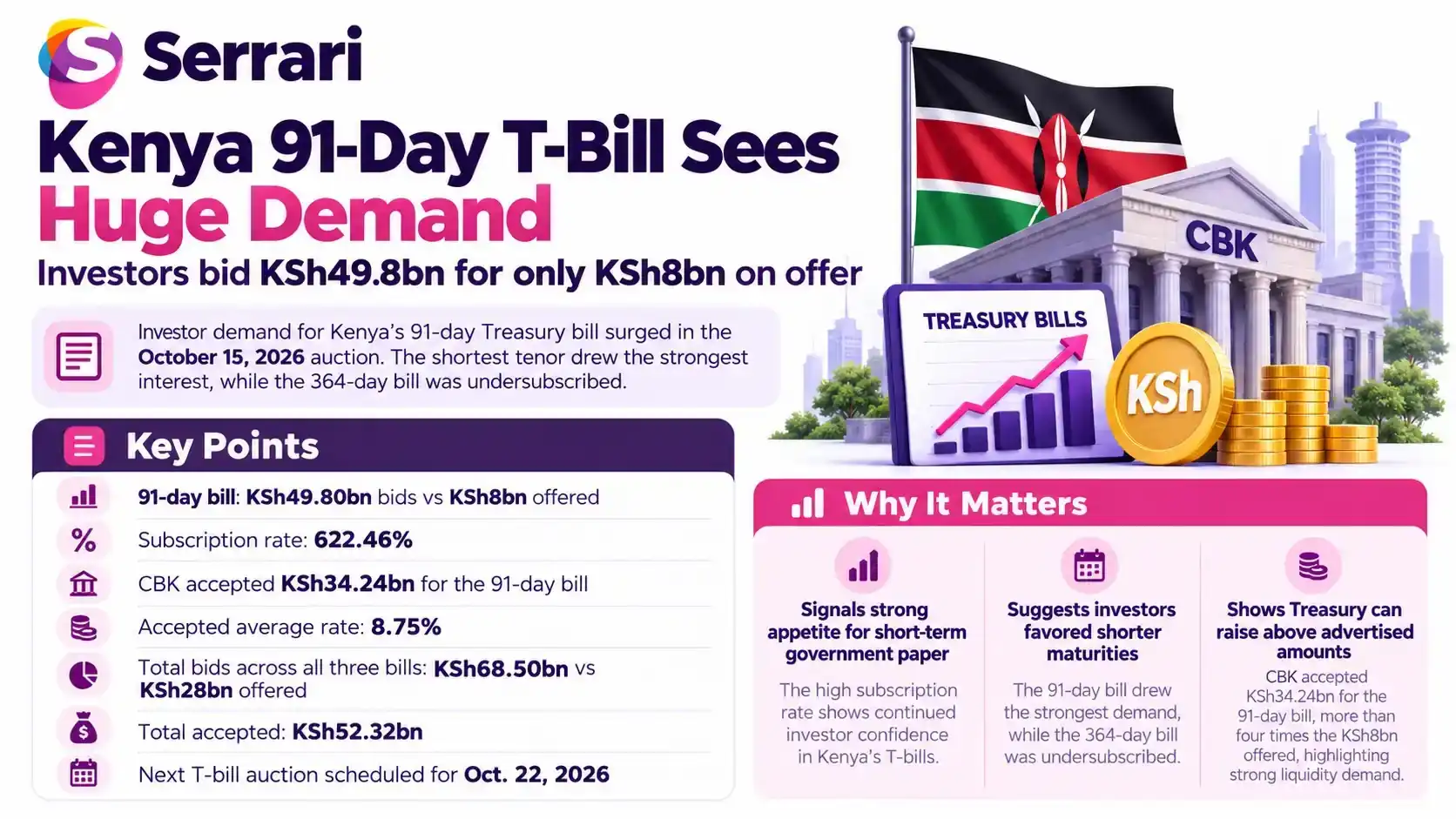
Investors placed KSh 49.80 billion in bids for Kenya’s 91-day Treasury bill in the October 15, 2026 auction, more than six times the KSh 8 billion originally offered. The Central Bank of Kenya (CBK) accepted KSh 34.24 billion for this short-term security, according to the official auction results, amid substantially weaker demand for the longer 364-day bill.
LIVET-bill rates: 91-day 8.76% · 182-day 8.87% · 364-day 9.04% · auction of 8 OctSee rates →Across all three Treasury bill tenors, investors submitted KSh 68.50 billion in bids against KSh 28 billion advertised, with KSh 52.32 billion accepted. The figures highlight a strong preference for shorter maturities in this auction, although they do not establish why individual investors chose them.
Key Overview
- 91-day bill: KSh 49.80 billion in bids against KSh 8 billion offered, representing 622.46% subscription.
- 182-day bill: KSh 12.06 billion in bids against KSh 10 billion offered, or 120.58% subscription.
- 364-day bill: KSh 6.64 billion in bids against KSh 10 billion offered, or 66.43% subscription.
- Total accepted: KSh 52.32 billion across all three bills, against KSh 28 billion initially offered.
- Accepted annualised rates: 8.7500% for 91 days, 8.8600% for 182 days and 9.0383% for 364 days.
- Next auction: October 22, 2026, with KSh 28 billion scheduled for offer.
Why the 91-Day Treasury Bill Dominated Demand
The 91-day instrument accounted for nearly 73% of the KSh 68.50 billion in total bids. Its 622.46% performance rate measures bids received relative to the original offer, not the proportion of bids accepted.
CBK accepted KSh 26.44 billion in competitive bids and KSh 7.80 billion in non-competitive bids for this tenor. Its published bid-to-cover ratio was 1.45, reflecting roughly KSh 49.80 billion submitted for every KSh 34.24 billion accepted. This is different from the 6.22-times subscription figure, which uses the KSh 8 billion offer as its denominator.
The accepted annualised interest rate fell marginally to 8.7500%, from 8.7615% in the previous week’s auction, a decline of 0.0115 percentage points. Strong bidding therefore did not translate into a higher accepted rate.
How the 182-Day and 364-Day Bills Performed
The 182-day bill received KSh 12.06 billion in bids, with KSh 11.48 billion accepted. Its subscription rate reached 120.58%, while the accepted annualised interest rate eased from 8.8744% to 8.8600%.
The 364-day bill was the only undersubscribed maturity. It attracted KSh 6.64 billion against a KSh 10 billion offer, with KSh 6.59 billion accepted. Its rate edged up from 9.0352% to 9.0383%, as shown in the three-tenor rate comparison, reversing the decline seen in shorter maturities.
The results show investors allocated substantially more bids to three-month bills than to one-year bills, despite the latter’s higher quoted annualised rate. Demand alone, however, cannot confirm whether this was driven by liquidity needs, rate expectations or other portfolio decisions.
Context is everything. Stay ahead of shifting trends with today’s market updates, and uncover emerging opportunities using the Serrari Group Market Index and Marketplace. Then, take control of your own financial future by exploring our Money & Life Reset Transformation Blueprint ™ to build stronger habits, create better systems, and design a path toward lasting wealth.
Government Accepts More Than Originally Offered
Of the KSh 52.32 billion accepted, KSh 34.20 billion came from competitive bids and KSh 18.12 billion from non-competitive bids. That was approximately KSh 24.32 billion above the advertised KSh 28 billion offer.
LIVEKenya bond yields: Average yield 11.93% across 58 bonds · 16 OctSee yields →The auction statement also recorded KSh 44.09 billion in rollovers and redemptions. Importantly, the amount ultimately realised depends on the National Treasury’s immediate liquidity requirements; accepted bids should not automatically be interpreted as entirely new government borrowing.
Treasury bills are short-term government debt instruments sold below face value and redeemed at face value on maturity. Their investment structure and bidding process allow individuals and institutions to choose between competitive bids, where they specify a rate, and non-competitive bids, which receive the accepted weighted-average rate.
Next Treasury Bills Auction Set for October 22
CBK plans to offer another KSh 28 billion on October 22: KSh 8 billion in 91-day bills and KSh 10 billion each in 182-day and 364-day bills. The next auction instructions require bids through DhowCSD or Treasury Mobile Direct by 2 p.m. on Thursday, October 22. Successful bidders must settle by 2 p.m. on Monday, October 26, through the prescribed electronic payment process.
The minimum face value is KSh 50,000 for a non-competitive bid and KSh 2 million for a competitive bid. Non-competitive bids are generally capped at KSh 50 million per account per tenor, subject to exemptions for certain public institutions. Only investors with active CSD accounts may participate.
Sources: Central Bank of Kenya / The Kenya Times
Your financial future isn’t something you wait for—it’s something you build.
The real question is: when do you begin?
Move beyond simply staying informed.
Navigate the markets with clarity—track trends through the Serrari Group Market Index, uncover opportunities in the Serrari Marketplace, and build practical knowledge with our Curated Wealth Builder Platform.
Stay connected to what truly matters.
Get daily insights on macro trends and financial movements across Kenya, Africa, and global markets—delivered through the Serrari Newsletter.
Growth opens doors.
Advance your career through professional programs including ACCA, HESI A2, ATI TEAS 7 , HESI EXIT , NCLEX – RN and NCLEX – PN, Financial Literacy!🌟—designed to move you forward with confidence.
See where money is flowing—clearly and in real time.
Track Money Market Funds, Treasury Bills, Treasury Bonds, Green Bonds, and Fixed Deposits, alongside global and African indexes, key economic indicators, and the evolving Crypto and stablecoin landscape—all within Serrari’s Market Index.