The International Monetary Fund (IMF) is urging governments to confront mounting debt and budget deficits as higher sovereign bond yields raise the cost of borrowing. In its October 14 warning, the fund said postponing fiscal consolidation could leave countries facing larger interest bills and more difficult spending decisions.
The warning comes as energy prices, persistent inflation and demand for investment capital put pressure on global bond markets. Countries already carrying substantial debt risk losing the financial flexibility needed to respond to future economic shocks.
Key Overview
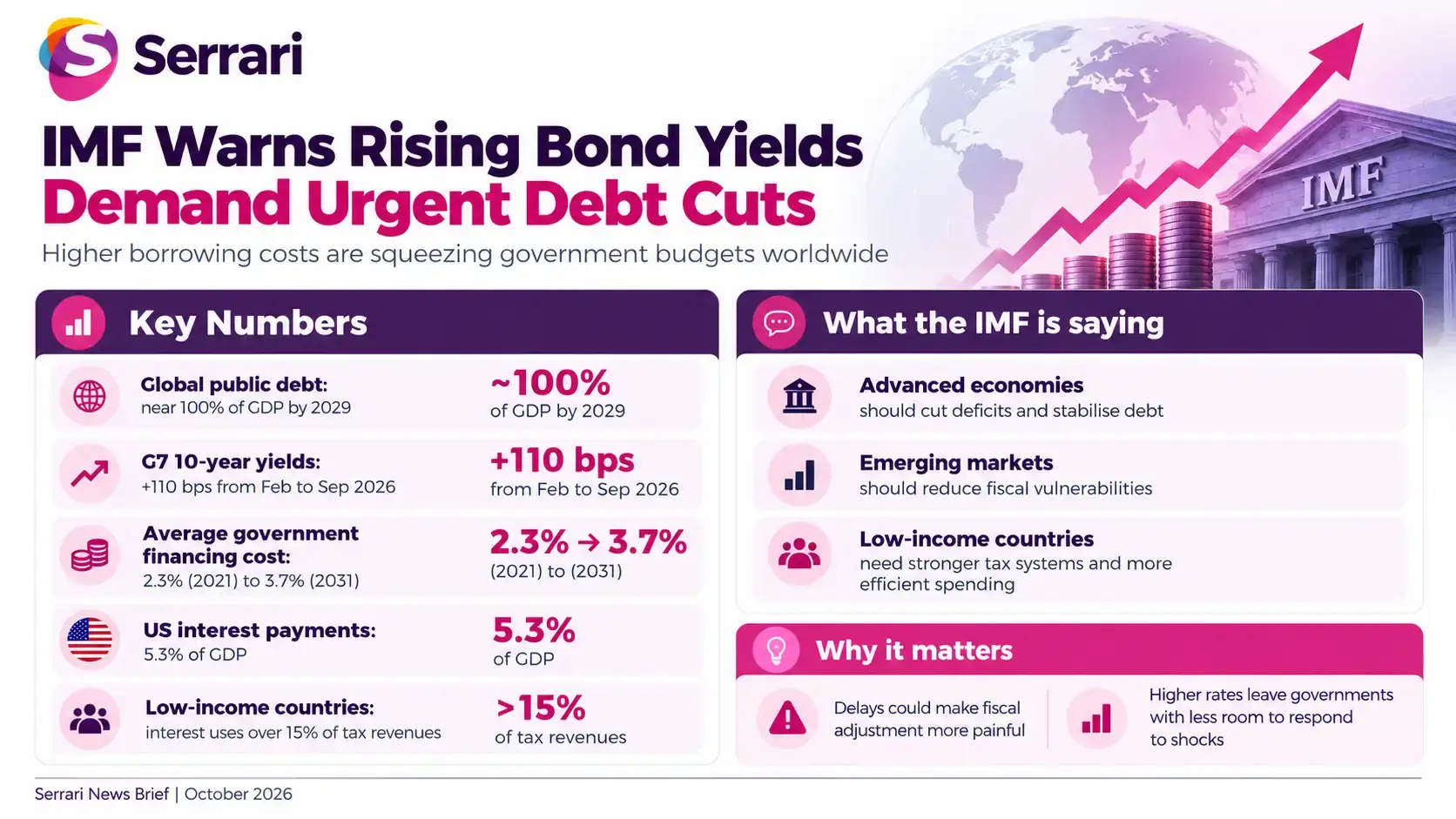
- Global public debt is projected to reach approximately 100% of GDP by 2029, a level not seen since the aftermath of World War II.
- Average 10-year government bond yields across the G7 rose by more than 110 basis points between February and September 2026.
- The average effective cost of government financing is projected to increase from 2.3% in 2021 to 3.7% by 2031.
- US government interest payments could reach 5.3% of GDP, while debt interest already absorbs more than 15% of tax revenue in low-income countries.
- The IMF wants credible, country-specific plans to reduce fiscal vulnerabilities, improve tax collection and manage public spending more effectively.
Rising Bond Yields Increase Pressure on Government Budgets
A sovereign bond yield represents the return investors demand to lend money to a government. When market yields rise, issuing new bonds generally becomes more expensive. Existing fixed-rate bonds do not automatically become costlier, but governments face higher rates as debt matures and must be refinanced.
According to the latest debt-market figures, the G7’s average 10-year sovereign yield increased by more than 1.1 percentage points between February and September, reaching its highest level in almost two decades. Strong investment demand, including spending linked to artificial intelligence, has added to competition for financing alongside inflation and elevated energy prices.
The IMF also estimates that, across the G7 and Spain, the share of government debt coming due within one year is approaching 30%. This shorter refinancing cycle can transmit higher market rates into public interest bills relatively quickly, squeezing the funds available for other priorities.
Context is everything. Stay ahead of shifting trends with today’s market updates, and uncover emerging opportunities using the Serrari Group Market Index and Marketplace. Then, take control of your own financial future by exploring our Money & Life Reset Transformation Blueprint ™ to build stronger habits, create better systems, and design a path toward lasting wealth.
Global Debt Approaches a Historic Threshold
The IMF’s earlier fiscal assessment estimated that public debt had reached about 94% of global GDP in 2025 and could rise to 100% by 2029. It also reported a global fiscal deficit of approximately 5% of GDP in 2025, highlighting the limited progress governments had made toward repairing their finances.
Rodrigo Valdés, director of the IMF’s Fiscal Affairs Department, said fiscal outcomes in 2026 had deteriorated compared with forecasts made six months and one year earlier. The concern is that governments continue expanding expenditure while higher debt-servicing costs make their fiscal positions less sustainable.
In the United States, interest costs are projected to reach 5.3% of GDP, up from 2.8% before the pandemic. For several countries, borrowing rates are also exceeding expected nominal economic growth, meaning governments may need larger improvements in their budget balances simply to stabilize debt ratios.
Developing Economies Face a Narrower Margin for Error
Although financing conditions have remained relatively supportive for many emerging economies, the IMF cautions that this could change. Higher yields in major economies can make it harder for developing countries to attract financing on affordable terms, particularly when investors become more cautious about risk.
Low-income countries face especially difficult trade-offs. With interest payments consuming more than 15% of tax revenues, a larger share of public resources is diverted toward servicing existing debt rather than financing infrastructure, healthcare and other development priorities.
Improving domestic revenue collection and spending efficiency is therefore central to the IMF’s recommendations. Its October fiscal analysis argues that better-designed tax systems, stronger administration and reduced economic distortions can support growth without necessarily sacrificing revenue.
What Fiscal Consolidation Means for Governments
Fiscal consolidation involves reducing budget deficits over time through more effective spending, stronger revenues or a combination of both. The IMF is calling for credible medium-term strategies rather than assuming every country must adopt identical or immediate spending cuts.
Its guidance on energy-price shocks also stresses protecting vulnerable households through targeted, temporary assistance instead of relying heavily on broad subsidies that could become costly and difficult to reverse.
The underlying challenge is to restore confidence in public finances while preserving essential services and productive investment. Without credible plans, mounting interest payments could force more abrupt adjustments later, when governments have fewer choices and weaker capacity to absorb economic shocks.
Sources: International Monetary Fund / Reuters
Your financial future isn’t something you wait for—it’s something you build.
The real question is: when do you begin?
Move beyond simply staying informed.
Navigate the markets with clarity—track trends through the Serrari Group Market Index, uncover opportunities in the Serrari Marketplace, and build practical knowledge with our Curated Wealth Builder Platform.
Stay connected to what truly matters.
Get daily insights on macro trends and financial movements across Kenya, Africa, and global markets—delivered through the Serrari Newsletter.
Growth opens doors.
Advance your career through professional programs including ACCA, HESI A2, ATI TEAS 7 , HESI EXIT , NCLEX – RN and NCLEX – PN, Financial Literacy!🌟—designed to move you forward with confidence.
See where money is flowing—clearly and in real time.
Track Money Market Funds, Treasury Bills, Treasury Bonds, Green Bonds, and Fixed Deposits, alongside global and African indexes, key economic indicators, and the evolving Crypto and stablecoin landscape—all within Serrari’s Market Index.