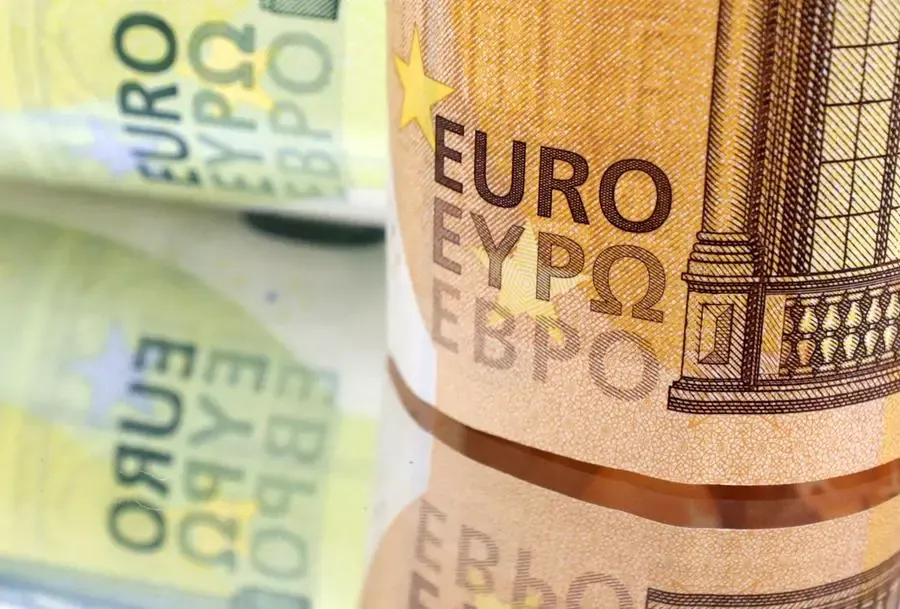
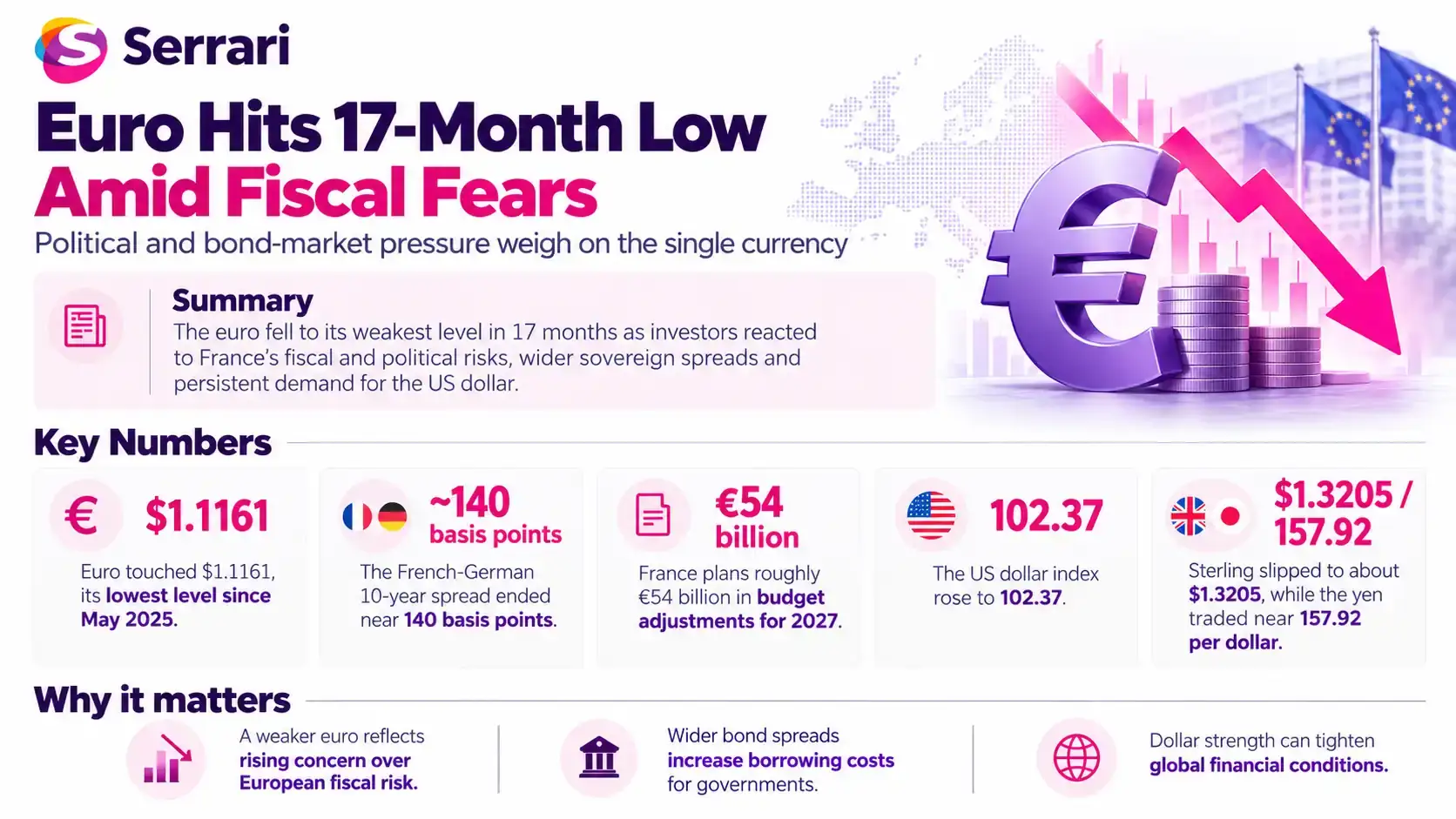
The euro has fallen to its weakest level in 17 months as investors grow increasingly concerned about France’s public finances, political uncertainty and the broader selloff in global government bonds.
The single currency dropped as much as 0.8% to touch $1.1161 against the US dollar during Asian trading on October 5, its lowest level since May 2025. The decline extended a four-week losing streak and helped strengthen the dollar despite softer US labour-market data reducing expectations of an immediate Federal Reserve rate increase.
Key Overview
- The euro fell as low as $1.1161, its weakest level since May 2025.
- Political uncertainty and France’s deteriorating fiscal outlook have increased investor caution.
- France’s 10-year borrowing premium over Germany ended last week at around 140 basis points.
- France plans a €54 billion fiscal adjustment in its proposed 2027 budget.
- The US dollar index rose 0.47% to 102.37 as investors sought relatively safer assets.
- Sterling slipped to around $1.3205, while the yen traded near 157.92 per dollar.
- US 10-year Treasury yields remained elevated at around 5.26% following last week’s 24-year high.
French Fiscal Concerns Hit the Euro
France has become a central source of anxiety for European financial markets as investors assess whether the government can stabilise public finances while navigating a highly fragmented political environment ahead of the 2027 presidential election.
The government’s latest fiscal plan aims to deliver €54 billion in budget adjustments and reduce the public deficit from an estimated 5.4% of GDP in 2026 to 5% in 2027.
Debt-servicing costs are also climbing. France expects interest expenses to rise from €79.2 billion in 2026 to €91.2 billion in 2027, consuming a growing share of government resources.
Investors remain uncertain about whether proposed spending cuts and revenue measures can survive the parliamentary process, particularly with a presidential election approaching in April 2027.
That uncertainty has spilled directly into currency and bond markets.
French-German Bond Spread Signals Higher Risk
One of the clearest indicators of investor concern is the widening difference between French and German government borrowing costs.
The premium investors demand to hold French 10-year debt rather than equivalent German bonds ended last week near 140 basis points, after widening by 34 basis points during the week.
That was its largest weekly increase in 17 years.
Recent trading has pushed the spread toward levels last associated with the eurozone sovereign-debt crisis. French sovereign credit-default swaps, which are used to insure against debt-default risk, have also risen sharply.
The combination of a weaker currency, higher bond yields and widening credit spreads illustrates how concerns about sovereign finances can tighten financial conditions even before central banks change monetary policy.
Context is everything. Stay ahead of shifting trends with today’s market updates, and uncover emerging opportunities using the Serrari Group Market Index and Marketplace. Then, take control of your own financial future by exploring our Money & Life Reset Transformation Blueprint ™ to build stronger habits, create better systems, and design a path toward lasting wealth.
Contagion Fears Return to European Markets
The market’s biggest concern is whether France’s difficulties remain largely domestic or begin spreading into other eurozone economies.
The eurozone’s structure means severe stress in one major sovereign bond market can affect neighbouring countries through banking exposure, investor positioning and changes in risk appetite.
For now, some market participants view the episode primarily as a French fiscal and political problem rather than the beginning of another eurozone-wide debt crisis.
However, French market risk indicators have deteriorated rapidly. The French-German 10-year spread recently approached 150 basis points, while five-year sovereign default insurance costs climbed to around 87 basis points, their highest since early 2013.
A prolonged deterioration could increase pressure on European policymakers to reassure markets about financial stability.
Dollar Gains From Global Bond-Market Stress
The euro’s decline has also been magnified by renewed demand for the US dollar.
The dollar index, which measures the currency against six major peers, rose 0.47% to 102.37. Sterling weakened about 0.25% to $1.3205, while the Japanese yen traded around 157.92 per dollar.
US government bond yields remain another source of dollar support. The benchmark 10-year Treasury yield traded near 5.26% after reaching a 24-year high during the previous week’s global bond rout.
High Treasury yields can increase the appeal of dollar-denominated assets by offering investors stronger returns on relatively low-risk government debt.
Fed Expectations Provide Some Counterweight
The dollar’s rise has occurred despite weaker US employment data reducing expectations for an October rate increase.
Markets were pricing roughly a 78% probability that the Federal Reserve would keep rates unchanged in October, compared with only 36% a week earlier.
Investors nevertheless continued to expect further monetary tightening later, including a possible December increase and additional rate hikes during the first half of 2027.
For the euro, the immediate outlook is therefore being shaped by two competing forces: US monetary-policy expectations and growing concern about Europe’s fiscal and political risks.
Unless France can restore confidence in its budget strategy and contain the rise in sovereign borrowing costs, the euro could remain vulnerable to further periods of volatility.
Sources: Reuters / French Ministry of Economy and Finance
Your financial future isn’t something you wait for—it’s something you build.
The real question is: when do you begin?
Move beyond simply staying informed.
Navigate the markets with clarity—track trends through the Serrari Group Market Index, uncover opportunities in the Serrari Marketplace, and build practical knowledge with our Curated Wealth Builder Platform.
Stay connected to what truly matters.
Get daily insights on macro trends and financial movements across Kenya, Africa, and global markets—delivered through the Serrari Newsletter.
Growth opens doors.
Advance your career through professional programs including ACCA, HESI A2, ATI TEAS 7 , HESI EXIT , NCLEX – RN and NCLEX – PN, Financial Literacy!🌟—designed to move you forward with confidence.
See where money is flowing—clearly and in real time.
Track Money Market Funds, Treasury Bills, Treasury Bonds, Green Bonds, and Fixed Deposits, alongside global and African indexes, key economic indicators, and the evolving Crypto and stablecoin landscape—all within Serrari’s Market Index.