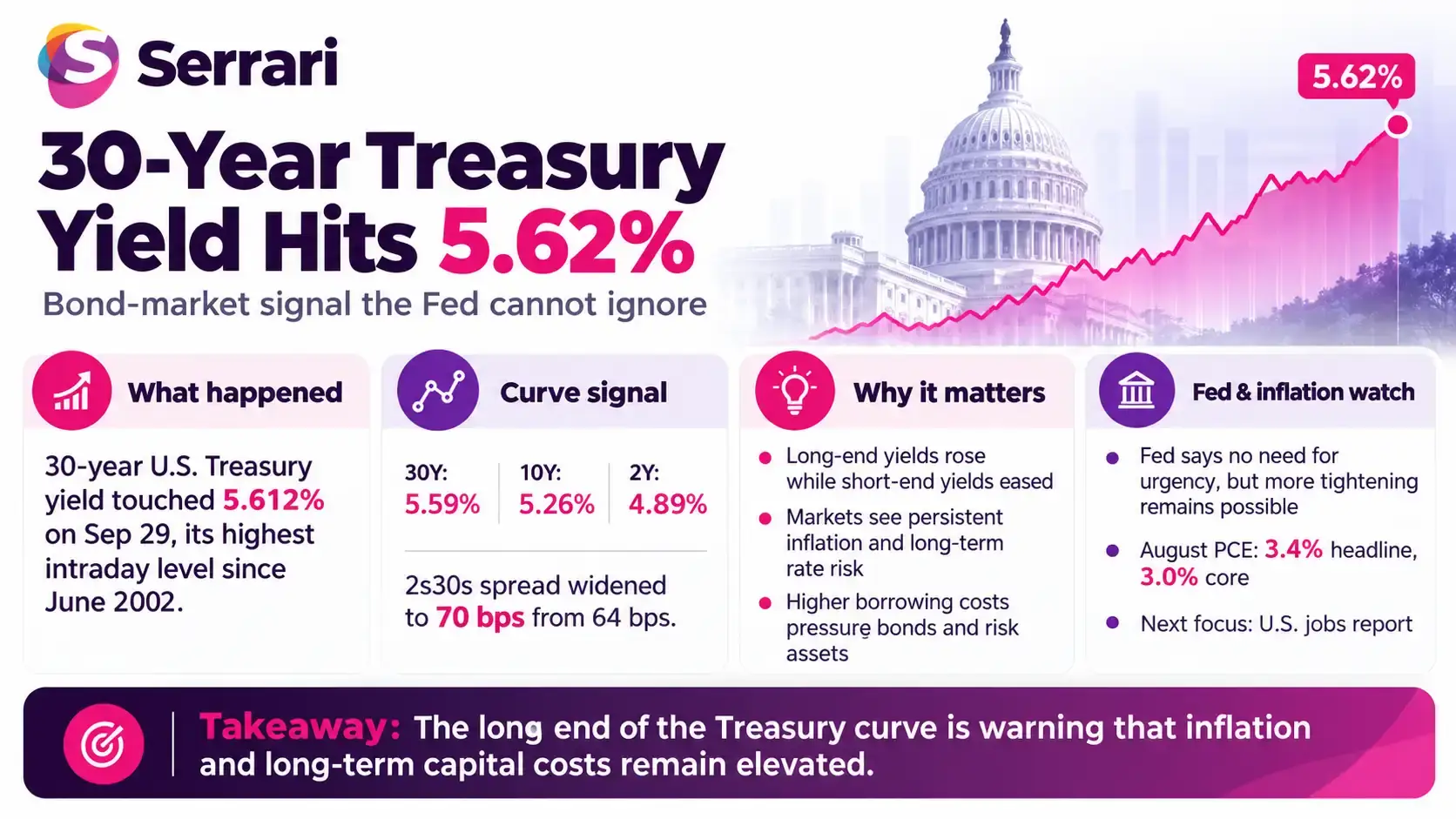
The U.S. Treasury market is sending an increasingly complex signal to the Federal Reserve. The 30-year Treasury yield touched 5.612% on September 29, its highest intraday level since June 2002, as investors continued demanding substantially higher returns to hold long-dated government debt.
The move matters not merely because yields have returned to levels last seen more than two decades ago. The more significant development is the shape of the yield curve: short-term yields eased while longer-term borrowing costs climbed, suggesting investors are distinguishing between near-term Federal Reserve policy and longer-term risks surrounding inflation, economic growth and interest rates.
Key Overview
- The 30-year Treasury yield reached an intraday 5.612% on September 29, its highest level since June 2002.
- Official Treasury data placed the September 29 30-year yield at 5.59%, before it climbed further to 5.64% on September 30.
- The 10-year yield rose while the 2-year yield declined on September 29, producing a steeper yield curve.
- The widening gap suggests longer-term inflation and rate risks remain elevated even as expectations for an immediate Fed increase have softened.
- August PCE inflation came in below expectations, with headline inflation at 3.4% and core inflation at 3.0% year over year.
- Investors are now focused on the September U.S. employment report scheduled for October 2.
The Yield Curve Is Sending a Bigger Signal
The 5.62% intraday level captured market attention, but the movement across the Treasury curve tells a more revealing story.
Official Treasury yield-curve data show the 30-year par yield rising from 5.56% on September 28 to 5.59% on September 29. Over the same period, the 10-year yield increased from 5.24% to 5.26%, while the 2-year yield fell from 4.92% to 4.89%.
That pushed the gap between 2-year and 30-year yields from 64 basis points to 70 basis points.
The direction matters. Instead of Treasury yields moving uniformly higher in response to expectations of tighter monetary policy, shorter maturities declined while longer maturities remained under selling pressure.
That can indicate investors see less urgency for an immediate rate increase but continue to demand greater compensation for committing capital for decades amid uncertainty over inflation, economic growth and the future path of interest rates.
The pressure did not disappear the following day. Treasury data show the 30-year yield rising again to 5.64% on September 30, while the 10-year climbed to 5.29%.
Context is everything. Stay ahead of shifting trends with today’s market updates, and uncover emerging opportunities using the Serrari Group Market Index and Marketplace. Then, take control of your own financial future by exploring our Money & Life Reset Transformation Blueprint ™ to build stronger habits, create better systems, and design a path toward lasting wealth.
Fed Officials Face a Complicated Inflation Picture
Federal Reserve officials are simultaneously signalling patience and continued concern about inflation.
New York Fed President John Williams said in his September 29 remarks that there was “no need for urgency” after September’s policy move and argued that officials have time to gather additional economic information.
Williams nevertheless said another upward adjustment in the federal funds target range could become appropriate later in 2026 if the economy develops broadly in line with his forecast. He stressed that this was a forecast rather than a predetermined policy decision.
Governor Michael Barr offered a more inflation-focused assessment. His September 29 economic outlook remarks noted that inflation has exceeded the Federal Open Market Committee’s 2% objective for five and a half years.
Barr highlighted elevated energy prices and investment associated with the artificial-intelligence buildout as factors adding to price pressures and complicating the path back toward the Fed’s target.
The comments follow the Fed’s September 16 decision to raise its target range by 25 basis points to 3.75%-4.00%. September projections also put median 2026 PCE inflation at 3.7%, remaining significantly above the central bank’s 2% objective.
Cooler PCE Data Changes the Near-Term Debate
The picture shifted again on September 30 when the latest inflation figures arrived.
The August personal income and spending report showed the PCE price index increasing 0.3% month over month and 3.4% from a year earlier. Core PCE, which excludes food and energy, increased 0.2% monthly and 3.0% annually.
Those inflation readings were softer than markets had expected and reduced some of the immediate pressure for another rate increase in October.
Yet the continued rise in long-term Treasury yields illustrates why the bond market is not treating softer near-term inflation data as the end of the debate. Long-duration investors must price inflation, future policy, economic growth and fiscal risks over periods extending far beyond the Fed’s next meeting.
Jobs Data Becomes the Next Major Test
Attention now shifts to the U.S. labour market.
The official employment-release schedule lists the September employment report for 8:30 a.m. ET on October 2.
A resilient labour market could reinforce the argument that the economy can withstand restrictive monetary conditions and keep future rate increases under consideration. Weaker employment data could strengthen the case for patience.
For markets, however, the key development remains broader than one Fed meeting. With the 30-year Treasury yield trading around levels unseen since 2002, the long end of the bond market is signalling that the cost of long-term capital has entered a markedly different regime.
Sources: U.S. Department of the Treasury / Federal Reserve Board / Federal Reserve Bank of New York / U.S. Bureau of Economic Analysis / U.S. Bureau of Labor Statistics / Reuters / Financial Times / MarketWatch
Your financial future isn’t something you wait for—it’s something you build.
The real question is: when do you begin?
Move beyond simply staying informed.
Navigate the markets with clarity—track trends through the Serrari Group Market Index, uncover opportunities in the Serrari Marketplace, and build practical knowledge with our Curated Wealth Builder Platform.
Stay connected to what truly matters.
Get daily insights on macro trends and financial movements across Kenya, Africa, and global markets—delivered through the Serrari Newsletter.
Growth opens doors.
Advance your career through professional programs including ACCA, HESI A2, ATI TEAS 7 , HESI EXIT , NCLEX – RN and NCLEX – PN, Financial Literacy!🌟—designed to move you forward with confidence.
See where money is flowing—clearly and in real time.
Track Money Market Funds, Treasury Bills, Treasury Bonds, Green Bonds, and Fixed Deposits, alongside global and African indexes, key economic indicators, and the evolving Crypto and stablecoin landscape—all within Serrari’s Market Index.