
US agencies are reportedly considering partnerships with private stablecoin issuers and financial infrastructure companies to expand the use of dollar-denominated stablecoins overseas in 2026. The initiative remains at an early policy-discussion stage, with no formal announcement, confirmed private partners or implementation timeline disclosed. The broader policy rationale is that wider use of dollar-backed stablecoins could extend access to the dollar while potentially creating additional demand for short-term US Treasury securities.
Key Overview
- Focus: Overseas adoption of dollar-denominated stablecoins
- Status: Early-stage policy discussions
- Potential partners: Private stablecoin issuers and financial infrastructure firms
- Policy objective: Expand international use of the US dollar
- Stablecoin market: Around $300 billion, according to Treasury
- Treasury exposure: Stablecoin providers hold nearly $200 billion in Treasury bills and other near-maturity securities
- Regulatory framework: GENIUS Act
- Implementation: No formal programme or timeline announced
US Explores Wider Overseas Use of Dollar Stablecoins
US agencies are reportedly weighing partnerships with private-sector companies to expand the adoption of dollar-denominated stablecoins in overseas markets.
The discussions remain in a formative stage, and no formal government programme has been announced. Details regarding the agencies involved, potential private-sector partners, regulatory pathway and implementation timeline have not been disclosed.
The proposal would potentially involve private stablecoin issuers and financial infrastructure companies working to expand access to dollar-pegged digital assets in markets where currency volatility and limited banking access have contributed to demand for dollar-based digital assets.
Stablecoins and Dollar Demand
Dollar-denominated stablecoins already account for the vast majority of the global stablecoin market.
US Treasury officials have highlighted the potential connection between stablecoin growth and international demand for dollars and Treasury securities.
When the GENIUS Act was signed into law in July 2025, Treasury Secretary Scott Bessent said stablecoins could strengthen the dollar’s role as the global reserve currency and expand access to the dollar economy. He also said the assets backing stablecoins could create additional demand for US Treasuries.
The Treasury has continued to examine how stablecoin growth could affect Treasury markets.
Stablecoin Providers Already Hold Treasury Securities
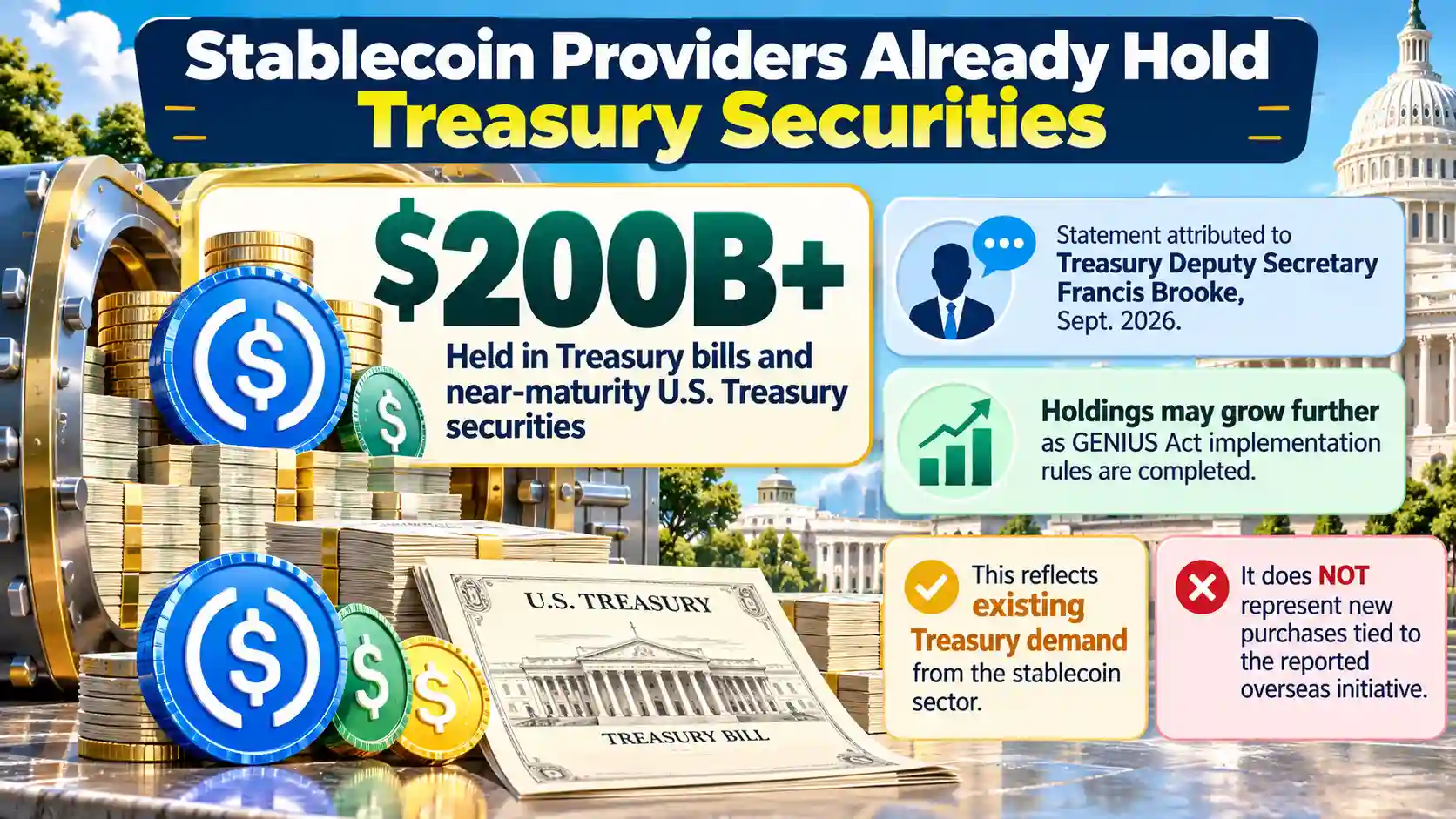
Treasury Deputy Secretary Francis Brooke said in September 2026 that stablecoin providers already hold nearly $200 billion in Treasury bills and other short-term securities close to maturity.
He said the Treasury could see stablecoin providers continue to grow and increase their holdings as rules implementing the GENIUS Act are completed.
The figure represents existing Treasury demand from the stablecoin sector and does not represent new purchases associated with the reported overseas initiative.
Treasury has also noted that the impact of stablecoin growth depends on how much adoption represents new demand from users who previously held non-dollar assets.
GENIUS Act Creates Regulatory Framework
The overseas discussions come as the US implements the GENIUS Act, which established a federal framework for payment stablecoins.
Under the legislation, permitted stablecoins must be backed on a one-to-one basis by eligible reserve assets, including cash, deposits, repurchase agreements and short-term Treasury securities with remaining maturities of 93 days or less.
The framework is intended to establish requirements around stablecoin reserves and operations while providing regulatory clarity for the sector.
Treasury has also continued work on regulations implementing the legislation, including requirements related to anti-money-laundering and sanctions compliance.
Potential Impact on Treasury Demand
Stablecoin expansion could affect the Treasury market because regulated issuers need to hold qualifying reserve assets.
Treasury’s Borrowing Advisory Committee has examined the possibility that increased stablecoin issuance could create additional demand for short-maturity Treasury securities. However, the committee also noted that this effect could be offset if stablecoins replace deposits, money market funds or other cash-like instruments rather than bringing new money into the dollar system.
Treasury analysis has similarly identified offshore adoption as a potential source of additional demand for short-term Treasury issuance when new users move into dollar-denominated stablecoins.
Context is everything. Stay ahead of shifting trends with today’s market updates, and uncover emerging opportunities using the Serrari Group Market Index and Marketplace. Then, take control of your own financial future by exploring our Money & Life Reset Transformation Blueprint ™ to build stronger habits, create better systems, and design a path toward lasting wealth.
International Dollar Access
The potential overseas initiative would build on an existing market trend in which users in some emerging markets use dollar-linked digital assets as an alternative means of holding and transferring dollar value.
Treasury has described dollar-based stablecoins as a potential digital payment rail that could extend the reach of the US dollar into emerging digital payment systems.
For users moving from local currencies into dollar-denominated stablecoins, adoption could increase exposure to the dollar. However, the scale of additional dollar demand would depend on whether users are bringing new funds into the dollar system or simply moving existing dollar assets into stablecoins.
Private-Sector Role
Private companies would be central to any expansion because stablecoin issuance and related payment infrastructure are largely operated by private-sector firms.
A public-private model could potentially involve stablecoin issuers, financial institutions, payment companies and blockchain infrastructure providers.
However, the specific companies that could participate have not been disclosed, and there has been no formal announcement confirming a government-backed overseas stablecoin programme.
Regulatory and Banking Considerations
Any international expansion would also have to account for regulations in individual countries.
Foreign governments may impose their own requirements on stablecoin issuers, digital payments and cross-border transactions. Local regulators may also consider the impact of dollar stablecoins on domestic currencies, financial institutions and bank deposits.
The Treasury has recognised that stablecoin growth could affect bank deposits, particularly if users move funds from traditional banking products into stablecoins.
Outlook
The reported overseas stablecoin initiative remains at an early discussion stage, with no formal programme, confirmed partners or implementation schedule announced.
Meanwhile, the US Treasury is continuing to implement the GENIUS Act and monitor the stablecoin market. Treasury officials have identified stablecoins as a potential source of additional demand for short-term Treasury securities, with providers already holding nearly $200 billion in Treasury bills and other short-term securities.
If overseas adoption expands, the effect on dollar demand and Treasury markets will depend on the scale of new non-dollar users entering the stablecoin ecosystem, the reserve structures used by issuers and the regulatory approaches adopted by other countries.
FAQs
1. What is the reported US stablecoin initiative?
US agencies are reportedly considering partnerships with private companies to expand the use of dollar-denominated stablecoins overseas. The discussions remain preliminary.
2. Why are dollar stablecoins important to the US?
US officials have said wider stablecoin adoption could expand access to the dollar internationally and potentially increase demand for US Treasury securities.
3. How much Treasury debt do stablecoin providers hold?
Treasury Deputy Secretary Francis Brooke said stablecoin providers hold nearly $200 billion in Treasury bills and other securities close to maturity.
4. What is the GENIUS Act?
The GENIUS Act established a federal regulatory framework for payment stablecoins in the US, including requirements concerning eligible reserves and issuer obligations.
Your financial future isn’t something you wait for—it’s something you build.
The real question is: when do you begin?
Move beyond simply staying informed.
Navigate the markets with clarity—track trends through the Serrari Group Market Index, uncover opportunities in the Serrari Marketplace, and build practical knowledge with our Curated Wealth Builder Platform.
Stay connected to what truly matters.
Get daily insights on macro trends and financial movements across Kenya, Africa, and global markets—delivered through the Serrari Newsletter.
Growth opens doors.
Advance your career through professional programs including ACCA, HESI A2, ATI TEAS 7 , HESI EXIT , NCLEX – RN and NCLEX – PN, Financial Literacy!🌟—designed to move you forward with confidence.
See where money is flowing—clearly and in real time.
Track Money Market Funds, Treasury Bills, Treasury Bonds, Green Bonds, and Fixed Deposits, alongside global and African indexes, key economic indicators, and the evolving Crypto and stablecoin landscape—all within Serrari’s Market Index.