Kenya’s Energy and Petroleum Regulatory Authority (EPRA) has removed the 15,000 kilowatt-hour monthly limit that restricted access to the special electricity tariff for e-mobility businesses. Under the amended tariff, eligible consumers supplied by Kenya Power at 240 or 415 volts will pay KSh16 per unit during applicable periods and KSh8 per unit for electricity supplied and metered during off-peak hours.
Key Overview
- EPRA has removed the previous 15,000 kWh monthly ceiling for e-mobility consumers.
- The applicable electricity charge is KSh16 per unit.
- The off-peak rate is KSh8 per unit.
- The tariff applies to eligible consumers supplied by Kenya Power at 240 or 415 volts.
- Customers can use either post-paid billing or prepaid electricity units.
- EPRA recorded a 300% increase in e-mobility electricity consumption to 5.04 GWh in the year ended June 2025.
EPRA Removes 15,000 kWh E-Mobility Tariff Limit
Kenya’s electric vehicle industry has received a policy boost after the Energy and Petroleum Regulatory Authority (EPRA) removed the 15,000 kilowatt-hour monthly limit that had restricted access to the special electricity tariff for e-mobility businesses.
Under the amended tariff, e-mobility consumers will be charged KSh16 per unit for electricity consumed during applicable periods. The rate falls to KSh8 per unit for electricity supplied and metered during off-peak hours.
The provision applies to e-mobility consumers supplied and metered by Kenya Power and Lighting Company Limited at 240 or 415 volts.
EPRA stated that the tariff is applicable to e-mobility consumers under either post-paid billing or prepaid electricity units.
E-Mobility Customers Get Discounted Off-Peak Rate
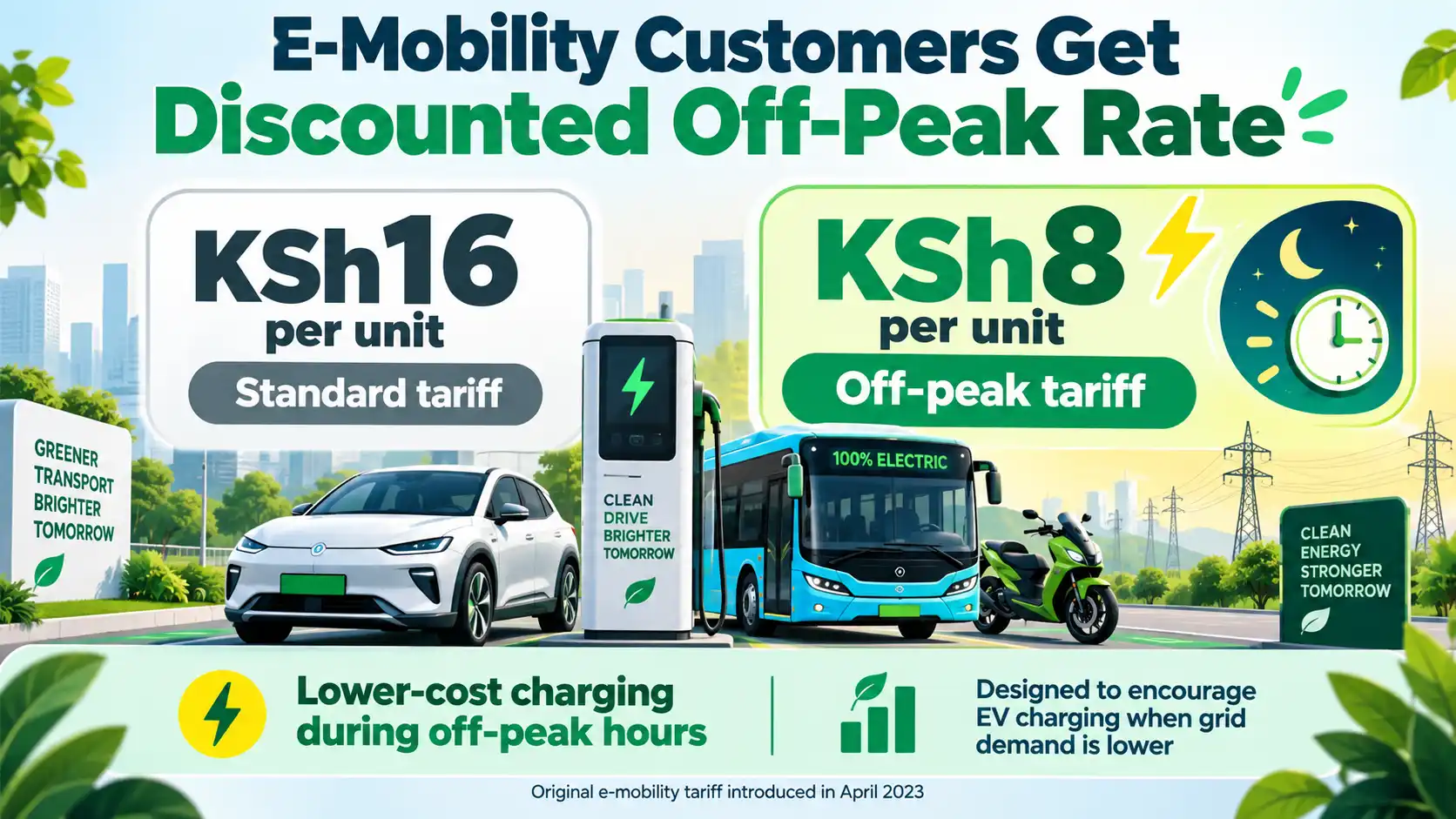
The amended tariff creates a lower-cost period for electric mobility businesses that use electricity during off-peak hours.
The tariff schedule states that eligible e-mobility consumers will pay KSh16 per unit for units consumed, while electricity supplied and metered during off-peak hours will attract an energy charge of KSh8 per unit.
This structure maintains the incentive to shift electricity consumption to periods when demand on the national grid is lower.
The original e-mobility tariff, introduced in April 2023, was designed to provide cheaper electricity to the emerging industry and encourage EV charging during periods of lower electricity demand.
How the New Consumption Threshold Works
EPRA’s tariff schedule introduces an Energy Consumption Threshold for electric vehicle consumers under the applicable categories.
Customers under the SC3, EM, and CI categories are required to meet their monthly Energy Consumption Threshold. Electricity units consumed above the applicable threshold are billed under the discounted Time-of-Use (TOU) tariff, subject to the conditions in the tariff schedule.
For new SC3, EM and CI1–CI7 customers, the threshold will be calculated using their average monthly consumption over the first three consecutive months.
Customers operating at 100% production capacity during both on-peak and off-peak hours may also qualify for an additional 5% discount on the applicable off-peak energy rate.
What the Removal of the Cap Means for EV Businesses
The previous 15,000 kWh ceiling created a limitation for businesses whose electricity consumption increased as their operations expanded.
Charging-station operators, electric bus fleets, battery-swapping companies and commercial fleets can have electricity demand that rises alongside the number of electric vehicles they serve.
Under the amended framework, electricity consumption above the applicable threshold is instead billed under the discounted Time-of-Use tariff, subject to the tariff conditions.
This removes the previous sharp tariff limitation associated with crossing the 15,000 kWh monthly level.
E-Mobility Electricity Consumption Rises
EPRA has recorded significant growth in electricity consumption by the e-mobility category.
According to the regulator, consumption increased by 300 per cent to 5.04 gigawatt-hours in the year ended June 2025, compared with 1.26 GWh a year earlier.
By June 2025, 69 customers were being billed under the e-mobility tariff.
Kenya Power has also reported increased revenue from EV charging. Between July 2023 and April 2026, cumulative revenue from EV charging reached Sh382 million, while monthly revenue increased from less than Sh1 million at the beginning of the period to Sh35.25 million in February 2026.
Kenya Power projects that electricity sales to the e-mobility sector could generate Sh5.9 billion in revenue by 2030.
Context is everything. Stay ahead of shifting trends with today’s market updates, and uncover emerging opportunities using the Serrari Group Market Index and Marketplace. Then, take control of your own financial future by exploring our Money & Life Reset Transformation Blueprint ™ to build stronger habits, create better systems, and design a path toward lasting wealth.
Off-Peak Charging and Grid Capacity
The removal of the consumption ceiling also comes as Kenya considers how electric mobility can support electricity demand during periods when the grid has spare capacity.
The draft National Electric Mobility Policy noted that Kenya curtailed 495,437 MWh of electricity between July 2022 and June 2023, equivalent to an average of more than 1,350 MWh per day.
The policy identified night-time EV charging as one potential way of absorbing some of this otherwise unused generation.
The tariff therefore continues to encourage charging during off-peak periods, when electricity costs are lower.
Electric Mobility and Kenya’s Energy Transition
Kenya’s transport system remains heavily dependent on imported petroleum, exposing motorists and businesses to global oil-price movements, exchange-rate changes and geopolitical disruptions.
At the launch of the National Electric Mobility Policy in February, the government said petroleum products were Kenya’s largest single import category in 2023, with fuel imports rising to Sh628.4 billion from Sh348.3 billion in 2021.
The policy identifies geothermal, hydro, wind and solar resources as advantages for Kenya’s transition toward electric transport.
Kenya has also committed to reducing greenhouse gas emissions by 32 per cent by 2030 against the business-as-usual scenario under its updated Nationally Determined Contribution.
EV Market Continues to Expand
Kenya’s electric vehicle market has expanded alongside the development of supportive policies.
The National Electric Mobility Policy projects that Kenya’s total vehicle population could exceed 10 million by 2030, including about five million two-wheelers.
Under the policy’s growth scenario, EVs could account for approximately 8.8 per cent of the vehicle stock by 2030, while representing about 8.1% of new vehicle sales.
EV registrations are projected to rise from about 11,680 in 2025 to nearly 47,900 in 2030.
The Ministry of Roads and Transport said cumulative EV registrations reached 39,324 by 2025, up from 1,378 in 2022, with electric motorcycles recording particularly strong growth.
Outlook
EPRA’s removal of the 15,000 kWh monthly ceiling changes how electricity consumption is treated under Kenya’s e-mobility tariff.
The amended framework retains the KSh16 per-unit applicable charge and KSh8 off-peak rate while introducing an Energy Consumption Threshold for eligible customers.
The change comes as electricity consumption from e-mobility increases and Kenya seeks to encourage off-peak charging. However, the sector continues to face challenges including high upfront EV costs, limited charging infrastructure outside major urban centres, financing constraints, technical skills shortages and battery disposal and recycling concerns.
FAQs
1. What did EPRA change in Kenya’s e-mobility electricity tariff?
EPRA removed the previous 15,000 kWh monthly limit that restricted access to the special e-mobility electricity tariff.
2. How much does electricity cost under the e-mobility tariff?
Eligible consumers pay KSh16 per unit during applicable periods, while electricity supplied and metered during off-peak hours costs KSh8 per unit.
3. Who can access the e-mobility tariff?
The tariff applies to e-mobility consumers supplied and metered by Kenya Power at 240 or 415 volts, with customers able to use either post-paid billing or prepaid electricity units.
4. Why is the removal of the 15,000 kWh limit important?
It allows e-mobility businesses with growing electricity demand, including charging stations, electric bus fleets and battery-swapping operators, to continue operating under the tariff framework without the previous 15,000 kWh ceiling.
Sources: The Star, Kenyans.co.ke , The Kenya Times
Your financial future isn’t something you wait for—it’s something you build.
The real question is: when do you begin?
Move beyond simply staying informed.
Navigate the markets with clarity—track trends through the Serrari Group Market Index, uncover opportunities in the Serrari Marketplace, and build practical knowledge with our Curated Wealth Builder Platform.
Stay connected to what truly matters.
Get daily insights on macro trends and financial movements across Kenya, Africa, and global markets—delivered through the Serrari Newsletter.
Growth opens doors.
Advance your career through professional programs including ACCA, HESI A2, ATI TEAS 7 , HESI EXIT , NCLEX – RN and NCLEX – PN, Financial Literacy!🌟—designed to move you forward with confidence.
See where money is flowing—clearly and in real time.
Track Money Market Funds, Treasury Bills, Treasury Bonds, Green Bonds, and Fixed Deposits, alongside global and African indexes, key economic indicators, and the evolving Crypto and stablecoin landscape—all within Serrari’s Market Index.