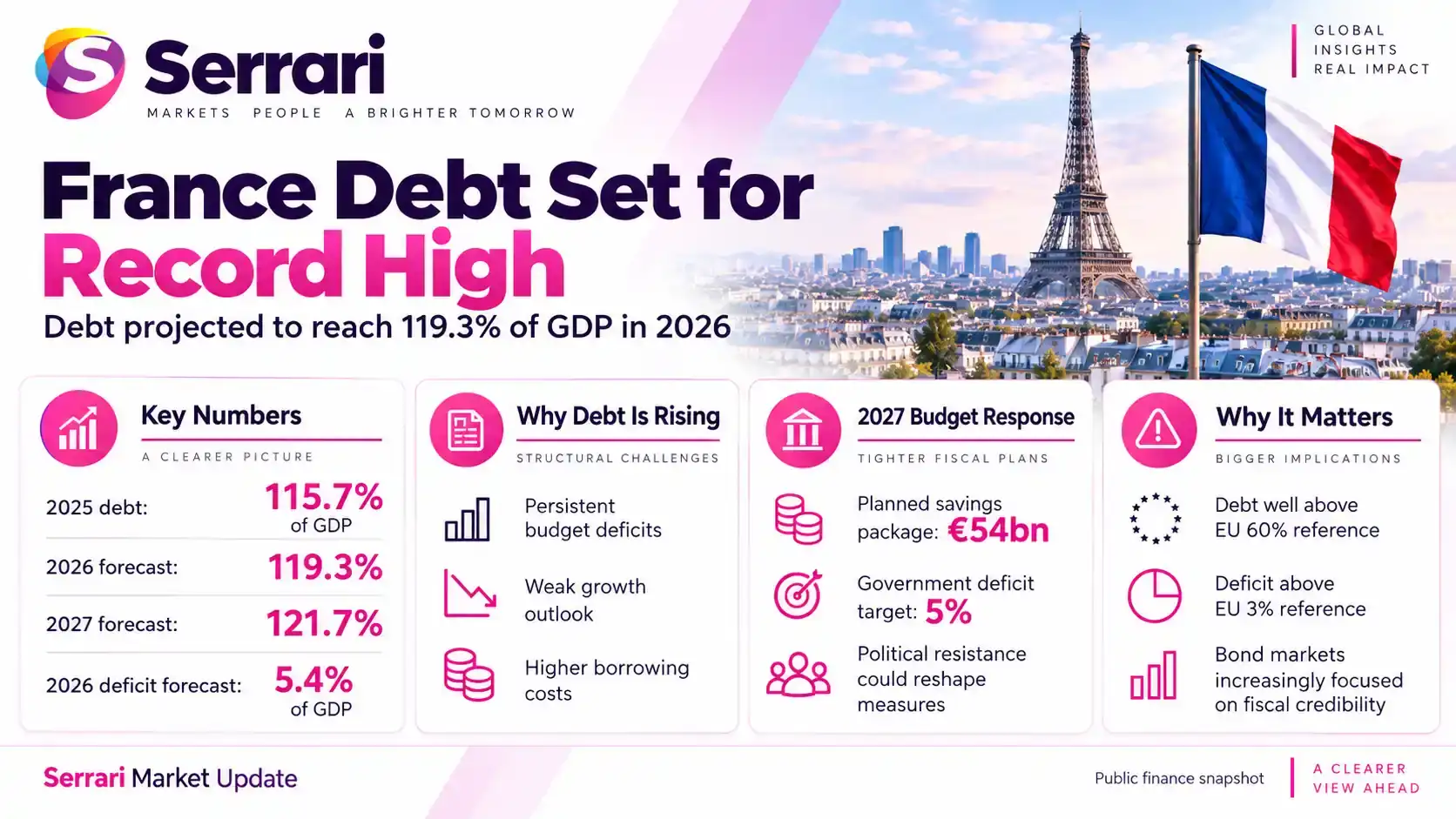
France is entering another difficult phase for its public finances, with government debt projected to rise to 119.3% of GDP in 2026 and 121.7% in 2027. The increase comes as the deficit remains well above European Union reference levels and economic growth stays weak.
The government is preparing a €54 billion fiscal adjustment for 2027 in an effort to slow the deterioration. However, higher borrowing costs, subdued growth and political resistance to spending reductions are making the path back toward lower deficits increasingly challenging.
Key Overview
- Public debt is projected to rise from 115.7% of GDP in 2025 to 119.3% in 2026.
- The debt ratio is forecast to climb further to 121.7% in 2027.
- France expects its deficit to reach 5.4% of GDP in 2026 before declining to 5% in 2027.
- The government is planning a €54 billion savings effort in the 2027 budget.
- EU treaty reference values are 3% of GDP for the deficit and 60% for public debt.
- France’s borrowing premium over Germany has risen sharply, reflecting greater investor concern over fiscal and political uncertainty.
- The Bank of France expects economic growth of only 0.4% in 2026.
Debt Ratio Continues to Rise
France’s fiscal position has weakened further after public debt reached 115.7% of GDP in 2025, up from 112.6% a year earlier. The government now expects the ratio to reach 119.3% in 2026 and 121.7% in 2027.
The rise is closely linked to France continuing to spend substantially more than it collects. The public deficit stood at 5.1% of GDP in 2025 and is now projected to widen to 5.4% in 2026 before easing to 5% next year.
Those figures remain well above the EU’s 3% deficit and 60% debt reference values. France is already subject to the bloc’s excessive deficit procedure, which requires countries with large fiscal imbalances to follow an agreed path toward more sustainable public finances.
€54 Billion Adjustment Planned for 2027
Prime Minister Sébastien Lecornu’s government has outlined a €54 billion savings drive for the 2027 budget.
The government says that without corrective measures, next year’s deficit could exceed 6.5% of GDP. Its current target is to bring that figure down to 5%, with spending restraint expected across areas including social expenditure and local government finances.
The political challenge is substantial. France’s parliament remains divided, while proposed spending reductions and changes affecting households have attracted opposition from political parties, unions and other groups. That uncertainty means the final shape of the budget could change during parliamentary negotiations.
Context is everything. Stay ahead of shifting trends with today’s market updates, and uncover emerging opportunities using the Serrari Group Market Index and Marketplace. Then, take control of your own financial future by exploring our Money & Life Reset Transformation Blueprint ™ to build stronger habits, create better systems, and design a path toward lasting wealth.
Weak Growth Complicates Debt Reduction
Reducing the debt ratio becomes harder when economic growth is slow because the denominator in the debt-to-GDP calculation expands more gradually.
The latest macroeconomic projections put French GDP growth at just 0.4% in 2026, followed by 0.9% in 2027 and 1.2% in 2028.
The outlook has been affected by soft domestic demand, tighter financing conditions and higher energy costs. At the same time, rising interest costs increase the amount the government must spend simply to service existing debt, reducing fiscal room for other priorities.
Bond Markets Signal Greater Concern
Financial markets are increasingly pricing in France’s fiscal challenges. The additional yield investors demand to hold French government bonds rather than comparable German debt recently rose above one percentage point, a level not seen since the eurozone debt crisis.
A wider spread raises the cost of future borrowing if it persists, adding pressure to a government already managing high debt and large annual deficits.
The immediate issue is therefore not simply the size of France’s debt, but whether the government can establish a credible path in which deficits fall, economic growth strengthens and debt eventually stabilises relative to GDP.
Fiscal Outlook Hinges on Execution
France’s 2027 budget will be central to that effort. The proposed €54 billion adjustment is intended to slow the pace of borrowing, but delivering it will depend on both parliamentary approval and the wider economy.
If growth remains weak or planned savings are diluted, debt could remain on an upward path for longer. If the government succeeds in reducing the deficit while growth gradually recovers, the pressure on the debt ratio could begin to ease.
For now, France enters the 2027 budget process with record projected debt, a deficit still far above the EU reference value and investors paying increasingly close attention to the credibility of its fiscal plans.
Sources: Reuters / INSEE / Council of the European Union / Banque de France / Euronews
Your financial future isn’t something you wait for—it’s something you build.
The real question is: when do you begin?
Move beyond simply staying informed.
Navigate the markets with clarity—track trends through the Serrari Group Market Index, uncover opportunities in the Serrari Marketplace, and build practical knowledge with our Curated Wealth Builder Platform.
Stay connected to what truly matters.
Get daily insights on macro trends and financial movements across Kenya, Africa, and global markets—delivered through the Serrari Newsletter.
Growth opens doors.
Advance your career through professional programs including ACCA, HESI A2, ATI TEAS 7 , HESI EXIT , NCLEX – RN and NCLEX – PN, Financial Literacy!🌟—designed to move you forward with confidence.
See where money is flowing—clearly and in real time.
Track Money Market Funds, Treasury Bills, Treasury Bonds, Green Bonds, and Fixed Deposits, alongside global and African indexes, key economic indicators, and the evolving Crypto and stablecoin landscape—all within Serrari’s Market Index.