Africa continues to face a large climate-finance shortfall as governments, businesses and investors struggle to mobilise enough capital for adaptation, resilient infrastructure and low-carbon development. At an UNGA-linked investment roundtable in New York, Sahara Power Enterprise Group Managing Director Kola Adesina argued that closing the financing gap is essential to expanding productive capacity and strengthening economic resilience.
The widely cited estimate of $277 billion in annual climate-finance needs remains relevant, although the $30 billion annual flow figure cited in the roundtable reflects an older benchmark. More recent data show that climate finance to Africa has increased, but remains far below the continent’s requirements.
Key Overview
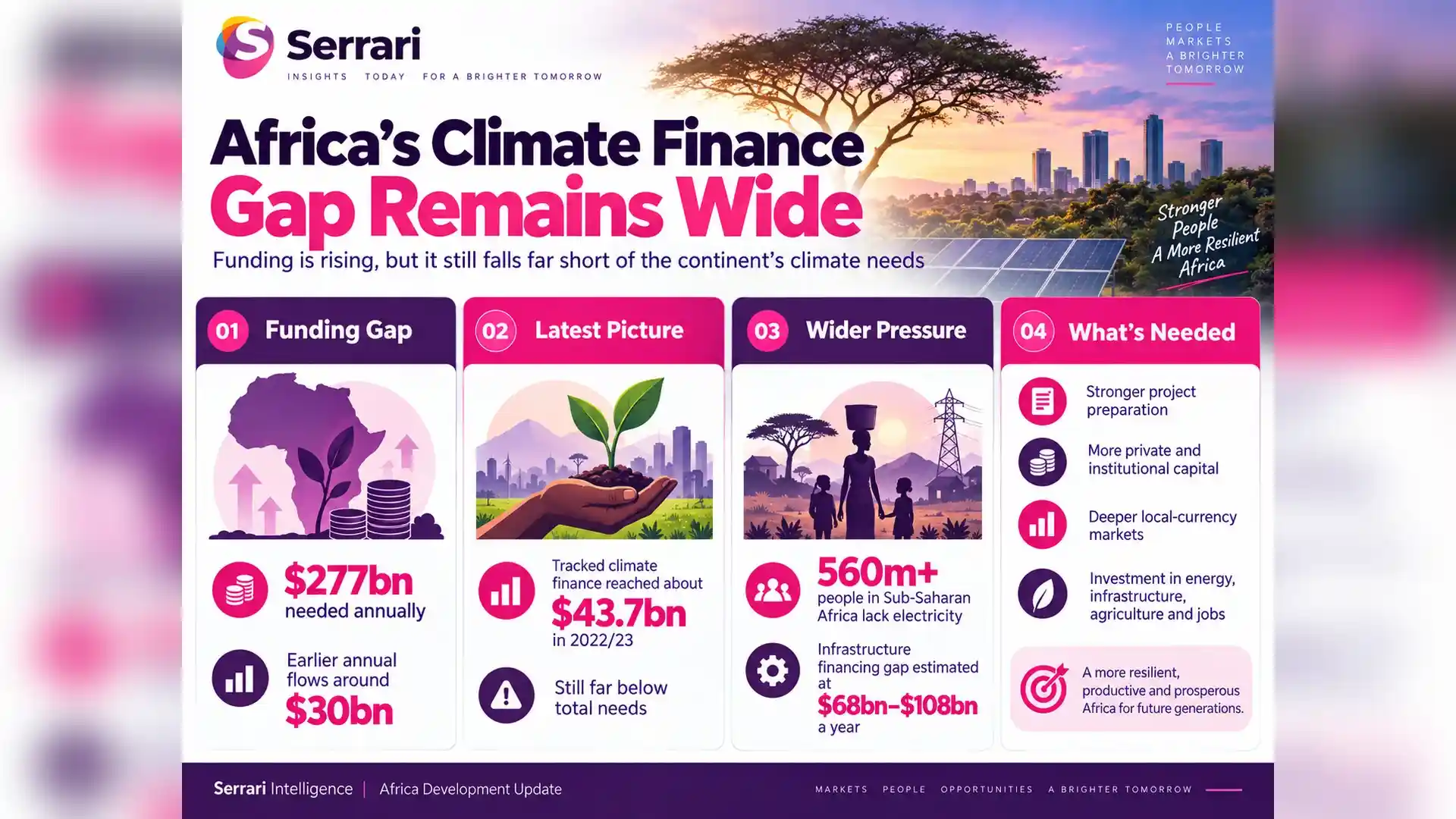
- Africa is estimated to need about $277 billion annually to meet its climate commitments through 2030.
- The commonly cited $30 billion funding figure is based on earlier climate-finance data.
- More recent figures put Africa’s tracked climate finance at about $43.7 billion in 2022/23.
- More than 560 million people in Sub-Saharan Africa still lack access to electricity.
- Africa’s annual infrastructure-financing gap remains estimated at $68 billion to $108 billion.
- Global capital is available, but the central challenge is directing more of it toward bankable African projects.
Climate Finance Remains Far Below Africa’s Needs
Adesina used the New York roundtable to call for stronger mobilisation of climate finance for energy, infrastructure, agriculture, industry and enterprise development across the continent.
The scale of the challenge remains substantial. A widely used assessment estimates that Africa requires about $277 billion every year to implement its Nationally Determined Contributions and meet its 2030 climate goals.
That same assessment found annual climate-finance flows of about $30 billion, equivalent to only around 11% of estimated needs at the time. However, that figure reflects earlier data rather than a current 2026 flow estimate.
More recent reporting indicates some improvement. Africa received about $43.7 billion in climate finance in 2022/23, still less than one-sixth of the estimated annual requirement.
Energy Access and Infrastructure Add to the Funding Pressure
Africa’s climate-finance challenge overlaps with major infrastructure and energy-access deficits. The latest global energy-access tracking shows that more than 560 million people in Sub-Saharan Africa lack electricity, making the region the centre of the global electricity-access gap.
At the same time, the continent needs between $130 billion and $170 billion annually for infrastructure, leaving an estimated financing gap of $68 billion to $108 billion each year.
These shortages affect far more than climate projects. Energy systems, transport networks, water infrastructure, logistics and industrial capacity all influence whether African economies can withstand droughts, floods and extreme heat while continuing to create jobs and raise productivity.
The funding challenge is particularly important because Africa contributes less than 4% of global greenhouse-gas emissions yet remains among the regions most exposed to climate-related disruption.
Context is everything. Stay ahead of shifting trends with today’s market updates, and uncover emerging opportunities using the Serrari Group Market Index and Marketplace. Then, take control of your own financial future by exploring our Money & Life Reset Transformation Blueprint ™ to build stronger habits, create better systems, and design a path toward lasting wealth.
Global Capital Exists, but Africa Must Attract More of It
The global financing pool is large. Foreign direct investment reached about $1.6 trillion in 2025, although much of the increase was concentrated in developed economies and a small number of large projects.
Sustainable investment also represents a significant pool of capital. Estimates cited in 2026 place assets linked to sustainable investment strategies at about $16.7 trillion globally.
The challenge is therefore not simply the absence of money. African countries need investment structures that can convert global and domestic savings into commercially viable infrastructure, energy and climate-resilience projects.
That requires stronger project preparation, clearer regulation, deeper local-currency capital markets and greater participation by pension funds, insurers, sovereign wealth funds and other institutional investors.
Private Capital Could Play a Larger Role
Private climate finance remains relatively limited in Africa. Earlier continent-wide tracking found that private sources contributed only 14% of total climate finance, highlighting the need to improve the risk-return profile of projects and develop financing structures capable of attracting commercial capital.
Adesina has called for greater mobilisation of African institutional capital alongside international investment, as well as stronger regional cooperation in energy, transport and logistics.
Sahara says its own approach includes investment across gas, power, logistics and renewable energy while pursuing a 2060 net-zero roadmap that includes renewable-energy platforms and nature-based solutions.
The broader issue is how to ensure that climate investment supports development as well as emissions reduction. For Africa, financing resilient power systems, transport networks, agriculture and enterprise growth can simultaneously strengthen adaptation, expand productive capacity and create employment.
Closing the Gap Will Require Better Investment Pipelines
Africa’s climate-finance problem is increasingly a question of both scale and execution. The continent needs more capital, but it also needs more projects that are sufficiently prepared, structured and de-risked to attract that capital.
With climate shocks becoming more frequent and infrastructure deficits still large, delaying investment can increase both future adaptation costs and economic losses. Expanding climate finance will therefore depend on governments, development institutions and private investors building stronger pipelines of projects that can turn available capital into reliable infrastructure, productive businesses and long-term resilience.
Sources: The Sun Nigeria / TheCable / Climate Policy Initiative / African Development Bank / World Bank / UN Trade and Development / Morningstar / Sahara Group
Your financial future isn’t something you wait for—it’s something you build.
The real question is: when do you begin?
Move beyond simply staying informed.
Navigate the markets with clarity—track trends through the Serrari Group Market Index, uncover opportunities in the Serrari Marketplace, and build practical knowledge with our Curated Wealth Builder Platform.
Stay connected to what truly matters.
Get daily insights on macro trends and financial movements across Kenya, Africa, and global markets—delivered through the Serrari Newsletter.
Growth opens doors.
Advance your career through professional programs including ACCA, HESI A2, ATI TEAS 7 , HESI EXIT , NCLEX – RN and NCLEX – PN, Financial Literacy!🌟—designed to move you forward with confidence.
See where money is flowing—clearly and in real time.
Track Money Market Funds, Treasury Bills, Treasury Bonds, Green Bonds, and Fixed Deposits, alongside global and African indexes, key economic indicators, and the evolving Crypto and stablecoin landscape—all within Serrari’s Market Index.