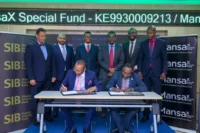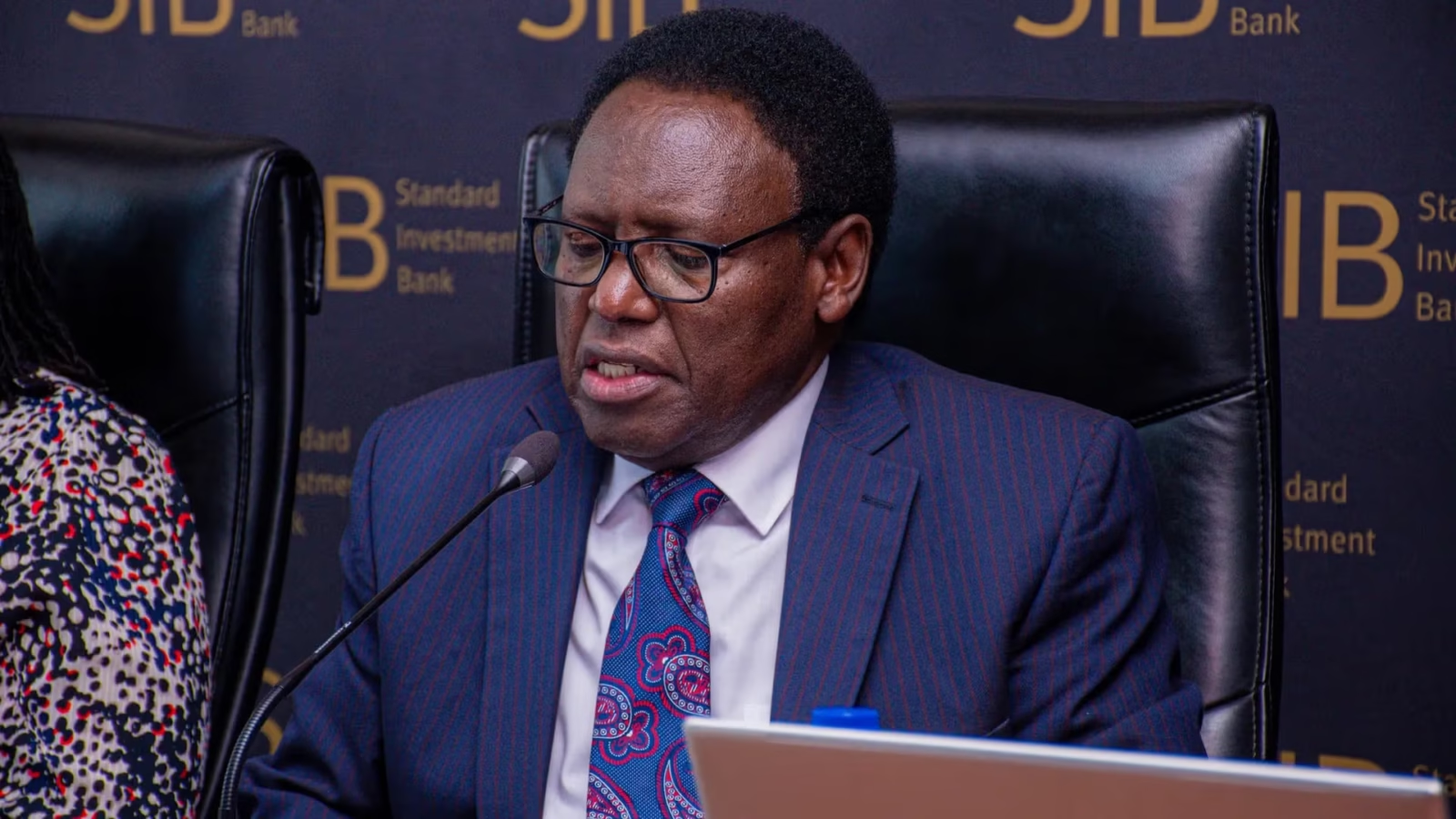
Standard Investment Bank (SIB), the operator of the Mansa X fund suite, closed FY2025 with a record profit of KSh 1.040 billion — up from KSh 97.50 million in FY2024 — marking its sharpest single-year financial performance on record. Total income more than tripled to KSh 2.188 billion, driven primarily by a 202.5% surge in financial services revenue to KSh 1.553 billion, the income line most directly tied to Mansa X management fees. The results reflect the dramatic growth in assets under management across SIB’s fund businesses, including the January 2025 co-launch of the Ziidi Money Market Fund with Safaricom and ALA Capital, which has already accumulated KSh 15.48 billion in net assets. Operating expenses grew at a fraction of the revenue pace, rising just 25.61%, while excess liquid capital under CMA requirements nearly tripled to KSh 934.3 million — signalling both operational discipline and a materially strengthened balance sheet heading into FY2026.
LIVENSE market summarySee NSE data →Key Overview
- FY2025 Profit: KSh 1.040 billion (vs KSh 97.50 million in FY2024)
- Total Income: KSh 2.188 billion (up from KSh 680.2 million)
- Financial Services Revenue: KSh 1.553 billion (+202.5%)
- Mansa X Management Fee: 5% on AUM
- Brokerage Commissions: KSh 338.0 million (+169.8%)
- Corporate Finance Income: KSh 55.76 million (5x increase)
- Interest Income: KSh 214.4 million (up from KSh 20.80 million)
- Operating Profit: KSh 1.504 billion (vs KSh 265.1 million)
- Operating Expenses: KSh 429.3 million (+25.61%)
- Total Assets: KSh 3.025 billion (more than doubled)
- Shareholders’ Funds: KSh 2.139 billion (+91.34%)
- Excess Liquid Capital (CMA): KSh 934.3 million (~3x FY2024 level)
- Ziidi MMF Net Assets: KSh 15.48 billion
- Ziidi Investment Income: KSh 1.005 billion
- Key Co-ventures: Ziidi MMF with Safaricom and ALA Capital; Taifa Pension Fund mandate
The Year Everything Changed at Standard Investment Bank
There are financial results that confirm a trend, and there are financial results that announce a transformation. Standard Investment Bank’s FY2025 numbers belong firmly in the second category. A profit of KSh 1.040 billion against KSh 97.50 million a year earlier is not an incremental improvement. It is a tenfold multiplication of the bottom line in a single financial year — the kind of performance that forces a reassessment of what kind of institution SIB has become and where its growth trajectory is headed.
The headline profit figure, striking as it is, understates the depth of the transformation underway. Revenue more than tripled. Operating leverage expanded dramatically, with expenses growing at one-eighth the pace of income. The balance sheet more than doubled. Regulatory capital buffers nearly tripled. And at the centre of it all, a single business line — financial services revenue, the most direct proxy for Mansa X fund management fees — grew by more than 200% in twelve months.
To fully appreciate what these numbers represent, it is necessary to understand what SIB has built, how the Kenyan asset management landscape has evolved, and why the FY2025 results are as much a structural story as a financial one.
Markets move fast; don’t get left behind. We’ve paired the Serrari Group Market Index with a curated Marketplace and a comprehensive Wealth Builder Course to ensure you have the data—and the skills—to act on it.
Historical Context: Kenya’s Asset Management Evolution and SIB’s Positioning
Kenya’s investment and asset management industry has undergone a quiet but consequential evolution over the past two decades — one that created the conditions for SIB’s current performance to be possible.
In the early 2000s, Kenya’s capital markets were thin, retail participation in formal investment products was limited, and the asset management industry was dominated by a small number of institutions — primarily insurance companies, pension fund managers, and a handful of unit trust operators — serving a relatively narrow base of formally employed, higher-income investors. The Nairobi Securities Exchange functioned as a brokerage-driven market, and investment banking services were concentrated among a few established players.
The transformation began with a combination of demographic, technological, and regulatory shifts. Kenya’s growing middle class, rising mobile penetration, and the financial inclusion revolution catalysed by M-Pesa created both the savings capacity and the digital infrastructure for a much wider range of investment products to reach ordinary Kenyans. The Capital Markets Authority progressively modernised its framework for collective investment schemes, making it easier for new operators to launch, distribute, and manage retail investment funds.
Money market funds emerged as the gateway product — accessible, liquid, relatively low-risk, and offering returns that materially exceeded what commercial bank savings accounts provided. The success of early Kenyan money market funds demonstrated that retail investors would move savings into formal investment products if the access friction was low enough and the returns compelling enough. Platforms that could reduce that friction — through mobile-first distribution, low minimum investments, and intuitive interfaces — found enormous latent demand.
SIB’s Mansa X platform was built on this insight. By offering a suite of unit trust funds accessible through a digital interface, with investment minimums designed to accommodate a wide range of investor profiles, SIB positioned itself to capture retail and high-net-worth investment flows that were increasingly seeking alternatives to traditional bank deposits. The 5% management fee structure on assets under management created a revenue model that scales directly with AUM growth — meaning that every shilling of new investment flowing into the Mansa X sub-funds generates incremental fee income without a proportional increase in marginal cost.
The FY2025 results are the financial expression of that model reaching a scale where its operating leverage becomes visible in the income statement.
Deconstructing the Revenue Surge: What Each Line Reveals
The tripling of SIB’s total income from KSh 680.2 million to KSh 2.188 billion is the aggregate of several distinct revenue streams, each telling its own part of the story.
Financial services revenue — KSh 1.553 billion (+202.5%)
This is the number that matters most and reveals the most. Financial services revenue is the income line that most directly captures Mansa X management fees — the 5% annual charge applied to assets under management across SIB’s fund suite. A 202.5% increase in this line implies that AUM across the Mansa X sub-funds grew at a rate that, when combined with performance within the portfolio, produced a near-threefold expansion of fee-generating assets during the year.
The mathematics of a 5% management fee applied to growing AUM are straightforward but powerful. If financial services revenue reached KSh 1.553 billion at a 5% fee rate, the implied AUM generating that revenue — averaging across the year — would be in the range of KSh 31 billion. That figure, which represents a rough estimate given the annual averaging implicit in annual fee income, contextualises just how rapidly the Mansa X platform has accumulated investor assets. For a business that began as a relatively modest fund operation, reaching implied average AUM of that scale in a single year is a significant operational achievement.
Brokerage commissions — KSh 338.0 million (+169.8%)
Brokerage commission growth of nearly 170% reflects both increased transaction volumes on the Nairobi Securities Exchange and, potentially, higher-value transactions facilitated by SIB’s growing institutional client base. As SIB’s profile has risen through the Mansa X platform and its associated co-ventures, its brokerage business has benefited from the institutional credibility and distribution reach that a larger balance sheet and higher AUM confer. Clients who invest through Mansa X funds may also conduct equity brokerage through SIB, creating cross-selling dynamics that amplify revenue per relationship.
Corporate finance income — KSh 55.76 million (more than 5x)
The quintupling of corporate finance income from what was previously a modest contribution reflects SIB’s growing capability and reputation in transaction advisory, capital raising, and structured finance. As the firm’s institutional profile has grown — evidenced by its appointment as co-fund manager for the Taifa Pension Fund — its ability to originate and execute corporate finance mandates has expanded correspondingly. This line, while smaller in absolute terms than financial services or brokerage revenue, is strategically significant as an indicator of SIB’s evolution from a primarily retail-facing fund manager into a broader institutional financial services provider.
Interest income — KSh 214.4 million (up from KSh 20.80 million)
The more than tenfold increase in interest income is the most analytically interesting line in the revenue breakdown, precisely because the audited statements do not provide a granular decomposition of its drivers. Two primary explanations are plausible and likely concurrent. First, a significantly larger deployed balance sheet — total assets more than doubled to KSh 3.025 billion — generates proportionally more interest income from treasury management of liquid capital. Second, SIB’s November 2024 appointment as co-fund manager for the Taifa Pension Fund alongside CPF Financial Services may have brought additional fee and income streams that manifest partly in the interest income line, depending on how the management arrangement is structured and reported.
The Ziidi Money Market Fund: Kenya’s Most Consequential New Financial Product
No element of SIB’s FY2025 story is more strategically significant than the January 2025 co-launch of the Ziidi Money Market Fund with Safaricom and ALA Capital — and the speed with which it has accumulated scale is remarkable by any measure.
Ziidi’s net assets of KSh 15.48 billion, achieved within months of its January 2025 launch, place it among the fastest-growing money market funds in Kenyan history. Investment income of KSh 1.005 billion and a profit before distribution to unit holders of KSh 784.3 million confirm that the fund is not just large — it is generating substantial returns for its investor base.
The structural logic behind Ziidi’s rapid accumulation is straightforward. Safaricom’s M-Pesa ecosystem reaches over 30 million active users in Kenya — the country’s most extensive and deeply embedded financial services distribution network. By integrating Ziidi fund access directly into the M-Pesa interface, the co-venture removed the primary friction point that has historically limited retail investment adoption: the need for investors to navigate a separate platform, complete separate onboarding, and maintain a separate relationship with an investment provider. A Ziidi investment becomes as accessible as a standard M-Pesa transaction — available to anyone with an active M-Pesa account, investable in small increments, and redeemable with the speed and simplicity that M-Pesa users expect.
LIVENSE market summarySee NSE data →ALA Capital’s role as the third co-venture partner brings investment management expertise and regulatory experience that complements Safaricom’s distribution reach and SIB’s existing fund operations infrastructure. The three-way structure — telecommunications distribution, investment management expertise, and fund operations — reflects a deliberate division of responsibilities that gives each partner the ability to contribute its core competency without duplicating capabilities that the others already possess.
For SIB, the Ziidi relationship is a distribution multiplier of a kind that would have been impossible to build organically. Access to Safaricom’s user base compresses what would otherwise be a decade-long distribution built into a product launch. The fee income generated from Ziidi’s KSh 15.48 billion in net assets — at whatever the agreed management fee split between the three co-venture partners is — contributes to the financial services revenue line that drove SIB’s FY2025 transformation.
Context is everything. While you follow today’s updates, use the Serrari Group Market Index and Marketplace to spot emerging shifts. Need to sharpen your edge? Our Wealth Builder Course turns these insights into a professional-grade strategy.
The Operating Leverage Story: Why Expense Discipline Matters as Much as Revenue Growth
Revenue growth of the magnitude SIB reported in FY2025 would be impressive but incomplete without the operating leverage story that accompanies it. Operating expenses grew just 25.61% to KSh 429.3 million — a fraction of the revenue growth rate — while finance costs actually fell 21.97% to KSh 27.10 million.
The result is an operating profit of KSh 1.504 billion against KSh 265.1 million previously — a near-sixfold expansion that confirms SIB is not buying its revenue growth through proportional expense escalation. The business model underlying Mansa X and Ziidi is inherently scalable: the marginal cost of managing an additional KSh 1 billion in AUM is materially lower than the marginal revenue that AUM generates at a 5% fee rate, particularly as the operational infrastructure — compliance, reporting, technology, and investment management — is already in place and largely fixed-cost in nature.
This operating leverage dynamic is the defining characteristic of well-run asset management businesses at scale. It means that continued AUM growth — if achieved — will generate profit expansion at a pace that outstrips the growth in the expense base, progressively improving margin and return on equity. The FY2025 results demonstrate that SIB has crossed the threshold where that dynamic is visible in the numbers, rather than merely theoretical in the business model.
Balance Sheet Strength: The Foundation for What Comes Next
The income statement transformation is matched by a balance sheet that has been fundamentally restructured in scale and strength.
Total assets more than doubling to KSh 3.025 billion reflects both the reinvestment of retained earnings and the natural expansion of the balance sheet that accompanies growing fund operations. Shareholders’ funds rising 91.34% to KSh 2.139 billion and retained earnings expanding to KSh 1.579 billion from KSh 539.0 million demonstrate that SIB is retaining and compounding the profits generated by its operating businesses rather than distributing them, building an equity base that can support further growth without requiring external capital.
The CMA excess liquid capital figure — KSh 934.3 million, nearly three times the FY2024 level of KSh 310.8 million — is the most practically significant balance sheet data point for assessing SIB’s strategic optionality. CMA-regulated entities are required to maintain minimum liquid capital above defined thresholds relative to their risk-weighted exposures. Excess liquid capital represents the buffer above those requirements — the financial headroom available to support business expansion, absorb unexpected losses, or pursue new mandates and product launches without triggering regulatory constraint.
At KSh 934.3 million in excess capital, SIB enters FY2026 with significant capacity to grow its fund management activities, take on additional pension fund mandates, expand its brokerage operations, or develop new financial products — all without needing to raise external capital or constrain existing operations to stay within regulatory limits.
Why This Matters: The Broader Signal for Kenyan Capital Markets
SIB’s FY2025 performance carries implications beyond one firm’s financial results.
It validates the retail investment platform model in the Kenyan market. The debate about whether ordinary Kenyans would move meaningful savings from bank deposits and mobile wallets into formal investment funds has been settled by the scale of Mansa X and Ziidi’s AUM accumulation. They will — when the access is simple, the minimum investment is low, the distribution channel is trusted, and the returns are competitive.
It demonstrates the value of telecommunications-fintech partnerships in financial services distribution. The Ziidi co-venture’s rapid asset accumulation is a proof of concept for the model of embedding investment products within existing high-penetration digital platforms. The lesson for the broader Kenyan and African financial services ecosystem is that distribution — reaching customers where they already are — is the critical constraint that telecommunications partnerships can unlock.
It raises the competitive bar for Kenyan asset managers. SIB’s growth to KSh 15+ billion in Ziidi AUM and its record profitability will not go unnoticed by competitors. Expect accelerated product development, distribution partnerships, and fee competition across the Kenyan money market fund and unit trust sector as established and new entrants respond to the market share dynamics that Mansa X and Ziidi are reshaping.
Risks to Consider
AUM concentration risk is the most significant near-term vulnerability. A large portion of SIB’s dramatically expanded revenue base derives from fund management fees, which are directly tied to the market value of assets under management. A significant market downturn that reduced the value of money market and other fund assets would compress fee revenue in a manner that the fixed expense base would not immediately offset, creating downward pressure on profitability.
Regulatory and compliance risk grows in proportion to AUM and institutional mandate scale. The addition of the Taifa Pension Fund mandate and the Ziidi co-venture brings SIB into more intensive regulatory oversight from both the CMA and, potentially, the Retirement Benefits Authority. Compliance failures in this environment — even inadvertent ones — carry reputational and financial consequences that could disrupt the growth trajectory.
Partner dependency risk in the Ziidi co-venture is a structural consideration. SIB’s distribution access to Safaricom’s user base is mediated through a co-venture arrangement whose terms, duration, and exclusivity provisions are not publicly detailed. Any change in the relationship with Safaricom or ALA Capital could materially affect Ziidi’s growth trajectory and the fee income SIB derives from it.
Looking Ahead: Can FY2026 Sustain the Momentum?
The FY2025 results create an elevated base from which continued growth requires either sustained AUM expansion, new mandate wins, or both. The Ziidi fund’s trajectory — KSh 15.48 billion in net assets from a January 2025 launch — suggests the former is plausible if Safaricom’s distribution reach continues to channel retail savings into the platform at anything close to the pace established in its first year.
The Taifa Pension Fund mandate, whose full-year income contribution will be visible in FY2026 for the first time across a complete financial year, provides an additional institutional revenue stream that was only partially reflected in FY2025’s interest income line. Pension fund management mandates are typically long-duration and relatively stable, providing a recurring income foundation that complements the more variable fee income generated by retail fund AUM.
SIB enters FY2026 as a categorically different institution from the one that closed FY2024 with KSh 97.50 million in profit. It has a proven fund management platform, a high-penetration distribution partnership, a strengthened balance sheet, and the institutional credibility that a record financial year confers. Whether it can sustain, extend, or consolidate that performance over the next twelve months will be the defining question — and Kenyan investors in Mansa X and Ziidi funds will be watching the answer closely.
Your financial future isn’t something you wait for, it’s something you build.
The real question is: when do you begin?
Move beyond simply staying informed.
Navigate the markets with clarity—track trends through the Serrari Group Market Index, uncover opportunities in the Serrari Marketplace, and build practical knowledge with our Curated Wealth Builder Course.
Stay connected to what truly matters.
Get daily insights on macro trends and financial movements across Kenya, Africa, and global markets—delivered through the Serrari Newsletter.
Growth opens doors.
Advance your career through professional programs including ACCA, HESI A2, ATI TEAS 7 , HESI EXIT , NCLEX – RN and NCLEX – PN, Financial Literacy!🌟—designed to move you forward with confidence.
See where money is flowing—clearly and in real time.
Track Money Market Funds, Treasury Bills, Treasury Bonds, Green Bonds, and Fixed Deposits, alongside global and African indexes, key economic indicators, and the evolving Crypto and stablecoin landscape—all within Serrari’s Market Index.