The stablecoin market contracted by $1.04 billion in the week ending March 21, with seven of the top ten stablecoins posting net outflows, according to data from DeFiLlama. Tether’s USDT retained its dominant position at a $184 billion market cap despite a marginal decline, while Circle’s USDC recorded the largest absolute outflow at approximately $1.37 billion. Against the broader trend, three assets posted notable gains: BlackRock’s BUIDL tokenised money market fund rose 6.15%, Circle’s USYC led all gainers with a 7.26% weekly increase, and Global Dollar’s USDG posted a 1.23% gain. Analysts and market observers are characterising the week’s data as selective capital rotation rather than systemic stress — a distinction with significant implications for how investors read current stablecoin market dynamics.
Key Overview
- Total Stablecoin Market Cap: $315.072 billion (as of this weekend)
- Weekly Outflow: -$1.04 billion (since March 21)
- Stablecoins with Net Outflows: 7 of top 10
- USDT Market Cap: $184.068 billion (58.42% market share, -0.03% weekly)
- USDC Market Cap: $77.723 billion (-1.73% weekly, ~$1.37B outflow)
- Largest Weekly Gainer: Circle’s USYC (+7.26%)
- Second Largest Gainer: BlackRock’s BUIDL (+6.15%)
- USDG Weekly Change: +1.23%
- Context: Pullback coincides with broader crypto market contraction erasing early March gains
- Market Interpretation: Selective rotation, not systemic exit
A Pullback That Tells a More Interesting Story
On the surface, a $1.04 billion reduction in the stablecoin market’s total capitalization over a single week looks like a straightforward story of contraction. Seven of the top ten stablecoins lost ground. The sector’s total valuation dipped from above $316 billion to $315.072 billion. The timing aligned with a broader crypto market pullback that unwound a significant portion of early March’s gains.
But surface readings of stablecoin market data are frequently misleading, and this week is a case in point. Beneath the aggregate outflow figure lies a pattern that tells a considerably more nuanced story — one not of indiscriminate capital flight but of deliberate reallocation, with institutional-grade yield-bearing instruments posting some of the week’s strongest gains even as traditional fiat-pegged stablecoins shed assets. Understanding that distinction matters for anyone trying to read where sophisticated capital is moving within the digital asset ecosystem.
Markets move fast; don’t get left behind. We’ve paired the Serrari Group Market Index with a curated Marketplace and a comprehensive Wealth Builder Course to ensure you have the data—and the skills—to act on it.
Historical Context: The Rise of the Stablecoin Economy
The stablecoin market’s journey from a niche crypto trading utility to a $315 billion financial ecosystem is one of the more remarkable stories in modern financial history — and its evolution directly shapes how weekly data points like this week’s outflow figures should be interpreted.
Stablecoins emerged in the mid-2010s as a practical solution to a specific problem: cryptocurrency traders needed a way to move in and out of volatile digital asset positions without converting back to fiat currency through slow and costly banking channels. Tether, launched in 2014 as the first major fiat-pegged stablecoin, addressed that need by creating a dollar-denominated token that could be transferred on blockchain rails without leaving the crypto ecosystem. Its adoption was rapid and its dominance enduring — a position that the current data, with USDT commanding 58.42% of the entire stablecoin market, confirms remains intact more than a decade after launch.
The market’s evolution over the subsequent decade was shaped by a series of defining events. The 2017 and 2020 to 2021 crypto bull markets drove massive growth in stablecoin supply as traders sought dollar exposure without fiat off-ramps. Circle’s USDC, launched in 2018, introduced a more regulated and transparent alternative to Tether, attracting institutional users who required audited reserve attestations and regulatory engagement. The algorithmic stablecoin experiment — culminating in the catastrophic collapse of TerraUSD in May 2022, which wiped approximately $40 billion from the market in under a week — demonstrated the fatal fragility of stablecoins without genuine asset backing and accelerated the flight of institutional capital toward collateralised alternatives.
Post-Terra, the stablecoin market went through a period of consolidation and maturation. Regulatory scrutiny intensified globally. The European Union’s MiCA framework established formal requirements for stablecoin issuers operating in European markets. The United States began moving — slowly — toward a legislative framework for payment stablecoins. Institutional appetite, rather than being dampened by the Terra collapse, was redirected toward instruments with demonstrably sound reserve structures and regulatory compliance postures.
The emergence of yield-bearing stablecoin alternatives — tokenised money market funds, treasury-backed instruments, and structured yield products denominated in stablecoin-equivalent units — represents the most significant recent development in the sector’s structural evolution. These instruments, of which BlackRock’s BUIDL and Circle’s USYC are the leading examples, blur the line between stablecoins and money market instruments, offering dollar-denominated stability alongside yield generation that traditional fiat-pegged stablecoins cannot provide. This week’s data, in which BUIDL and USYC posted the two largest percentage gains in the top ten, is a direct expression of that structural shift.
Reading the Data: What Each Position Reveals
The granular breakdown of this week’s stablecoin market data is worth examining carefully, because each position carries distinct information about the forces shaping the market.
Tether (USDT) — $184.068 billion, -0.03%
USDT’s marginal weekly decline of $56 million against a total market cap of $184 billion is statistically negligible — a rounding error at scale. The more significant data point is the market share figure: 58.42% of the entire stablecoin sector sits in a single instrument issued by a single company. This concentration is a defining structural characteristic of the stablecoin market and a persistent source of systemic risk concern for regulators and market observers. USDT’s resilience through multiple market cycles, regulatory challenges, and competitor growth has repeatedly surprised its critics. This week’s data offers no evidence that its dominance is under immediate threat.
Circle’s USDC — $77.723 billion, -1.73%
USDC’s $1.372 billion in outflows is the largest absolute decline in the top ten and warrants attention. USDC has historically functioned as the institutionally preferred stablecoin — more regulatory-compliant, more audited, and more integrated with traditional financial infrastructure than USDT. Large outflows from USDC can reflect several dynamics: institutional risk reduction ahead of anticipated market volatility, rotation into yield-bearing alternatives like USYC, or strategic treasury management decisions by large corporate holders. Without transaction-level data, distinguishing between these possibilities is difficult, but the magnitude of the outflow relative to USDC’s total market cap — approximately 1.7% in a single week — is notable and warrants monitoring over subsequent periods.
Sky Dollar (USDS) — $8.146 billion, -1.18% and DAI — $4.555 billion, -0.32%
The Sky ecosystem’s two stablecoin products — USDS and DAI — both posted outflows this week, though at different magnitudes. DAI, the decentralised stablecoin that has been a cornerstone of the DeFi ecosystem since its 2017 launch, maintained relative stability with only a 0.32% decline. USDS, the upgraded version introduced under the Sky protocol rebranding, saw a steeper 1.18% contraction. The divergence may reflect user familiarity and integration depth favouring DAI in the existing DeFi stack, even as the broader Sky ecosystem transitions its canonical stablecoin product.
Ethena’s USDe — $5.904 billion, -0.32%
USDe’s modest weekly decline, in line with DAI’s performance, reflects a market that is holding its position reasonably well given the broader contraction. USDe’s delta-neutral synthetic construction — backing the stablecoin through a combination of crypto collateral and offsetting short futures positions — has attracted significant institutional interest as a yield-generating mechanism. Its relative stability this week, compared to the steeper declines recorded by USDC and USDS, suggests its holder base is less prone to tactical rotation than some larger stablecoin pools.
World Liberty Financial’s USD1 — $4.404 billion, -0.54%
USD1’s presence in the top six stablecoins by market cap is itself a notable market development, reflecting the rapid accumulation of assets in a relatively recently launched instrument. Its 0.54% weekly decline, while modest in percentage terms, represents meaningful absolute capital movement at this scale. The political and institutional associations surrounding World Liberty Financial give USD1 a distinctive profile within the stablecoin landscape — one that will continue to attract scrutiny from regulators and market observers as its market cap grows.
PYUSD — $3.87 billion, -4.80%
PayPal’s PYUSD recorded the steepest weekly decline among the top ten, losing 4.80% of its market cap over the period. This outflow, while not catastrophic in absolute terms, is large enough relative to PYUSD’s total market cap to merit attention. PYUSD’s growth trajectory since its 2023 launch has been gradual rather than explosive, and its integration primarily within PayPal’s consumer payment ecosystem means its market cap is more directly tied to active usage flows than to treasury management or DeFi deployment. A near-5% weekly decline may reflect seasonal usage patterns, specific platform dynamics, or broader user behaviour changes that are worth monitoring.
BlackRock’s BUIDL — $2.699 billion, +6.15%
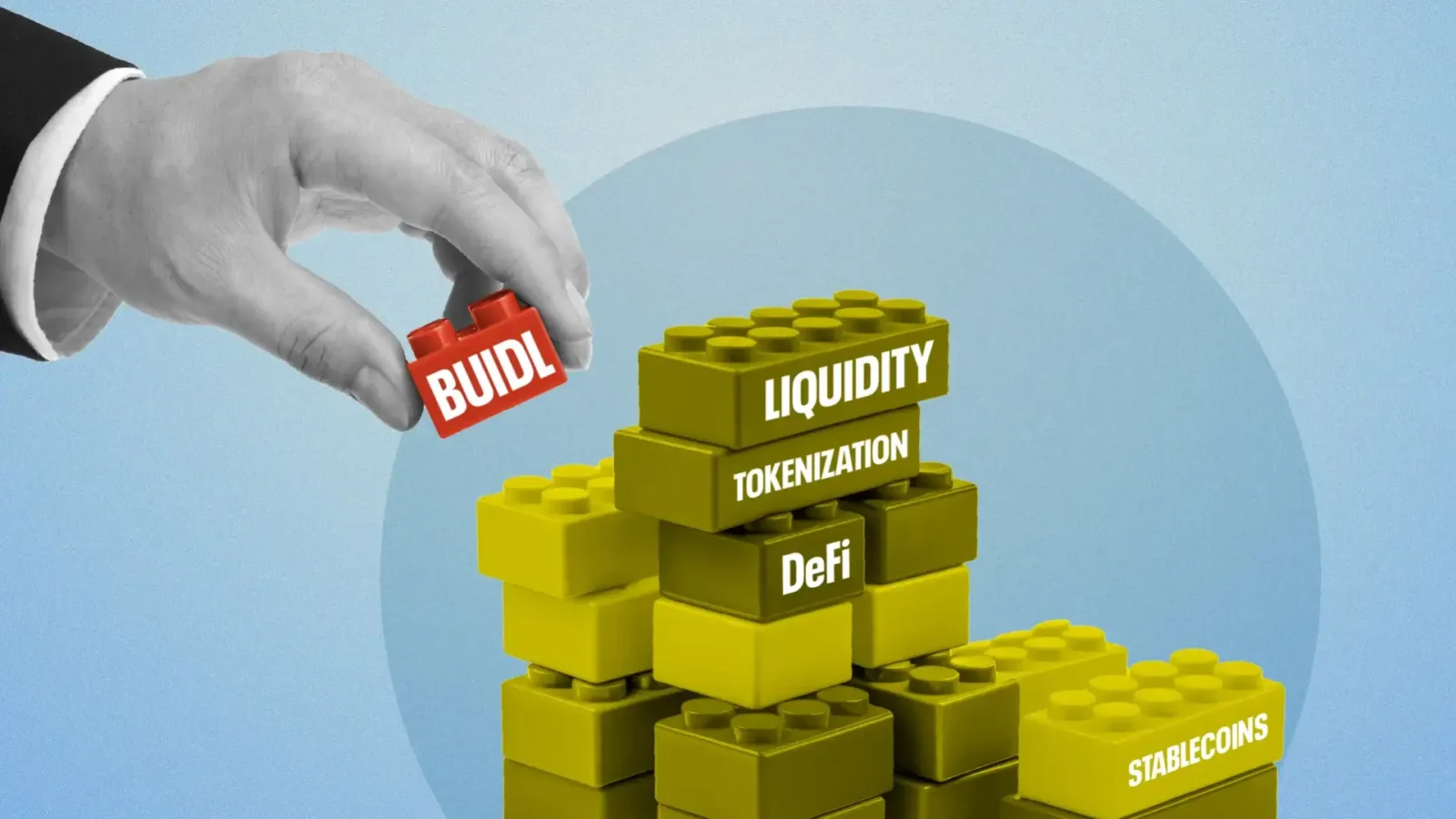
BUIDL’s 6.15% weekly gain is the second-largest percentage increase in the top ten and is arguably the week’s most structurally significant data point. BUIDL is not a conventional stablecoin. It is a tokenised money market fund — a representation on blockchain rails of a fund holding US Treasury bills and other short-duration government securities. Its dollar value is designed to remain stable while generating yield from the underlying securities. The strong inflow over the past week, occurring simultaneously with outflows from conventional stablecoins, is precisely the rotation pattern that market observers have been anticipating: capital moving from non-yielding dollar instruments into yield-generating tokenised equivalents.
BlackRock’s entry into the tokenised asset space through BUIDL represents one of the most consequential institutional endorsements the on-chain finance sector has received. When the world’s largest asset manager commits its brand and distribution infrastructure to a tokenised money market fund, it sends a signal to every other institutional investor about the legitimacy and viability of the format. The growth trajectory of BUIDL’s market cap over its first year of existence has been consistently strong, and this week’s 6.15% gain — against a backdrop of broader stablecoin contraction — suggests demand is accelerating rather than plateauing.
Circle’s USYC — $2.609 billion, +7.26%
USYC leads all top-ten gainers this week with a 7.26% increase, making it the standout performer in the current data. Like BUIDL, USYC is a yield-bearing instrument — specifically a tokenised representation of Circle’s US Yield product, which invests in short-duration US government securities and generates yield that accrues to token holders. The parallel strength of both USYC and BUIDL against the backdrop of conventional stablecoin outflows confirms the rotation narrative with additional conviction. Institutional and sophisticated retail capital is moving toward yield-bearing dollar instruments at exactly the moment that non-yielding stablecoins are experiencing outflows.
Global Dollar’s USDG — $1.692 billion, +1.23%
USDG’s modest 1.23% weekly gain rounds out the three assets that bucked the broader trend. USDG’s growth, while smaller in percentage terms than BUIDL and USYC, reflects continued adoption of an instrument that has been building market share steadily. Its presence in a week dominated by outflows from larger competitors suggests a differentiated user base or use case that is proving resilient to the broader contraction.
Context is everything. While you follow today’s updates, use the Serrari Group Market Index and Marketplace to spot emerging shifts. Need to sharpen your edge? Our Wealth Builder Course turns these insights into a professional-grade strategy.
The Rotation Thesis: Capital Moving, Not Exiting
The most important analytical conclusion from this week’s data is the one the raw aggregate number obscures: this is not a stablecoin market in distress. It is a stablecoin market in transition.
The $1.04 billion net outflow, while real and noteworthy, represents less than 0.33% of the sector’s total market cap. More tellingly, the distribution of that outflow is highly concentrated — USDC alone accounts for $1.372 billion of the total contraction, meaning that the rest of the top ten collectively registered a net inflow once BUIDL, USYC, and USDG’s gains are factored in alongside the smaller declines in other positions. The sector as a whole is not haemorrhaging capital. Specific instruments within it are losing ground to specific competitors.
The competitive dynamic driving that shift is the yield differential. In an environment where US Treasury yields remain meaningfully positive — short-duration government securities have offered 4% to 5% annualised returns for much of the past two years — holding non-yielding stablecoins carries a genuine opportunity cost. For institutional holders managing large dollar positions on-chain, the choice between a non-yielding USDC balance and a USYC or BUIDL position generating equivalent treasury yield is increasingly straightforward. The migration is rational, gradual, and likely to continue.
This pattern has direct echoes in traditional money market history. When US money market mutual funds began offering competitive yields in the late 1970s, capital flowed rapidly out of non-interest-bearing bank demand deposits into money market vehicles. The structural parallel is imperfect — the on-chain ecosystem operates differently from the traditional banking system in important ways — but the underlying incentive logic is identical: when a yield-bearing alternative is available with comparable liquidity and credit quality, rational capital holders will pursue it.
Risks to Consider
Concentration risk in USDT remains the stablecoin market’s most persistent systemic vulnerability. A 58.42% market share held by a single issuer means that any credible challenge to Tether’s reserve adequacy, regulatory standing, or operational continuity would have market-wide consequences that no degree of diversification among the remaining 41.58% could fully offset.
Yield instrument risk in BUIDL and USYC differs meaningfully from traditional stablecoin risk. Both instruments are backed by short-duration US government securities, which are among the safest assets in the world in nominal terms. But they carry interest rate sensitivity, smart contract risk from the tokenisation layer, and dependency on the continued operational integrity of their respective issuers that conventional fiat-pegged stablecoins managed by different mechanisms do not share in the same configuration.
Regulatory transition risk is a live variable across multiple jurisdictions. MiCA implementation in Europe is ongoing, US stablecoin legislation remains in progress, and the regulatory treatment of yield-bearing tokenised instruments — which sit at the intersection of securities law and payment instrument regulation — is not yet settled in most major markets. Regulatory reclassification of BUIDL or USYC as securities in certain jurisdictions could affect their accessibility and market cap trajectory.
Challenges Ahead
Interoperability and integration depth remain barriers to the faster growth of yield-bearing stablecoin alternatives. USDC and USDT are integrated into thousands of DeFi protocols, centralized exchanges, payment platforms, and corporate treasury systems. BUIDL and USYC, despite their yield advantages, are not yet accessible across the same breadth of platforms. The friction of switching, for users whose workflows are built around USDC or USDT, slows the rotation that the incentive logic would otherwise accelerate.
Transparency and audit standards across the stablecoin sector remain uneven. The market’s continued healthy functioning depends on the maintenance of user trust in reserve backing, and any significant reserve transparency failure — even from a smaller issuer — can have contagion effects on confidence across the sector.
Looking Ahead: The Market Structure Is Shifting
The week’s data, read carefully, points toward a stablecoin market undergoing a structural evolution that the aggregate outflow figure understates. The growth of tokenised yield instruments within the top ten — BUIDL and USYC combined now represent over $5.3 billion in market cap and are growing rapidly — reflects a maturing market in which institutional participants are applying increasingly sophisticated criteria to their dollar-denominated on-chain holdings.
The conventional stablecoin market, anchored by USDT and USDC, is not going away. Its infrastructure integration, liquidity depth, and network effects are far too entrenched for displacement in anything other than a multi-year timeframe. But the marginal dollar entering the stablecoin ecosystem is increasingly likely to go into a yield-bearing instrument rather than a non-yielding peg — and that shift, playing out week by week in data like this, is gradually reshaping the market’s composition and competitive dynamics.
For investors, analysts, and market participants tracking the digital dollar economy, the lesson from this week is to look past the headline number. A $1.04 billion contraction in a $315 billion market is noise. The signal is in the rotation — and the rotation points clearly toward a market that is becoming, week by week, more institutionally sophisticated and more yield-conscious than the one that preceded it.
Your financial future isn’t something you wait for, it’s something you build.
The real question is: when do you begin?
Move beyond simply staying informed.
Navigate the markets with clarity—track trends through the Serrari Group Market Index, uncover opportunities in the Serrari Marketplace, and build practical knowledge with our Curated Wealth Builder Course.
Stay connected to what truly matters.
Get daily insights on macro trends and financial movements across Kenya, Africa, and global markets—delivered through the Serrari Newsletter.
Growth opens doors.
Advance your career through professional programs including ACCA, HESI A2, ATI TEAS 7 , HESI EXIT , NCLEX – RN and NCLEX – PN, Financial Literacy!🌟—designed to move you forward with confidence.
See where money is flowing—clearly and in real time.
Track Money Market Funds, Treasury Bills, Treasury Bonds, Green Bonds, and Fixed Deposits, alongside global and African indexes, key economic indicators, and the evolving Crypto and stablecoin landscape—all within Serrari’s Market Index.