
















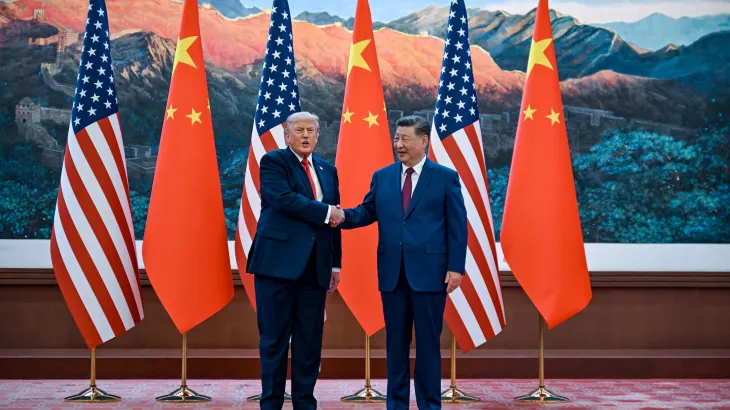
The United States and China are moving toward a managed trade mechanism that could see each side reduce tariffs on approximately $30 billion worth of non-sensitive goods, according to people familiar with the Trump administration’s objectives. The proposal, branded the “Board of Trade” by US Trade Representative Jamieson Greer, is the centrepiece deliverable expected from the high-stakes summit between President Donald Trump and President Xi Jinping in Beijing on 14–15 May 2026 — Trump’s first visit to the Chinese capital since 2017. The framework represents a significant philosophical shift: Washington is no longer demanding that Beijing overhaul its state-directed economic model, instead focusing on numerical trade targets in non-strategic sectors while maintaining broad tariffs and export controls on national security-sensitive technologies. The summit comes against the backdrop of a dramatic contraction in bilateral trade — US-China two-way goods trade shrank 29 percent to $415 billion in 2025, with the US trade deficit falling nearly 32 percent to $202 billion, its lowest level in two decades. Trump arrived in Beijing accompanied by a delegation of corporate executives including Apple CEO Tim Cook, Tesla CEO Elon Musk, and Nvidia CEO Jensen Huang, signalling the administration’s priorities around technology, agriculture, and aircraft.
Markets move fast; don’t get left behind. We’ve paired the Serrari Group Market Index with a curated Marketplace and a comprehensive Wealth Builder Platform to ensure you have the data—and the skills—to act on it.
Key Overview
- $30 billion in trade barriers each side may reduce under the proposed “Board of Trade” mechanism
- $30–$50 billion basket of goods under discussion, according to former USTR negotiator Wendy Cutler
- $415 billion in total US-China two-way goods trade in 2025, down 29% from $582 billion in 2024
- $202 billion US trade deficit with China in 2025, the lowest in two decades
- 47% current effective tariff rate on Chinese goods following the October 2025 Busan trade truce
- 10% temporary global US tariff on Chinese goods, set to expire in July 2026
- 10% matching general tariff China maintains on all US imports
- 2,200+ product-specific tariff exclusions from Trump’s first term, mostly expired
- Iran, Taiwan, AI also on the summit agenda alongside trade
- Board of Investment concept also under discussion, though at an earlier stage
President Donald Trump and Chinese President Xi Jinping opened a two-day summit in Beijing on 14 May 2026, with both sides expected to inch toward a managed trade mechanism for non-sensitive goods that could see each identify approximately $30 billion worth of products on which to reduce tariffs without crossing national security red lines.
The summit, Trump’s first visit to Beijing since 2017, comes at a moment of heightened geopolitical complexity. The US president arrived accompanied by a delegation of high-profile corporate executives including Apple CEO Tim Cook, Tesla CEO Elon Musk, and Nvidia CEO Jensen Huang, as CNN reported, underscoring the centrality of technology, agriculture, and aircraft to the administration’s trade agenda.
In a notable opening moment, Xi asked Trump whether the United States and China could avoid the “Thucydides Trap” — a reference to the historical pattern in which tensions between a rising power and an established one often lead to conflict.
The “Board of Trade” Mechanism
The proposed mechanism, which US Trade Representative Jamieson Greer has branded the “Board of Trade,” was first broached in March as a key deliverable for the Beijing summit. Four people familiar with the Trump administration’s objectives told Reuters they expected a $30 billion-for-$30 billion trade-barrier reduction framework to launch the new mechanism, although it remains unclear whether specific goods will be identified by Trump and Xi or left to subsequent meetings.
Wendy Cutler, a former USTR negotiator who heads the Asia Society Policy Center in Washington, said both sides were “coalescing around” a $30 to $50 billion basket of goods for reduced tariffs or other barriers. “The non-sensitive basket is just such a small part now of our overall trade with China,” Cutler said at a virtual Asia Society forum. “So maybe this Board of Trade, maybe it starts with that” and expands in the future.
The contours of the plan mark a fundamental philosophical shift in Washington’s approach to China. The US is no longer demanding that Beijing change its state-directed, export-driven economic model to become more like the American consumer-driven, market-oriented system. Instead, the effort focuses on numerical trading targets in non-strategic sectors while keeping in place broad tariffs and export controls on national security-sensitive technologies.
“It’s not really a situation where we go and get China to change the way they govern, the way they manage their economy,” Greer told Fox Business Network last week. “That’s all baked into their system, but I think there is a world where we find out where can we optimize trade between China and the United States to achieve more balance.”
Greer likened the mechanism to a plug “adapter” that can help connect two incompatible economic systems.
China has not adopted the “Board of Trade” name. In March, Beijing said the two sides had “agreed to explore the establishment of working mechanisms to expand economic and trade cooperation” without further details. The USTR’s office and the US Treasury declined to comment further on the proposed mechanism ahead of the summit.
The Incheon Prelude
In the days before Trump’s arrival in Beijing, US Treasury Secretary Scott Bessent and Chinese Vice Premier He Lifeng met for three hours in Incheon, South Korea, to lay the final groundwork on economic proposals. The two officials did not issue any statements about their preliminary meeting, maintaining a deliberate silence ahead of the leaders’ discussions.
The Bessent-He Lifeng channel has become the primary backchannel for US-China economic diplomacy, having also played a central role in the preparation for the Busan APEC meeting in October 2025, where the two countries reached a one-year trade truce that lowered tariffs and temporarily paused some Chinese export controls on rare earths.
A Sharply Contracted Trade Relationship
The proposed Board of Trade framework operates against the backdrop of a dramatic contraction in bilateral commerce. According to US Census Bureau data, US-China two-way goods trade shrank by 29 percent to $415 billion in 2025, down from $582 billion in 2024. US goods exports to China fell 25.8 percent to $106.3 billion, while US imports from China plunged 29.7 percent to $308.4 billion.
The US trade deficit with China fell nearly 32 percent to $202.1 billion in 2025, its lowest level in two decades. While the Trump administration has framed the shrinking deficit as a success of its tariff policy, the decline has come at the cost of significantly reduced trade volumes in both directions, with disruptions reverberating across supply chains worldwide.
The trajectory reflects years of escalating tariff action. As the Atlantic Council noted, US tariffs on Chinese goods have risen eighteenfold since the start of Trump’s 2018 trade war. The current effective tariff rate on Chinese goods stands at approximately 47 percent, following the Busan trade truce in October 2025, where Trump agreed to cut tariffs from 57 percent to 47 percent by halving fentanyl-related tariffs from 20 percent to 10 percent.
Energy, Agriculture, and the Tariff Web
With the US aiming to increase sales of energy and agricultural products to China, Beijing’s retaliatory tariffs on these commodities are a primary area for potential concessions. China currently maintains a general extra 10 percent tariff on all US imports, matching the current 10 percent US temporary global tariff on Chinese goods. On top of these and pre-existing “most favoured nation” tariffs, Beijing imposes additional retaliatory duties including 10 percent on crude oil, 15 percent on liquefied natural gas, 15 percent on coal, and up to 55 percent on beef.
The US, for its part, maintains 7.5 percent tariffs on a broad range of Chinese consumer products imposed in 2019 during Trump’s first-term trade war. These cover flat-panel television sets, flash memory devices, smart speakers, Bluetooth headphones, bed linens, multifunction printers, and many types of footwear. The 10 percent temporary global US tariff, set to expire in July, stacks on top of these duties.
One avenue for progress involves the more than 2,200 product-specific exclusions from China tariffs that were granted during Trump’s first term but have since largely expired. In November 2025, Trump extended for one year temporary tariff exclusions on solar product manufacturing equipment and 164 categories of industrial and medical products, from printed circuit boards to electric motors and blood pressure monitoring equipment. Some of these could potentially be made permanent as part of the Board of Trade framework.
Washington has also pushed for China to increase purchases of American goods, including Boeing aircraft, beef, and soybeans — echoing the purchase commitments that were a centrepiece of the “Phase One” deal during Trump’s first term.
Context is everything. While you follow today’s updates, use the Serrari Group Market Index and Marketplace to spot emerging shifts. Need to sharpen your edge? Our Wealth Builder Platform turns these insights into a professional-grade strategy.
The Busan Precedent
The Beijing summit builds directly on the Busan trade truce reached in October 2025. At that APEC sideline meeting, Trump and Xi agreed to a one-year tariff truce that included the tariff reduction from 57 to 47 percent, China’s commitment to pause rare earth export controls for one year, the resumption of US soybean purchases, and the suspension of fees on ships docking at each other’s ports.
As China Briefing detailed, the agreement saw China’s State Council Tariff Commission remove tariffs on a range of US agricultural products including the 15 percent tariff on chicken, wheat, corn, and cotton. China’s Ministry of Commerce also removed 31 American companies from its export control list and 10 from its unreliable entities list.
However, analysts at the time cautioned that the truce merely returned conditions to roughly where they were before the escalation of spring 2025. As Piper Sandler analyst Andy Laperriere observed, “China is getting the better of the US in these recent truce negotiations,” noting that Beijing had previously made similar promises on soybeans and fentanyl during Trump’s first term.
Beyond Trade: Iran, Taiwan, and AI
While trade is the declared centrepiece, the summit agenda extends well beyond tariffs. As CNBC reported, Iran is expected to dominate significant portions of the conversation. The US continues its blockade of the Strait of Hormuz, with major implications for China as the largest consumer of Iranian oil. Iran’s foreign minister visited Beijing just days before Trump’s arrival, underscoring the close ties between Beijing and Tehran.
Taiwan remains one of the most sensitive and contested issues in the relationship. Some US officials have expressed concern that Trump could inadvertently shift US language on Taiwan’s status in a way that benefits Beijing’s position. Trump has also said he plans to raise the case of Jimmy Lai, the jailed Hong Kong media tycoon.
Artificial intelligence is also on the table, with Beijing expected to press Washington to ease restrictions on advanced semiconductor exports and roll back measures limiting China’s access to critical chip-making technology — a demand that the presence of Nvidia CEO Huang in Trump’s delegation makes all the more pointed.
The Board of Investment and Domestic Pushback
The two sides are also expected to discuss the less-developed concept of a “Board of Investment” to address cross-border investment issues. However, Greer told the Hudson Institute last month that “I don’t think we’re at the point in our relationship with the Chinese where we want to talk about big investment programs either way.”
That caution is driven in part by significant domestic opposition. US lawmakers, automotive, steel, and technology industry groups have warned Trump against any deal that opens the door to Chinese investment in the US vehicle sector, arguing that such a move would hollow out the core of American manufacturing.
Managing Expectations
Despite the ambitious framing, analysts remain cautious about what the Beijing summit can realistically deliver. “A comprehensive trade deal seems unlikely because the structural sources of rivalry remain unresolved,” Samuel Regilme, a professor at Leiden University, told Al Jazeera. Instead, he said a limited agreement is more likely, potentially involving tariff pauses, purchase commitments, rare earth arrangements, or a framework for future negotiations.
Trump, for his part, is approaching the summit from a position of domestic political pressure. He arrives in Beijing amid record-low voter popularity and spiking gas prices driven by the Iran war, with November’s midterm elections looming. A visible, easy-to-sell trade win would carry significant political value.
Some residents in Beijing, interviewed by CNN before the summit, sensed that dynamic. “He’s in a pretty difficult situation right now, with the war in Iran,” said one programmer. “So, I think he’s coming here to gain some leverage.”
Whether the Board of Trade mechanism proves to be a genuine structural innovation in the US-China economic relationship or merely another incremental step in a long cycle of truces and escalations will depend on the details that emerge from Beijing — and, critically, on what follows.
Sources: US News & World Report / CNBC / CNN / Al Jazeera / Reuters / Atlantic Council / Council on Foreign Relations / China Briefing / Supply Chain Dive / CBC News / US Trade Representative / US Bureau of Economic Analysis / Investing.com
Your financial future isn’t something you wait for—it’s something you build.
The real question is: when do you begin?
Move beyond simply staying informed.
Navigate the markets with clarity—track trends through the Serrari Group Market Index, uncover opportunities in the Serrari Marketplace, and build practical knowledge with our Curated Wealth Builder Platform.
Stay connected to what truly matters.
Get daily insights on macro trends and financial movements across Kenya, Africa, and global markets—delivered through the Serrari Newsletter.
Growth opens doors.
Advance your career through professional programs including ACCA, HESI A2, ATI TEAS 7 , HESI EXIT , NCLEX – RN and NCLEX – PN, Financial Literacy!🌟—designed to move you forward with confidence.
See where money is flowing—clearly and in real time.
Track Money Market Funds, Treasury Bills, Treasury Bonds, Green Bonds, and Fixed Deposits, alongside global and African indexes, key economic indicators, and the evolving Crypto and stablecoin landscape—all within Serrari’s Market Index.