
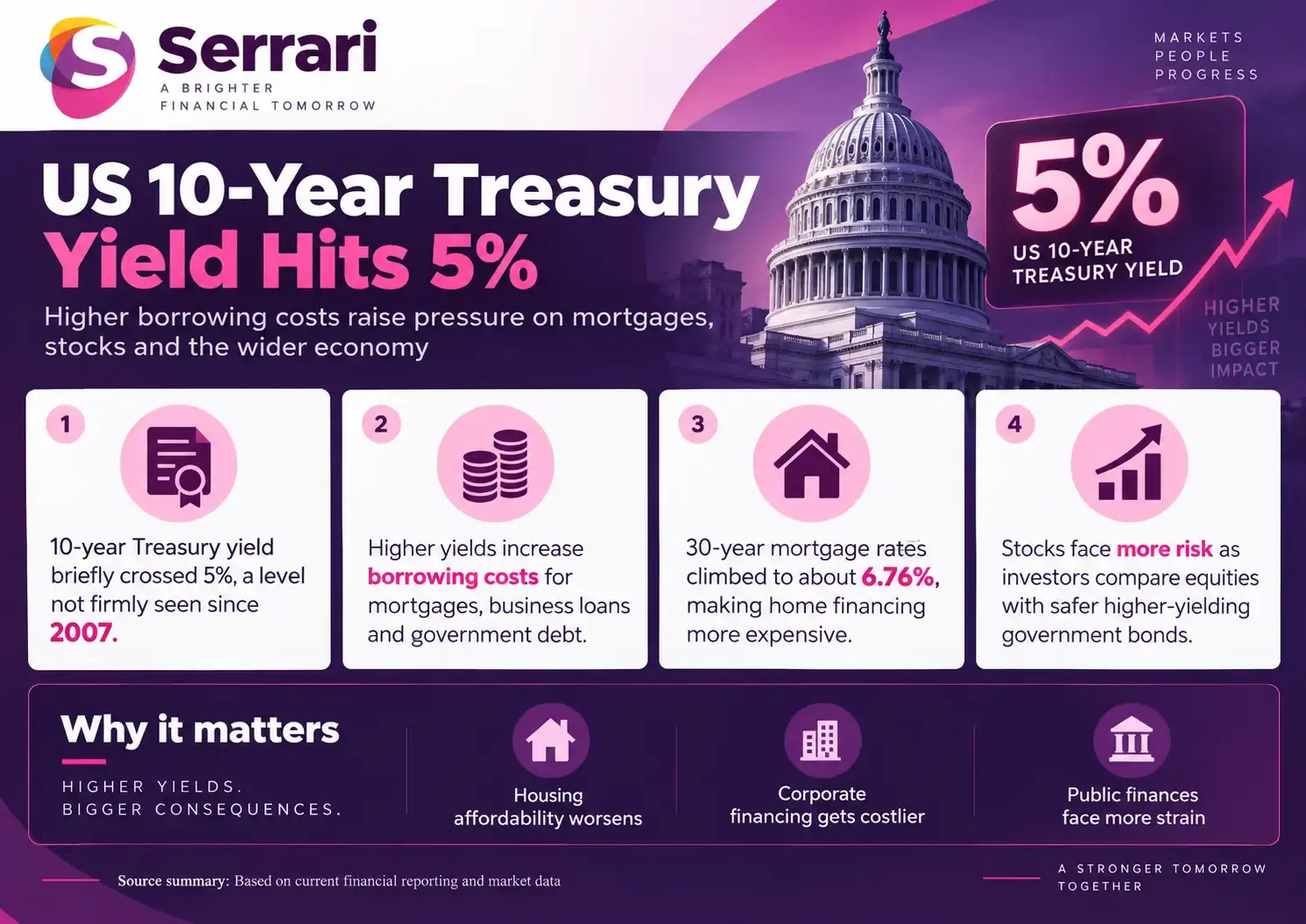
The US 10-year Treasury yield crossed the closely watched 5% threshold on September 14, 2026, marking its highest level since October 2023 and intensifying concerns about borrowing costs across the world’s largest economy.
The benchmark yield briefly rose to about 5.01% before pulling back, but the move underscored how sharply the interest-rate environment has changed as investors confront inflation risks, higher energy prices, heavy borrowing requirements and uncertainty over monetary policy.
Because the 10-year Treasury influences pricing across mortgages, corporate debt and other forms of credit, a sustained move around 5% could affect households, businesses, government finances and equity valuations.
Key Overview
- The 10-year Treasury yield crossed 5% on September 14, its first move above that level since October 2023.
- Higher long-term yields are increasing borrowing costs even before any further central-bank tightening.
- Average US 30-year fixed mortgage rates reached 6.76% in early September.
- Treasury yields are facing pressure from inflation concerns, energy prices, heavy debt issuance and expectations surrounding future Federal Reserve policy.
- Global bond markets are experiencing similar pressure as central banks respond to renewed inflation risks.
Why the 5% Treasury Yield Matters
The 10-year Treasury is one of the most important benchmarks in global finance. It acts as a reference point for the cost of capital across mortgages, business loans, corporate bonds and investment valuations.
The latest move represents a major change from the beginning of 2026. The 10-year yield was around 4.16% in the first week of January, meaning long-term borrowing costs have increased substantially within the year.
The 5% threshold is also psychologically important for investors. Government bonds offering yields around this level provide a more attractive alternative to equities because Treasuries carry far less credit risk. That can increase the return investors demand before accepting the additional uncertainty associated with stocks and other risk assets.
The move has been driven by several forces rather than one isolated event. Investors have been responding to renewed inflation risks from higher energy prices while simultaneously assessing strong economic activity, future interest-rate decisions and concerns over government borrowing.
Those financing requirements remain significant. Current projections show the government expects to undertake about $739 billion of privately held net marketable borrowing during the July-to-September quarter, followed by an estimated $628 billion in the final quarter of 2026.
Mortgage Borrowers Face Increasing Pressure
Housing is one of the areas where rising Treasury yields can become particularly visible for consumers.
Mortgage rates do not move perfectly with the 10-year Treasury, but they are strongly influenced by movements in longer-term market interest rates. As bond yields have climbed, mortgage financing has become more expensive.
The average 30-year fixed mortgage rate reached 6.76% for the week ending September 10, compared with 6.16% in the first weekly reading of January.
That difference can materially increase the monthly payment required to finance the same property. Higher mortgage costs can also weaken purchasing power, reduce housing demand and make refinancing less attractive for existing homeowners.
The effects extend beyond housing. Higher Treasury yields can influence auto loans, corporate borrowing and other forms of credit, progressively tightening financial conditions throughout the economy.
Context is everything. Stay ahead of shifting trends with today’s market updates, and uncover emerging opportunities using the Serrari Group Market Index and Marketplace. Then, take control of your own financial future by exploring our Money & Life Reset Transformation Blueprint ™ to build stronger habits, create better systems, and design a path toward lasting wealth.
What Higher Yields Mean for Stocks
A 5% Treasury yield does not automatically mean stocks will fall, but it raises the hurdle equities must clear.
Higher bond yields increase the discount rates investors use when valuing companies’ future cash flows. This can place particular pressure on businesses whose valuations depend heavily on profits expected far into the future.
Treasuries also become more competitive against equities when investors can earn around 5% from government securities without taking comparable corporate or market risk.
So far, the broader stock market has remained resilient. Despite Monday’s decline, the S&P 500 remained about 11.3% higher for 2026, demonstrating that strong earnings and economic growth can partly offset pressure from higher yields.
However, the combination becomes more challenging if bond yields remain elevated while corporate earnings weaken. In that environment, investors could face both lower expected profit growth and higher discount rates simultaneously.
A Global Shift Toward Higher Rates
The US bond market is not moving in isolation. Government borrowing costs have been rising across major economies as inflation risks and energy-market pressures force investors to reconsider how quickly interest rates can decline.
In Europe, policymakers recently raised all three key interest rates by 25 basis points, taking the deposit facility rate to 2.50% as officials responded to persistent inflation pressures associated with the Middle East conflict.
The United Kingdom has faced similar market pressure, with its 10-year government bond yield reaching a 19-year high during September as investors priced a more difficult inflation outlook.
Together, these moves suggest markets are increasingly questioning whether the exceptionally low interest-rate environment that followed the 2008 financial crisis will return anytime soon.
The Bigger Risk Is How Long Yields Stay High
Crossing 5% for a single trading session is less important than whether Treasury yields remain around that level for an extended period.
Persistently high yields would gradually filter through refinancing decisions, mortgages, corporate investment and government interest expenses. They could also increase competition between bonds and equities and place greater scrutiny on highly valued stocks.
Markets are therefore entering a period in which 5% is not necessarily a trigger for immediate financial stress, but it represents an important test. If inflation, government borrowing and energy prices keep long-term yields elevated, the consequences could become increasingly visible across the US economy.
The emerging environment may ultimately be defined less by a return to the ultra-low rates of the previous decade and more by a prolonged period in which households, governments, businesses and investors must adapt to structurally higher borrowing costs.
Sources: Reuters / Freddie Mac / Federal Reserve Bank of St. Louis / U.S. Department of the Treasury / European Central Bank / Associated Press
Your financial future isn’t something you wait for—it’s something you build.
The real question is: when do you begin?
Move beyond simply staying informed.
Navigate the markets with clarity—track trends through the Serrari Group Market Index, uncover opportunities in the Serrari Marketplace, and build practical knowledge with our Curated Wealth Builder Platform.
Stay connected to what truly matters.
Get daily insights on macro trends and financial movements across Kenya, Africa, and global markets—delivered through the Serrari Newsletter.
Growth opens doors.
Advance your career through professional programs including ACCA, HESI A2, ATI TEAS 7 , HESI EXIT , NCLEX – RN and NCLEX – PN, Financial Literacy!🌟—designed to move you forward with confidence.
See where money is flowing—clearly and in real time.
Track Money Market Funds, Treasury Bills, Treasury Bonds, Green Bonds, and Fixed Deposits, alongside global and African indexes, key economic indicators, and the evolving Crypto and stablecoin landscape—all within Serrari’s Market Index.