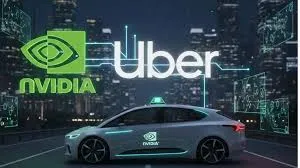
One of the most consequential announcements in the history of autonomous vehicle commercialisation was made at Nvidia’s annual GTC conference in Santa Clara on March 16, 2026: Uber Technologies and Nvidia Corporation are expanding their autonomous vehicle partnership to deploy a global fleet of 100,000 Level 4 robotaxis across 28 cities worldwide by 2028. The deployment will begin in Los Angeles and San Francisco in the first half of 2027 and expand to markets across North America, Europe, Australia and Asia over the following eighteen months. Shares of Uber Technologies (NYSE: UBER) surged 5.6% on March 17, closing at a multi-year high of $78.83 — a market validation of the partnership’s strategic significance.
The announcement represents Nvidia’s formal entry as a full-stack Level 4 autonomous vehicle software provider for commercial ride-hailing operations — a role that extends far beyond its established position as a hardware supplier of GPUs and chips to autonomous vehicle developers. By partnering with Uber to build, deploy and operate an entire software ecosystem for driverless ride-hailing, Nvidia is staking a claim on the value generated by the AV revolution rather than merely supplying components to others who will capture that value.
Markets move fast; don’t get left behind. We’ve paired the Serrari Group Market Index with a curated Marketplace and a comprehensive Wealth Builder Course to ensure you have the data—and the skills—to act on it.
The Technology: DRIVE Hyperion and Alpamayo
Central to the deployment is the NVIDIA DRIVE Hyperion platform — an autonomous vehicle development and testing architecture that integrates perception, planning and control into a unified safety framework. DRIVE Hyperion provides a standardised starting point for automakers, eliminating the need for each manufacturer to build safety systems from scratch and enabling faster deployment of Level 4 capable vehicles.
Powering the intelligence layer is Alpamayo, a next-generation reasoning-based AI model for autonomous vehicles designed specifically to handle complex “long-tail” scenarios — the unpredictable, low-frequency situations that conventional autonomous systems struggle to manage reliably. Construction zones with unmarked lanes, erratic pedestrian behaviour, unusual road configurations and emergency vehicle interactions are examples of the scenarios that have historically defeated autonomous systems relying on rule-based logic. Alpamayo uses chain-of-thought reasoning — a technique borrowed from large language model AI research — to process sensor data, model multiple possible interpretations of a scene and select responses based on logical inference rather than pattern matching alone.
The naming of the model after Alpamayo — a Peruvian mountain with particularly challenging terrain — is deliberate branding for a system designed to navigate exactly the kind of complex, difficult situations that standard models fail at. According to Nvidia, more than 100,000 automotive developers worldwide had downloaded Alpamayo since its initial release earlier in the year — a sign of rapid ecosystem adoption. Each launch city in the Uber-Nvidia deployment will follow a phased rollout: an initial data-collection phase to train Alpamayo on city-specific driving conditions, followed by an operator-led launch before transitioning to fully driverless Level 4 operations.
Uber’s Strategy: Orchestrator, Not Owner
Uber CEO Dara Khosrowshahi framed the partnership in explicitly ecosystem terms, describing its intent to support a “multi-player autonomous vehicle world” rather than a single-provider monopoly. “By expanding our partnership with NVIDIA and combining advanced AI with Uber’s global network and operating experience,” Khosrowshahi said, “we are laying the foundation for an increasingly multi-player AV world, ensuring broad commercialization and helping to bring robotaxi service to more riders over time.”
This positioning is strategically crucial. Uber made an early decision — reinforced consistently over the past five years — not to build its own autonomous vehicle technology but instead to serve as the platform and marketplace on which third-party AV developers deploy their solutions. The strategy is analogous to how Uber operates its conventional ride-hailing business: it does not own cars or employ drivers but instead creates the matching infrastructure that connects riders with transportation options. Applied to the AV world, this means Uber benefits from the commercialisation of autonomous mobility without bearing the billions in R&D costs required to develop the underlying technology.
The Nvidia collaboration is the latest and largest expression of this strategy. Earlier AV partnerships secured by Uber include deals with electric vehicle maker Lucid Group and autonomous driving startup Nuro (to deploy robotaxis on Lucid vehicles), Amazon subsidiary Zoox (for AV availability on the Uber app in Las Vegas), and a Tokyo pilot programme using Nissan vehicles equipped with DRIVE Hyperion scheduled for late 2026. By assembling multiple technology providers rather than betting on a single solution, Uber maximises its flexibility and resilience against individual technology failures while leveraging competitive dynamics between its AV partners to accelerate deployment.
Context is everything. While you follow today’s updates, use the Serrari Market Index and Marketplace to spot emerging shifts. Need to sharpen your edge? Our Wealth Builder Course turns these insights into a professional-grade strategy.
The Automaker Ecosystem: BYD, Geely, Hyundai and Beyond
The Nvidia-Uber partnership is not a bilateral arrangement — it is the centre of a broad ecosystem of committed automaker partners who will manufacture the DRIVE Hyperion-equipped vehicles that will populate the global robotaxi fleet. By the time of the GTC 2026 announcement, Nvidia’s automotive OEM partners included BYD, Geely, Isuzu, Nissan and seven others, alongside established partners General Motors, Mercedes and Toyota. The addition of BYD and Geely — China’s dominant EV manufacturers — is particularly significant, as it provides access to high-volume, cost-competitive vehicle manufacturing that will be essential for scaling from the initial launch cities to 28 markets globally.
Ride-hailing platforms beyond Uber are also integrating into the Nvidia ecosystem. Bolt, Grab, Lyft and TIER IV are all scaling robotaxi development on DRIVE Hyperion, broadening the platform’s commercial reach beyond Uber into regional mobility markets across Europe and Southeast Asia. This multi-platform approach is central to Nvidia’s ambition: by becoming the dominant software infrastructure provider for commercial robotaxi operations globally, Nvidia is pursuing a strategy analogous to the CUDA compute platform’s dominance of AI training — establishing the standard that the entire ecosystem builds on.
Jensen Huang, Nvidia’s founder and CEO, captured the strategic vision at GTC: “Uber is building one of the world’s most expansive autonomous ride-hailing platforms. We are delighted to connect Nvidia’s large ecosystem of robotaxi-ready partners to the Uber network to bring the magic of robotaxis to cities worldwide.”
The Competitive Landscape: Waymo, Tesla and the Race for AV Dominance
The Uber-Nvidia announcement arrives in a competitive landscape that is intensifying rapidly. Alphabet’s Waymo currently operates the most advanced commercial robotaxi service in the United States, running fully driverless rides in Phoenix, San Francisco and Los Angeles and steadily expanding its fleet. Waymo’s competitive advantage lies in its years of driverless mile accumulation, its proprietary sensor technology and the depth of its mapping data — advantages that are real but costly to maintain and difficult to scale globally without manufacturing partners willing to produce vehicles at volume.
Tesla, meanwhile, is betting on a camera-based approach to autonomy and has said it plans to launch its own robotaxi service — the “Cybercab” — while leveraging its large vehicle manufacturing capacity. Tesla’s scale advantage in vehicle production is formidable, but Uber’s ability to simultaneously partner with multiple automakers provides regional flexibility and deployment speed that Tesla’s single-brand model may struggle to match.
The US SELF DRIVE Act of 2026 has provided a federal framework for autonomous vehicles, significantly simplifying the regulatory pathway for large-scale commercial deployment. The NHTSA’s proposed rule change to Federal Motor Vehicle Safety Standards, which would officially allow the mass production of vehicles without traditional steering wheels or pedals, removes a key regulatory barrier to deploying fully purpose-built robotaxis rather than converted conventional vehicles.
Economic Impact: Margins, Pricing and the Disruption of Traditional Transport
The financial case for robotaxis rests on a compelling unit economics argument. Robotaxis could reduce ride prices by approximately 50% compared with driver-operated rides, dramatically expanding the total addressable market by attracting price-sensitive users who currently cannot afford frequent ride-hailing. At the same time, driverless vehicles can operate 24 hours a day without fatigue, increasing utilisation rates and revenue per vehicle. For Uber, the shift to robotaxis reduces the “take rate” paid to human drivers — currently a significant portion of each fare — thereby dramatically improving margins on every ride completed.
The ripple effects extend well beyond Uber. Traditional taxi companies, rental car businesses and even some forms of public transport could be disrupted as robotaxis achieve pricing parity or better with alternatives. Car rental companies, recognising the long-term threat, are reportedly pivoting to serve as fleet managers — offering cleaning, charging and maintenance services for robotaxi fleets. Cities are already grappling with planning questions: if robotaxis reduce car ownership and parking demand, what happens to municipal parking revenue and urban land use patterns?
For investors in Uber and Nvidia, the March 16 announcement represents a significant step toward monetising years of investment in autonomous vehicle technology. The 5.6% surge in Uber’s stock on March 17 suggests that markets are pricing in a non-trivial probability of the partnership delivering on its ambitious deployment timeline.
Your financial future isn’t something you wait for—it’s something you build.
The real question is: when do you begin?
Move beyond simply staying informed.
Navigate the markets with clarity—track trends through the Serrari Group Market Index, uncover opportunities in the Serrari Marketplace, and build practical knowledge with our Curated Wealth Builder Course.
Stay connected to what truly matters.
Get daily insights on macro trends and financial movements across Kenya, Africa, and global markets—delivered through the Serrari Newsletter.
Growth opens doors.
Advance your career through professional programs including ACCA, HESI A2, ATI TEAS 7 , HESI EXIT , NCLEX – RN and NCLEX – PN, Financial Literacy!🌟—designed to move you forward with confidence.
See where money is flowing—clearly and in real time.
Track Money Market Funds, Treasury Bills, Treasury Bonds, Green Bonds, and Fixed Deposits, alongside global and African indexes, key economic indicators, and the evolving Crypto and stablecoin landscape—all within Serrari’s Market Index.
Photo Source: Google
By: Montel Kamau
Serrari Financial Analyst
19th March, 2026