The latest Treasury switch bond auction conducted by the Central Bank of Kenya attracted healthy investor participation as the government continued its domestic debt management programme. The exercise enabled the CBK to switch KSh7.91 billion into a longer-dated Treasury bond while accepting KSh754.43 million in competitive bids, highlighting sustained demand for Treasury bonds Kenya despite a tightening fixed-income environment.
LIVEKenya bond yields: Average yield 11.93% across 58 bonds · 16 OctSee yields →Key Overview
- CBK accepted KSh754.43 million.
- The auction attracted KSh1.95 billion.
- Performance rate reached 103%.
- KSh7.91 billion was switched.
- Debt refinancing continued.
- Investor demand remained strong.
- Treasury bonds attracted interest.
- August auctions are expected soon.
Treasury Switch Bond Auction Attracts Strong Investor Demand
The Treasury switch bond auction organised by the Central Bank of Kenya (CBK) attracted solid investor interest as the government continued implementing its domestic debt management strategy aimed at refinancing maturing obligations and extending the country’s debt profile.
According to the CBK, the latest switch auction accepted KSh754.43 million in bids while successfully transferring KSh7.91 billion from an existing Treasury bond into a longer-dated security. The transaction forms part of the government’s broader efforts to improve the structure of Kenya’s domestic debt without significantly increasing borrowing costs.
Context is everything. Stay ahead of shifting trends with today’s market updates, and uncover emerging opportunities using the Serrari Group Market Index and Marketplace. Then, take control of your own financial future by exploring our Money & Life Reset Transformation Blueprint ™ to build stronger habits, create better systems, and design a path toward lasting wealth.
CBK Conducts Latest Treasury Switch Bond Auction
The switch auction focused on the FXD1/2012/020 Treasury bond, which currently has approximately 6.3 years remaining before its maturity on 1 November 2032.
Unlike conventional Treasury bond auctions that raise new funds, switch auctions allow investors holding an existing government security to exchange it for another bond with a different maturity profile. This helps the government spread future repayments over a longer period while giving investors flexibility to adjust the duration of their portfolios.
According to the CBK, the auction attracted bids worth KSh1.954 billion, with KSh754.43 million ultimately accepted.
The accepted bids represented a performance rate of 103%, indicating that investor demand marginally exceeded the amount offered.
Debt Refinancing Remains a Government Priority
One of the most significant outcomes of the auction was the successful switching of KSh7.91 billion from the source bond into the destination security.
This refinancing exercise allows the government to manage upcoming debt maturities more efficiently by reducing refinancing pressure when existing bonds mature.
Treasury switch auctions have become an increasingly important tool for sovereign debt managers because they help smooth repayment schedules while reducing the concentration of large maturities in any single year.
Rather than issuing entirely new debt to repay maturing obligations, governments can restructure existing liabilities through voluntary exchanges with investors.
Strong Appetite for Government Securities
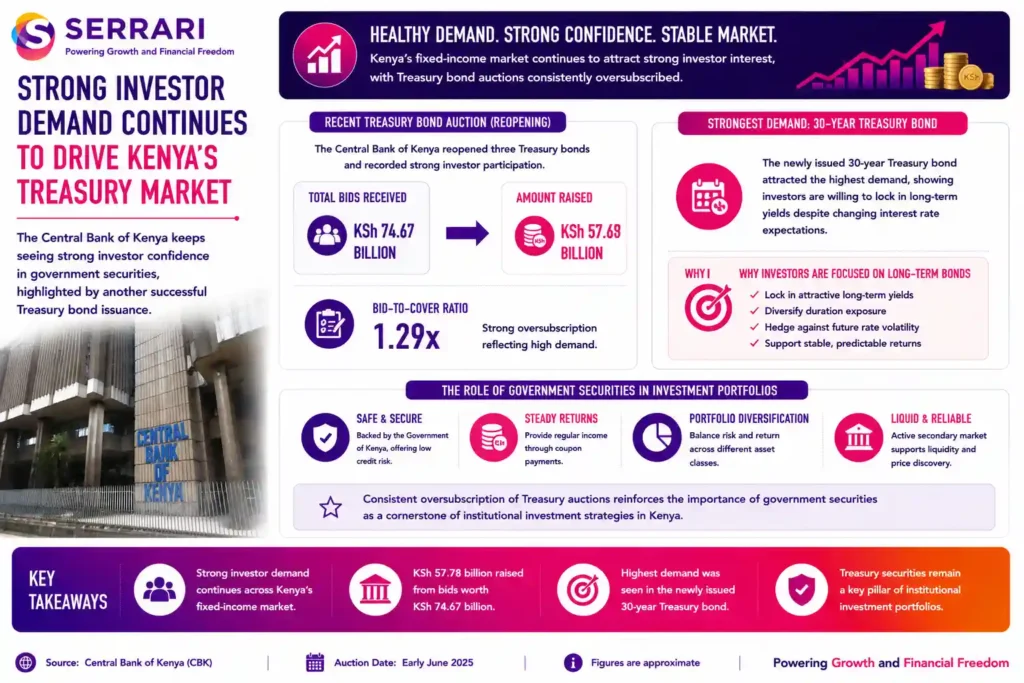
The latest results continue a trend of healthy investor demand across Kenya’s fixed-income market.
Only days earlier, the Central Bank of Kenya raised approximately KSh57.78 billion through the reopening of three Treasury bonds after receiving bids worth KSh74.67 billion, demonstrating continued confidence in government securities.
The strongest demand during that auction centred on a newly issued 30-year Treasury bond, reflecting investor willingness to lock in long-term yields despite changing interest rate expectations.
The consistent oversubscription of Treasury auctions highlights the important role government securities continue to play within institutional investment portfolios.
Treasury Bonds Remain Central to Government Financing
Treasury bonds remain one of Kenya’s most important domestic borrowing instruments.
LIVEKenya bond yields: Average yield 11.93% across 58 bonds · 16 OctSee yields →Funds raised through government securities help finance infrastructure projects, public services, budgetary requirements and debt refinancing activities while supporting the development of Kenya’s capital markets.
The government also uses regular bond reopenings and switch auctions to improve liquidity in existing securities and maintain an orderly sovereign yield curve across different maturities.
For investors, Treasury bonds continue offering relatively low-risk fixed-income opportunities backed by the Government of Kenya.
What the Results Mean for Investors
The bid-to-cover ratio of 1.03 suggests that demand remained resilient despite increasingly selective bidding by investors.
Rather than accepting all bids submitted, the CBK maintained pricing discipline by allocating only those bids consistent with its borrowing objectives.
For institutional investors such as pension funds, insurance companies and asset managers, switch auctions also provide opportunities to rebalance portfolios while maintaining exposure to government securities.
Meanwhile, the successful refinancing exercise helps reduce future redemption risks without placing additional pressure on the domestic borrowing programme.
Outlook for Kenya’s Fixed Income Market
The successful Treasury switch bond auction reinforces continued investor confidence in Kenya’s domestic bond market as the government actively manages its public debt profile.
The Central Bank of Kenya has indicated that additional details regarding the August 2026 Treasury bond auctions will be released before the next issuance cycle. Given the sustained oversubscription seen in recent Treasury bill and bond auctions, investor appetite for government securities is expected to remain strong, particularly if inflation and interest rate expectations remain relatively stable.
FAQs
What is a Treasury switch bond auction?
A Treasury switch bond auction allows investors to exchange an existing government bond for another Treasury bond with a different maturity. The process helps governments refinance debt and spread future repayment obligations over a longer period without issuing entirely new debt.
Why did the Central Bank of Kenya conduct this switch auction?
The Central Bank of Kenya conducted the auction as part of the government’s debt management strategy to refinance existing obligations, extend debt maturities and improve the overall structure of Kenya’s domestic public debt portfolio.
How much was raised during the Treasury switch bond auction?
The auction attracted bids worth KSh1.954 billion, with the Central Bank accepting KSh754.43 million. In addition, KSh7.91 billion was successfully switched from the source Treasury bond into the destination security as part of the refinancing exercise.
Why are Treasury bonds important to investors?
Treasury bonds are considered among the safest fixed-income investments because they are backed by the government. They provide predictable interest income, preserve capital, and help institutional and individual investors diversify their portfolios while supporting government financing needs.
Your financial future isn’t something you wait for—it’s something you build.
The real question is: when do you begin?
Move beyond simply staying informed.
Navigate the markets with clarity—track trends through the Serrari Group Market Index, uncover opportunities in the Serrari Marketplace, and build practical knowledge with our Curated Wealth Builder Platform.
Stay connected to what truly matters.
Get daily insights on macro trends and financial movements across Kenya, Africa, and global markets—delivered through the Serrari Newsletter.
Growth opens doors.
Advance your career through professional programs including ACCA, HESI A2, ATI TEAS 7 , HESI EXIT , NCLEX – RN and NCLEX – PN, Financial Literacy!🌟—designed to move you forward with confidence.
See where money is flowing—clearly and in real time.
Track Money Market Funds, Treasury Bills, Treasury Bonds, Green Bonds, and Fixed Deposits, alongside global and African indexes, key economic indicators, and the evolving Crypto and stablecoin landscape—all within Serrari’s Market Index.