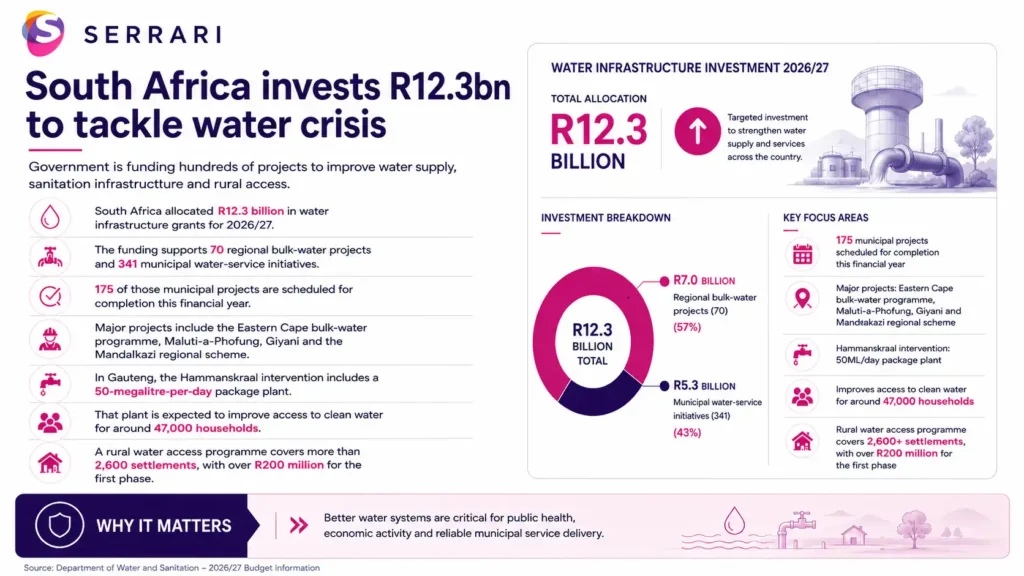
South Africa’s Department of Water and Sanitation has allocated R12.3 billion in municipal infrastructure grants for the 2026/27 financial year as the government intensifies efforts to stabilise failing water and sanitation systems.
The funding will support 70 regional bulk-water projects and 341 water-services initiatives across all nine provinces. Of the municipal projects, 175 are scheduled for completion during the current financial year, according to the government’s 2026 water infrastructure allocation.
The programme targets ageing treatment plants, sewage spillages, high water losses, interrupted supply and persistent service backlogs. It also forms part of a wider national response to a water crisis that has affected households, businesses and public institutions.
Key Overview
The R12.3 billion will be channelled through the Regional Bulk Infrastructure Grant and the Water Services Infrastructure Grant. The first supports large-scale infrastructure such as treatment plants, reservoirs and bulk pipelines, while the second focuses on municipal water and sanitation services.
Major interventions include projects in the Eastern Cape, Free State, Gauteng, KwaZulu-Natal and Limpopo. The government is also launching a Rural Water Access Programme covering more than 2,600 settlements, with over R200 million allocated to the initial phase.
The department is increasingly appointing water boards as implementing agents where municipalities lack the capacity to deliver complex projects. It is also working with the National Treasury and the Department of Cooperative Governance and Traditional Affairs to improve financial management and operational performance.
Major Projects Target Provincial Supply Gaps
In the Eastern Cape, the government is progressing a R2.6 billion bulk-water programme serving Mthatha, Libode, Ngqeleni and Mqanduli. The intervention is intended to strengthen supply across communities that have experienced persistent shortages and infrastructure constraints.
The Free State’s Maluti-a-Phofung intervention is valued at about R4 billion and includes the repair and expansion of water and sanitation infrastructure. The municipality has faced years of system failures, weak maintenance and financial pressure.
In Limpopo, the R1.3 billion Giyani Water Project has connected 24 villages, with additional work continuing to expand access. KwaZulu-Natal’s R4.9 billion Mandlakazi Regional Bulk Water Supply Scheme is also expected to improve water availability across underserved communities.
These projects are part of a broader effort to complete delayed schemes and rehabilitate treatment plants that have fallen below required operating standards.
Hammanskraal Project Nears Completion
In Gauteng, the Hammanskraal clean-water intervention is approaching completion. The project includes a 50-megalitre-per-day package treatment plant designed to improve access to safe water for approximately 47,000 households.
The development follows years of concern over water quality in Hammanskraal and the performance of the Rooiwal Wastewater Treatment Works. A government progress update on the project confirmed that the intervention is being implemented by Magalies Water in partnership with the Department of Water and Sanitation and the City of Tshwane.
The package plant is intended to provide a faster source of potable water while longer-term upgrades to the wider system continue. Its success will depend on effective maintenance, reliable electricity and coordinated management after construction is completed.
Context is everything. Stay ahead of shifting trends with today’s market updates, and uncover emerging opportunities using the Serrari Group Market Index and Marketplace. Then, take control of your own financial future by exploring our Money & Life Reset Transformation Blueprint ™ to build stronger habits, create better systems, and design a path toward lasting wealth.
Rural Water Programme Targets 2,600 Settlements
The nationwide Rural Water Access Programme will use boreholes, protected springs, rainwater harvesting and the rehabilitation of non-functional systems to improve supply in unserved communities.
More than 2,600 settlements have been identified for intervention. The first phase, valued at over R200 million, will focus on KwaZulu-Natal, Gauteng and the Eastern Cape. Implementation is scheduled to run from July to September 2026.
The rural supply programme is designed to provide practical short-term improvements while larger infrastructure projects are developed. However, rural schemes will require local maintenance capacity, water-quality monitoring and clear accountability to remain functional.
Weak Municipal Systems Remain the Main Risk
South Africa’s water challenges are not caused by infrastructure shortages alone. Many municipalities struggle with technical skills, revenue collection, procurement failures, corruption and inadequate maintenance.
National non-revenue water, which includes leaks, illegal connections and unbilled consumption, remains a major concern. High losses reduce the amount of treated water that reaches customers and weaken municipal finances.
The Department of Water and Sanitation is therefore expanding the role of water boards in project delivery and municipal support. This approach can improve technical execution, but it does not remove the need for stronger governance within local authorities.
The government has also reinforced anti-corruption measures through the Water Sector Anti-Corruption Forum, working with the Special Investigating Unit to investigate misconduct and protect infrastructure spending.
Investment Must Translate Into Reliable Services
The R12.3 billion allocation represents a significant intervention, but the effectiveness of the programme will depend on delivery rather than announced budgets. Projects must be completed on time, operated correctly and supported by sustainable municipal finances.
Reliable water and sanitation services are essential for public health, housing, industrial development and investor confidence. Continued interruptions and sewage failures impose costs on households and weaken local economic activity.
South Africa’s latest programme combines large bulk-water schemes, municipal repairs and targeted rural interventions. Its success will be measured by whether communities experience cleaner water, fewer interruptions and functioning sanitation systems after construction is complete.
Sources: SAnews / Parliament of South Africa / Bizcommunity / South African Government
Your financial future isn’t something you wait for—it’s something you build.
The real question is: when do you begin?
Move beyond simply staying informed.
Navigate the markets with clarity—track trends through the Serrari Group Market Index, uncover opportunities in the Serrari Marketplace, and build practical knowledge with our Curated Wealth Builder Platform.
Stay connected to what truly matters.
Get daily insights on macro trends and financial movements across Kenya, Africa, and global markets—delivered through the Serrari Newsletter.
Growth opens doors.
Advance your career through professional programs including ACCA, HESI A2, ATI TEAS 7 , HESI EXIT , NCLEX – RN and NCLEX – PN, Financial Literacy!🌟—designed to move you forward with confidence.
See where money is flowing—clearly and in real time.
Track Money Market Funds, Treasury Bills, Treasury Bonds, Green Bonds, and Fixed Deposits, alongside global and African indexes, key economic indicators, and the evolving Crypto and stablecoin landscape—all within Serrari’s Market Index.