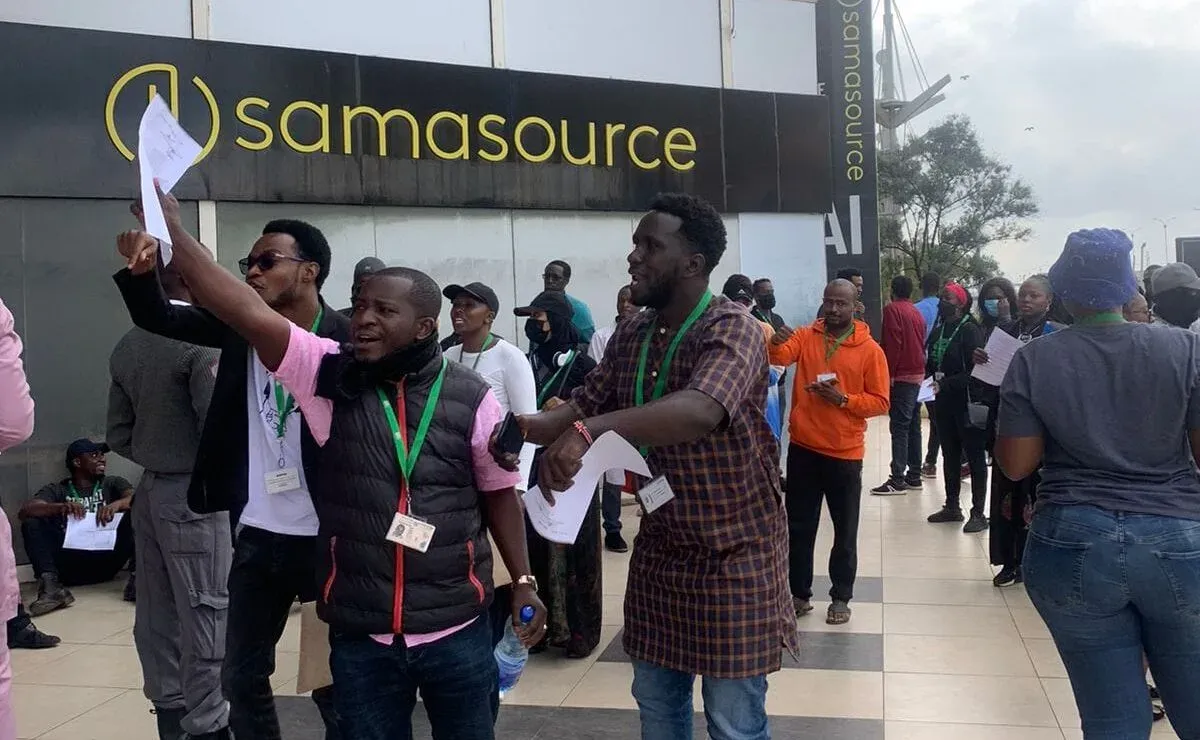
Data annotation firm Sama has issued redundancy notices to 1,108 employees at its Nairobi delivery centre after Meta, the parent company of Facebook, Instagram, and WhatsApp, formally terminated a major contract. The layoffs, announced on 16 April 2026, represent one of the largest single workforce reductions in Kenya’s digital economy and lay bare the structural vulnerability of an outsourcing model built around a single dominant client. Sama, headquartered in San Francisco and formerly known as Samasource, has provided AI training data services to Meta for years — first through content moderation and later through computer vision and data annotation work. The contract termination comes against a backdrop of ongoing legal battles between the two companies and former Sama employees, a recent investigation into Meta’s Ray-Ban smart glasses data practices, and a broader industry shift towards automation that is reducing demand for human data labellers globally.
Key Overview
- Employees affected: 1,108 workers issued redundancy notices on 16 April 2026
- Reason: Meta formally terminated a major engagement at Sama’s Nairobi office; negotiations to retain the contract were unsuccessful
- Timeline: The client engagement is expected to conclude by the end of April
- Legal compliance: Redundancy notices issued under Section 40 of Kenya’s Employment Act 2007
- Ongoing litigation: 185 former Sama content moderators are suing Meta and Sama for $1.6 billion over unfair dismissal and poor working conditions
- Recent controversy: A Swedish investigation in February 2026 revealed Sama workers were reviewing intimate footage from Meta’s Ray-Ban smart glasses
- Broader client base: Sama also serves Google, Microsoft, GM, and Ford, but Meta was the anchor client for its Nairobi hub
Markets move fast; don’t get left behind. We’ve paired the Serrari Group Market Index with a curated Marketplace and a comprehensive Wealth Builder Platform to ensure you have the data—and the skills—to act on it.
A Single Client Dependency Exposed
The layoffs at Sama’s Nairobi office represent more than a corporate restructuring — they reveal the inherent fragility of Kenya’s position in the global AI supply chain. As WeeTracker’s analysis put it bluntly: while Sama’s client list includes major names such as Google, Microsoft, General Motors, and Ford, industry insiders have long known that Meta was the anchor for the Nairobi hub. When Meta decided to end its engagement, no other client was waiting to absorb the affected staff.
Sama’s Country Lead and Vice President for Global Delivery, Annepeace Alwala, acknowledged the impact in a statement released alongside the redundancy notice: “As is standard in our industry, client programmes evolve, and we work closely with our partners to manage these transitions responsibly. Our immediate priority is supporting our employees through this change and ensuring continuity across our broader operations.”
The company said it had engaged Meta in an attempt to retain the workstream, but those efforts failed. The redundancy notice was issued in compliance with Section 40 of Kenya’s Employment Act 2007, which governs large-scale layoffs. Under Kenyan law, employers issuing redundancies are required to pay severance at a rate of at least 15 days’ pay per completed year of service, along with notice or pay in lieu of notice. However, no specific severance details have been publicly disclosed.
From Content Moderation to Data Annotation — and Back to Crisis
To understand the significance of this moment, it helps to trace the arc of the Sama-Meta relationship. The partnership began around 2017, with Sama providing content moderation services for Facebook in sub-Saharan Africa from its Nairobi hub. Meta formally opened its first content review centre in sub-Saharan Africa in partnership with Sama in February 2019, hiring hundreds of Kenyan workers to review and remove harmful content from Facebook and Instagram.
But the content moderation work came at a steep human cost. In January 2022, a TIME Magazine investigation exposed the conditions inside Sama’s Nairobi facility, revealing that moderators earned as little as $1.46 per hour after taxes while being required to review graphic content — including beheadings, child sexual abuse material, and violent deaths — for eight hours a day. More than 140 workers were reportedly diagnosed with post-traumatic stress disorder. When some attempted to unionise and demand better conditions, they were fired.
The fallout was swift. In January 2023, Sama announced it would discontinue its content moderation work for Meta, citing the “current economic climate.” The company pivoted its Nairobi operations towards data annotation — specifically computer vision, natural language processing, and multi-modal data labelling for AI and machine learning systems. It was meant to be a fresh start. Meta’s content moderation contract in Nairobi was taken over by Majorel, a Luxembourg-based outsourcing firm.
Sama retained its relationship with Meta through its data annotation business, which became the primary workstream for the Nairobi office. For over a decade, the firm had built a reputation around what it called “impact sourcing” — a model that promised to create dignified digital employment in underserved communities. But the April 2026 contract termination has exposed the limits of that model. When the single largest client walks away, the impact evaporates.
Context is everything. While you follow today’s updates, use the Serrari Group Market Index and Marketplace to spot emerging shifts. Need to sharpen your edge? Our Wealth Builder Platform turns these insights into a professional-grade strategy.
A Trail of Legal Battles
The layoffs arrive at a particularly fraught legal moment. A group of 185 former Sama content moderators has been pursuing a $1.6 billion lawsuit against Meta, Sama, and Majorel in Kenyan courts, alleging unfair dismissal, exploitative working conditions, inadequate mental health support, and blacklisting from similar roles with other contractors.
Meta had fought to block the case from proceeding, arguing that Kenyan courts lacked jurisdiction over a US-based company. But in September 2024, Kenya’s Court of Appeal upheld the Employment Court’s ruling allowing the case to move forward, dismissing Meta’s appeal as lacking merit. The ruling was hailed as a significant victory by Mercy Mutemi, the Nairobi-based civil rights attorney representing the former moderators. As WeeTracker noted, the court ruling came just weeks before the April 16 redundancy notice.
The former moderators allege that they were subjected to horrific content with insufficient psychological support, paid roughly KES 60,000 (approximately $414) per month, and then terminated after attempting to organise. An out-of-court settlement collapsed in October 2023 after what the moderators’ legal team described as insincerity from Meta.
In a separate but related case, former content moderator Daniel Motaung, who originally blew the whistle on conditions at the Nairobi hub, has also been pursuing his own lawsuit against Meta, alleging exploitation and harm to mental health. Both cases are now cleared to proceed to trial.
The Ray-Ban Smart Glasses Controversy
Adding another layer of complexity to the Sama-Meta relationship is a privacy scandal that erupted in February 2026. An investigation by Swedish newspapers Svenska Dagbladet and Göteborgs-Posten revealed that footage captured by Meta’s Ray-Ban AI smart glasses — including recordings of people in bathrooms, bedrooms, and other private settings — was being reviewed by Sama’s data annotators in Nairobi.
Workers told the Swedish reporters that they regularly encountered deeply sensitive material, including financial information such as bank cards visible in recordings, and intimate moments that users likely did not know were being captured. One Sama employee described the experience in stark terms: “You understand that it is someone’s private life you are looking at, but at the same time you are just expected to carry out the work. You are not supposed to question it. If you start asking questions, you are gone.”
The investigation triggered regulatory responses across multiple jurisdictions. The UK’s Information Commissioner’s Office confirmed it was writing to Meta demanding answers about its data protection obligations. Kenya’s Office of the Data Protection Commissioner launched a formal investigation into the smart glasses on 31 March, examining privacy concerns and how footage is being used to train Meta’s AI systems. In the United States, a class action lawsuit was filed on 5 March accusing Meta of marketing the glasses as privacy-friendly while secretly routing footage to overseas contractors.
Whether the Ray-Ban controversy played any role in Meta’s decision to terminate the Sama contract has not been publicly stated. But the timing has not gone unnoticed.
Kenya’s Fragile Position in the AI Value Chain
The Sama layoffs are not an isolated event. They fit within a broader pattern of instability in Kenya’s digital outsourcing sector that has been building for years. Nairobi has positioned itself as a key hub in the global AI supply chain, leveraging its young, English-speaking, tech-literate workforce and relatively reliable internet infrastructure. A 2021 survey by the Kenya Private Sector Alliance found that at least 1.2 million Kenyans were working online, most of them informally.
But the model has consistently proved vulnerable to decisions made thousands of miles away. In March 2024, Scale AI’s subsidiary Remotasks abruptly ceased operations in Kenya without warning, leaving workers stranded. Across the sector, data workers in Kenya have reported earning less than $2 per hour compared to over $20 for similar roles in the United States. As sociologist Milagros Miceli has observed, the outsourcing model is driven not only by cost savings but by a desire to “hide the mere existence of these workers.”
The structural problem is one of leverage. Tech companies control the contracts, set the terms, and can terminate engagements with minimal notice. Outsourcing suppliers like Sama have limited bargaining power and, in many cases, insufficient client diversification to absorb the loss of a major contract. As TechTrendsKE noted, the scale of the Sama layoffs represents a significant blow to Kenya’s growing reputation as a hub for AI and data services.
There is also the automation threat. Across the industry, tech companies are investing heavily in automated content filtering and AI systems that can classify and label data without human review. Even where human annotators are still needed, contracts are getting shorter, margins are shrinking, and the work is increasingly commoditised. As Techweez reported, the Sama layoffs underscore a difficult truth: Nairobi has been quietly building a reputation as an impact sourcing hub, but the value chain it feeds into is only as stable as the next contract renewal.
What Comes Next for Affected Workers
Sama has stated that it is “actively supporting affected employees with care and respect,” noting that workers have access to comprehensive wellness resources, full medical benefits, and on-site counselling provided by qualified practitioners. The company emphasised that its teams “receive living wages and full benefits.”
Under Kenyan employment law, workers facing redundancy are entitled to severance pay and notice periods, but the specifics of what Sama will provide beyond the statutory minimum have not been disclosed. For the 1,108 workers losing their jobs, the immediate concern is income. The longer-term concern is whether other tech companies will follow Meta’s lead, and whether the skills these workers have developed in data annotation, computer vision labelling, and NLP are transferable to roles with other employers.
There are other data annotation firms operating in Kenya — including Digital Divide Data, Impact Outsourcing, and CloudFactory — but none operate at the scale that Sama’s Meta contract demanded. And with the global AI industry increasingly investing in automation over human labour, the competitive landscape for these roles is shifting fast.
Meanwhile, Kenyan data workers have been organising. In May 2023, more than 150 content moderators working for Meta, ByteDance, and OpenAI formed Africa’s first content moderators’ union with support from the Communications Workers’ Union of Kenya. More recently, workers established the Data Labelers Association to advocate for fair treatment and better conditions. These efforts represent a growing collective awareness that the global AI economy cannot be built on a foundation of precarious employment and disposable workers.
A Cautionary Tale
Sama’s R15 billion investment pledge this is not. The layoffs tell a different story about the global digital economy — one in which thousands of jobs can appear and disappear based on a single contract decision in Silicon Valley. Kenya’s ambition to become a “Silicon Savannah” remains real, but the Sama episode offers a sharp reminder of the risks embedded in an outsourcing model that depends on the goodwill and continued demand of a small number of multinational technology companies.
As TechMoran observed, the layoffs underscore the vulnerability of outsourced digital work in emerging markets to shifts in demand from global technology firms. For the 1,108 Sama employees in Nairobi who are about to lose their livelihoods, the promise of “impact sourcing” has collided with the reality of market forces — and the impact, this time, flows in only one direction.
Your financial future isn’t something you wait for—it’s something you build.
The real question is: when do you begin?
Move beyond simply staying informed.
Navigate the markets with clarity—track trends through the Serrari Group Market Index, uncover opportunities in the Serrari Marketplace, and build practical knowledge with our Curated Wealth Builder Platform.
Stay connected to what truly matters.
Get daily insights on macro trends and financial movements across Kenya, Africa, and global markets—delivered through the Serrari Newsletter.
Growth opens doors.
Advance your career through professional programs including ACCA, HESI A2, ATI TEAS 7 , HESI EXIT , NCLEX – RN and NCLEX – PN, Financial Literacy!🌟—designed to move you forward with confidence.
See where money is flowing—clearly and in real time.
Track Money Market Funds, Treasury Bills, Treasury Bonds, Green Bonds, and Fixed Deposits, alongside global and African indexes, key economic indicators, and the evolving Crypto and stablecoin landscape—all within Serrari’s Market Index.