Recent U.S. stock market divergence highlights growing differences in investor sentiment, with technology stocks dragging the Nasdaq lower while industrial and defensive sectors helped support the Dow Jones Industrial Average.
Key Overview
- Nasdaq Composite Index fell 1.33% to 26,166.60.
- Dow Jones Industrial Average gained 0.29%.
- S&P 500 declined 0.34%.
- Technology stocks led to market weakness.
- Alphabet dropped more than 5%.
- Amazon, Meta, Broadcom and ARM also declined.
- Investors rotated away from high-growth technology shares.
- European and U.S. stock index futures weakened.
- Market volatility increased across major equity markets.
- Diverging sector performance drove mixed index results.
Nasdaq Composite Index Falls as Technology Stocks Weigh on Markets
The Nasdaq Composite Index led losses across major U.S. equity benchmarks on June 23 as investors moved away from several large-cap technology stocks, creating a sharp divergence in market performance.
The technology-heavy index declined 1.33% to close at 26,166.60, significantly underperforming the broader market. Meanwhile, the Dow Jones Industrial Average gained 0.29% to finish at 51,712.53, while the S&P 500 slipped 0.34% to 7,475.17.
The mixed performance highlights a growing divide between technology-focused growth stocks and more diversified sectors of the market.
While some investors continued to favor industrial and value-oriented companies, profit-taking in several high-profile technology firms weighed heavily on broader market sentiment.
The result was a session that demonstrated how concentrated weakness in a handful of large technology companies can significantly impact major market benchmarks.
U.S. Stock Market Divergence Becomes More Visible
The latest trading session showcased a clear case of U.S. stock market divergence, where different segments of the market moved in opposite directions.
Traditionally, the three major U.S. indices often move in the same direction during strong bullish or bearish trends. However, the latest session revealed a more selective market environment.
The Dow Jones posted gains despite declines in both the S&P 500 and Nasdaq Composite.
This divergence reflects changing investor preferences as market participants reassess growth expectations, interest rate outlooks, earnings prospects, and sector valuations.
The shift also suggests that investors are becoming increasingly selective in their stock purchases rather than broadly buying or selling the entire market.
Such divergence often emerges during periods of uncertainty when investors rotate capital between sectors based on perceived risks and opportunities.
Nasdaq Falls 1% as Major Technology Stocks Decline
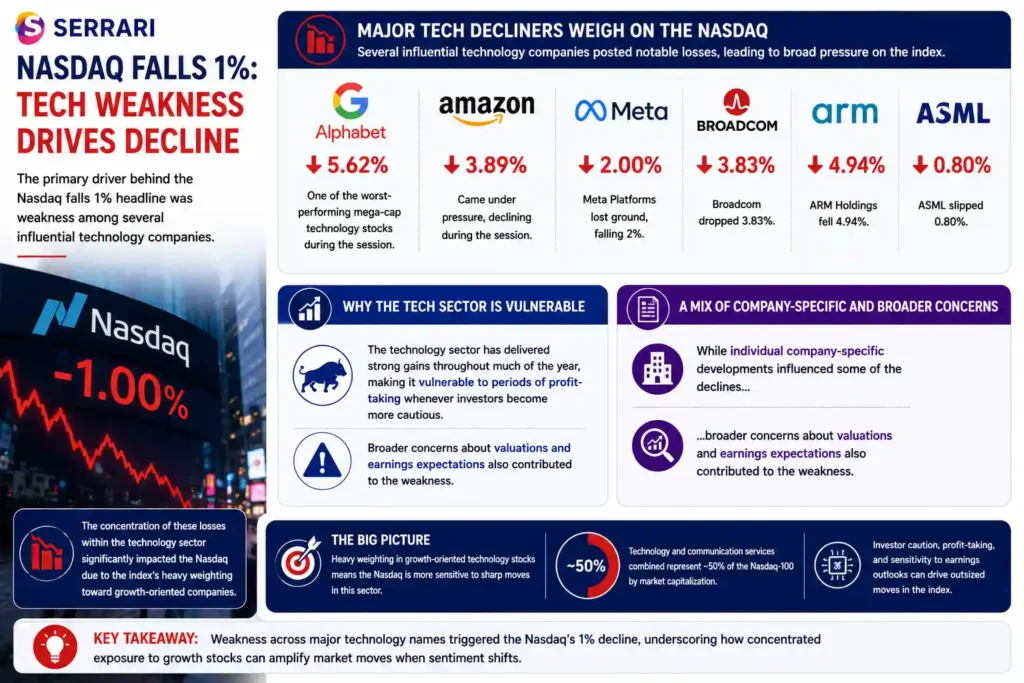
The primary driver behind the Nasdaq falls 1% headline was weakness among several influential technology companies.
Alphabet was among the biggest decliners, falling 5.62%, making it one of the worst-performing mega-cap technology stocks during the session.
Amazon also came under pressure, declining 3.89%, while Meta Platforms lost 2%.
Other technology names posted notable losses, including Broadcom, which dropped 3.83%, ARM Holdings, which fell 4.94%, and ASML, which slipped 0.80%.
The technology sector has delivered strong gains throughout much of the year, making it vulnerable to periods of profit-taking whenever investors become more cautious.
While individual company-specific developments influenced some of the declines, broader concerns about valuations and earnings expectations also contributed to the weakness.
The concentration of these losses within the technology sector significantly impacted the Nasdaq due to the index’s heavy weighting toward growth-oriented companies.
Context is everything. Stay ahead of shifting trends with today’s market updates, and uncover emerging opportunities using the Serrari Group Market Index and Marketplace. Then, take control of your own financial future by exploring our Money & Life Reset Transformation Blueprint ™ to build stronger habits, create better systems, and design a path toward lasting wealth.
Wall Street Stocks Show Mixed Performance
Despite weakness in technology, several Wall Street stocks posted gains and helped limit broader market losses.
Apple rose 0.61%, demonstrating resilience despite the challenging market environment.
Tesla gained 1.19%, while Taiwan Semiconductor Manufacturing Company (TSMC) climbed 1.61%.
Semiconductor-related names produced mixed results. Nvidia fell 0.60%, but Micron Technology advanced 4.57%, Intel gained 2.97%, and SanDisk surged 5.82%.
Texas Instruments also posted a solid gain of 2.16%.
These varied performances illustrate how investor sentiment differed even within the same industry groups.
Rather than abandoning technology entirely, investors appeared to be selectively favoring companies with stronger earnings momentum, attractive valuations, or favorable growth prospects.
This selective behavior is becoming increasingly common as markets move deeper into a mature economic cycle.
U.S. Stock Market Performance Reflects Investor Caution
The broader U.S. stock market performance reflects an environment where investors are balancing optimism about economic growth with concerns about market valuations and future earnings growth.
Economic indicators remain relatively supportive, but investors continue to monitor inflation trends, interest rate expectations, and corporate earnings guidance.
Market participants are also evaluating whether the strong gains recorded by technology stocks over the past year can be sustained.
As a result, capital is increasingly rotating into sectors perceived as offering better risk-adjusted returns.
The mixed market outcome suggests that investors are not abandoning equities altogether but are instead reallocating portfolios to manage risks more effectively.
This rotation can create significant performance gaps between sectors and individual stocks, contributing to broader market divergence.
Technology Stocks Remain Central to Market Direction
The performance of technology stocks continues to play a critical role in determining overall market direction.
Because companies such as Alphabet, Amazon, Nvidia, Meta, and Apple account for a substantial portion of major market indices, their movements often influence broader investor sentiment.
Recent declines among several technology leaders demonstrate how quickly market momentum can shift when investors become concerned about valuations or growth expectations.
At the same time, gains in companies such as Micron, Intel, and TSMC indicate that opportunities still exist within the sector.
The differing outcomes highlight the importance of company fundamentals, earnings performance, and competitive positioning in determining stock returns.
Technology remains one of the most influential sectors in global equity markets and is likely to continue driving index performance throughout the year.
Stock Market Volatility Increases Globally
The latest session also reflected rising stock market volatility across international markets.
Reports showed that major European index futures moved lower, with Euro Stoxx 50 futures, German DAX futures, and UK FTSE futures all declining by more than 1%.
In the United States, Nasdaq 100 futures fell as much as 1.8%, while S&P 500 futures lost nearly 1%.
The synchronized weakness across futures markets suggests that investors remain cautious about near-term risks.
Global concerns surrounding economic growth, corporate earnings, inflation pressures, and geopolitical developments continue to influence investor behavior.
While volatility can create uncertainty, it also provides opportunities for investors willing to focus on long-term fundamentals rather than short-term market fluctuations.
Conclusion
The Nasdaq Composite Index underperformed major U.S. benchmarks as weakness in several large technology stocks weighed on investor sentiment. While the Dow Jones Industrial Average managed to post gains, declines in the Nasdaq and S&P 500 underscored growing divergence within equity markets.
The mixed performance highlights a more selective investment environment where company fundamentals, sector positioning, and valuation considerations are increasingly driving market outcomes. As investors continue navigating uncertainty, technology stocks remain central to the direction of both U.S. and global equity markets.
FAQs
1. Why did the Nasdaq Composite Index fall?
The Nasdaq Composite Index fell primarily because of declines in several major technology companies, including Alphabet, Amazon, Meta, Broadcom, and ARM Holdings. Since technology firms make up a large portion of the index, weakness in these stocks had a significant impact on overall performance.
2. What is meant by U.S. stock market divergence?
U.S. stock market divergence occurs when major indices move in different directions. In this case, the Dow Jones Industrial Average rose while the Nasdaq Composite and S&P 500 declined, reflecting differences in sector performance and investor preferences.
3. Which technology stocks performed well despite the market decline?
Several technology-related companies posted gains during the session. Micron Technology, Intel, Taiwan Semiconductor Manufacturing Company (TSMC), and SanDisk all recorded positive returns, showing that investors remained selective rather than selling the entire technology sector.
4. What causes increased stock market volatility?
Stock market volatility can result from changes in economic data, interest rate expectations, corporate earnings reports, geopolitical events, and shifts in investor sentiment. During uncertain periods, investors often react more strongly to new information, causing larger price movements across markets.
Sources: Bidget, Bloomingbit, Kucoin, Binance Square
Your financial future isn’t something you wait for—it’s something you build.
The real question is: when do you begin?
Move beyond simply staying informed.
Navigate the markets with clarity—track trends through the Serrari Group Market Index, uncover opportunities in the Serrari Marketplace, and build practical knowledge with our Curated Wealth Builder Platform.
Stay connected to what truly matters.
Get daily insights on macro trends and financial movements across Kenya, Africa, and global markets—delivered through the Serrari Newsletter.
Growth opens doors.
Advance your career through professional programs including ACCA, HESI A2, ATI TEAS 7 , HESI EXIT , NCLEX – RN and NCLEX – PN, Financial Literacy!🌟—designed to move you forward with confidence.
See where money is flowing—clearly and in real time.
Track Money Market Funds, Treasury Bills, Treasury Bonds, Green Bonds, and Fixed Deposits, alongside global and African indexes, key economic indicators, and the evolving Crypto and stablecoin landscape—all within Serrari’s Market Index.