















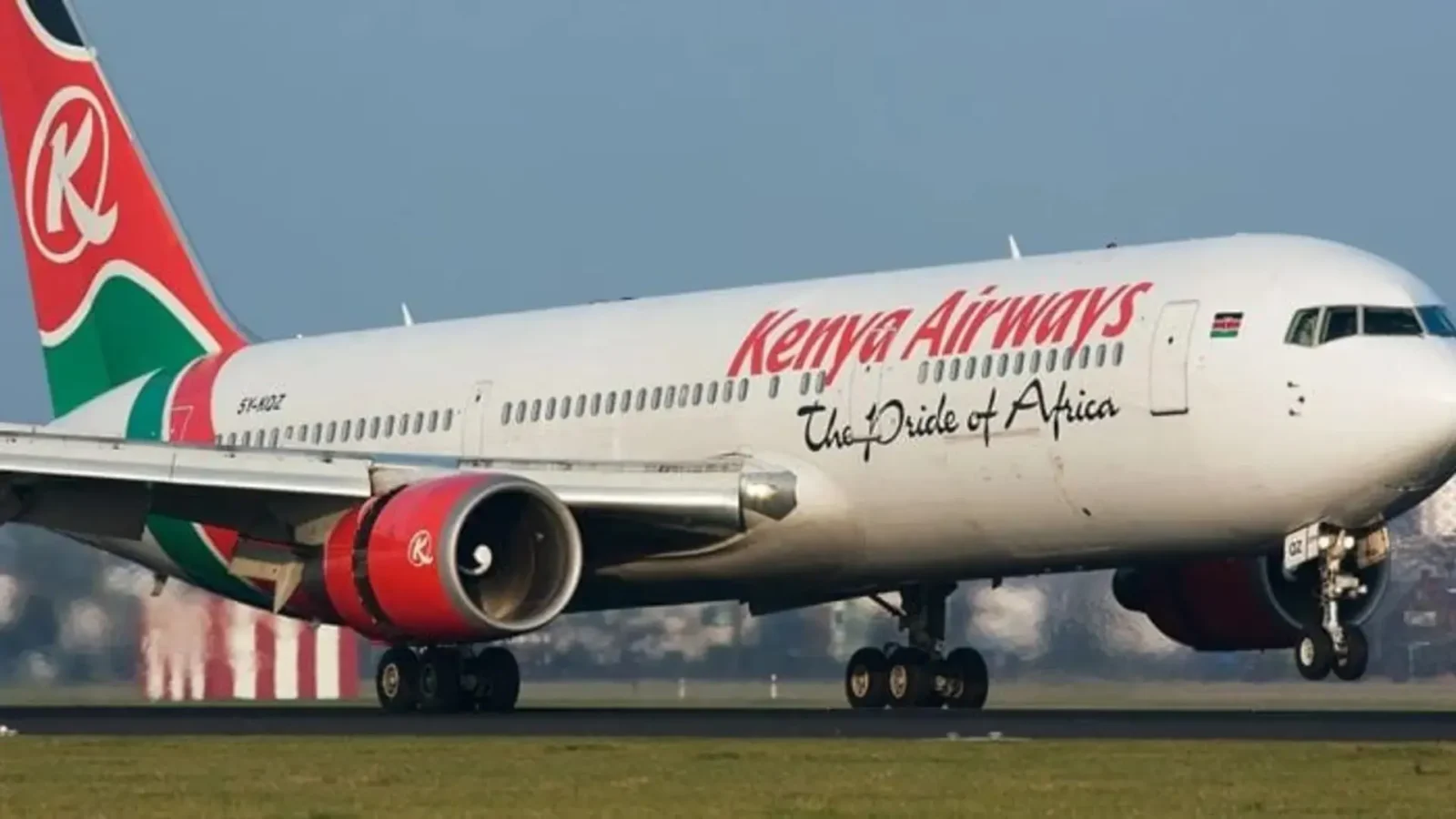
Kenya Airways (KQ) has become the Nairobi Securities Exchange’s top-gaining stock of 2026, with shares touching KSh 8.14 intraday on 14 April — a 131% gain from a January opening of KSh 3.53 and the highest level in 15 months. The rally has unfolded in 10 consecutive green sessions on surging volume, despite a KSh 17.2 billion FY2025 net loss, negative equity of KSh 132.1 billion, and the absence of a permanent CEO. What changed the stock’s trajectory was not the government’s $2 billion Expression of Interest — announced in February, but followed by drift — nor the Middle East-driven demand surge reported on 23 March. It was a regulatory filing showing Kiharu MP Ndindi Nyoro, a former stockbroker and one of Kenya’s most watched retail investors, had quietly bought 10.4 million KQ shares. Retail investors, chasing a replay of the Kenya Power trade that recently minted his reputation, have piled in. But the fundamentals tell a very different story.
Key Overview
- KQ shares hit KSh 8.14 intraday on 14 April, up 131% year-to-date; daily volumes rose from ~150,000 in late 2025 to above 2.5 million in April.
- Nyoro acquired 10,396,251 shares per February 2026 filings, ranking as KQ’s second-largest individual shareholder.
- KQ Lenders Company 2017 offloaded 104.4 million shares in the open market — their first trading since the 2017 debt restructuring.
- Treasury’s holding rose to 50.1% after ESOP was wound up, without buying more shares.
- Government seeking a strategic investor to inject $1.2bn–$2bn (KSh 154.8bn–KSh 258bn), with four parties in talks.
- New KCAA regulations effectively bar the kind of bailouts that delivered over KSh 105bn of state support since 2020.
Markets move fast; don’t get left behind. We’ve paired the Serrari Group Market Index with a curated Marketplace and a comprehensive Wealth Builder Platform to ensure you have the data—and the skills—to act on it.
Kenya Airways is the top-gaining stock on the Nairobi Securities Exchange this year, with shares touching KSh 8.14 intraday on 14 April — a 131% gain from the KSh 3.53 opening price in January and the highest level in 15 months. The rally has produced 10 consecutive green sessions heading into today’s trading, where the stock opened higher again, while daily volumes have surged from an average of roughly 150,000 shares in November and December 2025 to above 2.5 million in April, according to The Kenyan Wallstreet.
The airline just reported a KSh 17.2 billion net loss for FY2025, carries negative equity of KSh 132.1 billion, and operates without a permanent CEO. Despite this and other factors affecting the stock price, what seems to be driving the rally is two events: a regulatory filing and the increase in shares by a major shareholder.
The $2 billion deal and its limited initial punch
The government is seeking a strategic investor willing to inject up to KSh 258 billion ($2 billion), a sum that is roughly 5.6 times KQ’s current market capitalization of approximately KSh 46 billion. Treasury Cabinet Secretary John Mbadi in February announced that an international Expression of Interest (EoI) would be floated to tap a new strategic investor expected to inject between Sh154.8 billion ($1.2 billion) and Sh258 billion ($2 billion) — with the State ready to “sweeten the deal” by bundling additional assets alongside the airline. Acting CEO George Kamal has since confirmed talks with four parties.
Load factors have hit nearly 100% as the Middle East conflict reroutes passengers through Nairobi instead of disrupted Gulf hubs. According to Kamal, KQ’s seat occupancy jumped to 99% on some routes from an average of 70% at the start of the year, with most of the gains coming from Europe, the U.S. and Asia. Aviation analysts have noted that Jomo Kenyatta International Airport has recorded a surge in arrivals as transiting passengers reroute through Nairobi. On the back of the demand, the airline is adding frequencies to Amsterdam, Paris-CDG and London Gatwick, and has redeployed a larger Boeing 777-300ER on London Heathrow services.
A reconstituted board chaired by Kiprono Kittony — who is also chairman of the NSE — has been assembled to execute the deal. Economist David Ndii, chairperson of the President’s Council of Economic Advisors, is among three new non-executive directors appointed effective March 5. Kittony takes over from Michael Joseph, who retired last year after a decade at the helm.
Separately, new KCAA regulations published in early April effectively bar future government bailouts of the kind that have funneled over KSh 105 billion into KQ since 2020. Business Daily reports that, in a shift from the past, bailouts to any airline will now only be allowed if they support recovery from a natural disaster, promote an important national project, or correct a serious disturbance in the economy — bringing Kenya into compliance with global standards that restrict direct State aid to carriers. Although the KCAA has downplayed the constraints, saying the rules contain “clauses that do not make things more difficult for the government to decide if they want to bail out anybody,” the overall signal to markets is that private capital is now not just desirable but existential for the airline’s survival.
Why the stock didn’t move — until Nyoro’s filing surfaced
Yet the price action tells a different story about what actually moved the stock, and when. The $2 billion Expression of Interest was announced in February, and the stock traded sideways through most of March. The Middle East demand surge was reported on 23 March, the FY2025 results dropped on 24 March, and still the stock drifted lower, touching KSh 4.74 by 30 March, per data compiled by Bizna Kenya.
What changed was not another institutional development but a name on a regulatory filing: Kiharu MP Ndindi Nyoro, a former stockbroker turned politician and one of the most watched retail investors in the country, had quietly acquired 10.4 million KQ shares, becoming the second-largest individual shareholder and the seventh-largest shareholder overall. February 2026 filings first disclosed his purchase of 10,396,251 shares, valued at roughly KSh 49.2 million based on the then-prevailing price of KSh 4.74.
Around the same time, the KQ Lenders Company — the bank consortium that has held 38% of the airline since the 2017 debt restructuring — began selling shares in the open market for the first time, offloading 104.4 million shares and creating the liquidity that allowed new entrants to accumulate. KCB and Equity, two of the largest banks in the consortium, cut the vehicle’s holding from 38.09% to 37.2% in February. The airline confirmed the banks were “trading in the open market in the Nairobi Securities Exchange within pre-sanctioned (pre-approved) thresholds,” though it did not expound on what those thresholds are.
From the point the Nyoro filing became public, the stock went vertical and has not looked back. KQ shares closed at an average of KSh 6.44 per share on 8 April — a 36% gain in 10 days from the 30 March low. By 13 April the counter had traded as high as KSh 7.58, and on 14 April it touched KSh 8.14 intraday. Market data from African Markets pegs the stock’s 3-month return at roughly +148% and its year-to-date return at +130%.
Context is everything. While you follow today’s updates, use the Serrari Group Market Index and Marketplace to spot emerging shifts. Need to sharpen your edge? Our Wealth Builder Platform turns these insights into a professional-grade strategy.
The Kenya Power playbook — and why retail is racing to replicate it
What the market is reacting to is not Nyoro’s 10.4 million shares in isolation but what they represent: a replay of the Kenya Power trade that made his recent NSE reputation. Nyoro accumulated KPLC stock at an average of KSh 1.89 over four years, and the shares were recently trading around KSh 16.80, a return that every retail investor on the NSE watched unfold in real time. He ranks as the top individual investor in Kenya Power, holding a 1.3% stake — 24.1 million shares — valued at about Sh226.7 million based on prevailing prices.
When his name surfaced on the KQ register ahead of a $2 billion investor deal, the inference for retail was immediate and powerful: he positioned before Kenya Power’s turnaround and it worked spectacularly, now he is positioning before Kenya Airways’ transformation.
Retail followed in force. Thika Town MP Alice Ng’ang’a added 2.3 million shares — worth about Sh11 million at the time of filing — while several new block holders accumulated tens of millions more. The Kenya Times lists the new entrants, including Suods Logistics with 21 million shares, Danmill Enterprises with 14.5 million, and Primelane Properties with 8.3 million. Suods Logistics and Danmill Enterprises, notably, had previously bought a stake in the State-owned Development Bank of Kenya from the insolvent investment firm TransCentury. Ng’ang’a herself had previously acquired 13.6 million shares in Kenya Re, tracking Nyoro’s style of positioning in state-exposed counters.
The volume profile confirms the character of the buying: sustained daily turnover of 2 to 4 million shares represents thousands of small orders chasing a signal rather than institutional blocks. This is a retail-driven melt-up anchored to an inferred roadmap, not an institutional re-rating based on disclosed fundamentals.
Treasury sneaks to 50.1% control as ESOP winds up
While the Nyoro filings captured the retail imagination, a quieter but arguably more consequential ownership shift was unfolding in the background. Regulatory filings for February 2026 show that the government’s stake in KQ jumped to 50.1% from the previous 48.89% — without the Treasury buying a single additional share. The rise was driven by the winding up of the airline’s Employee Share Ownership Scheme (ESOP), which had held 142.1 million shares equivalent to a 2.44% stake.
The ESOP’s exit reduced the volume of the airline’s issued shares to 5.68 billion from 5.82 billion, lifting the proportional ownership of the Treasury and of every other investor who did not trade their holdings. The airline subsequently issued a public clarification in April pushing back on media reports that characterised this as deliberate accumulation, insisting that “any significant change in shareholding is governed by the Shareholders Agreement and will be approved at a General Meeting of the shareholders.”
How KQ differs from Kenya Power
Kenya Power, however, had positive equity, regulated revenues, and was generating operating profit when Nyoro built his position, giving the trade a fundamental floor even if sentiment turned.
Kenya Airways occupies a fundamentally different position. The airline has recorded only one profitable year in the past thirteen. The shilling’s 20%-plus appreciation against the dollar in 2024 generated forex windfalls that did not recur, while negative equity has deepened for eight consecutive years to KSh 132.1 billion. KQ’s total income in FY2025 fell to KSh 161.5 billion from KSh 188.5 billion, while passenger numbers declined 13% to 4.55 million and cargo volumes dropped from 70,776 to 64,780 tonnes.
The root cause of the FY2025 reversal was structural rather than demand-driven. CFO Mary Mwenga has said the airline “had a number of fleet grounded in 2025, especially our wide-body aircraft, and these are the money makers in the industry.” Dawan Africa reports that the grounding of three Boeing 787-8 Dreamliners cut operating capacity by roughly 20%, forcing KQ to scale back flights, reduce frequencies and limit expansion into high-demand markets — even as passenger appetite remained strong. Fleet ownership costs rose 33% on remeasurement of leased assets and the addition of Boeing 737-800s, per Khusoko’s financial breakdown.
The airline’s vulnerability has been compounded by local environmental factors. NewsTrendsKE reports that bird strikes at JKIA have, over seven years, cost the airline at least eight engines on the ground, with two damaged beyond economic repair. Kamal has publicly flagged an operating environment “marked by elevated input costs, particularly fuel and labour, and ongoing geopolitical uncertainty,” with closed airspaces in the Middle East forcing longer routings and higher fuel burn.
The broader African aviation backdrop is hardly encouraging. Industry forecasts Kenya Airways has cited suggest Africa’s airlines are expected to earn just about $1.30 in net profit per passenger in 2026, compared with nearly $10 in Europe and North America and close to $29 in the Middle East.
The deal risk sitting under the rally
The entire bull case rests on a deal that has not been signed, with investors who have not been named, for an airline that has just lost the implicit government backstop through new KCAA competition regulations. Industry reporting indicates that KQ has been the subject of fierce competition between Temasek Holdings — Singapore’s sovereign wealth fund — and Qatar Airways. Kenya Insights notes that Temasek is reported to have proposed acquiring a 90% stake through fresh capital injections (though it has publicly denied the reports), while Qatar Airways is said to be pursuing a comprehensive management agreement that could include operational control of JKIA alongside its investment in the airline.
The IMF has also put a thumb on the scale: Kenya Insights notes that the Fund made finding a strategic investor for Kenya Airways a condition of its lending programme with Nairobi, and “the government’s failure to secure a partner has left this IMF conditionality unmet, adding urgency to the current effort.”
Whether the underlying asset can support the valuation that momentum has created depends entirely on the strategic investor deal closing. If it does, the early movers are vindicated and the Nyoro playbook adds another chapter. If it stalls, the exit door on a stock carrying negative equity of KSh 132.1 billion and no signed deal will prove narrow — the sort of reverse that tends to punish the last retail investors through the door far more than the institutions and politicians who got in early.
For now, the trade is working. The KQ Lenders Company is still trickling shares into a market hungry to absorb them; the Treasury has technically crossed the 50.1% mark without spending a shilling; and Nyoro’s 10.4 million shares, bought at an average near KSh 4.74, are sitting on a gain of roughly 70% in six weeks. Whether that turns into a Kenya Power-style four-year compounding story — or into a cautionary tale about retail momentum trades in fundamentally distressed names — is a question that only the signatures on a strategic investor deal can ultimately answer.
Your financial future isn’t something you wait for—it’s something you build.
The real question is: when do you begin?
Move beyond simply staying informed.
Navigate the markets with clarity—track trends through the Serrari Group Market Index, uncover opportunities in the Serrari Marketplace, and build practical knowledge with our Curated Wealth Builder Platform.
Stay connected to what truly matters.
Get daily insights on macro trends and financial movements across Kenya, Africa, and global markets—delivered through the Serrari Newsletter.
Growth opens doors.
Advance your career through professional programs including ACCA, HESI A2, ATI TEAS 7 , HESI EXIT , NCLEX – RN and NCLEX – PN, Financial Literacy!🌟—designed to move you forward with confidence.
See where money is flowing—clearly and in real time.
Track Money Market Funds, Treasury Bills, Treasury Bonds, Green Bonds, and Fixed Deposits, alongside global and African indexes, key economic indicators, and the evolving Crypto and stablecoin landscape—all within Serrari’s Market Index.