




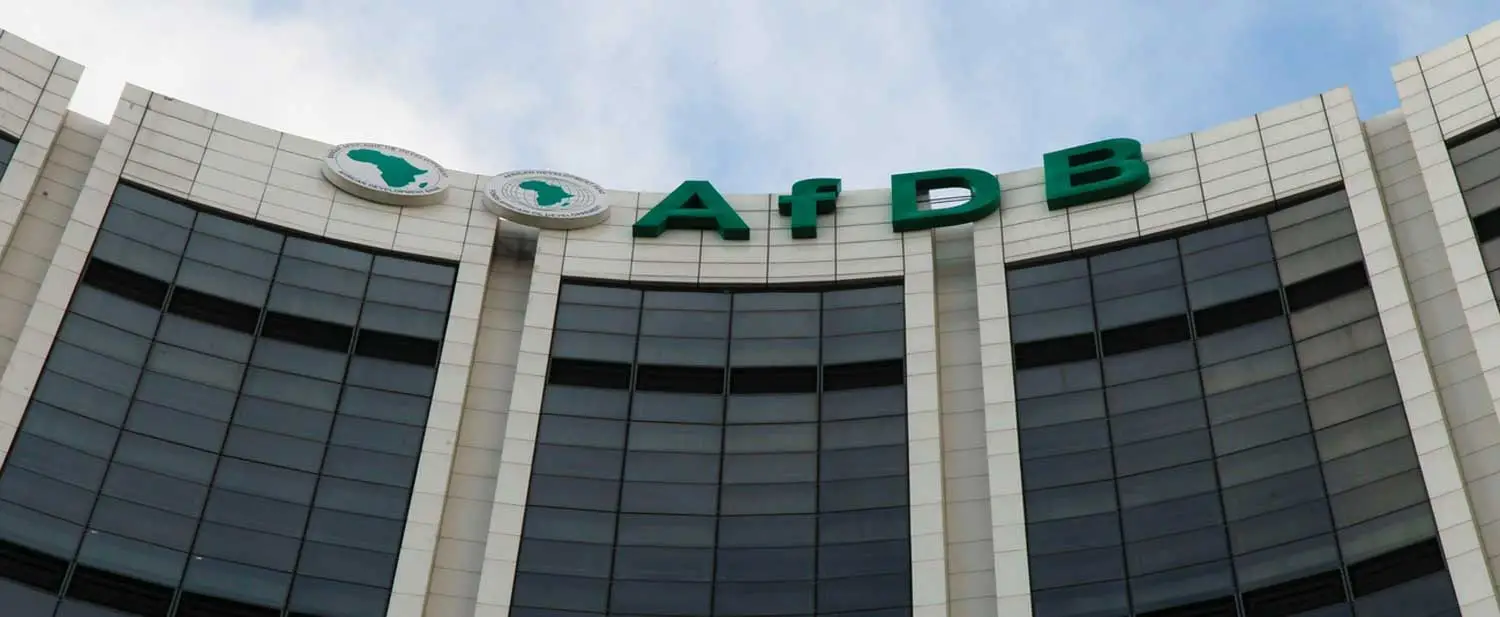
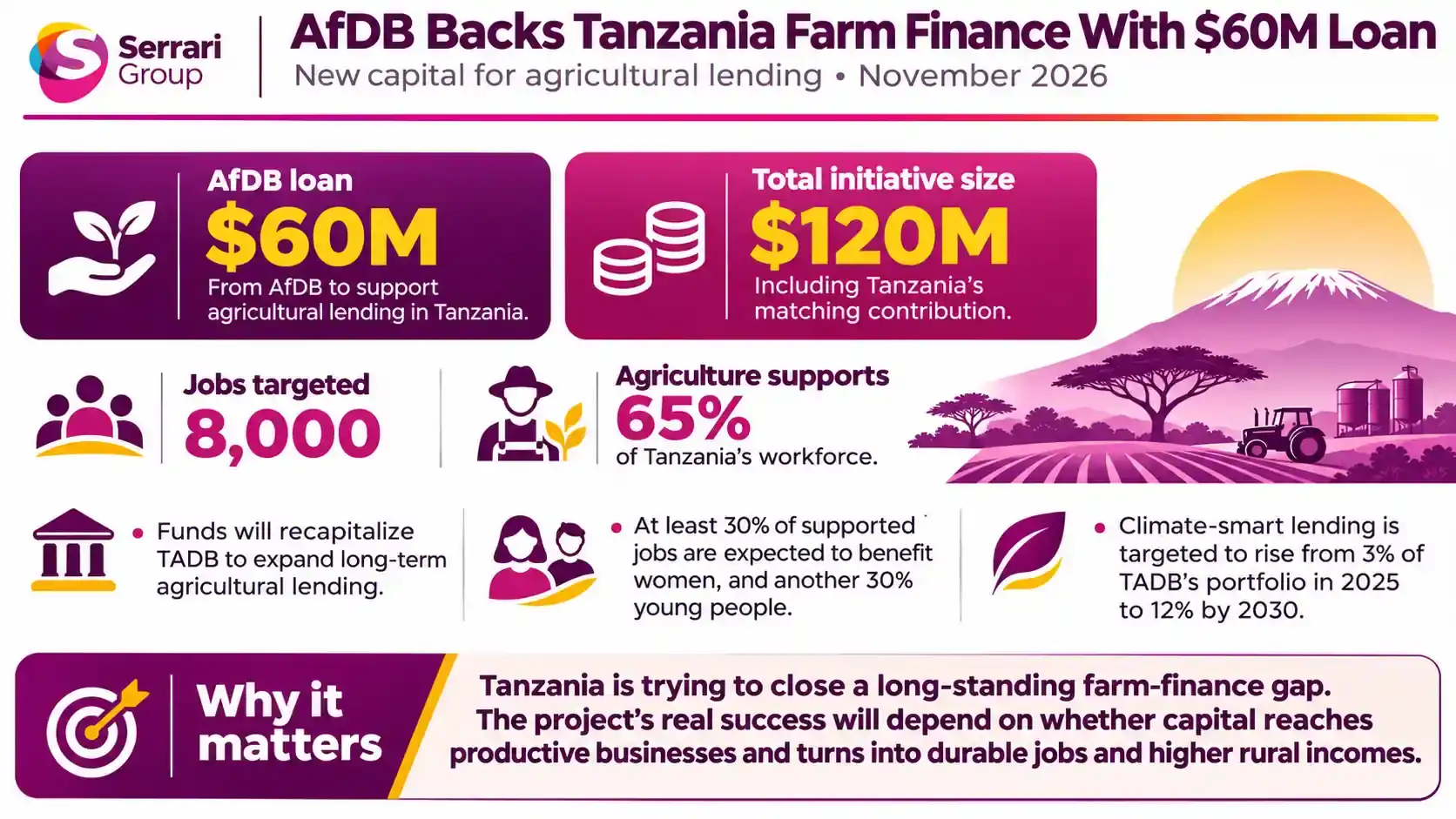
The African Development Bank Group has approved a $60 million sovereign loan to Tanzania to strengthen the Tanzania Agricultural Development Bank (TADB), as part of a $120 million recapitalization initiative designed to expand long-term farm and agribusiness financing. Approved on October 21 and announced on November 4, 2026, the third phase of the TADB Equity Enhancement Project is expected to support the creation of 8,000 jobs, with a strong focus on women, young entrepreneurs and climate-resilient production.
The decision addresses a structural contradiction: agriculture supports a large share of Tanzania’s population and roughly a quarter of economic output, yet farmers and agribusinesses have historically struggled to secure appropriately priced, long-term credit. The government plans to match the development bank’s financing with $60 million through capitalization of eligible retained earnings. The central question is whether stronger bank capital will translate into lending that reaches commercially viable businesses historically excluded by conventional credit rules—and ultimately raises productivity, incomes and food security.
Key Overview
- $120 million initiative: A $60 million development-bank loan to Tanzania will be invested as equity in TADB, alongside a planned $60 million government contribution through eligible retained earnings.
- 8,000 jobs targeted: The employment figure is a project expectation, not jobs already created; at least 30% of supported jobs are intended to benefit women and another 30% young people.
- Agricultural credit bottleneck: Farm businesses face collateral constraints, seasonal cash flows, climatic risks and loan maturities that often do not match investment cycles.
- More channels for finance: TADB plans to expand direct lending, wholesale funding and co-financing through other financial institutions.
- Climate-smart target: Climate-smart agriculture loans are expected to rise from 3% of TADB’s portfolio in 2025 to 12% by 2030.
- Delivery test: Successful recapitalization must be measured through actual disbursements, borrower reach, repayment performance, productive investment and jobs sustained or created.
Why Tanzania Needs More Than Another Agricultural Loan
Tanzania’s problem is not a lack of agricultural activity. It is a mismatch between the sector’s economic importance and the financing available to transform it. Farming supports millions of households, but much production remains dependent on rainfall, limited mechanization and weak storage and processing capacity. Without capital, producers struggle to move from low-margin crop sales into higher-value activities such as irrigation, cold storage and agro-processing.
The project’s official development rationale identifies chronic underinvestment and a shortage of affordable long-term funding as barriers to agricultural transformation. A farmer borrowing for seasonal seed purchases may need credit for months; a processor investing in equipment or a cooperative constructing a warehouse may need several years before the investment pays for itself. Short bank loan maturities can therefore make productive projects financially impractical, even when long-term demand exists.
Commercial lenders face genuine risks. Harvests depend on weather, commodity prices fluctuate, land documentation and collateral can be difficult to assess, and businesses may lack reliable financial records. Banks compensate through higher interest rates, short maturities or a refusal to lend. The result is a feedback loop: without investment, farmers remain less productive; with unstable earnings and limited collateral, they remain unattractive to lenders.
The headline statistics also need careful interpretation. The announcement describes agriculture as employing approximately 65% of workers and receiving around 12% of private-sector credit. Other datasets use narrower employment definitions and more recent credit periods. In particular, a 2026 assessment of Tanzania’s employment challenges emphasizes that the deeper problem is low-quality, low-productivity work, not simply the number of people employed. The financing imbalance is real, but a single percentage cannot tell the full story.
How the $120 Million Capital Structure Is Supposed to Work
The transaction is not a $60 million grant handed directly to farmers. Under the approved arrangement, the African Development Bank lends $60 million to the United Republic of Tanzania. Through the Ministry of Finance and the Office of the Treasury Registrar, that funding is intended to be invested as equity in TADB. Tanzania’s planned matching $60 million comes from capitalization of eligible retained earnings, not necessarily a fresh $60 million cash transfer to the bank.
That structure matters because bank equity supports the institution’s capacity to bear risk and expand lending. Instead of a one-off distribution to a small group of recipients, stronger capital can enable TADB to originate loans over time, subject to prudential requirements and the quality of its portfolio. The bank can then finance eligible agricultural businesses directly or work through partner lenders and co-financing arrangements that already have relationships with rural borrowers.
TADB’s stated institutional mandate includes acting as a catalyst for agricultural finance, supporting value chains and improving financial inclusion. Its model recognizes that financing a processor, cooperative or storage provider can support many farmers indirectly by creating a stronger market for their output. The value of recapitalization therefore depends on the loans it enables and the private financing it attracts, not simply the initial amount recorded as bank equity.
There is also a public-finance distinction. Tanzania remains responsible for its sovereign borrowing obligations under the development-bank loan. The government’s equity investment may strengthen a strategic institution, but the economic return must justify the associated financing exposure. Strong underwriting, governance and transparency are consequently essential to ensure development objectives do not become an excuse for weak credit decisions.
Why the 8,000 Jobs Target Depends on Productivity
The project aims to support 8,000 jobs, but approval does not mean those positions already exist. Employment could arise directly through farm businesses, processing facilities, irrigation services and distribution, or indirectly through increased purchases and activity along agricultural value chains. The eventual number will depend on which borrowers receive financing, how projects perform and whether enterprises expand rather than merely replace existing activity.
The more consequential measure is job quality. A recent assessment of Tanzania’s labor market found that many people work but do not earn adequate incomes, often because they are trapped in low-productivity agriculture or informal activities. Financing that raises output per worker, improves processing or connects producers to dependable markets may therefore matter more than job counts alone.
Consider a cooperative that finances a grain warehouse. Construction may generate temporary employment, but the enduring benefit could be lower post-harvest losses, more reliable deliveries and improved bargaining power for member farmers. Likewise, a food processor with appropriately structured credit might increase purchases from smallholders and employ additional technicians. Both pathways create wider value, but neither is automatic.
TADB’s previous lending disclosures describe financing through direct loans, partner financial institutions, co-financing and guarantee arrangements, illustrating the potential channels for this broader effect. To judge Phase III credibly, project reporting should distinguish temporary from permanent positions, direct from indirect jobs and new jobs from existing livelihoods supported.
Context is everything. Stay ahead of shifting trends with today’s market updates, and uncover emerging opportunities using the Serrari Group Market Index and Marketplace. Then, take control of your own financial future by exploring our Money & Life Reset Transformation Blueprint ™ to build stronger habits, create better systems, and design a path toward lasting wealth.
Women and Young Entrepreneurs Face More Than a Capital Shortage
The initiative assigns explicit inclusion targets. At least 30% of supported jobs are expected to benefit women and another 30% young people. By 2030, TADB aims to increase the share of financing for women-owned enterprises to 30% of its portfolio and youth-led businesses to 20%. These are separate measures: employment benefits and the allocation of lending cannot be treated as interchangeable, and women and young people can belong to overlapping groups.
The obstacles faced by these borrowers extend beyond bank liquidity. Women may have weaker legal or practical control over assets offered as collateral, while young entrepreneurs often lack long operating histories and audited accounts. Even a well-capitalized bank will struggle to reach them if lending standards and customer outreach remain unchanged.
A 2026 evaluation of agricultural credit guarantees provides a useful lesson: a $20 million guarantee initiative implemented with agricultural finance partners helped facilitate more than 21,000 loans worth about $68.8 million over its period of operation. Such arrangements can encourage lenders to serve borrowers they would otherwise consider too risky, although outcomes from a separate program cannot be assumed for TADB’s new phase.
For the inclusion targets to be credible, financial products may need flexible repayment dates linked to harvest cycles, greater use of cash-flow assessments, guarantees and practical business support. Reporting should also show the value and performance of loans to women- and youth-led firms, rather than counting beneficiaries alone.
Climate-Smart Lending Is a Food Security Strategy
A central objective is to raise climate-smart agricultural loans from 3% of TADB’s portfolio in 2025 to 12% by 2030. Eligible activities are expected to include efficient irrigation, renewable energy, better storage and equipment or methods that reduce crop losses. These investments matter because climate exposure and weak infrastructure undermine both farm productivity and borrowers’ ability to repay loans.
The latest Tanzania economic assessment calls for increased agricultural investment and better connections to inputs and markets. Financing for irrigation can reduce dependence on unpredictable rainfall, while cold storage can extend the selling period for perishable produce. Solar-powered equipment may lower exposure to energy costs in suitable settings. Each investment has a different risk profile, so climate-smart lending requires careful assessment rather than a broad label.
The commercial logic is particularly important. Reducing crop losses or securing more reliable production can increase farmers’ incomes and stabilize the cash flows used to repay loans. In this sense, adaptation finance can be a form of credit-risk management as well as an environmental investment. However, equipment maintenance, water availability and access to profitable markets remain necessary for the intended gains to materialize.
Is $120 Million Enough to Close the Financing Gap?
No single recapitalization can eliminate Tanzania’s agricultural financing shortfall. The announcement cites an annual gap of roughly $1.5 billion, while broader agricultural finance research has estimated substantially larger unmet demand under a different methodology. These figures should not be compared as though they measure precisely the same funding needs. Both nevertheless point to a problem too large for one development-finance transaction to solve.
The stronger argument for the project is catalytic. TADB may be able to use its capital base and partnerships to improve the terms and availability of lending, encourage commercial banks to enter neglected agricultural markets and demonstrate that carefully structured loans can perform. That potential makes the project’s design more significant than its headline size.
There are risks. Rapid lending growth without sound appraisal can create non-performing loans, eroding the capital intended to expand finance. Political pressure to lend to favored projects could weaken outcomes. Borrowers may also face losses from drought, floods or commodity-price declines, even when projects were initially viable. Independent oversight, portfolio transparency and credit-risk discipline will determine how sustainable the expansion becomes.
The Bigger Picture: From Subsistence Farming to Bankable Agribusiness
The new financing is part of a longer effort to shift Tanzanian agriculture toward higher productivity, stronger supply chains and more resilient rural incomes. It follows earlier phases of support to TADB and aligns with the country’s Development Vision 2050. The challenge is to build a financial system that understands agricultural business cycles while demanding the same commercial discipline needed for sustainable lending.
For farmers, success would mean practical access to appropriately structured capital, not merely a larger balance sheet at a state-owned bank. For agribusinesses, it could mean investment in equipment, storage and processing that allows them to purchase more from producers and serve more customers. For households, stronger food supply chains could improve income stability and reduce avoidable losses, although food prices will continue to depend on weather, logistics and market conditions.
Why this matters now is that Tanzania needs better-paying rural economic opportunities, not simply more agricultural activity. The $60 million development-bank loan, combined with the planned matching capitalization, offers an institutional route to expand credit and share risk across the financial system. Its success should ultimately be judged by realized lending, stronger businesses, genuinely additional jobs, inclusion of underserved entrepreneurs and improved agricultural resilience—not by the approval announcement itself.
Sources: African Development Bank Group / Tanzania Agricultural Development Bank / World Bank / International Labour Organization / TechnoServe
Your financial future isn’t something you wait for—it’s something you build.
The real question is: when do you begin?
Move beyond simply staying informed.
Navigate the markets with clarity—track trends through the Serrari Group Market Index, uncover opportunities in the Serrari Marketplace, and build practical knowledge with our Curated Wealth Builder Platform.
Stay connected to what truly matters.
Get daily insights on macro trends and financial movements across Kenya, Africa, and global markets—delivered through the Serrari Newsletter.
Growth opens doors.
Advance your career through professional programs including ACCA, HESI A2, ATI TEAS 7 , HESI EXIT , NCLEX – RN and NCLEX – PN, Financial Literacy!🌟—designed to move you forward with confidence.
See where money is flowing—clearly and in real time.
Track Money Market Funds, Treasury Bills, Treasury Bonds, Green Bonds, and Fixed Deposits, alongside global and African indexes, key economic indicators, and the evolving Crypto and stablecoin landscape—all within Serrari’s Market Index.