Ghana is seeking an estimated $10.8 billion in investment under its updated Renewable Energy Master Plan for 2026–2030, covering large-scale electricity generation, rural electrification and cleaner household cooking. The updated national roadmap targets hundreds of megawatts of solar and wind installations while projecting more than 353,000 jobs if its planned projects are implemented.
Key Overview
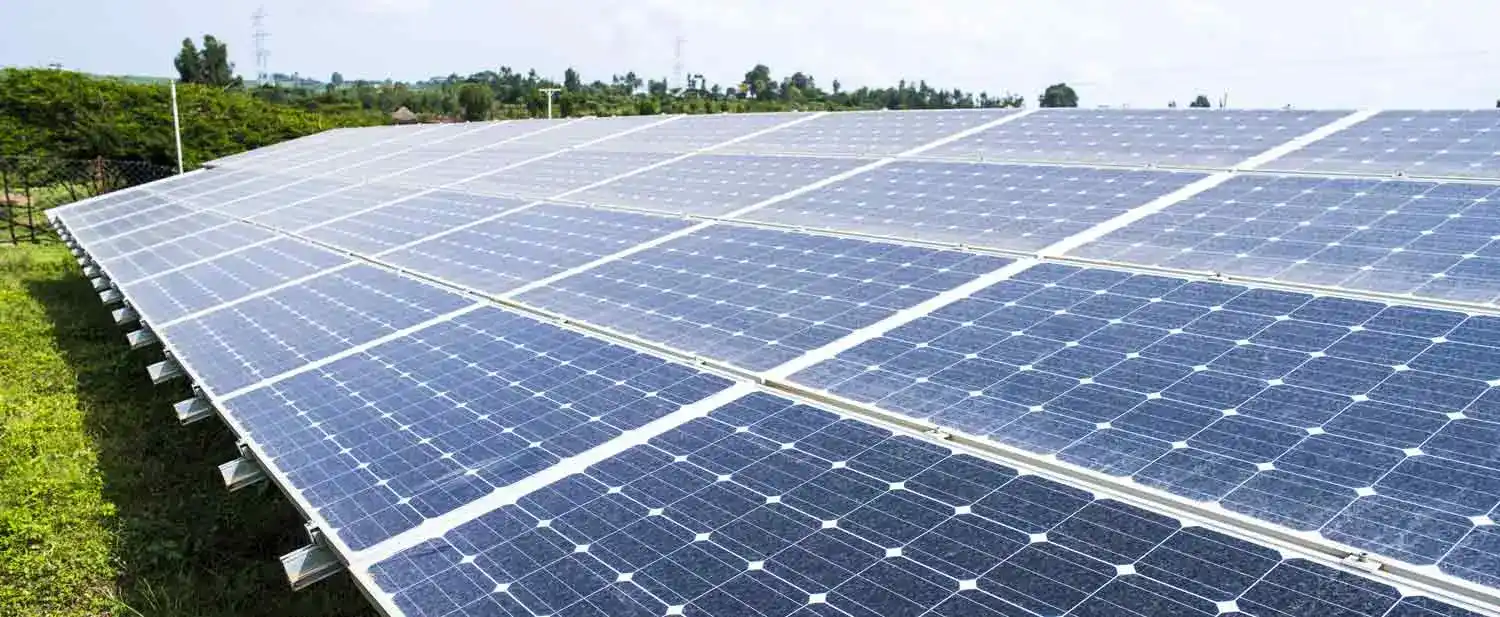
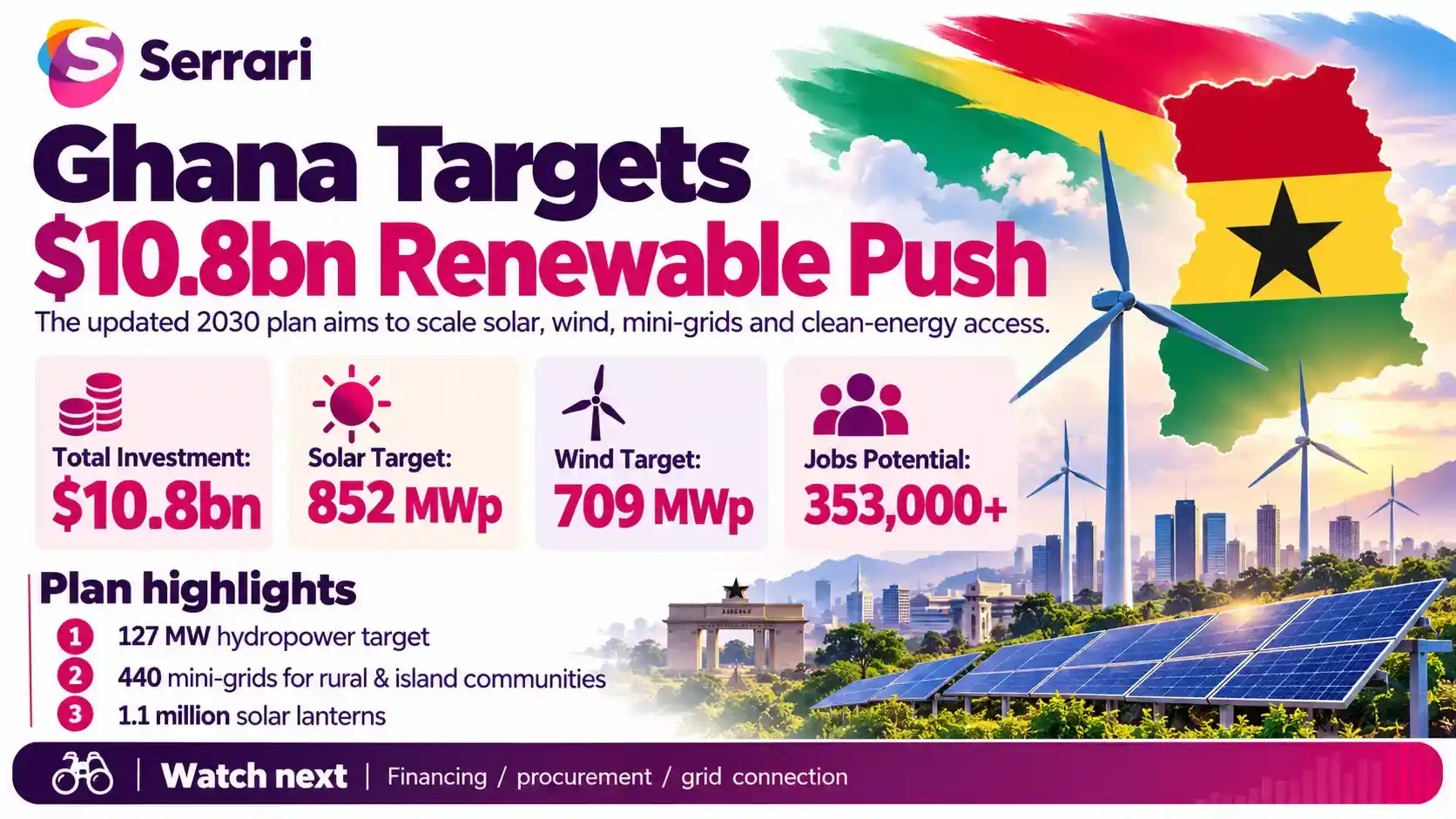
- Ghana targets 852 megawatt-peak (MWp) of utility-scale solar and 709 MWp of wind capacity by 2030.
- Indicative investment needs include $631 million for solar and $999 million for wind, within a broader $10.8 billion programme.
- Additional targets cover 127 MWp of hydropower, 440 rural and island mini-grids, and 1.1 million solar lanterns.
- The programme projects more than 353,000 potential jobs, rather than confirmed employment already created.
- Financing, procurement, grid connections and effective monitoring will determine how much of the plan becomes operational.
Solar and Wind Lead Ghana’s Energy Investment Pipeline
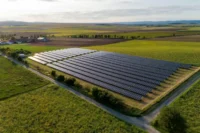
The 2026–2030 master plan, developed by Ghana’s Ministry of Energy and Green Transition with development support, sets out capacity and access targets intended to diversify the electricity supply. Its utility-scale solar and wind ambitions account for about 1,561 MWp of targeted capacity combined, although actual electricity output will depend on operating conditions and project completion.
According to the reported investment breakdown, solar generation would require approximately $631 million, while wind development would need about $999 million. The entire programme is estimated at $10.8 billion, compared with a $5.6 billion investment envelope associated with the earlier 2019 plan.
That total is a projected funding requirement, not proof that the money has already been secured or spent. Mobilising it will require viable projects and financing arrangements that match the different risks of power plants, distribution infrastructure and household energy products.
Context is everything. Stay ahead of shifting trends with today’s market updates, and uncover emerging opportunities using the Serrari Group Market Index and Marketplace. Then, take control of your own financial future by exploring our Money & Life Reset Transformation Blueprint ™ to build stronger habits, create better systems, and design a path toward lasting wealth.
Rural Mini-Grids and Clean Cooking Expand the Scope
Beyond large power stations, the 2030 energy targets include 440 mini-grids for communities that are difficult to connect to the main network. Ghana also plans wider distribution of solar lanterns, along with growth in biofuels and improved cooking technologies.
These measures address energy access as well as electricity generation. Rural systems can help power homes and small enterprises, while improved cookstoves may reduce reliance on inefficient or polluting cooking methods. The plan also emphasises local manufacturing and participation by women, young people and people with disabilities.
Ghana’s reported electricity access rate increased from 85% in 2019 to 89.5% by December 2024, providing a baseline against which future access improvements can be assessed.
Funding and Project Delivery Remain Major Tests
Execution could be more difficult than setting targets. An industry assessment of the updated plan points to shortcomings in coordination, monitoring and reporting during the previous planning cycle. These issues matter because projects need permits, credible procurement, financing and connections before they can deliver electricity.
Large-scale projects and remote mini-grids also require different financing approaches. Utility developments depend heavily on grid access and bankable electricity sales, while smaller off-grid systems must balance installation costs against customers’ ability to pay.
Regional Opportunity Extends Beyond Ghana
Ghana’s approach contrasts with Nigeria’s recently launched $300 million distributed renewable energy fund, which focuses on scaling decentralised electricity access. Together, the initiatives point to opportunities for solar developers, storage providers, engineering contractors and hybrid-power suppliers across West Africa.
Yet the strongest indicator of progress will not be the headline investment target. It will be the volume of projects financed, built and connected before the 2030 deadline, alongside measurable gains in reliable electricity access and employment.
Sources: United Nations Development Programme / TradeArabia / Africa Newsroom / Nigeria Sovereign Investment Authority
Your financial future isn’t something you wait for—it’s something you build.
The real question is: when do you begin?
Move beyond simply staying informed.
Navigate the markets with clarity—track trends through the Serrari Group Market Index, uncover opportunities in the Serrari Marketplace, and build practical knowledge with our Curated Wealth Builder Platform.
Stay connected to what truly matters.
Get daily insights on macro trends and financial movements across Kenya, Africa, and global markets—delivered through the Serrari Newsletter.
Growth opens doors.
Advance your career through professional programs including ACCA, HESI A2, ATI TEAS 7 , HESI EXIT , NCLEX – RN and NCLEX – PN, Financial Literacy!🌟—designed to move you forward with confidence.
See where money is flowing—clearly and in real time.
Track Money Market Funds, Treasury Bills, Treasury Bonds, Green Bonds, and Fixed Deposits, alongside global and African indexes, key economic indicators, and the evolving Crypto and stablecoin landscape—all within Serrari’s Market Index.