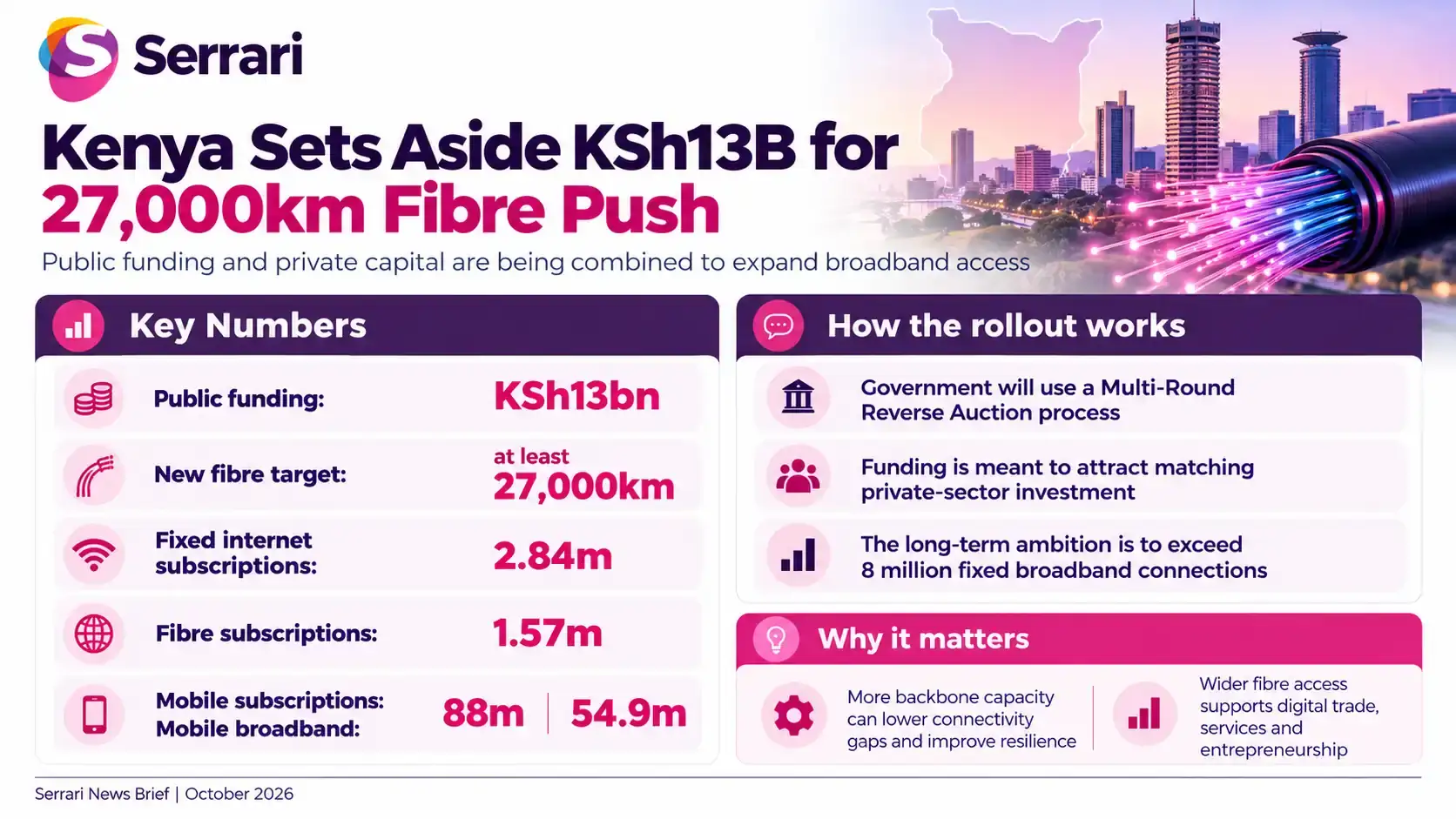
Kenya has announced KSh13 billion in public funding to help deliver at least 27,000 kilometres of additional fibre-optic infrastructure, aiming to expand reliable internet access across the country and strengthen links with neighbouring markets. The investment, unveiled on October 13, 2026, will seek matching private-sector capital under the Kenya Digital Economy Acceleration Project (KDEAP), rather than relying entirely on government construction spending.
The funding announcement made in Nairobi comes as demand for fixed broadband rises, but many homes, businesses and public institutions remain beyond affordable high-speed connections.
Key Overview
- KSh13 billion in government funding is intended to attract matching private investment.
- The expansion targets at least 27,000km of new backbone, middle-mile and cross-border fibre links.
- Kenya had 2.84 million fixed internet subscriptions in June 2026, up 32.4% year on year.
- Fibre-optic subscriptions reached 1.57 million, growing 29.7% annually.
- The government’s longer-term ambition is to exceed eight million fixed broadband connections, not to connect that many households immediately.
How the KSh13 Billion Fibre Investment Will Work
ICT Principal Secretary John Kipchumba Tanui announced the initiative during a pre-bid meeting attended by internet service providers, telecommunications operators, financiers and development partners. The planned infrastructure covers major national routes, regional distribution connections and links across Kenya’s borders.
The government will use a Multi-Round Reverse Auction (MRRA) approach to allocate support competitively. Under the investment-matching and auction framework, participating operators compete to deliver connectivity while limiting the public subsidy required. The approach is designed to mobilise private money and make public funding stretch further.
The official procurement notice divides the work into national backbone links and cross-border or metropolitan links, with a bid deadline of October 29, 2026. The 27,000km figure is a delivery target, not infrastructure already completed.
Broadband Subscriptions Are Growing, but Gaps Remain
Kenya’s April–June 2026 communications statistics recorded 88 million mobile SIM subscriptions, 54.9 million mobile broadband subscriptions and 54 million mobile money subscriptions. These are subscription counts rather than numbers of unique people, since an individual can use multiple SIM cards or services.
Fixed internet subscriptions stood at 2,838,656, compared with 2,144,713 a year earlier. Of those, 1,566,815 were fibre connections, an annual increase of 29.7%. The figures show strong adoption, while also underscoring the distance between today’s market and the target of more than eight million fixed broadband connections.
The new network aims to improve the underlying routes that internet providers use. However, more national fibre will not automatically mean every household gets connected: local distribution infrastructure, installation costs and consumer affordability will still matter.
Context is everything. Stay ahead of shifting trends with today’s market updates, and uncover emerging opportunities using the Serrari Group Market Index and Marketplace. Then, take control of your own financial future by exploring our Money & Life Reset Transformation Blueprint ™ to build stronger habits, create better systems, and design a path toward lasting wealth.
Cross-Border Infrastructure Could Support Digital Trade
Kenya reported approximately 28.95 terabits per second of available international internet bandwidth in June 2026, supported by submarine cables and cross-border links. Available capacity should not be confused with bandwidth actually being used, which was approximately 19.43Tbps over the same period.
Stronger backbone and cross-border connections could improve network resilience and support data-intensive services such as cloud computing, outsourcing and digital trade. Tanui said private operators had added 24,000km of fibre since 2022, while the public sector added 17,000km over that period, according to details of the expansion plan.
How the Programme Fits Kenya’s Digital Economy Goals
The broader digital acceleration programme received approval for $390 million in initial World Bank financing in 2023 and was designed to expand broadband, improve digital public services and strengthen digital skills. That programme financing is distinct from the newly announced KSh13 billion fibre commitment.
If completed and supported by affordable last-mile connections, the planned routes could make it easier for schools, public institutions, entrepreneurs and underserved communities to access online learning, government services and wider markets. The practical test will be how much additional infrastructure is built, how quickly providers connect users and whether prices improve.
Sources: People Daily / ICT Authority / Kenya Public Procurement Information Portal / Communications Authority of Kenya / TechAfrica News / World Bank
Your financial future isn’t something you wait for—it’s something you build.
The real question is: when do you begin?
Move beyond simply staying informed.
Navigate the markets with clarity—track trends through the Serrari Group Market Index, uncover opportunities in the Serrari Marketplace, and build practical knowledge with our Curated Wealth Builder Platform.
Stay connected to what truly matters.
Get daily insights on macro trends and financial movements across Kenya, Africa, and global markets—delivered through the Serrari Newsletter.
Growth opens doors.
Advance your career through professional programs including ACCA, HESI A2, ATI TEAS 7 , HESI EXIT , NCLEX – RN and NCLEX – PN, Financial Literacy!🌟—designed to move you forward with confidence.
See where money is flowing—clearly and in real time.
Track Money Market Funds, Treasury Bills, Treasury Bonds, Green Bonds, and Fixed Deposits, alongside global and African indexes, key economic indicators, and the evolving Crypto and stablecoin landscape—all within Serrari’s Market Index.