Nigeria’s National Information Technology Development Agency (NITDA), in partnership with Tech Revolution Africa, is targeting a ₦3 billion investment and pilot contract pipeline through the 2026 DNICE Builders Festival, an initiative designed to connect technology startups with investors and institutions seeking practical digital solutions.
The October 8, 2026 announcement outlines a structured approach to startup financing, linking entrepreneurs with venture capital firms, angel investors, financial institutions and public-sector organisations.
Unlike conventional startup pitching competitions, the programme focuses on identifying existing institutional challenges and matching them with Nigerian technology companies that have developed relevant products.
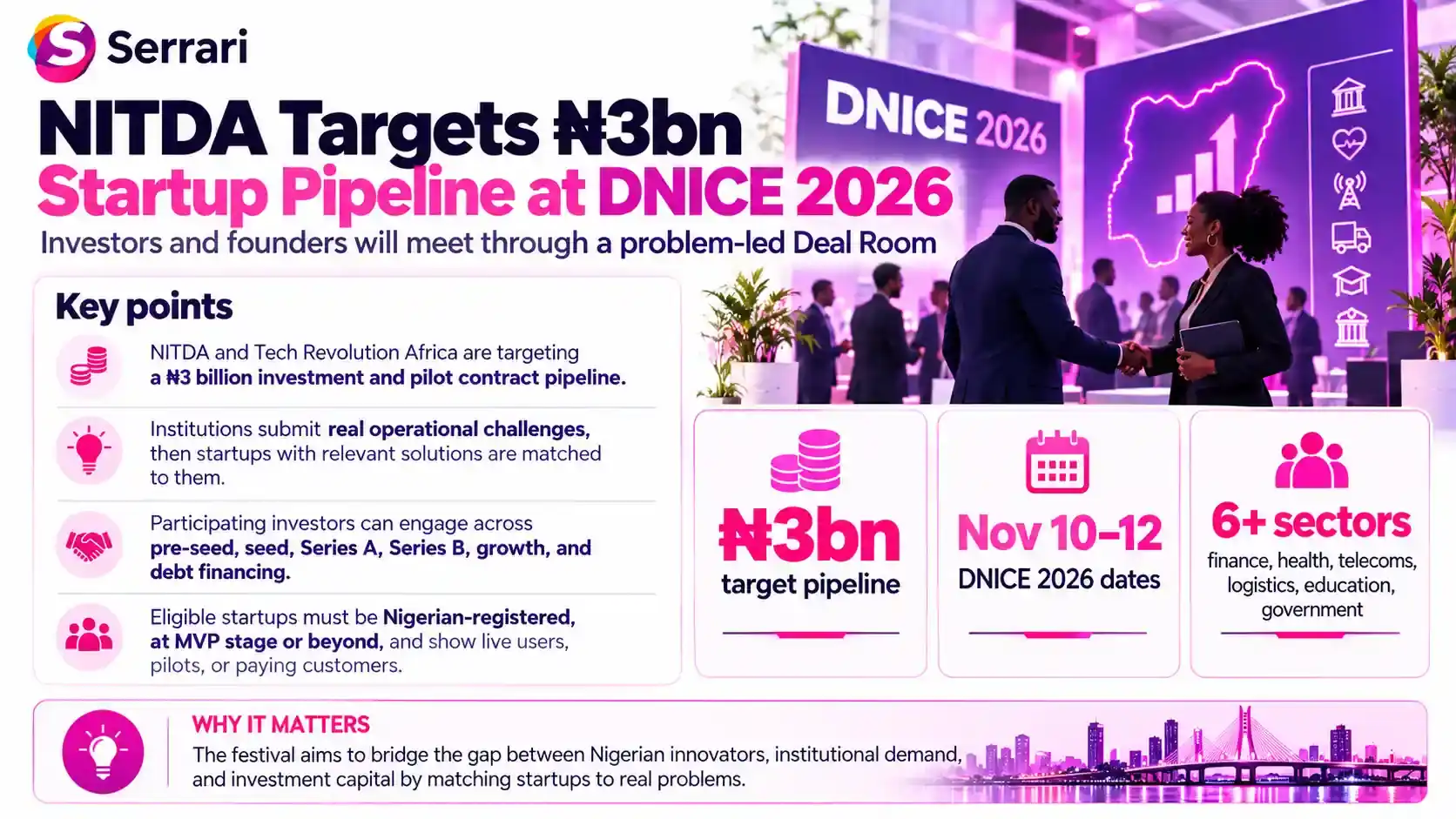
The initiative will culminate in Deal Room sessions during the Digital Nigeria International Conference and Exhibition (DNICE), scheduled for November 10–12, 2026, in Abuja.
Key Overview
- ₦3 billion investment target: The programme aims to develop a combined pipeline of startup investments and pilot contracts rather than distribute a guaranteed funding pool.
- Institutional partnerships: Government agencies, corporations and financial institutions will identify operational challenges for startups to address.
- Investor participation: Venture capital firms, angel investors and financial institutions can explore opportunities from pre-seed financing to growth and debt funding.
- Startup eligibility: Nigerian-registered businesses must have a minimum viable product (MVP) and evidence of users, active pilots or paying customers.
- Priority sectors: Financial technology, healthcare, telecommunications, logistics, education and government digital services.
- Conference dates: The Builders Festival will conclude at DNICE 2026, taking place November 10–12 at the BAT International Conference Centre in Abuja.
How the ₦3 Billion Startup Investment Programme Works
The Builders Festival introduces a problem-driven approach to connecting technology businesses with potential customers and financiers.
Under the programme’s institutional matching framework, participating government agencies, corporations and financial institutions identify specific operational challenges requiring technological solutions.
Qualified startups are subsequently matched with institutions based on their products, sector expertise and ability to deliver practical results.
Rather than relying exclusively on investment presentations, founders will have opportunities to demonstrate how their technologies address identified market needs.
The process involves institutional challenge submissions, startup screening, product demonstrations and structured negotiations between founders, investors and potential customers.
Successful matches may lead to pilot agreements, memoranda of understanding, commercial contracts or investment discussions.
However, the ₦3 billion figure represents the programme’s targeted pipeline of financing and pilot contracts, not confirmed investment commitments or funds already distributed.
The initiative could help startups demonstrate commercial demand before pursuing larger funding rounds, potentially reducing some uncertainties faced by investors evaluating early-stage technology businesses.
Investors Gain Access to Pre-Screened Technology Startups
The programme is expected to attract venture capital funds, angel investors, corporate investors, financial institutions and other financing partners.
According to the official investor participation framework, investors can indicate preferences across several funding stages, including pre-seed, seed, Series A, Series B, growth financing and debt financing.
Participating investors will have access to startup founders, product demonstrations and structured Deal Room meetings.
The approach is designed to connect financial capital with businesses whose technologies address problems already identified by potential customers.
Tech Revolution Africa co-founder David Ogebe has encouraged investors to evaluate startups based on the problems they solve rather than focusing exclusively on the quality of their investment pitches.
This emphasis on practical applications could support more informed investment decisions by allowing financiers to assess product maturity, existing traction and institutional demand.
Nevertheless, participation does not guarantee investment, and individual financing decisions will remain subject to due diligence, commercial negotiations and investor requirements.
Context is everything. Stay ahead of shifting trends with today’s market updates, and uncover emerging opportunities using the Serrari Group Market Index and Marketplace. Then, take control of your own financial future by exploring our Money & Life Reset Transformation Blueprint ™ to build stronger habits, create better systems, and design a path toward lasting wealth.
Financial Technology and Healthcare Among Priority Sectors
The Builders Festival is targeting technology solutions across several industries experiencing digital transformation.
According to the published institutional challenge framework, participating organisations have identified problems involving digital identity, customs risk assessment, cargo monitoring, satellite connectivity, SME financing and healthcare information systems.
Within financial services, startups may develop solutions addressing access to credit, payment infrastructure, financial inclusion and business financing.
Healthcare-related opportunities include patient identity management, medical information systems and improved vaccine supply chain visibility.
Government-focused challenges include digitising population records, strengthening public-sector information management and improving operational efficiency.
Logistics and telecommunications companies are also seeking technologies capable of improving shipment tracking, connectivity and infrastructure monitoring.
By concentrating on existing institutional problems, the programme aims to direct innovation toward solutions with identifiable potential customers rather than purely speculative business opportunities.
Startup Eligibility and Selection Requirements
The programme is specifically designed for Nigerian-registered startups with products that have progressed beyond the idea stage.
Under the published startup eligibility criteria, applicants must have developed a minimum viable product and demonstrate at least one live user, an active pilot project or a paying customer.
Organisers will evaluate participating businesses according to three principal considerations: market traction, team resilience and product maturity.
Applicants with deployment-ready technologies may be better positioned to secure institutional partnerships because they can demonstrate existing functionality rather than relying entirely on future development plans.
Startups can identify relevant institutional challenges during the application process, helping organisers match their products with suitable organisations.
The screening process is intended to improve the quality of introductions between businesses and prospective customers while giving investors greater visibility into commercial readiness.
DNICE 2026 to Host Live Investment Negotiations
The Builders Festival will conclude during the Digital Nigeria 2026 conference, scheduled for November 10–12 at the BAT International Conference Centre in Abuja.
The event will bring together government representatives, technology entrepreneurs, investors, financial institutions and other digital economy stakeholders.
Selected startups will participate in live Deal Room sessions, where they can discuss commercial partnerships, investment opportunities and pilot projects with relevant institutions.
The programme also includes opportunities for technical mentorship and business development support covering product engineering, operational resilience and go-to-market strategies.
For Nigeria’s technology ecosystem, the initiative represents an effort to strengthen connections between domestic innovation, institutional demand and private capital.
Its ultimate success will depend on the number of partnerships converted into funded investments, signed contracts and operational technology deployments.
If successful, the model could help Nigerian startups move beyond demonstrations toward sustainable commercial relationships while contributing to the country’s broader digital transformation objectives.
Sources
The Guardian Nigeria / National Information Technology Development Agency / Tech Revolution Africa / Digital Nigeria / Nigerian Tribune
Your financial future isn’t something you wait for—it’s something you build.
The real question is: when do you begin?
Move beyond simply staying informed.
Navigate the markets with clarity—track trends through the Serrari Group Market Index, uncover opportunities in the Serrari Marketplace, and build practical knowledge with our Curated Wealth Builder Platform.
Stay connected to what truly matters.
Get daily insights on macro trends and financial movements across Kenya, Africa, and global markets—delivered through the Serrari Newsletter.
Growth opens doors.
Advance your career through professional programs including ACCA, HESI A2, ATI TEAS 7 , HESI EXIT , NCLEX – RN and NCLEX – PN, Financial Literacy!🌟—designed to move you forward with confidence.
See where money is flowing—clearly and in real time.
Track Money Market Funds, Treasury Bills, Treasury Bonds, Green Bonds, and Fixed Deposits, alongside global and African indexes, key economic indicators, and the evolving Crypto and stablecoin landscape—all within Serrari’s Market Index.