The Climate Investment Funds (CIF) has endorsed $250 million in catalytic funding for Türkiye’s industrial decarbonisation programme, with the initiative expected to mobilise $2.8 billion in total investment. The programme targets emissions-intensive industries and will support technologies including green hydrogen, carbon capture, energy efficiency, circular economy solutions and renewable electricity.
Key Overview
- CIF has endorsed $250 million for Türkiye’s industrial decarbonisation programme.
- The funding is expected to mobilise $2.8 billion in total investment.
- The programme targets hard-to-abate industrial sectors.
- It aims to reduce or avoid 39 million tonnes of CO₂ equivalent annually by 2035.
- Around 378 businesses could gain improved access to green finance.
- Small and medium-sized enterprises and women-led businesses are among the priorities.
- Funding will be channelled through multilateral development bank partners.
$250 Million to Accelerate Industrial Decarbonisation
The Climate Investment Funds has endorsed $250 million in catalytic funding to support Türkiye’s industrial decarbonisation efforts.
The financing is expected to mobilise $2.8 billion in total investment, combining CIF support with financing from multilateral development banks, private investors and other sources.
The programme is designed to help Türkiye accelerate the transition of emissions-intensive industries towards cleaner production while supporting longer-term climate and economic objectives.
Focus on Hard-to-Abate Industries
The investment programme will focus on industrial activities where cutting emissions can be particularly challenging.
Its investment areas include green hydrogen, carbon capture, utilisation and storage, energy efficiency, circular economy solutions, renewable electricity and climate technologies.
These technologies are intended to help industrial companies reduce their dependence on high-emission production processes while improving access to cleaner energy and financing.
The programme will also support the development of green markets and technologies that can help companies transition towards lower-carbon production.
$2.8 Billion Investment Mobilisation
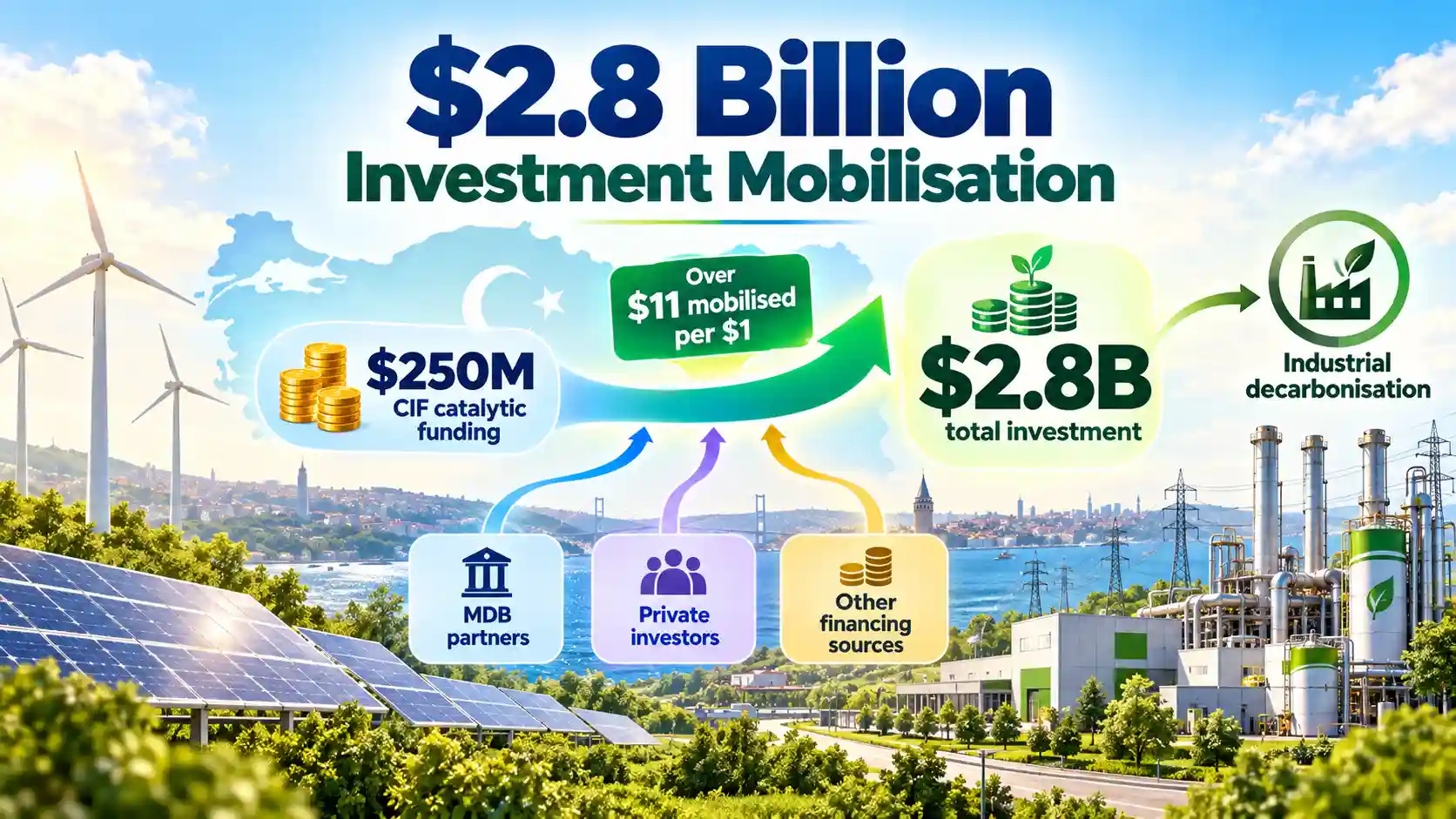
The CIF funding is intended to act as catalytic funding, helping attract substantially larger amounts of investment into industrial decarbonisation.
The wider financing package is expected to include contributions from multilateral development banks alongside private investors and other financing sources. This blended approach is designed to help overcome some of the financial barriers associated with industrial decarbonisation projects, particularly technologies that require significant upfront investment.
The initiative is expected to mobilise more than $11 for every dollar of CIF funding deployed, helping expand the impact of the initial $250 million commitment.
Emissions Target Reaches 39 Million Tonnes
A central objective of the programme is to reduce or avoid 39 million tonnes of CO₂ eq annually by 2035.
The target is intended to contribute to Türkiye’s longer-term goal of achieving net-zero emissions by 2053.
The programme also connects industrial investment with the country’s developing climate policy and emissions-pricing framework. Its investment priorities are aligned with Türkiye’s climate and industrial policies, including its 2025 Climate Law and pilot national emissions trading system.
Context is everything. Stay ahead of shifting trends with today’s market updates, and uncover emerging opportunities using the Serrari Group Market Index and Marketplace. Then, take control of your own financial future by exploring our Money & Life Reset Transformation Blueprint ™ to build stronger habits, create better systems, and design a path toward lasting wealth.
SMEs and Women-Led Businesses Included
The programme is not limited to large industrial companies. It aims to improve access to green financing for approximately 378 businesses by 2035.
Small and medium-sized enterprises and women-led businesses are among the groups receiving particular attention.
This focus could broaden participation in Türkiye’s industrial transition by helping businesses that may face greater challenges accessing capital for cleaner technologies and production processes.
The programme also incorporates considerations around a just transition, gender equality and social inclusion as industrial sectors undergo structural changes.
Multilateral Banks to Deliver Financing
The CIF financing will be implemented through multilateral development bank partners, including the Asian Development Bank, European Bank for Reconstruction and Development and World Bank Group institutions.
The Türkiye Industrial Decarbonisation Investment Platform will provide an important mechanism for coordinating investment and financing for industrial transformation.
The broader platform brings together public-sector institutions and international financial partners to connect industrial decarbonisation projects with suitable sources of finance and technical support.
Outlook
Türkiye’s $250 million CIF-backed programme could become an important test of how catalytic climate finance can unlock much larger pools of capital for industrial decarbonisation. The planned $2.8 billion mobilisation target places significant emphasis on bringing multilateral and private financing together to support cleaner industrial investment.
The programme’s 2035 targets also give investors and policymakers measurable milestones to track, including the potential reduction or avoidance of 39 million tonnes of CO₂ equivalent annually and improved access to green finance for hundreds of businesses.
For Türkiye, the initiative could accelerate investment in green hydrogen, carbon capture, renewable electricity, energy efficiency and circular economy solutions while supporting the country’s longer-term 2053 net-zero ambition.
FAQs
1. How much has CIF endorsed for Türkiye?
CIF has endorsed $250 million in catalytic funding for Türkiye’s industrial decarbonisation programme.
2. How much investment is expected to be mobilised?
The programme is expected to mobilise $2.8 billion in total investment.
3. What emissions reduction target has been set?
The programme aims to reduce or avoid 39 million tonnes of CO₂ equivalent annually by 2035.
4. Which businesses could benefit?
Around 378 businesses could gain improved access to green finance, with SMEs and women-led businesses among the priorities.
Your financial future isn’t something you wait for—it’s something you build.
The real question is: when do you begin?
Move beyond simply staying informed.
Navigate the markets with clarity—track trends through the Serrari Group Market Index, uncover opportunities in the Serrari Marketplace, and build practical knowledge with our Curated Wealth Builder Platform.
Stay connected to what truly matters.
Get daily insights on macro trends and financial movements across Kenya, Africa, and global markets—delivered through the Serrari Newsletter.
Growth opens doors.
Advance your career through professional programs including ACCA, HESI A2, ATI TEAS 7 , HESI EXIT , NCLEX – RN and NCLEX – PN, Financial Literacy!🌟—designed to move you forward with confidence.
See where money is flowing—clearly and in real time.
Track Money Market Funds, Treasury Bills, Treasury Bonds, Green Bonds, and Fixed Deposits, alongside global and African indexes, key economic indicators, and the evolving Crypto and stablecoin landscape—all within Serrari’s Market Index.