




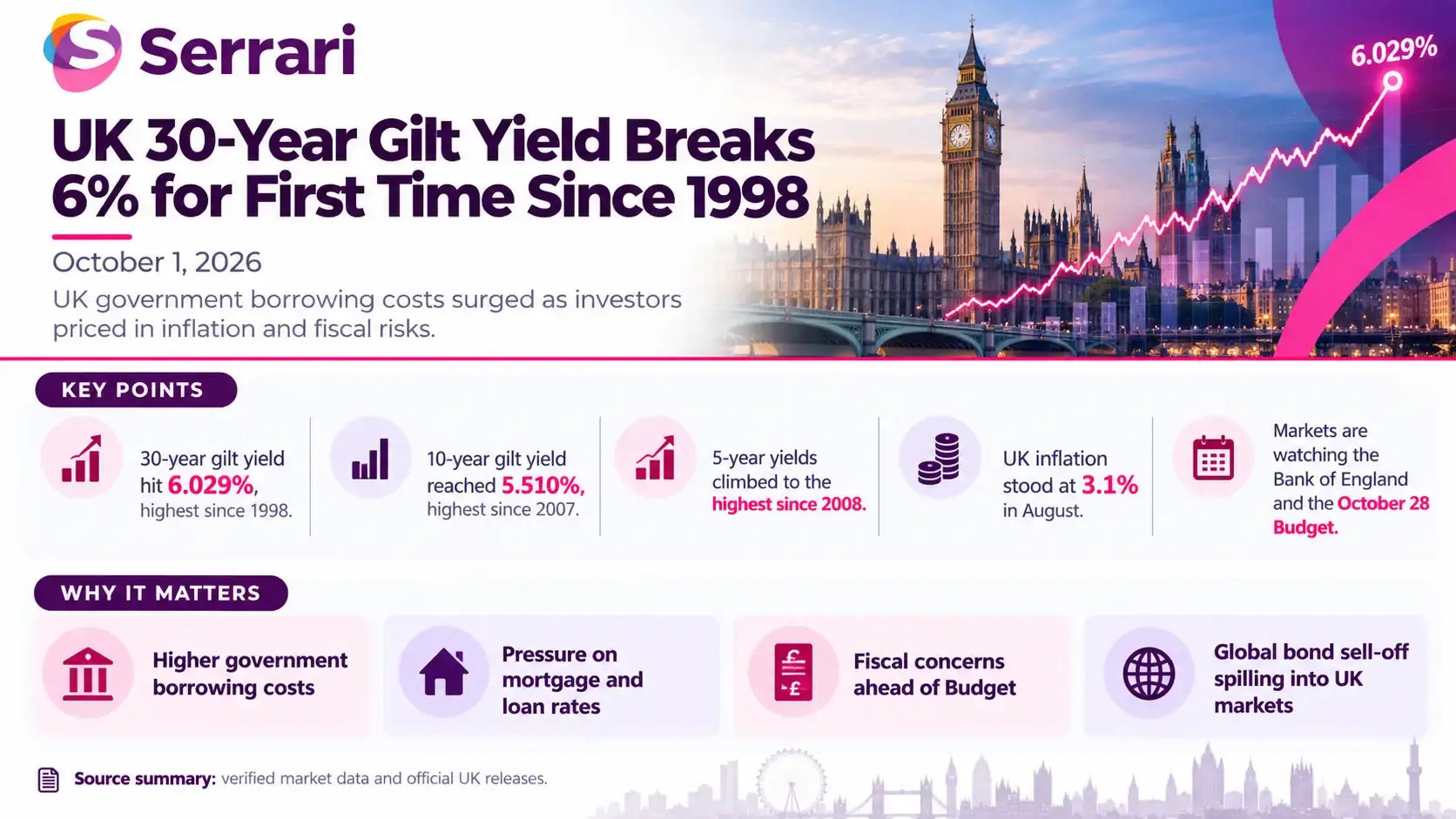
Britain’s long-term government borrowing costs have surged to levels not seen in nearly three decades, with the 30-year gilt yield climbing as high as 6.029% on October 1, 2026. The move marked the first time the benchmark had crossed 6% since 1998 and came as a global government bond sell-off intensified, pushing borrowing costs sharply higher across major economies.
The jump reflects a combination of persistent inflation concerns, elevated energy prices, expectations that interest rates may remain higher for longer and growing scrutiny of the UK’s fiscal position ahead of the government’s October Budget.
Key Overview
- The UK 30-year gilt yield climbed to 6.029%, its highest level since January 1998.
- The 10-year gilt yield reached 5.510%, its highest since July 2007.
- Five-year gilt yields rose to their highest level since July 2008.
- The sell-off followed another sharp rise in US Treasury yields and broader pressure across global bond markets.
- UK inflation stood at 3.1% in August 2026, above the Bank of England’s 2% target.
- Bank Rate remains at 3.75%, although three policymakers voted for a rise to 4% at the September meeting.
- Higher gilt yields increase the government’s borrowing costs and can feed into mortgage, business and consumer lending rates.
Long-Term UK Borrowing Costs Reach a 28-Year High
The yield on Britain’s 30-year government bond rose by about six basis points during Thursday’s trading session and briefly reached 6.029%, its highest level since January 1998. The 10-year gilt climbed to 5.510%, while shorter-dated bonds also sold off sharply.
Bond yields move inversely to prices, meaning the rise indicates investors were demanding higher returns to hold UK government debt. Long-dated gilt yields are particularly important because they influence government refinancing costs and serve as reference rates across pension, mortgage and investment markets.
The move was part of a wider repricing in global fixed-income markets. US 10-year Treasury yields briefly reached 5.34%, their highest level since 2002, as investors reassessed inflation risks, government borrowing needs and the outlook for interest rates.
Inflation and Energy Risks Put Pressure on Rates
The latest gilt sell-off comes at a difficult point for UK monetary policy. The Bank of England kept Bank Rate at 3.75% in September, but the decision was split 6–3, with three members voting to raise the rate to 4%.
Inflation has also moved further above target. UK CPI inflation reached 3.1% in August, while policymakers warned that higher energy costs could push inflation higher over coming quarters. The Bank currently expects inflation to rise further as the effects of the Middle East energy shock pass through to household bills and business costs.
This creates a challenging trade-off. Raising interest rates can help contain inflation, but higher borrowing costs also squeeze household budgets and weaken demand. Market expectations shifted after the latest bond sell-off, with investors increasingly considering the possibility of a Bank Rate increase at one of the final policy meetings of 2026.
Context is everything. Stay ahead of shifting trends with today’s market updates, and uncover emerging opportunities using the Serrari Group Market Index and Marketplace. Then, take control of your own financial future by exploring our Money & Life Reset Transformation Blueprint ™ to build stronger habits, create better systems, and design a path toward lasting wealth.
Fiscal Concerns Add to the Gilt Market Pressure
The rise in UK yields was sharper than the move in comparable German government bonds, drawing renewed attention to Britain’s fiscal position. Higher yields make it more expensive for the government to issue and refinance debt, potentially reducing the room available for spending or tax cuts.
The market move comes before Chancellor John Healey’s first Budget on October 28, 2026, a date the government formally confirmed in July. Healey has said the Budget will be based on fiscal discipline as the Treasury balances spending priorities against elevated debt-servicing costs.
For investors, the Budget will therefore be closely watched for measures affecting borrowing, taxation and the credibility of the government’s fiscal plans. Any change that materially alters expected gilt issuance or the path of public borrowing could influence yields further.
What Higher Gilt Yields Mean for Households and Markets
Rising gilt yields do not affect only government finances. They can feed through into the wider economy because lenders use government bond markets as a benchmark when pricing mortgages, corporate debt and other long-term financing.
For homeowners, sustained increases in gilt and swap rates can translate into more expensive fixed-rate mortgage deals. Businesses may also face higher refinancing costs, while bond investors can benefit from higher yields on newly issued debt but may experience capital losses on existing bonds when market yields rise.
The immediate direction of UK yields will depend heavily on energy prices, inflation data, global bond-market conditions and the Bank of England’s next policy decision on November 5, 2026. With long-term borrowing costs already at levels last seen in the late 1990s, markets are likely to remain sensitive to both monetary and fiscal policy signals.
Sources: Reuters / Bank of England / GOV.UK / Office for National Statistics
Your financial future isn’t something you wait for—it’s something you build.
The real question is: when do you begin?
Move beyond simply staying informed.
Navigate the markets with clarity—track trends through the Serrari Group Market Index, uncover opportunities in the Serrari Marketplace, and build practical knowledge with our Curated Wealth Builder Platform.
Stay connected to what truly matters.
Get daily insights on macro trends and financial movements across Kenya, Africa, and global markets—delivered through the Serrari Newsletter.
Growth opens doors.
Advance your career through professional programs including ACCA, HESI A2, ATI TEAS 7 , HESI EXIT , NCLEX – RN and NCLEX – PN, Financial Literacy!🌟—designed to move you forward with confidence.
See where money is flowing—clearly and in real time.
Track Money Market Funds, Treasury Bills, Treasury Bonds, Green Bonds, and Fixed Deposits, alongside global and African indexes, key economic indicators, and the evolving Crypto and stablecoin landscape—all within Serrari’s Market Index.




















Comments are closed.