Kenya’s proposed National Payment System Bill, 2026 could reshape how the billions of shillings backing mobile-money wallets are managed, while reopening a long-running debate over who should benefit from income generated by those funds.
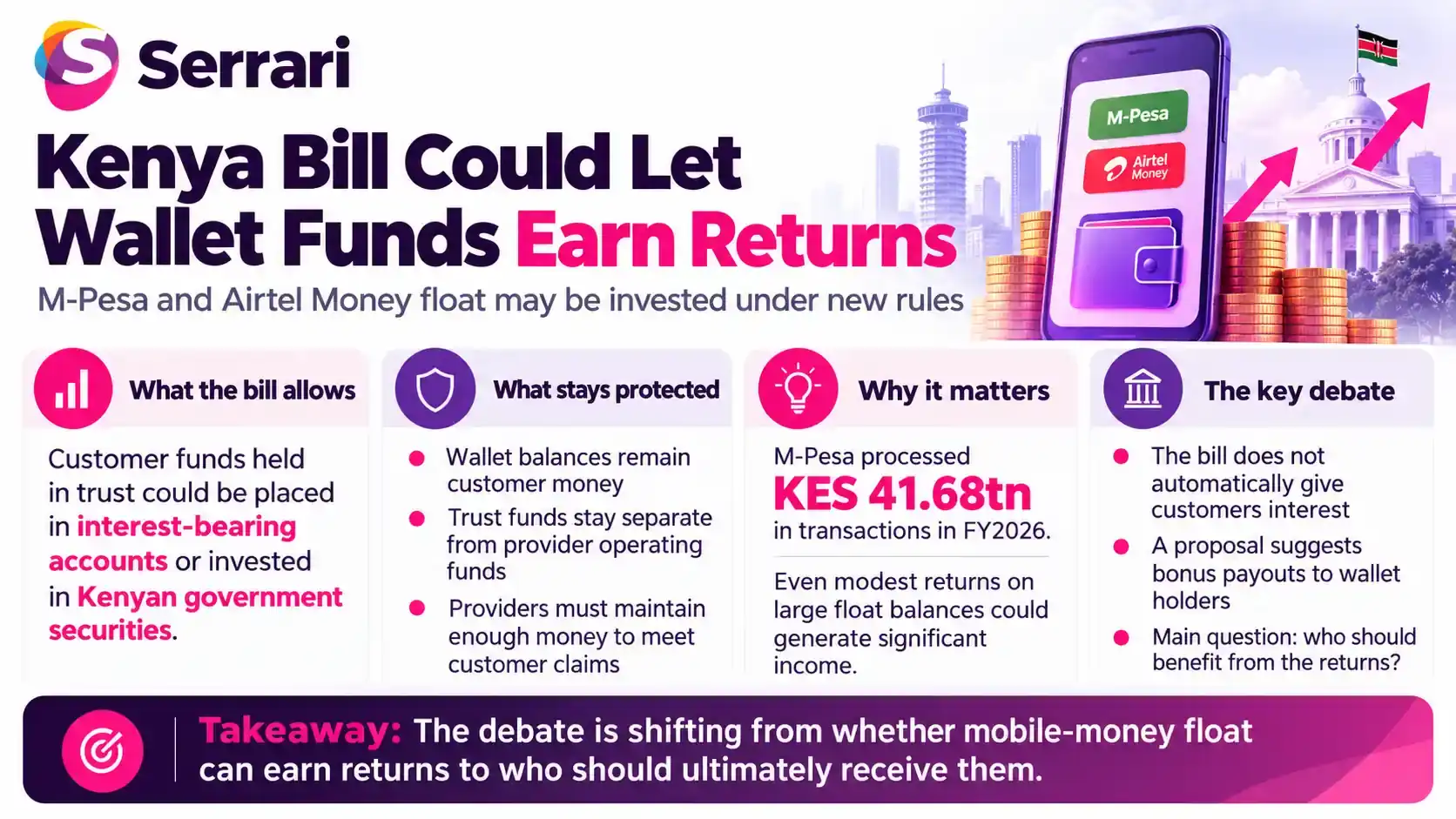
The draft framework maintains the principle that customer balances belong to users and must be protected through trust arrangements. However, funds backing electronic-money balances may be placed in approved interest-bearing accounts and government securities, potentially generating income while remaining available to meet customer claims.
The key issue is whether that investment income should continue being directed elsewhere under existing arrangements or whether a portion should eventually flow back to M-Pesa and Airtel Money users.
Key Overview
- Kenya has published a draft National Payment System Bill, 2026 for public consultation.
- Customer mobile-money balances would remain protected in trust and separate from providers’ operating funds.
- Trust funds may be held in approved bank accounts or invested in government securities.
- Mobile-money operators cannot simply use customer balances to finance their own ordinary business activities.
- M-Pesa processed KES 41.68 trillion in transactions during the year ended March 2026.
- Former CBK Governor Patrick Njoroge has proposed regular bonus payouts to wallet holders from surplus trust income.
- The draft Bill itself does not currently guarantee that users will earn interest on wallet balances.
How the Mobile-Money Trust Structure Works
The proposed law forms part of a broader effort by the National Treasury and Central Bank of Kenya to modernise the country’s payments framework.
The draft National Payment System framework is intended to replace the existing National Payment System Act while strengthening competition, consumer protection, financial stability, interoperability and innovation.
For mobile-money customers, one of the most important provisions concerns how providers safeguard funds corresponding to electronic-money balances.
When a customer deposits KES 10,000 into a mobile wallet, that money does not become ordinary operating cash belonging to the mobile-money provider. Instead, an equivalent amount must be protected through a trust structure established for the benefit of customers.
Under the proposed framework, those funds can continue to be invested in government securities or held in interest-bearing accounts, subject to regulatory requirements.
The provider must still maintain sufficient funds to satisfy customer claims. In practical terms, if users are collectively entitled to KES 100 billion, the trust cannot simply divert part of that amount into Safaricom’s or Airtel’s ordinary corporate expenditure.
That makes the arrangement fundamentally different from treating mobile-wallet balances as unrestricted corporate deposits.
The Size of M-Pesa Makes the Returns Significant
The economic significance comes from scale.
M-Pesa processed approximately KES 41.68 trillion in transaction value during the financial year ended March 2026, while transaction volumes climbed to more than 46 billion.
That figure does not mean KES 41.68 trillion was sitting in trust at one time. The same money can move repeatedly between customers, merchants, agents and businesses throughout the year.
The more relevant figure for investment purposes is the average customer float held across the system at any given moment.
Even so, mobile money’s enormous scale means relatively modest yields on the underlying pool of safeguarded funds can generate substantial investment income.
That is why rules governing who ultimately receives those returns are becoming increasingly important.
Context is everything. Stay ahead of shifting trends with today’s market updates, and uncover emerging opportunities using the Serrari Group Market Index and Marketplace. Then, take control of your own financial future by exploring our Money & Life Reset Transformation Blueprint ™ to build stronger habits, create better systems, and design a path toward lasting wealth.
Should Customers Receive Part of the Income?
The draft Bill does not automatically give customers interest on their M-Pesa or Airtel Money balances.
Under the existing framework, income generated by mobile-money trust funds has historically been handled in accordance with trust arrangements and regulatory requirements, including use for approved charitable purposes.
Former Central Bank Governor Patrick Njoroge is calling for that approach to change.
In comments submitted during consultation on the new payment framework, Njoroge proposed that payment service providers make regular bonus payouts to mobile-wallet customers using surplus income earned on trust funds after operating and related costs have been covered.
The proposal would effectively allow customers to benefit financially from returns generated by the funds supporting their own mobile-wallet balances.
However, it remains a proposal rather than a guaranteed provision of the legislation.
Njoroge’s submission does not prescribe a specific rate of return or exactly how often payments would be made, meaning substantial regulatory details would still need to be resolved.
What This Could Mean for M-Pesa and Airtel Money Users
For customers, the immediate effect of the proposed Bill is stronger clarity around how electronic-money balances are safeguarded and invested.
The bigger potential change would come if policymakers ultimately adopt a mechanism for distributing surplus investment income.
That could transform mobile wallets from purely transactional accounts into products capable of delivering modest financial benefits simply from maintaining a balance.
Yet any system would need to answer several questions, including how bonuses are calculated, whether they depend on average wallet balances, how frequently they are paid and how trust-administration costs are deducted.
For operators, clearer investment rules could improve the economics surrounding large pools of mobile-money float while still preventing them from treating customer money as unrestricted company capital.
Kenya’s payments debate is therefore moving beyond the question of whether safeguarded mobile-money funds can generate returns. The more consequential issue is increasingly who should receive the economic benefit when they do.
Sources: Central Bank of Kenya / National Treasury of Kenya / Business Daily / The Star / Safaricom / People Daily
Your financial future isn’t something you wait for—it’s something you build.
The real question is: when do you begin?
Move beyond simply staying informed.
Navigate the markets with clarity—track trends through the Serrari Group Market Index, uncover opportunities in the Serrari Marketplace, and build practical knowledge with our Curated Wealth Builder Platform.
Stay connected to what truly matters.
Get daily insights on macro trends and financial movements across Kenya, Africa, and global markets—delivered through the Serrari Newsletter.
Growth opens doors.
Advance your career through professional programs including ACCA, HESI A2, ATI TEAS 7 , HESI EXIT , NCLEX – RN and NCLEX – PN, Financial Literacy!🌟—designed to move you forward with confidence.
See where money is flowing—clearly and in real time.
Track Money Market Funds, Treasury Bills, Treasury Bonds, Green Bonds, and Fixed Deposits, alongside global and African indexes, key economic indicators, and the evolving Crypto and stablecoin landscape—all within Serrari’s Market Index.