Singapore allocated more than S$3.7 billion from its green-bond proceeds to finance the expansion of its electric rail network through the Jurong Region Line (JRL) and Cross Island Line (CRL) in the fiscal year ended March 31, 2026. Since its inaugural green-bond issuance in 2022, the Government has allocated a total of S$9.3 billion toward the two rail projects.
Key Overview
- More than S$3.7 billion in green-bond proceeds was allocated to the JRL and CRL in FY2025.
- The allocation included S$2.1 billion from June 2024 30-year green bonds, S$1.5 billion from October 2024 50-year green bonds and S$142.1 million from May 2025 30-year green bonds.
- Singapore has allocated S$9.3 billion toward the two rail lines since its first green-bond issuance in August 2022.
- The JRL is a 24km line with 24 stations, expected to be completed in 2029.
- The CRL is expected to be completed by 2032 and will have more than 50km of tracks.
- Together, the lines are projected to avoid 99,900–122,100 tonnes of CO₂e annually.
Singapore Directs Green-Bond Proceeds to Electric Rail
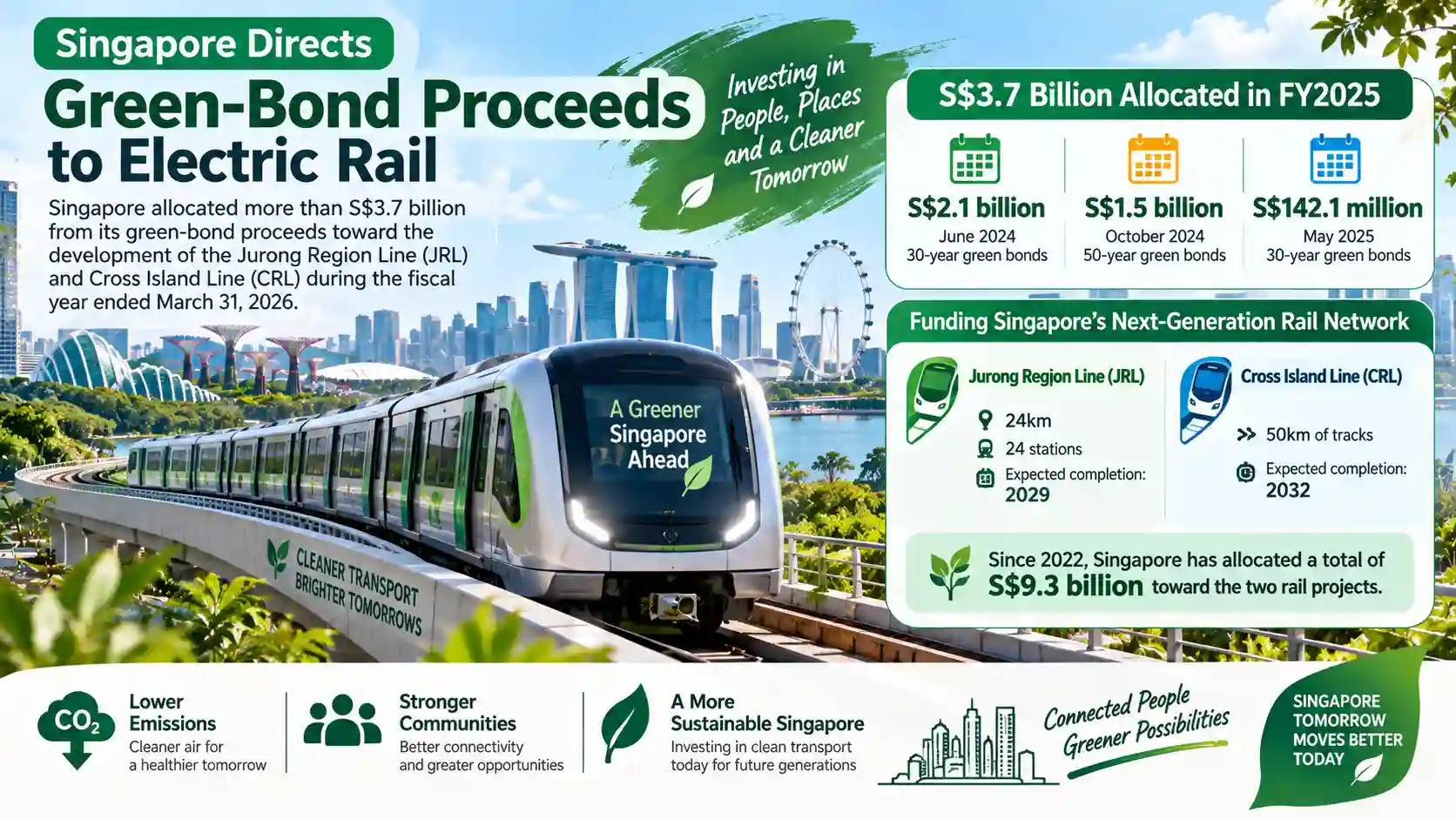
Singapore allocated more than S$3.7 billion from its green-bond proceeds toward the development of the Jurong Region Line and Cross Island Line during the fiscal year ended March 31, 2026.
The allocation comprised S$142.1 million from the second offer of 30-year green bonds issued in May 2025, S$1.5 billion from the third tranche of 50-year green bonds issued in October 2024 and S$2.1 billion from the first 30-year green bonds issued in June 2024.
The S$142.1 million allocated from the May 2025 issuance came from the S$1.8 billion of 30-year green bonds issued during that offering.
The Government also raised another S$1 billion through its fourth sale of 50-year green bonds in October 2025, although none of the proceeds from that offering had been allocated at the time covered by the report.
S$9.3 Billion Allocated Since 2022
Since Singapore’s inaugural green-bond issuance in August 2022, the Government has allocated a total of $9.3 billion toward financing the development of the JRL and CRL as of March 31, 2026.
This includes the S$3.7 billion allocated in FY2025, as well as:
- $2.4 billion from the inaugural 50-year green bonds.
- $2.8 billion from the reopening of the same 50-year bonds in September 2023.
- $404 million from the S$2.5 billion 30-year green bonds issued in June 2024.
The use of the proceeds for construction of the two rail lines was classified as eligible green expenditure under clean transportation and approved by Singapore’s green bond steering committee.
Green-Bond Proceeds Remain Ring-Fenced
The Singapore Green Bond Report for FY2025 said S$2.7 billion remained unallocated.
The funds were either temporarily held in a separate cash account maintained with the Monetary Authority of Singapore and ring-fenced for other eligible green expenditures, or invested by the Accountant-General’s Department in short-term liquidity instruments.
The report said this was in line with the Singapore Green Bond Framework.
The S$2.6 billion of 20-year green bonds issued in August 2026 was not included because those bonds were issued during the current financial year.
Jurong Region Line and Cross Island Line
The Jurong Region Line is a 24km train line with 24 stations serving western Singapore. It is expected to be completed in 2029.
The Cross Island Line is expected to be completed by 2032. When operational, it is projected to be Singapore’s longest fully underground line, with more than 50km of train tracks.
The report said development of both lines will contribute to Singapore’s goal of halving land-transport emissions by 2040 from their 2016 peak and achieving net-zero emissions by 2050.
The land-transport sector accounts for 15 per cent of the country’s carbon emissions.
Rail Expansion and Emissions Reduction
The Singapore Green Bond Report identified greener commuting as a key strategy for reducing the transport sector’s carbon footprint, alongside vehicle electrification and greener infrastructure and operations.
The completion of the JRL and CRL is expected to expand Singapore’s rail network to approximately 360 km by around 2030.
The lines are also expected to help increase the mass public-transport peak modal share to 75%, compared with the current 66%.
When fully operational, the two rail lines are estimated to prevent between 99,900 and 122,100 tonnes of carbon dioxide (CO₂e)annually over their operational lifetime.
This represents an estimated 81 per cent emissions reduction compared with the baseline scenario where the projects do not exist.
Context is everything. Stay ahead of shifting trends with today’s market updates, and uncover emerging opportunities using the Serrari Group Market Index and Marketplace. Then, take control of your own financial future by exploring our Money & Life Reset Transformation Blueprint ™ to build stronger habits, create better systems, and design a path toward lasting wealth.
Green-Bond Portfolio Climate Impact
Financed emissions avoided for the green-bond portfolio are estimated at between 16,100 and 24,100 tonnes of CO₂e annually, based on the S$9.3 billion allocated so far.
The avoided emissions intensity is projected at between 1.7 and 2.6 tonnes of carbon emissions for every $1 million allocated.
The report also stated that no ESG controversies were reported in FY2025.
Wider Economic and Social Benefits
Beyond emissions reductions, the JRL and CRL are expected to generate wider economic and social benefits.
These include enhanced connectivity and accessibility, increased public-transport usage, commuter travel-time savings and job creation.
The two rail projects combined are projected to create approximately 1,500 jobs by 2030, growing the rail workforce by around 16%.
Singapore’s Green-Bond Pipeline
Singapore has indicated that up to $35 billion of sovereign and public-sector green bonds could be issued by 2030.
A total of $25.8 billion had been raised by the end of FY2025. Of this amount, S$12 billion came from the Monetary Authority of Singapore acting on behalf of the Government, with the remainder raised by statutory boards.
Outlook
Singapore’s green-bond proceeds continue to support the expansion of its electric rail network, with S$9.3 billion allocated to the JRL and CRL since the inaugural green-bond issuance in 2022.
The projects are expected to expand rail connectivity, increase public-transport usage and contribute to Singapore’s transport emissions-reduction targets. The Government also has a pipeline of up to S$35 billion in sovereign and public-sector green bonds through 2030.
FAQs
1. How much did Singapore allocate from its green-bond proceeds to the rail projects?
Singapore allocated more than S$3.7 billion to the Jurong Region Line (JRL) and Cross Island Line (CRL) in FY2025.
2. How much has Singapore allocated to the two rail lines in total?
Since its inaugural green-bond issuance in August 2022, Singapore has allocated a total of S$9.3 billion toward the development of the JRL and CRL.
3. When are the Jurong Region Line and Cross Island Line expected to be completed?
The JRL is expected to be completed in 2029, while the CRL is expected to be completed by 2032.
4. How could the rail projects reduce emissions?
The two lines are estimated to prevent between 99,900 and 122,100 tonnes of CO₂e annually over their operational lifetime, while supporting greener commuting and increased public-transport use.
Your financial future isn’t something you wait for—it’s something you build.
The real question is: when do you begin?
Move beyond simply staying informed.
Navigate the markets with clarity—track trends through the Serrari Group Market Index, uncover opportunities in the Serrari Marketplace, and build practical knowledge with our Curated Wealth Builder Platform.
Stay connected to what truly matters.
Get daily insights on macro trends and financial movements across Kenya, Africa, and global markets—delivered through the Serrari Newsletter.
Growth opens doors.
Advance your career through professional programs including ACCA, HESI A2, ATI TEAS 7 , HESI EXIT , NCLEX – RN and NCLEX – PN, Financial Literacy!🌟—designed to move you forward with confidence.
See where money is flowing—clearly and in real time.
Track Money Market Funds, Treasury Bills, Treasury Bonds, Green Bonds, and Fixed Deposits, alongside global and African indexes, key economic indicators, and the evolving Crypto and stablecoin landscape—all within Serrari’s Market Index.