More than half of Americans surveyed by Visa said they would use stablecoins if they came with bank-level fraud protection and deposit insurance. Interest increased from 36% without those safeguards to 56% with them. The survey also found that trust in the provider plays a major role in payment adoption, with traditional banks and global payment networks among the most trusted providers of digital currency services.
Key Overview
- US stablecoin interest without safeguards: 36%
- US interest with bank-level safeguards: 56%
- Latin America interest with safeguards: 74%
- US respondents: 2,192 adults
- Global survey: 45,445 people across 20 markets
- Americans prioritising provider trust: 64%
- Trust in traditional banks: 61%
- Trust in global payment networks: 60%
- Americans accepting a 24-hour delay for stronger protection: 45%
Bank-Level Protection Increases Stablecoin Interest
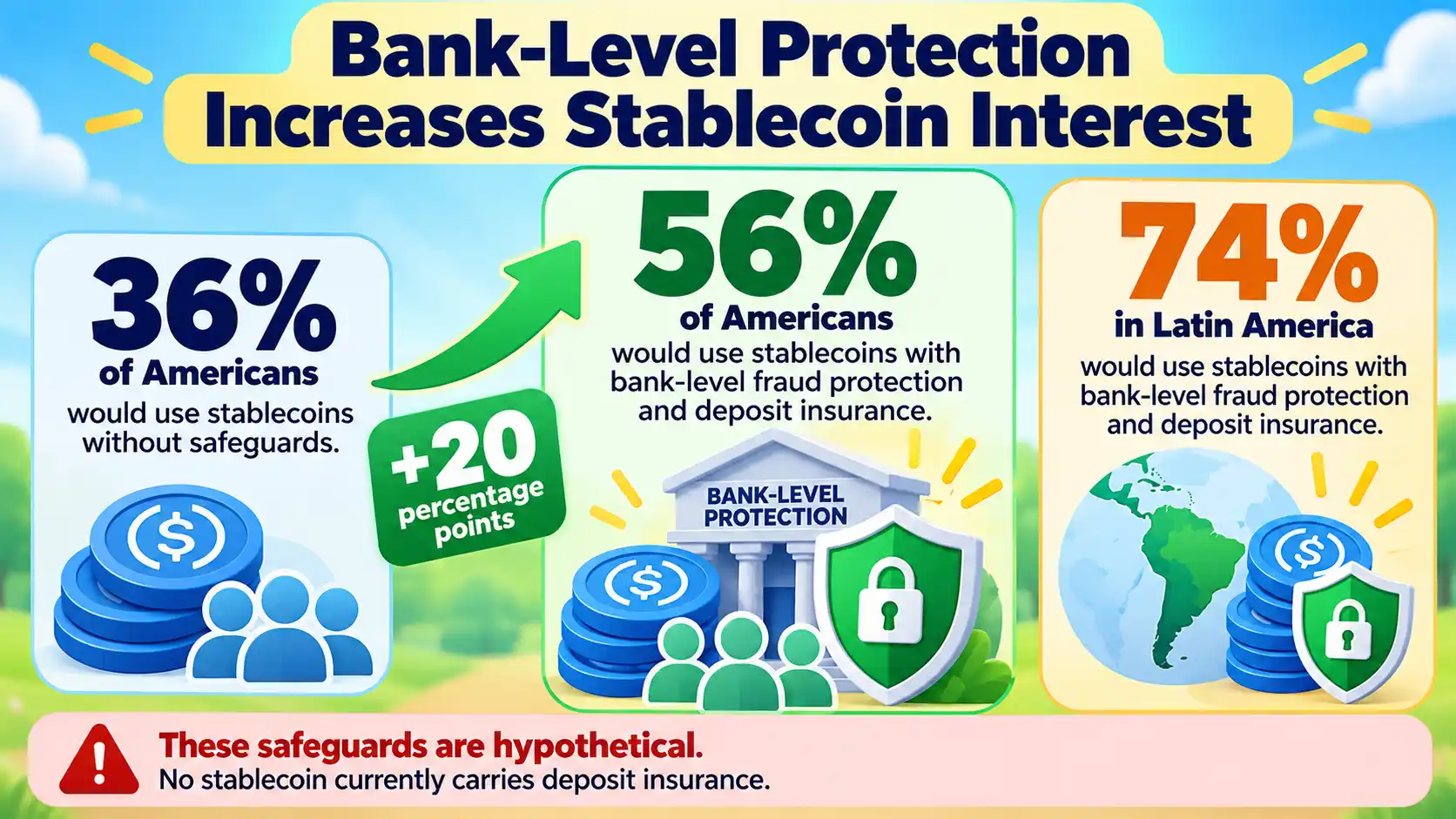
More than half of Americans would use stablecoins if they offered bank-level fraud protection and deposit insurance, according to a Visa study released on Wednesday.
The survey found that 36% of Americans would use stablecoins without the hypothetical safeguards, while willingness increased to 56% when fraud protection and deposit insurance were included.
Visa noted that these safeguards were hypothetical and that no stablecoin currently carries deposit insurance.
The same scenario increased stablecoin usage intent to 74% in Latin America.
Trust Depends on the Provider
The survey found that trust in the provider could be more important than the technology itself when people consider using digital payment services.
Nearly 64% of Americans said their trust in a payment method depends more on who offers it than on the technology behind it.
Willingness to use stablecoins increased to 45% when an existing financial provider offered them.
Traditional banks and global payment networks were the most trusted providers of digital currency services among US respondents, at 61% and 60%, respectively.
Globally, the trust figure was 69%.
Many Americans Still Have Limited Stablecoin Awareness
The survey also found that stablecoin awareness remains limited.
More than half of respondents, or 56%, said they had never heard of stablecoins.
Among those who had heard of them, many incorrectly assumed that stablecoins fluctuate in value in the same way as Bitcoin.
Stablecoins are designed to represent traditional currencies digitally, with dollar-denominated stablecoins generally designed to maintain a value linked to the US dollar.
Fraud Remains a Major Concern
Fraud was another significant concern identified in the survey.
Around one in four senders worldwide said they had experienced fraud, while more than one-third of Americans and 40% of Indians reported encountering fraud.
In the United States, 44% of respondents said they were concerned about AI deepfakes impersonating family members.
The survey also examined whether consumers would accept slower transactions in exchange for greater protection. About 45% of Americans said they would accept a 24-hour delay on a transfer if it provided stronger security.
In Japan, the figure was 68%.
Context is everything. Stay ahead of shifting trends with today’s market updates, and uncover emerging opportunities using the Serrari Group Market Index and Marketplace. Then, take control of your own financial future by exploring our Money & Life Reset Transformation Blueprint ™ to build stronger habits, create better systems, and design a path toward lasting wealth.
Visa Survey Covers 20 Markets
The findings come from Visa’s Money Travels 2026 report, which focuses on remittances and payment behaviour.
The US portion of the study involved a Morning Consult survey of 2,192 U.S. adults (Feb 24‑Mar 2).
The broader survey covered 45,445 people across 20 markets.
Visa Direct Global Head Vira Platonova said providers that work to establish consumer trust will play an important role in the future of the industry.
Visa Expands Its Stablecoin Activities
Visa is also expanding its involvement in stablecoin and blockchain-based payment infrastructure.
The company is a founding validator on Circle’s Arc blockchain, alongside BlackRock, Mastercard and DTCC.
According to the information provided, crypto-linked card payments reached $18 billion in 2025, with Visa handling more than 90% of stablecoin card transactions.
Visa also added PayPal USD (PYUSD) and the Global Dollar (USDG) to its settlement stablecoins through Paxos, alongside the Stellar and Avalanche networks.
Stablecoins Gain a Larger Role in Payments
Visa said stablecoins are accounting for a growing share of cross-border money flows.
The total supply of dollar stablecoins in circulation is around $312 billion, according to the information provided, with Tether’s USDT at approximately $184 billion and Circle’s USDC at about $76 billion.
The survey findings suggest that consumer trust and protection could remain important factors as stablecoins move into broader payment applications.
Outlook
The Visa survey highlights the importance of trust, fraud protection and consumer safeguards in the potential adoption of stablecoins.
In the US, willingness to use stablecoins increased from 36% to 56% when hypothetical bank-level fraud protection and deposit insurance were included. At the same time, the survey found that many Americans remain unfamiliar with stablecoins.
As stablecoin payment services expand, providers may face increasing pressure to demonstrate security and build trust through established financial institutions and payment networks.
FAQs
1. How many Americans would use stablecoins with additional safeguards?
Visa found that 56% of Americans would use stablecoins if they came with bank-level fraud protection and deposit insurance.
2. What was the figure without those safeguards?
Without the hypothetical safeguards, 36% of Americans said they would use stablecoins.
3. What do Americans trust most when choosing digital currency services?
Traditional banks and global payment networks were among the most trusted providers, at 61% and 60%, respectively.
4. How many Americans were concerned about AI deepfakes?
The survey found that 44% of Americans were concerned about AI deepfakes impersonating family members.
Your financial future isn’t something you wait for—it’s something you build.
The real question is: when do you begin?
Move beyond simply staying informed.
Navigate the markets with clarity—track trends through the Serrari Group Market Index, uncover opportunities in the Serrari Marketplace, and build practical knowledge with our Curated Wealth Builder Platform.
Stay connected to what truly matters.
Get daily insights on macro trends and financial movements across Kenya, Africa, and global markets—delivered through the Serrari Newsletter.
Growth opens doors.
Advance your career through professional programs including ACCA, HESI A2, ATI TEAS 7 , HESI EXIT , NCLEX – RN and NCLEX – PN, Financial Literacy!🌟—designed to move you forward with confidence.
See where money is flowing—clearly and in real time.
Track Money Market Funds, Treasury Bills, Treasury Bonds, Green Bonds, and Fixed Deposits, alongside global and African indexes, key economic indicators, and the evolving Crypto and stablecoin landscape—all within Serrari’s Market Index.