Vietnam has officially launched the pilot phase of its domestic carbon market with the introduction of its national carbon trading platform, marking a major milestone in the country’s climate transition. The market allocates emissions quotas to major industrial emitters, enables carbon credit trading, and supports Vietnam’s objective of achieving net-zero greenhouse gas emissions by 2050. Officials expect the initiative to strengthen green finance, encourage investment in emissions reduction technologies, and improve business competitiveness through market-based climate solutions.
Key Overview
- Vietnam officially launched the pilot phase of its domestic carbon market.
- The national carbon exchange began trading greenhouse gas emissions quotas.
- More than 100 major industrial emitters will participate in the pilot programme.
- The initiative supports Vietnam’s net-zero emissions target by 2050.
- Trading fees will be waived throughout the pilot phase ending in 2028.
Carbon Exchange Begins Pilot Operations
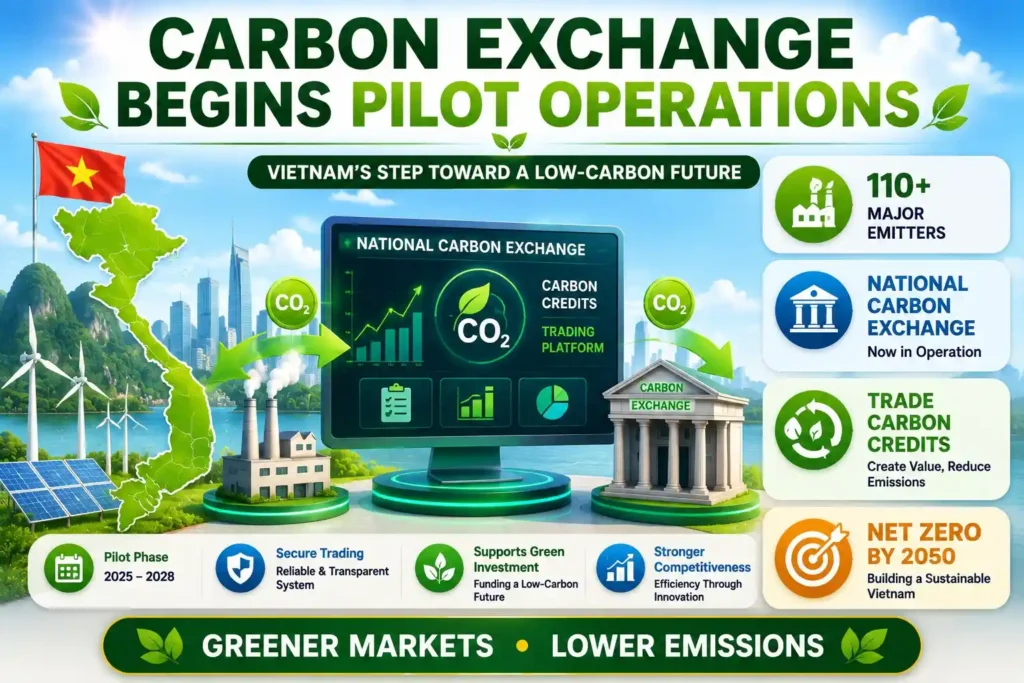
Vietnam has officially launched the pilot phase of its domestic carbon market, introducing its national carbon trading platform as part of the country’s broader strategy to accelerate green finance, reduce greenhouse gas emissions, and achieve net-zero emissions by 2050.
The domestic carbon exchange officially commenced operations on June 29 at the Hanoi Stock Exchange (HNX), marking one of the country’s most significant climate policy milestones. The launch establishes a market-based mechanism for trading greenhouse gas emissions quotas and carbon credits while encouraging businesses to invest in cleaner technologies and improve environmental performance.
The initiative forms part of Vietnam’s long-term climate strategy and is expected to strengthen sustainable economic growth by creating new opportunities for carbon finance and emissions reduction.
Government Establishes Carbon Market Framework
The launch follows several important policy measures introduced during 2026 to establish the country’s domestic carbon market.
The Government issued Decree No. 29/2026/ND-CP, creating the legal framework for the national carbon exchange, while Decision No. 263/QD-TTg approved pilot greenhouse gas emissions quotas covering the 2025–2026 compliance period.
Under the pilot programme, emissions quotas have been allocated to 110 major emitters across the thermal power, steel, and cement industries, creating the foundation for Vietnam’s first carbon trading activities.
Authorities believe the market will encourage companies to reduce emissions while providing greater access to green finance and improving compliance with increasingly demanding Environmental, Social and Governance (ESG) requirements.
Carbon Trading Supports Green Investment
According to officials from the Department of Climate Change, the domestic carbon market is designed to help Vietnam fulfil its Nationally Determined Contribution (NDC) commitments under the Paris Agreement while supporting its net-zero target by 2050.
The trading platform is expected to mobilise investment into emissions reduction projects, improve business competitiveness, strengthen corporate sustainability strategies, and create financial incentives for companies that successfully reduce greenhouse gas emissions.
By placing an economic value on carbon emissions, businesses can increasingly view emissions reductions as commercial opportunities rather than solely regulatory obligations.
National Infrastructure Ready for Trading
Ahead of the launch, the Department of Climate Change signed cooperation agreements with several organisations, including the Vietnam Exchange (VNX), the Vietnam Securities Depository and Clearing Corporation (VSDC), the Hanoi Stock Exchange (HNX), and BIDV.
These agreements establish systems for market supervision, transaction settlement, quota registration, and secure trading of both emissions quotas and carbon credits.
According to authorities, the information technology infrastructure connecting participating institutions has been successfully tested and is fully operational, demonstrating Vietnam’s readiness to operate its domestic carbon market efficiently.
Pilot Market Focuses on Major Industrial Emitters
The pilot phase initially covers more than 100 emissions sources, including companies operating in electricity generation, steel manufacturing, and cement production.
Several major industrial enterprises are expected to participate, with companies receiving emissions quotas that correspond to their permitted greenhouse gas emissions.
Businesses capable of reducing emissions below their allocated quotas will eventually be able to sell surplus allowances, while companies facing higher emissions reduction costs can purchase additional quotas through the market.
Officials believe this market-based approach will reduce national emissions more efficiently while lowering overall compliance costs for industry.
Context is everything. Stay ahead of shifting trends with today’s market updates, and uncover emerging opportunities using the Serrari Group Market Index and Marketplace. Then, take control of your own financial future by exploring our Money & Life Reset Transformation Blueprint ™ to build stronger habits, create better systems, and design a path toward lasting wealth.
Businesses Face New Opportunities and Challenges
Climate experts note that while the legal framework and technical infrastructure are now largely in place, business preparedness remains one of the market’s biggest challenges.
Participation provides companies with early experience in carbon trading while encouraging them to treat carbon emissions as financial assets capable of generating additional value through carbon credits and quota trading.
Industry representatives also believe the market will encourage investment in cleaner production technologies, energy efficiency improvements, and emissions monitoring systems, particularly as international climate regulations continue to evolve.
The initiative is expected to help exporters prepare for mechanisms such as the European Union’s Carbon Border Adjustment Mechanism (CBAM), which places increasing importance on carbon emissions throughout global supply chains.
Challenges Remain for Market Development
Despite the progress, experts caution that several issues must still be addressed before Vietnam’s carbon market reaches full maturity.
Among the challenges identified are relatively low carbon credit prices, incomplete legal provisions governing certain sectors such as forest carbon, limited measurement, reporting and verification (MRV) capacity, and fragmented emissions data systems.
Specialists also recommend further clarification regarding carbon credit ownership, benefit-sharing mechanisms, and trading rules to better align Vietnam’s market with international carbon trading standards.
Additional investment in digital market infrastructure, carbon accounting systems, and technical expertise will also be important for supporting long-term market growth.
Pilot Continues Until 2028
Vietnam plans to operate the domestic carbon exchange on a pilot basis through 2028, with a fully operational national carbon market scheduled to launch in 2029.
To encourage participation, the Government has announced that no fees will be charged during the pilot period.
Officials believe this policy will reduce participation costs while encouraging businesses to actively implement emissions reduction projects, adopt cleaner technologies, and contribute to Vietnam’s sustainable development objectives.
Outlook
Vietnam’s domestic carbon market represents a significant step toward integrating market-based climate solutions into the country’s economic development strategy. As businesses gain experience with emissions trading and carbon finance, the market is expected to encourage greater investment in low-carbon technologies, renewable energy, and industrial decarbonisation. With the pilot phase continuing through 2028 before full implementation in 2029, Vietnam is positioning itself to become an increasingly important participant in regional and global carbon markets while advancing its commitment to achieving net-zero greenhouse gas emissions by 2050.
FAQs
1. What is Vietnam’s domestic carbon market?
It is a national trading system that allows companies to buy and sell greenhouse gas emissions quotas and carbon credits.
2. Which industries are included in the pilot phase?
The pilot initially covers major emitters in the thermal power, steel, and cement industries.
3. How long will the pilot carbon market operate?
The pilot phase will run until 2028, with a fully operational carbon market planned for 2029.
4. Why is the carbon market important?
It helps Vietnam reduce greenhouse gas emissions, mobilise green finance, improve business competitiveness, and support its net-zero emissions target by 2050.
Sources: Vietnam Pictorial, VnEconomy, Vietnam Law and Legal Forum magazine, Vietnam+ (VietnamPlus)
Your financial future isn’t something you wait for—it’s something you build.
The real question is: when do you begin?
Move beyond simply staying informed.
Navigate the markets with clarity—track trends through the Serrari Group Market Index, uncover opportunities in the Serrari Marketplace, and build practical knowledge with our Curated Wealth Builder Platform.
Stay connected to what truly matters.
Get daily insights on macro trends and financial movements across Kenya, Africa, and global markets—delivered through the Serrari Newsletter.
Growth opens doors.
Advance your career through professional programs including ACCA, HESI A2, ATI TEAS 7 , HESI EXIT , NCLEX – RN and NCLEX – PN, Financial Literacy!🌟—designed to move you forward with confidence.
See where money is flowing—clearly and in real time.
Track Money Market Funds, Treasury Bills, Treasury Bonds, Green Bonds, and Fixed Deposits, alongside global and African indexes, key economic indicators, and the evolving Crypto and stablecoin landscape—all within Serrari’s Market Index.