















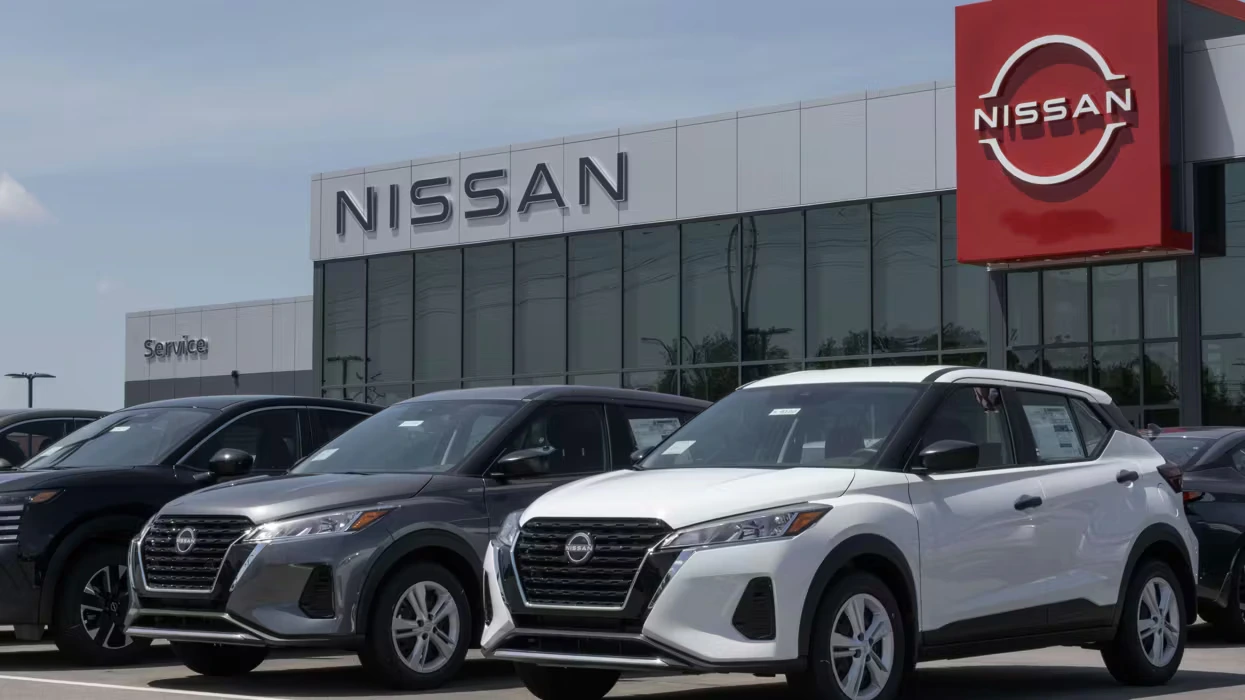
Nissan has reportedly halted development of the fully electric Qashqai as part of a broader restructuring and cost-cutting strategy. The decision reflects slowing EV demand in Europe, increasing competition from Chinese manufacturers, and Nissan’s growing focus on hybrid technologies such as e-Power. While the company remains committed to electrification, the future of the electric Qashqai remains uncertain, with any potential launch unlikely before the early 2030s.
Key Overview
- Nissan reportedly halted development of the electric Qashqai.
- The Qashqai accounts for about 45% of Nissan’s European sales.
- The Sunderland plant currently employs around 6,000 workers.
- Nissan is increasingly focusing on hybrid technologies.
- European EV demand remains volatile.
- Competition from Chinese EV makers is increasing.
- The company is reducing its global model range.
- The electric Qashqai could return later in the decade.
Nissan Reassesses Electric Qashqai Plans Amid Market Changes
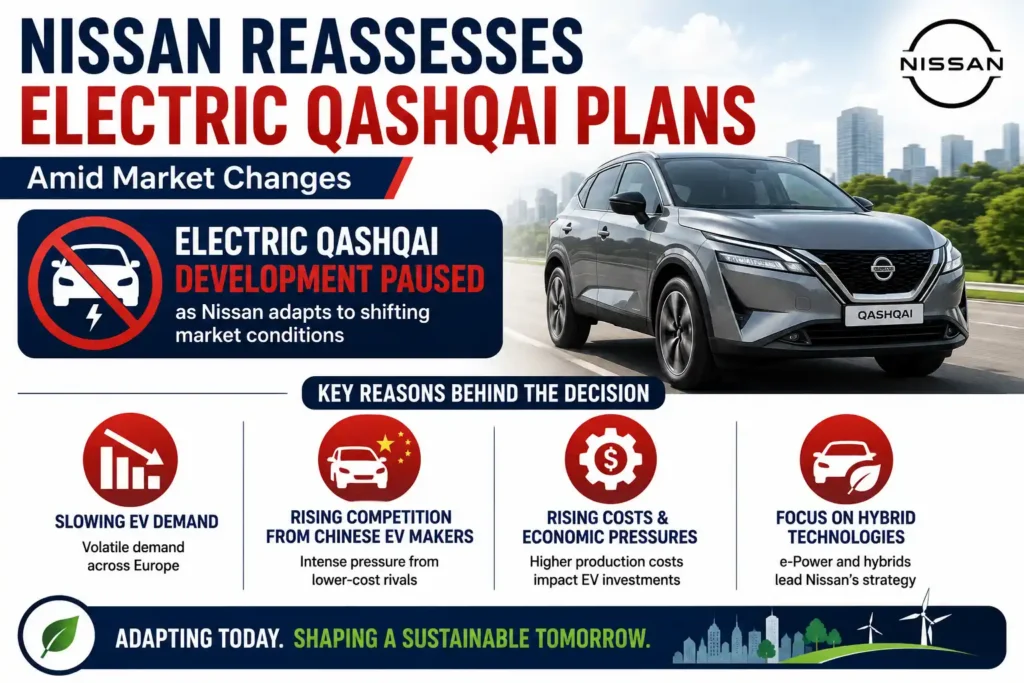
Nissan has reportedly abandoned plans to develop a fully electric version of the Qashqai, one of its most important models in Europe, as the company restructures its global operations and responds to changing market conditions.
According to reports citing sources familiar with the matter, development of the battery-electric Qashqai was quietly halted early last year as part of wider cost-cutting efforts and a review of the company’s future vehicle lineup.
The decision highlights the growing challenges facing traditional automakers as slowing electric vehicle demand, rising production costs, and increasing competition reshape the global automotive market.
Qashqai Remains Central to Nissan’s European Business
The Qashqai is one of Nissan’s most successful vehicles in Europe.
The crossover accounted for about 45% of Nissan’s European sales in 2025, with around 330,000 vehicles sold across the region.
Since its launch, more than 4.5 million Qashqai models have been produced at Nissan’s Sunderland plant in northeast England, making it one of the company’s most important manufacturing facilities.
Given the model’s significance, any changes to its future powertrain strategy carry major implications for Nissan’s European operations.
Electric Qashqai Was Previously Confirmed
In 2023, Nissan announced plans to build an electric version of the Qashqai at its Sunderland facility.
The UK government welcomed the announcement, viewing the investment as evidence of Britain’s position as a leading electric vehicle manufacturing hub.
However, the company never announced a production timeline for the model.
According to reports, if the project eventually returns, the electric Qashqai may not reach the market until the early 2030s.
Nissan has neither confirmed nor denied the cancellation reports.
Nissan Pursues a Balanced Electrification Strategy
The company said it remains committed to expanding its electrified lineup but emphasized the importance of maintaining a balanced approach.
Nissan cited significant volatility in European EV demand and indicated that hybrid vehicles will continue to play an important role in its product strategy.
The company stated that it intends to continue building on its history of vehicle electrification while adapting to changing market conditions.
This approach increasingly emphasizes hybrid technologies alongside battery-electric vehicles.
Context is everything. Stay ahead of shifting trends with today’s market updates, and uncover emerging opportunities using the Serrari Group Market Index and Marketplace. Then, take control of your own financial future by exploring our Money & Life Reset Transformation Blueprint ™ to build stronger habits, create better systems, and design a path toward lasting wealth.
e-Power Gains Momentum
One of Nissan’s strongest products in Europe has been its e-Power hybrid technology.
Unlike conventional hybrids, the Qashqai e-Power uses a 1.5-liter gasoline engine solely to generate electricity.
The engine does not directly drive the wheels.
Instead, an electric motor powers the vehicle, creating an EV-like driving experience without requiring drivers to charge the vehicle.
The system offers:
- Electric driving characteristics.
- Improved fuel efficiency.
- Reduced emissions.
- No charging requirements.
- Lower range anxiety.
Growing consumer interest in hybrids has strengthened Nissan’s confidence in this technology.
Sunderland Plant Faces Uncertainty
The Sunderland facility remains a key asset for Nissan.
The factory currently employs approximately 6,000 workers and produces the Leaf electric vehicle.
Earlier this year, Nissan unveiled an electric version of the Juke crossover that will also be produced at the site.
However, several planned investments have been delayed or canceled.
A proposed three-in-one EV powertrain facility through Nissan subsidiary JATCO has reportedly been abandoned.
The company is also discussing financial support measures with the UK government to support future production plans.
Competition Intensifies in Europe
European automakers are facing growing competition from Chinese electric vehicle manufacturers.
Lower-cost Chinese EVs are increasingly entering European markets, putting pressure on established manufacturers.
This competition has influenced investment decisions throughout the automotive industry.
Nissan is not alone in reconsidering electric vehicle plans.
The company has already canceled plans for two electric SUVs intended for production in Mississippi, choosing instead to prioritize hybrid models.
The automaker also plans to reduce its global model lineup from 56 to 45 vehicles.
Regulatory Challenges Add Pressure
Regulatory uncertainty is adding further complexity to Nissan’s decision-making process.
Proposed European local content rules could affect the competitiveness of vehicles manufactured in the United Kingdom.
Approximately 60% of British-built cars are exported to Europe, making access to EU markets particularly important.
Meanwhile, the UK government is consulting manufacturers about potential changes to electric vehicle sales targets.
These discussions may provide automakers with greater flexibility to continue offering hybrid vehicles.
Nissan’s Electric Future Continues
Despite uncertainty surrounding the Qashqai EV, Nissan continues to expand its electric vehicle lineup.
The company already sells:
- Nissan Ariya.
- Nissan Leaf.
- Upcoming electric Micra.
- Future electric Juke.
An entry-level electric vehicle is also expected to join the lineup.
Nissan executives maintain that electrification remains a long-term objective, although the company appears increasingly focused on balancing electric and hybrid technologies.
Outlook
Nissan’s decision to reportedly pause the electric Qashqai reflects the broader challenges currently facing the automotive industry. Slowing EV demand, increased competition, rising costs, and changing consumer preferences are forcing manufacturers to reassess their electrification strategies.
While the future of the electric Qashqai remains uncertain, Nissan’s growing emphasis on hybrid technologies suggests that the company sees multiple pathways toward reducing emissions. The eventual return of the electric Qashqai may depend on future market conditions, regulatory developments, battery costs, and the pace of EV adoption across Europe.
FAQs
1. Has Nissan officially canceled the electric Qashqai?
Nissan has not officially confirmed the cancellation, but reports indicate that development was halted early last year.
2. Why is Nissan focusing more on hybrids?
The company cites volatile EV demand and growing consumer interest in hybrid technologies such as e-Power.
3. What is Nissan e-Power technology?
e-Power is a series hybrid system where a gasoline engine generates electricity while an electric motor drives the wheels.
4. Will the electric Qashqai return in the future?
Reports suggest that if development resumes, the vehicle may not reach the market until the early 2030s.
Sources: Yahoo Finance, The Guardian, autoevolution, Auto Express, Carwow, Just Auto
Your financial future isn’t something you wait for—it’s something you build.
The real question is: when do you begin?
Move beyond simply staying informed.
Navigate the markets with clarity—track trends through the Serrari Group Market Index, uncover opportunities in the Serrari Marketplace, and build practical knowledge with our Curated Wealth Builder Platform.
Stay connected to what truly matters.
Get daily insights on macro trends and financial movements across Kenya, Africa, and global markets—delivered through the Serrari Newsletter.
Growth opens doors.
Advance your career through professional programs including ACCA, HESI A2, ATI TEAS 7 , HESI EXIT , NCLEX – RN and NCLEX – PN, Financial Literacy!🌟—designed to move you forward with confidence.
See where money is flowing—clearly and in real time.
Track Money Market Funds, Treasury Bills, Treasury Bonds, Green Bonds, and Fixed Deposits, alongside global and African indexes, key economic indicators, and the evolving Crypto and stablecoin landscape—all within Serrari’s Market Index.