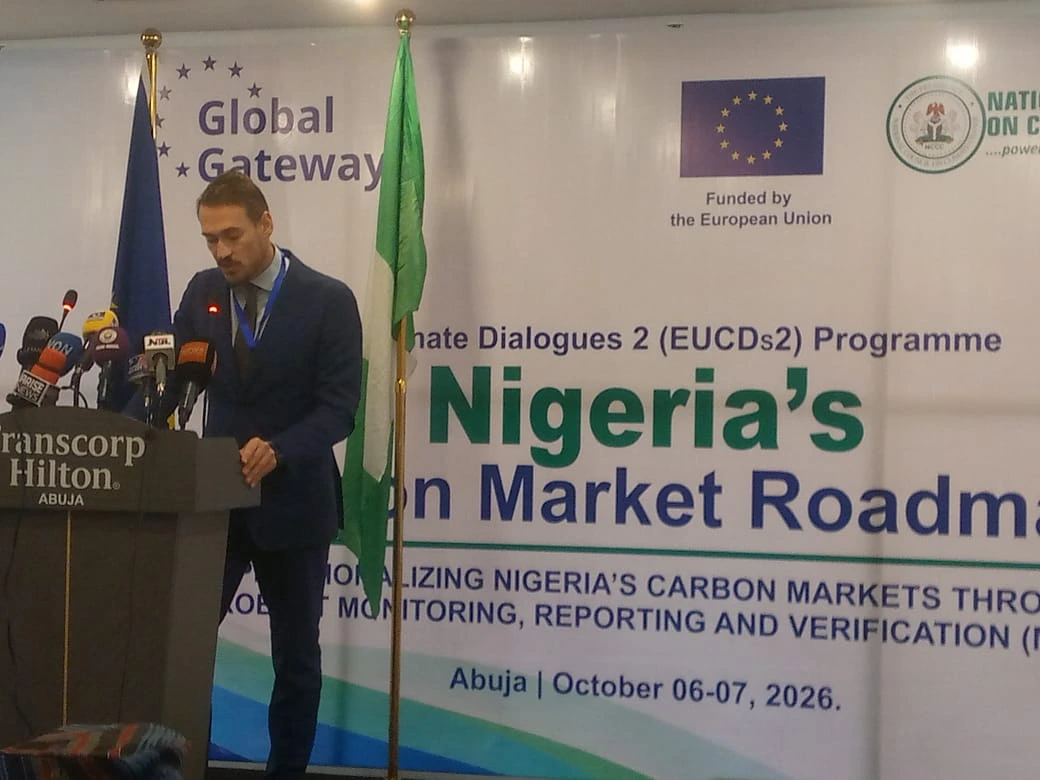
Nigeria is moving to strengthen the credibility and integrity of its emerging carbon market by improving carbon verification and measurement, reporting and verification systems. The National Council on Climate Change is working with the European Union and other stakeholders to operationalise a unified national carbon registry, develop digital MRV systems and establish stronger standards for carbon projects.
Key Overview
- Focus: Carbon market integrity and verification
- Key system: National carbon registry
- Technology: Digital MRV, remote sensing, IoT, geospatial data and distributed ledgers
- International partner: European Union
- Market framework: National Carbon Markets Framework
- Priority: High-integrity carbon investments
- Key areas: Article 6 cooperation and voluntary carbon markets
Nigeria Targets Higher-Integrity Carbon Market
Nigeria is seeking to strengthen the credibility of its emerging carbon market as the government looks to attract more private investment into climate action.
The National Council on Climate Change (NCCC) has called for stronger carbon verification to ensure that carbon projects generate credible and measurable climate outcomes.
The push was discussed during a high-level roundtable on carbon markets in Abuja organised under the European Union Climate Dialogues programme. Government officials, development partners and other stakeholders used the meeting to discuss how Nigeria can operationalise its carbon-market framework and improve the systems used to measure and verify emissions reductions.
NCCC Director-General Omotenioye Majekodunmi said Nigeria needs to translate its climate ambitions into tangible, bankable and verifiable actions that can support sustainable economic growth and attract climate finance.
Stronger Measurement, Reporting and Verification
A central part of Nigeria’s strategy is the development of stronger Measurement, Reporting and Verification (MRV) systems.
The NCCC is promoting digital MRV technologies, including remote sensing, Internet of Things (IoT) sensors, geospatial data and distributed ledger technologies.
These technologies are expected to improve the accuracy and reliability of emissions data while reducing some of the costs and time associated with verifying carbon projects.
The NCCC says effective MRV is necessary for buyers to establish whether claimed emissions reductions are genuine. It can also help regulators track emissions, prevent double-counting and give communities greater visibility over benefit-sharing arrangements.
National Carbon Registry Planned
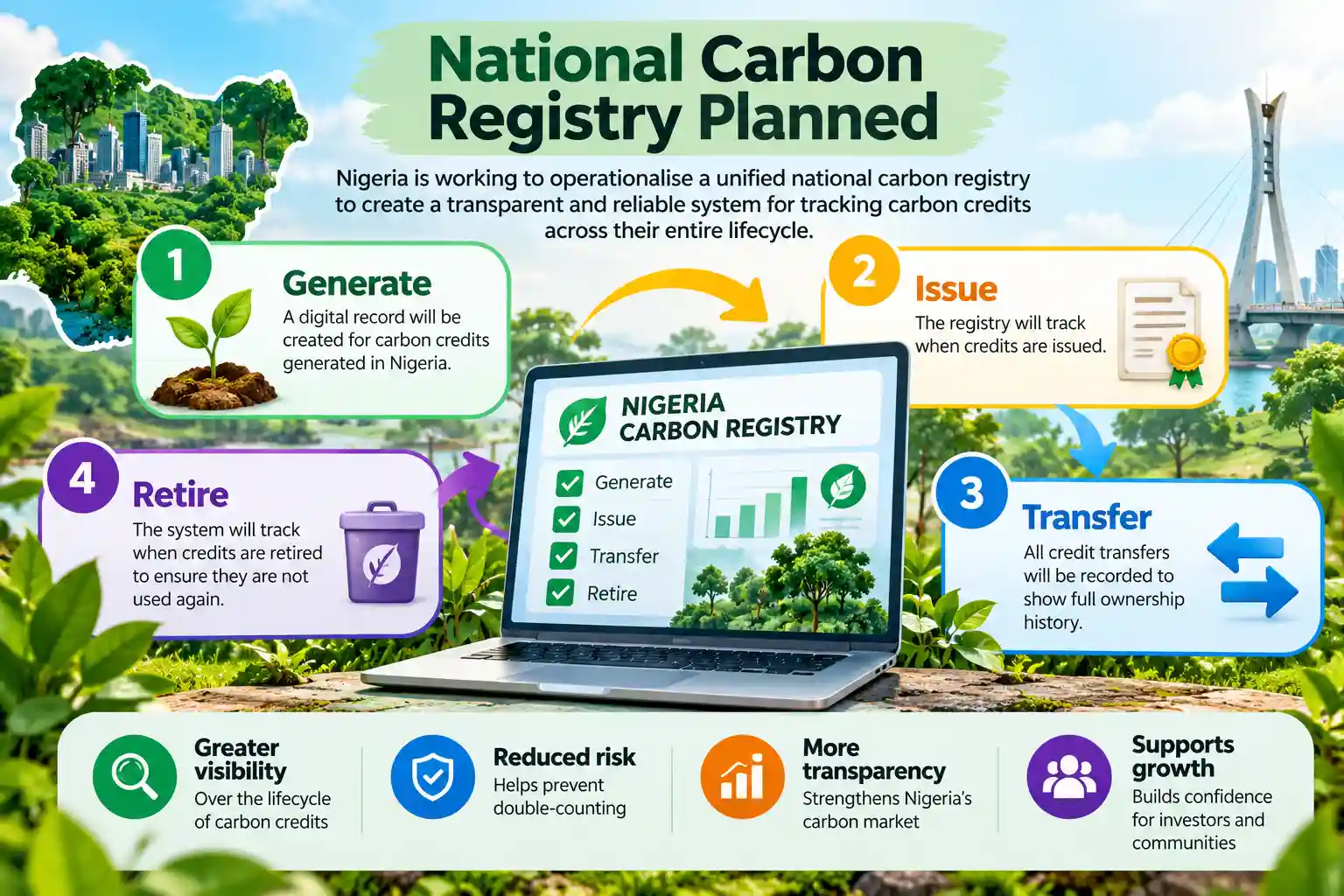
Nigeria is also working to operationalise a unified national carbon registry.
The registry is expected to create a digital record of carbon credits generated, issued, transferred and retired in Nigeria. This would provide greater visibility over the lifecycle of credits and help reduce the risk of the same emissions reduction being counted more than once.
The system is part of the broader effort to create a transparent infrastructure for Nigeria’s carbon market as activity increases.
The NCCC also wants to finalise carbon-market regulations, publish sector-specific MRV guidelines and establish local capacity-building hubs to strengthen verification expertise within the country.
EU Supports Nigeria’s Carbon Market Development
The European Union is supporting Nigeria’s efforts through the EU Climate Dialogues programme.
The Abuja roundtable formed part of the second phase of the EU Climate Dialogues, which is focused on supporting Nigeria’s climate and carbon-market development.
EU representatives said credible carbon markets require robust systems for transparency, accountability and environmental integrity. The partnership is also intended to help stakeholders align around Nigeria’s National Carbon Markets Framework and develop a roadmap for putting the framework into operation.
The EU sees stronger carbon-market systems as a way to support emissions reductions while mobilising investment and encouraging the development of low-carbon economic activities.
Nigeria’s National Carbon Markets Framework
Nigeria’s National Carbon Markets Framework provides the institutional and regulatory architecture for carbon-market activities in the country.
The framework covers domestic and international carbon trading, including Article 6 cooperation, and voluntary markets.
It is intended to provide greater clarity for project developers, investors, buyers and regulators while supporting Nigeria’s participation in international carbon markets.
The NCCC says the framework can help position Nigeria as a destination for high-integrity carbon investment, provided the country strengthens the systems needed to verify and monitor carbon projects.
Context is everything. Stay ahead of shifting trends with today’s market updates, and uncover emerging opportunities using the Serrari Group Market Index and Marketplace. Then, take control of your own financial future by exploring our Money & Life Reset Transformation Blueprint ™ to build stronger habits, create better systems, and design a path toward lasting wealth.
Protecting Against Greenwashing
Improving verification is also intended to reduce the risk of low-quality credits and greenwashing.
The NCCC has stressed that carbon markets need to deliver real, additional and permanent mitigation outcomes while also supporting community development and environmental protection.
Without credible verification, investors and buyers may find it difficult to determine whether projects are delivering the emissions reductions they claim.
This makes transparency particularly important as Nigeria seeks to attract larger volumes of private and international climate finance.
Forest Carbon Monitoring Gets Attention
Forestry is another area where Nigeria wants stronger monitoring and verification.
Representatives from the Ministry of Environment called for improvements in forest inventories, monitoring systems, remote sensing and satellite technology. Satellite information is expected to complement ground measurements and field verification.
The aim is to create coordinated, transparent and independently verifiable forest-carbon data while strengthening the capacity of forestry institutions to collect and manage reliable information.
Better data could improve confidence in forest-based carbon projects and help protect the integrity of credits generated from natural climate solutions.
Collaboration Seen as Critical
The NCCC is also calling for stronger cooperation between government agencies, private-sector developers, financial institutions, development partners, civil society and academic institutions.
The collaboration is intended to support the development of bankable projects while strengthening local verification capabilities.
The European Union and other development partners are expected to provide technical assistance as Nigeria works to improve its carbon-market infrastructure.
Outlook
Nigeria’s push to strengthen carbon verification comes as the country seeks to turn its emerging carbon market into a credible source of climate investment.
The combination of a unified national registry, digital MRV technologies, stronger regulations and local verification capacity could provide the infrastructure needed to improve confidence in Nigerian carbon credits.
The immediate challenge will be turning these plans into functioning systems and ensuring that carbon projects produce measurable environmental outcomes while delivering fair benefits to communities and investors.
If successfully implemented, the framework could strengthen Nigeria’s position in international carbon markets and create a more transparent pathway for mobilising private capital toward climate action.
FAQs
1. Why is Nigeria strengthening carbon verification?
Nigeria wants to improve the credibility and integrity of its carbon market, attract investment and ensure that carbon credits represent genuine emissions reductions.
2. What technologies will Nigeria use for carbon verification?
The NCCC is promoting remote sensing, IoT sensors, geospatial data and distributed ledger technologies as part of digital MRV systems.
3. What is Nigeria’s national carbon registry?
It is a planned unified digital system designed to record carbon credits generated, issued, transferred and retired in Nigeria.
4. What role is the EU playing?
The European Union is supporting Nigeria through the EU Climate Dialogues programme, including discussions on operationalising the National Carbon Markets Framework and strengthening MRV practices.
Your financial future isn’t something you wait for—it’s something you build.
The real question is: when do you begin?
Move beyond simply staying informed.
Navigate the markets with clarity—track trends through the Serrari Group Market Index, uncover opportunities in the Serrari Marketplace, and build practical knowledge with our Curated Wealth Builder Platform.
Stay connected to what truly matters.
Get daily insights on macro trends and financial movements across Kenya, Africa, and global markets—delivered through the Serrari Newsletter.
Growth opens doors.
Advance your career through professional programs including ACCA, HESI A2, ATI TEAS 7 , HESI EXIT , NCLEX – RN and NCLEX – PN, Financial Literacy!🌟—designed to move you forward with confidence.
See where money is flowing—clearly and in real time.
Track Money Market Funds, Treasury Bills, Treasury Bonds, Green Bonds, and Fixed Deposits, alongside global and African indexes, key economic indicators, and the evolving Crypto and stablecoin landscape—all within Serrari’s Market Index.