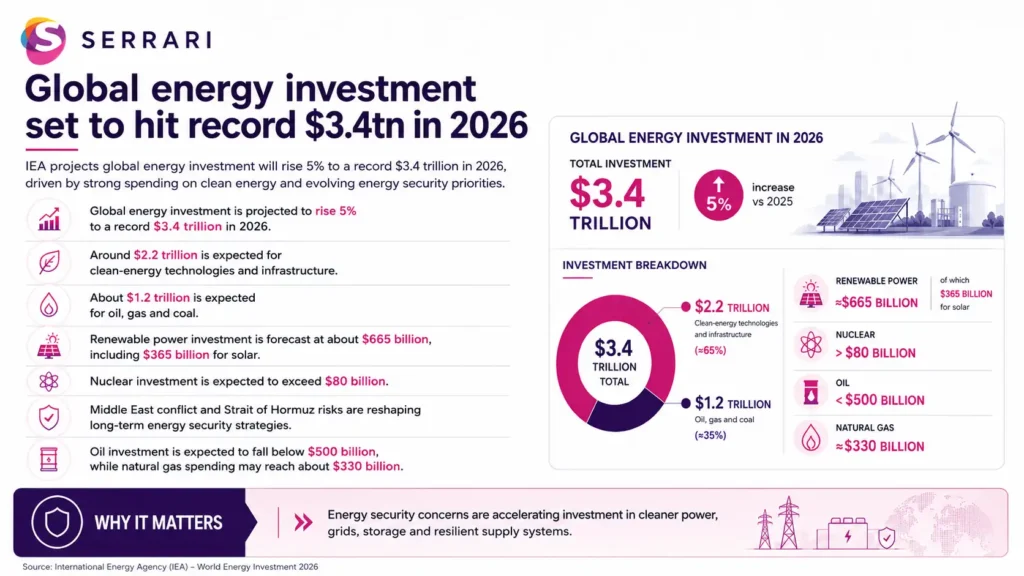
Global energy investment is projected to rise by 5% to a record $3.4 trillion in 2026 as governments and companies respond to heightened energy-security risks, supply disruptions and accelerating electricity demand. According to the World Energy Investment 2026 report, around $2.2 trillion is expected to flow into renewables, nuclear power, electricity grids, storage, low-emissions fuels, efficiency and electrification. About $1.2 trillion is forecast for oil, natural gas and coal.
The investment shift reflects both the long-term expansion of cleaner energy systems and the immediate need to strengthen resilience after conflict in the Middle East disrupted infrastructure and trade through the Strait of Hormuz.
Key Overview
The 2026 investment outlook shows electricity-related spending remaining the dominant force in global energy markets. Investment in electricity supply and infrastructure is expected to reach nearly $1.6 trillion, rising to about $2 trillion when end-use electrification is included.
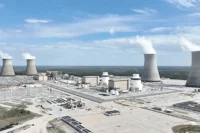
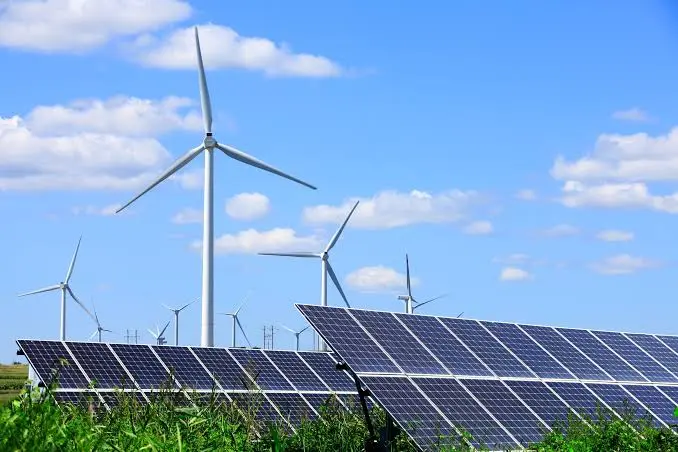
Renewable power investment is forecast at roughly $665 billion, including $365 billion for solar. Nuclear investment is expected to exceed $80 billion, while close to 80 gigawatts of new nuclear capacity is under construction across 15 countries.
At the same time, oil investment is projected to fall below $500 billion for a third consecutive annual decline. Natural gas investment is moving in the opposite direction, rising to about $330 billion, its highest level in a decade.
Energy Security Reshapes Capital Allocation
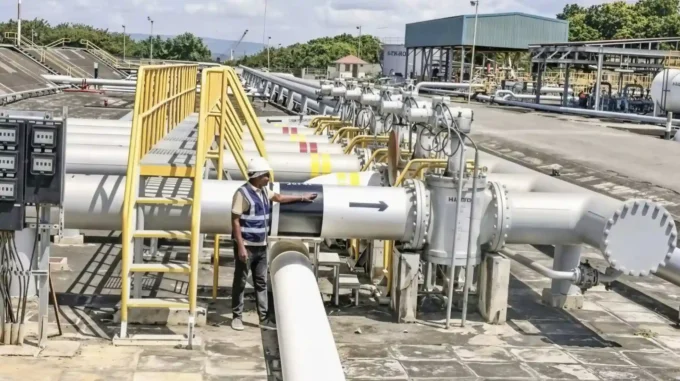
The Middle East conflict has changed how countries assess energy infrastructure, trade routes and supply concentration. The effective disruption of tanker movements through the Strait of Hormuz exposed the risks of relying heavily on a single maritime corridor.
The IEA said producer and consumer countries are increasingly pursuing alternative pipelines, ports and domestic energy sources. Saudi Arabia and the United Arab Emirates have greater capacity to redirect exports through alternative infrastructure, while other regional producers remain more exposed to Hormuz-related disruptions.
The conflict has also affected project financing. Higher risk perceptions, volatile markets and reconstruction needs may increase borrowing costs and divert capital from new projects. A separate estimate placed potential damage to regional energy assets at as much as $58 billion, underlining the scale of capital that may be required simply to restore damaged facilities.
Clean Power, Grids and Storage Lead Growth
Low-emissions technologies are expected to account for more than 70% of global power-generation investment in 2026. Solar remains the largest single destination for renewable capital, while nuclear power is receiving renewed attention as countries seek dependable domestic generation.
Electricity grids are another major investment priority. Spending on grids is projected to approach $550 billion, almost 20% higher than a year earlier, while battery-storage investment is expected to exceed $100 billion. These investments are increasingly essential as power systems absorb more renewable generation, electric vehicles, industrial electrification and data-centre demand.
Around $350 billion is also invested annually in energy-efficiency improvements. The IEA noted that several countries have introduced new efficiency measures in response to the latest energy crisis, although policy coverage remains uneven.
Context is everything. Stay ahead of shifting trends with today’s market updates, and uncover emerging opportunities using the Serrari Group Market Index and Marketplace. Then, take control of your own financial future by exploring our Money & Life Reset Transformation Blueprint ™ to build stronger habits, create better systems, and design a path toward lasting wealth.
Gas Spending Rises as Oil Investment Weakens
Despite elevated oil prices, producers have generally avoided a rapid increase in upstream spending. Long project lead times, uncertainty over the duration of price spikes, tighter offshore rig markets and supply-chain constraints are limiting near-term investment responses.
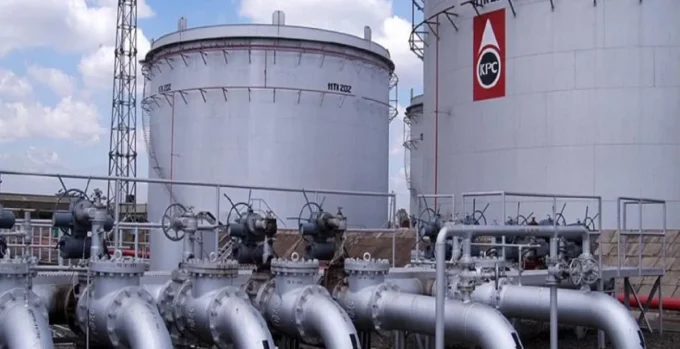
By contrast, natural gas investment is forecast to rise by more than 10% to $330 billion. New liquefied natural gas projects in the United States and Qatar are supporting the increase, although damage and shipping disruption in the Gulf have delayed the expected arrival of some new supply.
Coal investment is also projected to rise to $180 billion, its highest level since 2012, as some countries prioritise supply security and extend the operating life of existing coal-fired plants.
AI and Data Centres Add Pressure to Power Systems
The rapid expansion of artificial intelligence and data centres is becoming a significant driver of generation and grid investment, particularly in the United States. The IEA said orders for new gas-fired power plants reached a 25-year high in 2025, partly because of rising data-centre electricity needs.
Global data-centre electricity consumption is expected to more than double by 2030, reaching about 945 terawatt-hours. This growth is intensifying competition for turbines, grid connections and dependable power supplies.
The investment outlook therefore reflects more than an energy transition. It also shows a global race to build energy systems that are cleaner, more secure and capable of supporting rapidly expanding digital demand.
Sources: International Energy Agency / Reuters / Fast Company Middle Eas
Your financial future isn’t something you wait for—it’s something you build.
The real question is: when do you begin?
Move beyond simply staying informed.
Navigate the markets with clarity—track trends through the Serrari Group Market Index, uncover opportunities in the Serrari Marketplace, and build practical knowledge with our Curated Wealth Builder Platform.
Stay connected to what truly matters.
Get daily insights on macro trends and financial movements across Kenya, Africa, and global markets—delivered through the Serrari Newsletter.
Growth opens doors.
Advance your career through professional programs including ACCA, HESI A2, ATI TEAS 7 , HESI EXIT , NCLEX – RN and NCLEX – PN, Financial Literacy!🌟—designed to move you forward with confidence.
See where money is flowing—clearly and in real time.
Track Money Market Funds, Treasury Bills, Treasury Bonds, Green Bonds, and Fixed Deposits, alongside global and African indexes, key economic indicators, and the evolving Crypto and stablecoin landscape—all within Serrari’s Market Index.