South Florida Flooding: Extreme Rainfall Exposes Pressure on Aging Flood-Control Infrastructure
South Florida is dealing with widespread flooding after several rounds of heavy rainfall affected Broward and Miami-Dade counties between 17 and 19 November 2026. The rainfall inundated residential neighbourhoods, submerged roads, stranded motorists and forced the closure of schools and public facilities.
Reported · Published
Extreme Rainfall Leaves Parts of South Florida Underwater
South Florida is dealing with widespread flooding after several rounds of heavy rainfall affected Broward and Miami-Dade counties between 17 and 19 November 2026. The rainfall inundated residential neighbourhoods, submerged roads, stranded motorists and forced the closure of schools and public facilities.
According to CBS News Miami, parts of Broward County received more than 15 inches of rain over a 72-hour period. Sunrise recorded 15.44 inches, Hollywood 15.37 inches and Plantation 15.32 inches. Davie received 13.16 inches, while Fort Lauderdale-Hollywood International Airport recorded nearly 10 inches.
CBS News
Rainfall recorded over approximately 72 hours, as reported by CBS News Miami.
| Location | Rainfall |
|---|---|
| Sunrise | 15.44 inches |
| Hollywood | 15.37 inches |
| Plantation | 15.32 inches |
| Davie | 13.16 inches |
| Fort Lauderdale-Hollywood International Airport | Nearly 10 inches |
The rainfall intensity left some communities struggling to drain accumulated water. In Hollywood's Driftwood neighbourhood, up to 16 inches of rain was reported, with residents beginning clean-up while dealing with debris and standing water.
CBS News
Emergency Measures and Disruption to Public Services
The severity of the flooding prompted Broward County to declare a local state of emergency on 18 November. Schools, government facilities, parks and libraries were closed as authorities responded to dangerous road conditions.
Hundreds of motorists became stranded, requiring rescue operations by emergency responders. Flooding affected sections of Interstate 95 and Florida's Turnpike near Hollywood. Memorial Regional Hospital in Hollywood temporarily suspended visitor access after water entered parts of the facility.
The disruption continued into 20 November. CBS reported that Broward County Public Schools remained closed, with approximately 30 schools reported to have flooding or damage. Miami-Dade public schools had reopened on Friday, while Broward's reopening was expected after the Thanksgiving break.
Public transport was also affected. Broward County Transit reported delays and route diversions due to flooded roads. Brightline suspended its Orlando-to-West Palm Beach passenger service for 20 November because of flooding and hazardous conditions along sections of the rail corridor in Orange and Brevard counties. Its South Florida service between Miami and West Palm Beach continued operating normally.
Saturated Ground and Drainage Systems Under Pressure
The continued flood risk is being intensified by already saturated ground and drainage systems struggling to manage additional runoff.
CBS News reported that the National Weather Service extended a flood watch for Miami-Dade and Broward counties through 7 a.m. on Friday, 20 November. The agency warned that further rainfall could trigger flash flooding, particularly in urban areas, neighbourhoods with poor drainage and locations where the ground was already saturated.
The situation illustrates how successive rainfall events can increase flood exposure. When soil is saturated, less additional water can infiltrate into the ground. More rainfall consequently becomes surface runoff, increasing the volume of water that drainage networks, canals and pumps must manage.
This is particularly significant in densely developed areas where roads, buildings and paved surfaces limit natural water absorption.
Context is everything. Stay ahead of shifting trends with today’s market updates, and uncover emerging opportunities using the Serrari Group Market Index and Marketplace. Then, take control of your own financial future by exploring our Money & Life Reset Transformation Blueprint ™ to build stronger habits, create better systems, and design a path toward lasting wealth.
South Florida's Aging Flood-Control Network Faces Scrutiny
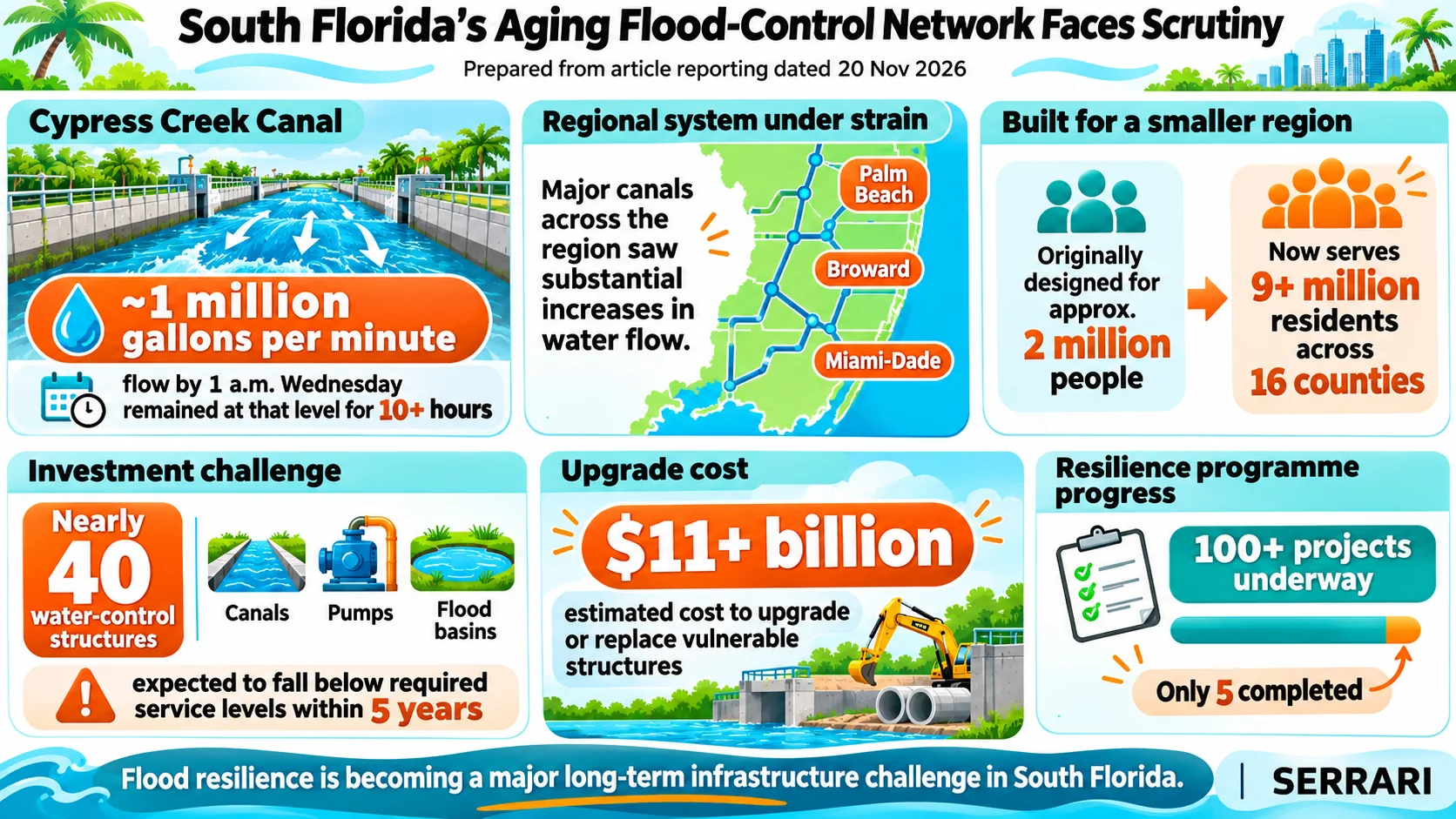
Beyond the immediate weather event, the flooding has renewed questions about the capacity of South Florida's flood-management infrastructure.
A 19 November investigation by WLRN Public Media reported that the Cypress Creek Canal in Broward County was moving approximately one million gallons of water per minute by 1 a.m. on Wednesday. The flow remained at that level for more than 10 hours.
Other major canals serving Broward, Miami-Dade and Palm Beach counties also experienced substantial increases in water flow. The South Florida Water Management District's engineers were reviewing readings from canal spillways and pumps to confirm the recorded figures.
The regional flood-control system was originally designed decades ago, when the area had a much smaller population and infrastructure was planned around less demanding rainfall conditions.
WLRN reported that the system was initially designed to serve approximately two million people but now supports a region with more than nine million residents across 16 counties.
The infrastructure is therefore managing a significantly larger population and greater development pressure than it was originally designed for.
The investigation also highlighted the scale of investment required. According to a flood-resilience report cited by WLRN, nearly 40 water-control structures, including canals, pumps and flood basins, are expected to fall below their required service levels over the next five years. Upgrading or replacing them could cost more than $11 billion.
A resilience programme involving more than 100 projects is underway, but only five had been completed at the time of WLRN's report.
El Niño Adds to Seasonal Climate Concerns
The flooding is taking place as South Florida prepares for a developing El Niño climate pattern.
WLRN reported that regional water-management officials are concerned about the potential for a particularly wet dry season as El Niño strengthens. The climate pattern can influence atmospheric circulation and rainfall distribution, although it does not explain every individual storm or flooding event.
The immediate rainfall episode was associated with a complex weather system. According to WLRN, a warm front moving north helped establish conditions for heavy rain, while changes in the front's position made it difficult for forecasters to pinpoint where the heaviest rainfall would occur.
Forecasts had initially indicated a good chance of two to four inches of rain, with only a 10% chance of higher totals. However, some parts of western Broward subsequently received more than 10 inches within 24 hours.
The distinction between the immediate weather system and the wider El Niño outlook is important. El Niño may influence seasonal conditions, but the reported flooding resulted from the particular atmospheric system and rainfall intensity affecting South Florida.
Coastal Flooding and King-Tide Exposure
The region also faces additional coastal flood concerns as another king-tide period approaches.
WLRN reported that moderate coastal flooding was possible in Lake Worth, with minor flooding possible in Fort Lauderdale and Miami during the approaching weekend.
Higher coastal water levels can make it more difficult for inland floodwater to drain naturally into the sea. Some drainage structures that previously relied on gravity now require pumping to move water out.
This creates an additional challenge when heavy rainfall occurs at the same time as elevated coastal water levels. Even pumping infrastructure may struggle when rainfall volumes exceed the system's design capacity.
Economic and Infrastructure Implications
The flooding has implications for businesses, households, transport networks and public infrastructure.
- Transport and logistics: Flooded roads, route diversions and suspended rail services disrupt passenger and freight movement.
- Businesses and commercial property: Flooded premises, damaged equipment and restricted access can interrupt operations and increase recovery costs.
- Education and public services: School closures and damage to public facilities affect service delivery and daily activities.
- Insurance and property: Flood damage increases financial exposure for homeowners, businesses and insurers, particularly where properties lack adequate flood coverage.
- Infrastructure investment: The event highlights the financial demands of upgrading drainage networks, canals, pumps and coastal flood-control structures.
The potential cost of upgrading nearly 40 water-control structures, estimated at more than $11 billion in the WLRN report, demonstrates that flood resilience is also a major long-term investment issue.
Weather and Flood Situation as of 20 November
By Friday, 20 November, CBS News Miami reported that floodwaters were slowly receding in some parts of Hollywood, although several roads remained underwater and clean-up operations were continuing.
The flood watch for Miami-Dade and Broward had been extended through Friday morning. Broward County schools remained closed, while Miami-Dade schools had resumed operations.
The immediate concern had shifted towards draining flooded neighbourhoods, restoring affected services and monitoring areas where standing water remained.
Analyst Desk Outlook
The South Florida flooding highlights the combined risks of extreme rainfall, saturated ground, urban development and ageing flood-control infrastructure.
Rainfall exceeding 15 inches in parts of Broward County within approximately 72 hours overwhelmed local drainage capacity, disrupted transport and public services, and left residential communities dealing with standing water and property damage.
The event also exposes a longer-term infrastructure challenge. South Florida's flood-control network is serving a population more than four times the size of the population it was originally designed to support. The projected cost of upgrading nearly 40 vulnerable water-control structures further demonstrates the scale of investment required to strengthen regional resilience.
The approaching king-tide period adds another consideration for coastal communities, where elevated sea levels can complicate the movement of inland floodwater towards the ocean.
For governments, infrastructure operators, insurers and businesses, the central issue is whether existing drainage and flood-management systems can keep pace with the region's growing exposure to intense rainfall and coastal flooding. Recovery from the November event will be important, but the longer-term priority remains improving the capacity of infrastructure to manage future flood events.
Sources
- CBS News Miami – South Florida Flooding Live Updates: More Rain Threatens Flooded Communities, Roads Remain Underwater
- WLRN Public Media – Epic Rain and Gushing Canals: Is South Florida's Aging Flood System Ready?
- CBS News Miami – South Florida Flooding Leads to State of Emergency in Broward as Hundreds Get Stranded, Schools Close
- CBS News Miami – NEXT Weather Alert Continues Due to Threat of Heavy Rain, Flooding Across South Florida
Your financial future isn’t something you wait for—it’s something you build. The real question is: when do you begin?
Move beyond simply staying informed. Navigate the markets with clarity—track trends through the Serrari Group Market Index, uncover opportunities in the Serrari Marketplace, and build practical knowledge with our Curated Wealth Builder Platform.
Stay connected to what truly matters. Get daily insights on macro trends and financial movements across Kenya, Africa, and global markets—delivered through the Serrari Newsletter.
Growth opens doors. Advance your career through professional programs including ACCA, HESI A2, ATI TEAS 7 , HESI EXIT , NCLEX - RN and NCLEX - PN, Financial Literacy!🌟—designed to move you forward with confidence.
See where money is flowing—clearly and in real time. Track Money Market Funds, Treasury Bills, Treasury Bonds, Green Bonds, and Fixed Deposits, alongside global and African indexes, key economic indicators, and the evolving Crypto and stablecoin landscape—all within Serrari’s Market Index.