Kenya’s Rains Intensify as Saturated Ground Increases Flood Risk
Kenya is experiencing heightened flood risks as the October-November-December (OND) short-rains season reaches its peak. Continued rainfall across several parts of the country is leaving soils increasingly saturated, reducing their capacity to absorb additional water and increasing surface runoff.
Reported · Published
Rainfall Intensifies Across Multiple Regions
Kenya is experiencing heightened flood risks as the October-November-December (OND) short-rains season reaches its peak. Continued rainfall across several parts of the country is leaving soils increasingly saturated, reducing their capacity to absorb additional water and increasing surface runoff.
According to the Daily Nation report published on 17 November, rainfall observations show that significant amounts have already been recorded in nearly all regions. Some weather stations in the South-Eastern Lowlands, particularly Machakos County, recorded more than 50 millimetres (mm) within 24 hours. Parts of northern Kenya received more than 30mm, while Nairobi recorded rainfall exceeding 20mm.
The rainfall accumulation is also reflected in the Kenya Meteorological Service Authority's review for 9–15 November. Kalungu Rainfall Station in Kitui County recorded the highest seven-day rainfall total at 147.7mm. Irbaan Primary School weather station in Narok recorded 108.4mm within 24 hours on 12 November.
The review further indicated that rainfall increased across the country between 2–8 November and 9–15 November, pointing to a strengthening rainfall pattern.
Saturated Soils Increase Flash-Flood Exposure
The growing concern is the condition of the ground following successive rainfall events. As soils absorb water over an extended period, their ability to take in additional moisture declines. Further rainfall is therefore more likely to flow across the surface rather than infiltrate into the ground.
This increases the potential for flash floods, particularly in low-lying settlements, riverine communities and urban areas with inadequate drainage.
Urban centres face additional exposure because extensive construction and paved surfaces limit water infiltration. When drainage systems cannot accommodate the volume of runoff, water accumulates on roads and in residential areas, disrupting transport and exposing households and businesses to flooding.
The implications extend beyond locations receiving the heaviest rainfall. Water flowing downstream can increase pressure on rivers and drainage channels, putting communities some distance from the original rainfall areas at risk.
Context is everything. Stay ahead of shifting trends with today’s market updates, and uncover emerging opportunities using the Serrari Group Market Index and Marketplace. Then, take control of your own financial future by exploring our Money & Life Reset Transformation Blueprint ™ to build stronger habits, create better systems, and design a path toward lasting wealth.
Flooding Already Affecting Households and Livelihoods
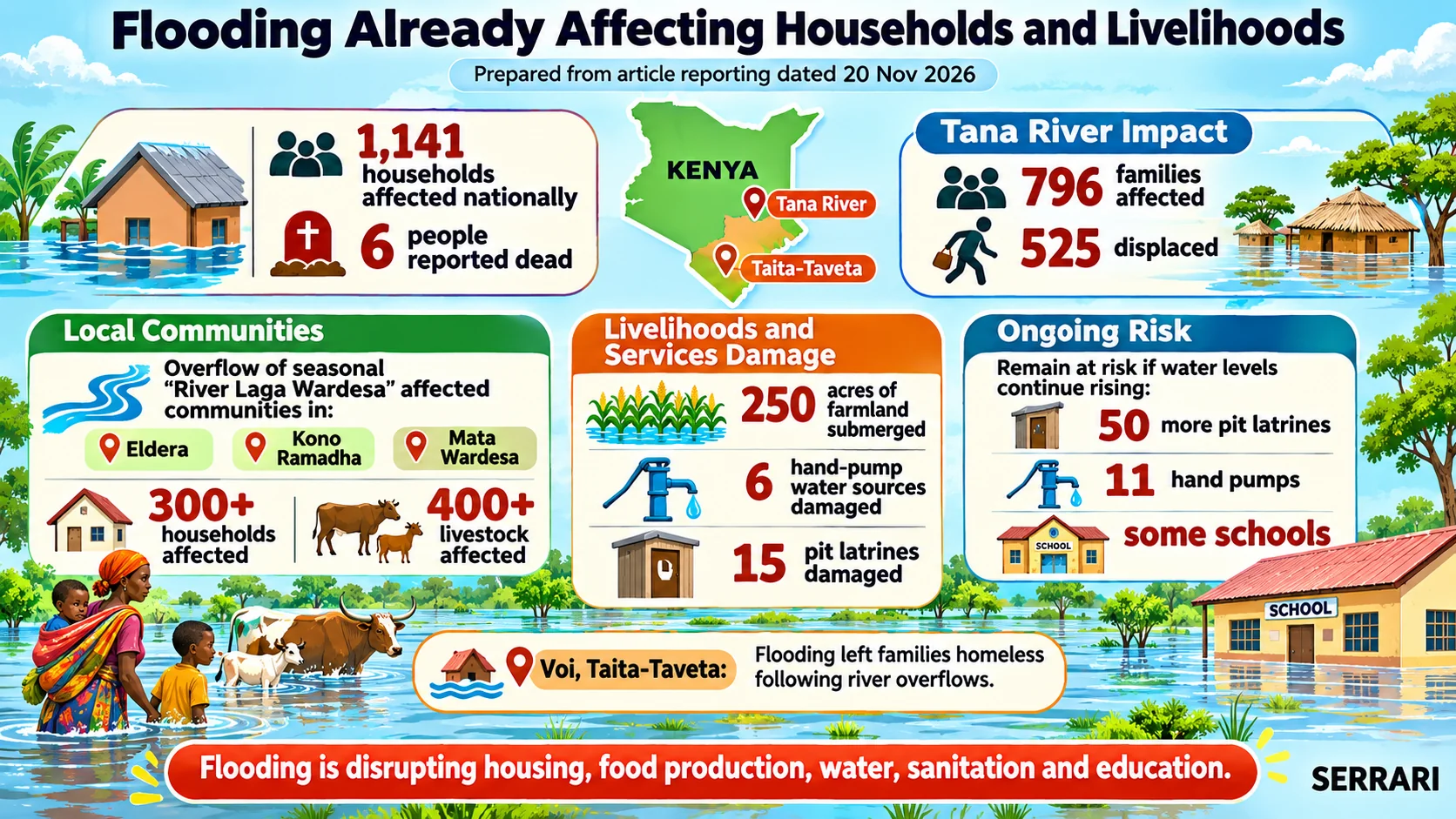
The developing situation is no longer limited to weather forecasts. A Kenya Red Cross situation report cited by the Daily Nation on 19 November indicated that 1,141 households had been affected by flooding nationally, with six people reported dead.
Tana River County has recorded the highest number of affected households, with 796 families affected and 525 displaced. In Taita-Taveta County, flooding in Voi has also left families homeless following river overflows.
In Tana River, the overflow of seasonal River Laga Wardesa has affected communities in Eldera, Kono Ramadha and Mata Wardesa. More than 300 households and over 400 livestock were affected in these areas.
The humanitarian impact is also visible in damage to essential services. At least 250 acres of farmland in Tana River were reported submerged, while six hand-pump water sources and 15 pit latrines were damaged by floodwaters. A further 50 pit latrines, 11 hand pumps and some schools were reported to be at risk if water levels continued rising.
These developments highlight how flooding can affect several dimensions of local livelihoods simultaneously, including housing, food production, access to clean water, sanitation and education.
Transport and Infrastructure Disruptions
Flooding is creating additional pressure on road networks and movement across affected counties.
Sections of the Mombasa-Nairobi Highway at Maungu were reported impassable, leaving motorists and truck drivers stranded for hours. The Kono Ramadha-Mlanjo road in Tana River was also cut off.
Elsewhere, flooding affected the Kitui-Mwingi-Garissa Road at Mbakini Bridge, while the Doldol-Nanyuki Road in Laikipia was cut off at Daraja ya Mungu following the overflow of River Salama Ngororo.
Such disruptions can delay the movement of agricultural produce, essential supplies and passengers. For businesses dependent on road transport, prolonged flooding can increase delivery delays and interrupt supply chains.
The damage to roads and access routes also complicates emergency response, particularly when affected communities need evacuation, food assistance and medical support.
Agricultural Exposure and Food Security
Agriculture remains particularly exposed to prolonged rainfall and flooding. Although the short-rains season supports agricultural production and replenishes water resources, excessive rainfall can create adverse growing conditions.
Waterlogged fields can damage crops, wash away fertile topsoil and interrupt planting, harvesting and movement of produce. Flooding can also destroy livestock and disrupt access to pasture.
The situation in Tana River illustrates these risks. More than 400 livestock were affected in the Laga Wardesa flooding, while at least 250 acres of farmland were submerged.
The impact on agricultural livelihoods could extend beyond immediate crop and livestock losses. Where roads are flooded, farmers may also struggle to transport produce to markets, increasing the risk of post-harvest losses and income disruptions.
Prolonged flooding could therefore place additional pressure on household food availability and the livelihoods of communities dependent on farming and livestock production.
What Is Sustaining the Rainfall?
The Daily Nation report attributes the continued rainfall to a combination of global climate patterns and local atmospheric conditions.
According to David Koros, Assistant Director of Forecasting Services at the Kenya Meteorological Service Authority, both El Niño and a positive Indian Ocean Dipole (IOD) remain active.
Warmer sea temperatures in the western Indian Ocean are sustaining the positive IOD. Locally, abundant atmospheric moisture, instability and favourable wind patterns are supporting the development of rain-bearing clouds.
The report also identifies Convective Available Potential Energy (CAPE) as one of the measures used to understand atmospheric instability. CAPE represents the energy available to support the upward movement of warm, moist air, which can contribute to cloud formation and rainfall.
The combination of these conditions is expected to sustain rainfall, particularly in western Kenya and several other parts of the country, over the coming weeks.
Kenya Meteorological Service Outlook: 17–23 November
The Kenya Meteorological Service Authority's weekly forecast issued on 16 November indicates that rainfall is expected to continue across several counties between 17 and 23 November.
The forecast covers parts of the following regions:
- Western Kenya: Busia, Kakamega, Kisumu, Siaya, Homa Bay, Migori, Kisii, Nyamira and Vihiga.
- Central and Nairobi region: Nairobi, Kiambu, Murang’a, Nyeri, Kirinyaga, Nyandarua and Laikipia.
- Eastern and South-Eastern Kenya: Embu, Meru, Tharaka-Nithi, Kitui, Machakos and Makueni.
- Rift Valley: Bomet, Kericho, Nakuru, Narok, Nandi, Nyandarua and Kajiado.
- Coastal region: Mombasa, Kilifi, Kwale, Lamu, Tana River and Taita-Taveta.
- Northern and North-Eastern Kenya: Garissa and Wajir.
The forecast also indicates that daytime average temperatures exceeding 35°C are expected in parts of Samburu, Turkana and Marsabit counties.
The continued rainfall forecast means that flood-prone communities and areas with already saturated soils remain exposed to additional rainfall during this period.
Humanitarian Response and Community Preparedness
The Kenya Red Cross has been supporting affected communities, including households displaced by flooding in Tana River County.
In a report published by the Kenya News Agency on 17 November, at least 320 households in villages within Madogo Ward had received non-food relief assistance. The support included emergency shelter and household items.
The organisation also indicated plans to register approximately 15,500 people for cash assistance to facilitate relocation from flood-risk areas. Residents were urged to move to higher ground and follow weather warnings issued by the Kenya Meteorological Service Authority and other government agencies.
These interventions demonstrate the importance of anticipatory action, particularly where communities have limited time to respond to rising water levels.
Early evacuation, reliable weather information and access to emergency support remain important in reducing exposure to flooding.
Analyst Desk Outlook
Kenya's current rainfall situation presents a growing risk because repeated downpours are occurring over increasingly saturated ground. The combination increases the likelihood of rapid surface runoff, flash floods and river overflows, particularly in low-lying settlements, urban centres with inadequate drainage and communities located along river corridors.
The latest reported impacts in Tana River, Taita-Taveta and other affected counties show that the consequences are already extending beyond temporary waterlogging. Households have been displaced, farmland submerged, livestock affected, roads disrupted and water and sanitation facilities damaged.
The Kenya Meteorological Service Authority's 17–23 November forecast indicates that rainfall is expected to continue across a wide range of counties. This keeps flood exposure elevated during a period when November is expected to mark the peak of the short-rains season.
For agriculture, transport, businesses and humanitarian operations, the key concern is the cumulative effect of continued rainfall on already vulnerable infrastructure and livelihoods. Monitoring rainfall accumulation, river levels and local flood warnings will remain essential as the season progresses.
Sources
- Daily Nation – Rains Intensify Across Kenya as Saturated Ground Raises Flood Risk (17 November 2026) https://nation.africa/kenya/climate/rains-intensify-across-kenya-as-saturated-ground-raises-flood-risk-5673846
- Daily Nation – Floods Displace Hundreds as Six People Die Across the Country (19 November 2026) https://beta.nation.co.ke/kenya/news/floods-displace-hundreds-as-six-people-die-across-the-country-5675924
- Kenya Meteorological Service Authority – Weekly Weather Forecast, 17–23 November 2026 https://meteo.go.ke/documents/5678/Weekly_weather_forecast_valid_17th_to_23rd_November_2026.pdf
- Kenya News Agency – Flood Victims in Tana River Receive Non-Food Items Support, Urged to Move to Higher Grounds (17 November 2026) https://www.kenyanews.go.ke/flood-victims-in-tana-river-receive-nonfood-items-support-urged-to-move-to-higher-grounds/
- KBC – Brace for Above-Average Rainfall in November – Kenya Met (1 November 2026) https://www.kbc.co.ke/brace-for-above-average-rainfall-in-november-kenya-met/
- Daily Nation – Residents Warned of Flooding as River Tana Swells (5 November 2026) https://beta.nation.co.ke/kenya/counties/tana-river/residents-warned-of-flooding-as-river-tana-swells--5659780
- Daily Nation – Coastal Floods Displace Hundreds as Tana River and Lamu Brace for More Water (31 October 2026) https://beta.nation.co.ke/kenya/counties/coastal-floods-displace-hundreds-as-tana-river-and-lamu-brace-for-more-water-5653216
Your financial future isn’t something you wait for—it’s something you build. The real question is: when do you begin?
Move beyond simply staying informed. Navigate the markets with clarity—track trends through the Serrari Group Market Index, uncover opportunities in the Serrari Marketplace, and build practical knowledge with our Curated Wealth Builder Platform.
Stay connected to what truly matters. Get daily insights on macro trends and financial movements across Kenya, Africa, and global markets—delivered through the Serrari Newsletter.
Growth opens doors. Advance your career through professional programs including ACCA, HESI A2, ATI TEAS 7 , HESI EXIT , NCLEX - RN and NCLEX - PN, Financial Literacy!🌟—designed to move you forward with confidence.
See where money is flowing—clearly and in real time. Track Money Market Funds, Treasury Bills, Treasury Bonds, Green Bonds, and Fixed Deposits, alongside global and African indexes, key economic indicators, and the evolving Crypto and stablecoin landscape—all within Serrari’s Market Index.