
The U.S. Securities and Exchange Commission has proposed new rules creating a regulatory framework for how registered investment advisers and regulated funds can hold crypto assets. The proposal would allow limited self-custody when an appropriate custodian is unavailable and would expand custody options to state trust companies.
Key Overview
- The SEC proposed the new crypto custody framework on October 1, 2026.
- It covers registered investment advisers and regulated funds.
- Advisers could use self-custody under specific conditions.
- State trust companies could serve as crypto custodians.
- Self-custody would require regular assessments and strong safeguards.
- Public comments will remain open for 60 days after Federal Register publication.
SEC Moves to Clarify Crypto Custody
The SEC has proposed new rules aimed at establishing a clearer framework for how investment advisers and regulated funds hold crypto assets for clients.
The proposal would update custody requirements under the Investment Advisers Act of 1940 and the Investment Company Act of 1940, legislation originally designed around traditional financial assets.
The changes would create a framework governing how registered investment advisers and regulated funds hold crypto assets while also expanding the range of crypto investment strategies that regulated funds can offer investors.
The SEC said the proposal is intended to remove regulatory barriers that have made it difficult for advisers to provide crypto-related investment services.
Conditional Self-Custody Gets a Path
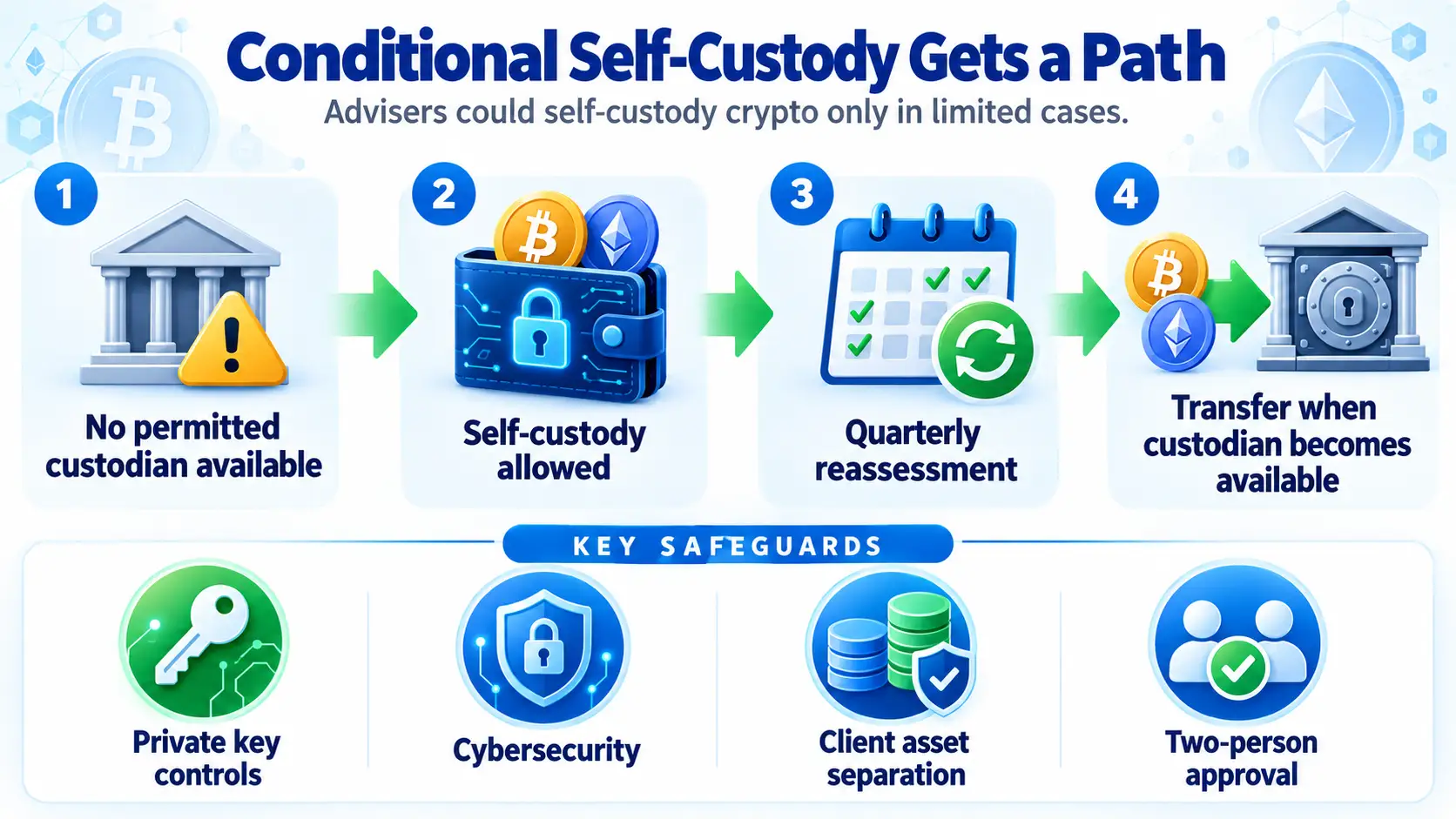
One of the most significant elements is a proposed pathway allowing advisers to hold crypto assets themselves in limited circumstances.
Under the proposal, an adviser could use self-custody only after determining that no permitted custodian is available for the particular crypto asset.
That determination would then need to be reassessed quarterly.
The arrangement would come with additional safeguards covering private keys, cybersecurity and the separation of individual client holdings. Transfers of self-custodied assets would also require approval from at least two authorised individuals.
If an appropriate custodian later becomes available, the assets would need to be transferred to that custodian as soon as reasonably practicable.
State Trust Companies Could Become Custodians
The proposal would also expand the pool of institutions that could provide crypto custody.
State trust companies would be eligible to take on custodial roles for client and fund holdings, subject to regulatory requirements.
These companies would need appropriate state authorisation and safeguards covering risks such as theft, loss, misuse and misappropriation of crypto assets and related cash.
The change could broaden the custody market beyond traditional banks and broker-dealers, particularly for crypto assets that may not yet be supported by established custodians.
Addressing the Custodian Gap
A key issue behind the proposal is the limited availability of qualified custodians for some crypto assets.
Newly launched digital assets may take months to become supported by appropriate custody providers. This can create difficulties for advisers that want to offer clients exposure while still meeting existing custody requirements.
The proposed framework is designed to address this gap by allowing conditional self-custody when a suitable permitted custodian is genuinely unavailable.
The proposal therefore does not create unrestricted self-custody. Instead, it establishes a conditional route that requires advisers to demonstrate that the relevant requirements have been met.
Context is everything. Stay ahead of shifting trends with today’s market updates, and uncover emerging opportunities using the Serrari Group Market Index and Marketplace. Then, take control of your own financial future by exploring our Money & Life Reset Transformation Blueprint ™ to build stronger habits, create better systems, and design a path toward lasting wealth.
Broader Crypto Investment Access
The SEC’s proposal could also expand the range of crypto strategies available through regulated investment products.
The framework covers registered investment companies and business development companies alongside registered investment advisers. By providing clearer custody arrangements, the SEC expects advisers and regulated funds to have greater ability to offer crypto-related investment strategies.
The changes also include updates to financial statement audit requirements for registered investment advisers and broker-dealer custodial services for regulated funds.
Public Consultation Still Ahead
The proposal is not yet final.
Interested parties will have 60 days to submit comments after the SEC’s proposing release is published in the Federal Register. The feedback period gives advisers, funds, custodians and other market participants an opportunity to respond before the rules potentially move towards adoption.
The SEC could revise the framework following the consultation.
The proposal comes as U.S. regulators continue developing rules around crypto markets, custody and tokenised financial assets.
Outlook
The SEC’s proposed custody framework could provide greater regulatory clarity for investment advisers and regulated funds seeking to offer crypto exposure. The combination of conditional self-custody and state trust company custody would give market participants additional options while maintaining safeguards around client assets.
For advisers, the most important change could be the creation of a defined route for holding crypto when an appropriate custodian is unavailable. However, the proposed conditions mean self-custody would remain a tightly controlled exception rather than a broad permission.
The 60-day public comment period will now give the industry an opportunity to assess the framework before the SEC decides whether and how to finalise the rules.
FAQs
1. What did the SEC propose?
The SEC proposed new rules governing how registered investment advisers and regulated funds can custody crypto assets.
2. Would advisers be allowed to self-custody crypto?
Yes, but only under specific conditions, including determining that no permitted custodian is available for the relevant asset.
3. Can state trust companies custody crypto?
Under the proposal, state trust companies could serve as custodians, subject to applicable authorisation and safeguards.
4. When can the public comment on the proposal?
Comments will remain open for 60 days after the proposal is published in the Federal Register.
Sources: Forex Crunch | Quartz | Yahoo Finance
Your financial future isn’t something you wait for—it’s something you build.
The real question is: when do you begin?
Move beyond simply staying informed.
Navigate the markets with clarity—track trends through the Serrari Group Market Index, uncover opportunities in the Serrari Marketplace, and build practical knowledge with our Curated Wealth Builder Platform.
Stay connected to what truly matters.
Get daily insights on macro trends and financial movements across Kenya, Africa, and global markets—delivered through the Serrari Newsletter.
Growth opens doors.
Advance your career through professional programs including ACCA, HESI A2, ATI TEAS 7 , HESI EXIT , NCLEX – RN and NCLEX – PN, Financial Literacy!🌟—designed to move you forward with confidence.
See where money is flowing—clearly and in real time.
Track Money Market Funds, Treasury Bills, Treasury Bonds, Green Bonds, and Fixed Deposits, alongside global and African indexes, key economic indicators, and the evolving Crypto and stablecoin landscape—all within Serrari’s Market Index.