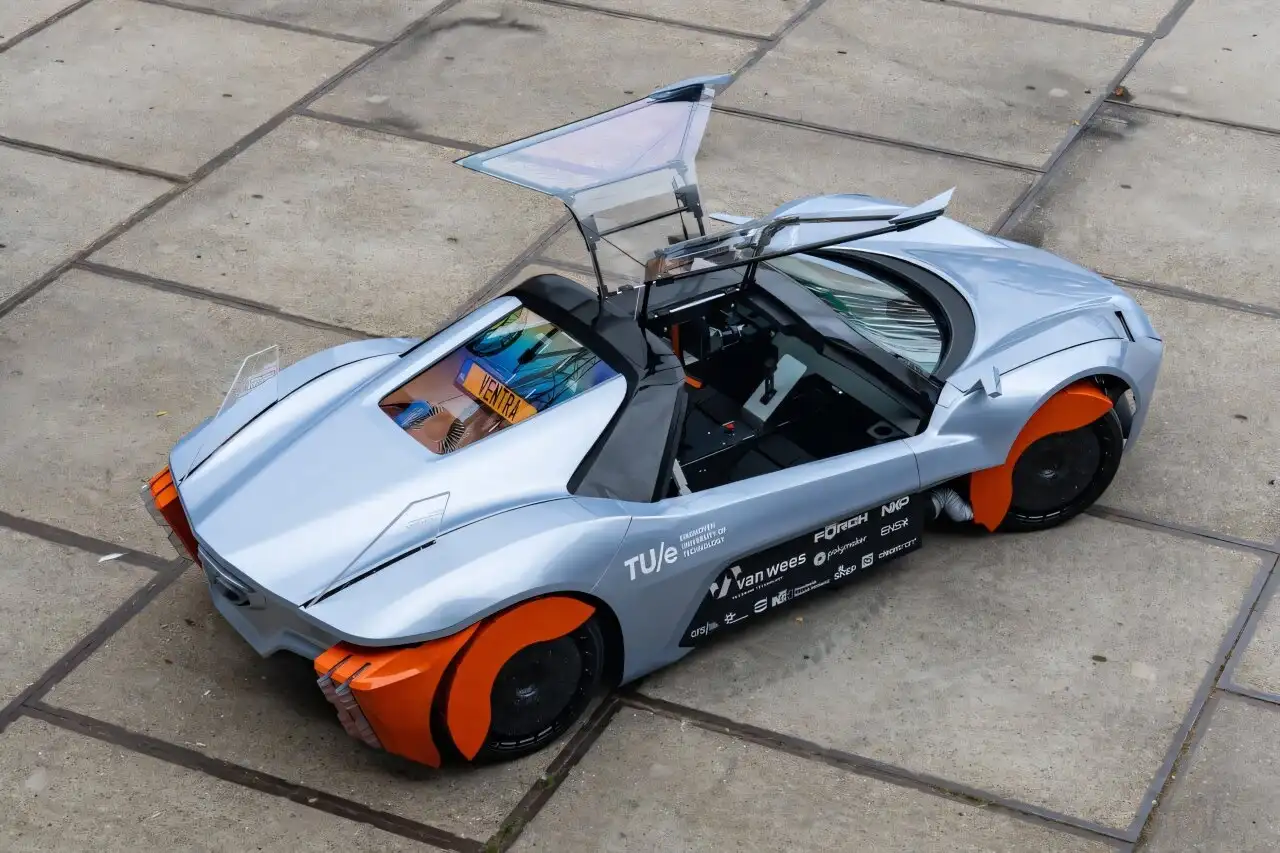
Students from Eindhoven University of Technology have developed VENTRA, an electric concept car designed to capture particulate matter produced by tire and brake wear while driving. The vehicle uses an electrostatic collection system to capture particles near the wheels, while its lightweight design aims to reduce the amount of particulate matter generated in the first place.
Key Overview
- VENTRA was developed by student team TU/ecomotive at Eindhoven University of Technology.
- The car targets particulate matter from tires, brakes and road wear.
- Its T.R.A.C.E. system uses electrical charging to attract particles to a grounded collection surface.
- The system can capture up to 42% of particles at lower speeds.
- At 50–80 km/h, the system can capture 24% of particulate matter.
- The lightweight chassis reduces the vehicle’s weight by nearly 100 kilograms.
- Captured particles can be cleaned and recycled into the vehicle’s interior.
- The car also includes a Clean Drive system designed to encourage smoother driving.
Eindhoven Students Develop an EV That Captures Particulate Matter
Students from Eindhoven University of Technology have unveiled VENTRA, a sustainable electric concept car designed to tackle a source of vehicle pollution that does not come from the exhaust pipe.
The student team TU/ecomotive developed the vehicle to capture particulate matter generated by tire and brake wear while the car is moving.
VENTRA, a car that captures polluting particles from the air as it drives.
The concept was presented as an effort to encourage the automotive industry to look beyond traditional exhaust emissions when considering vehicle pollution.
Tackling Pollution From Tires and Brakes
Electric vehicles do not produce tailpipe emissions, but they can still generate particulate matter through tire, brake and road wear.
“No exhaust emissions does not necessarily mean no emissions,” said TU/ecomotive team manager Tim Spencer.
The students are focusing on these non-exhaust emissions because particles released around the wheels can contribute to pollution near roads.
The issue is particularly relevant for electric vehicles because their weight and acceleration characteristics can place additional forces on tires.
VENTRA Uses an Electrostatic Capture System
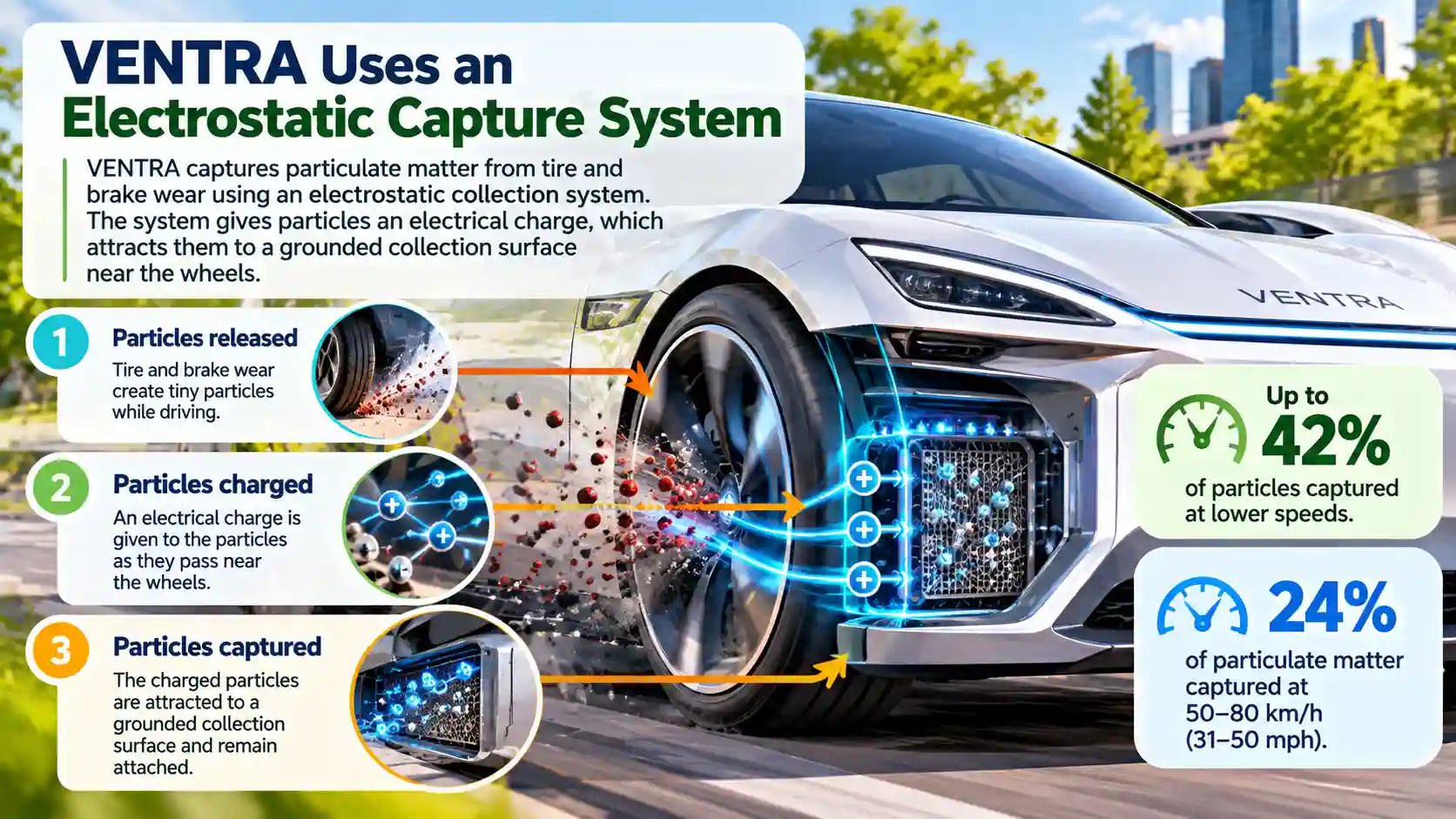
VENTRA’s main innovation is its particulate-matter collection system.
Instead of using a conventional physical filter, the system gives particles an electrical charge. The charged particles are then attracted toward a grounded collection surface positioned near the wheels.
The particles remain attached to the collection surface rather than continuing into the surrounding air.
At lower speeds, it could capture up to 42 percent.
At higher speeds, the system can still capture a significant share of the particles.
At speeds of 50 to 80 kilometers per hour (31 to 50 miles per hour), 24% of the particulate matter could be directed into the collection container.
Captured Particles Can Be Recycled
The system is designed so that captured particles can be removed after driving.
The collection system can be cleaned using a vacuum cleaner or water, while the students have also demonstrated the possibility of recycling the captured material.
The concept uses the collected particles as part of the vehicle’s interior, showing how material captured from tire and brake wear could potentially be reused.
Lightweight Design Helps Reduce Pollution
VENTRA does not only capture particulate matter after it is produced. Its design also aims to reduce the amount generated by the vehicle.
The car uses lightweight carbon-fiber-reinforced thermoplastic panels for much of its chassis.
As a result, the car weighs nearly 100 kilograms (220 pounds) less.
A lighter vehicle puts less pressure on the tires, which can reduce tire wear and therefore the amount of particulate matter released.
Context is everything. Stay ahead of shifting trends with today’s market updates, and uncover emerging opportunities using the Serrari Group Market Index and Marketplace. Then, take control of your own financial future by exploring our Money & Life Reset Transformation Blueprint ™ to build stronger habits, create better systems, and design a path toward lasting wealth.
Clean Drive Encourages Smoother Driving
VENTRA also includes a system called Clean Drive, which monitors driving behavior and provides feedback through the dashboard.
The system encourages drivers to accelerate more gradually, brake less aggressively and avoid unnecessary steering.
These driving habits can reduce tire and brake wear while also supporting more efficient driving.
The students therefore combine three approaches: reducing particulate generation through lower vehicle weight, capturing particles that are released, and encouraging driving behavior that produces less wear.
Student Innovation Targets a Wider EV Challenge
VENTRA was developed over one year by a multidisciplinary student team.
The project is intended as a proof of concept showing that electric vehicles can address pollution beyond traditional exhaust emissions.
The students also want the project to encourage automakers to consider tire and brake emissions when developing future vehicles.
New European Emissions Rules
The issue is also receiving greater regulatory attention in Europe.
According to Interesting Engineering, “From November 2026, Euro 7 rules will introduce requirements covering emissions from brake and tire wear.”
This means VENTRA’s focus on non-exhaust emissions comes as European vehicle regulations expand their attention beyond traditional tailpipe pollution.
Outlook
VENTRA demonstrates a different approach to electric vehicle emissions by targeting particulate matter generated by tires, brakes and road wear.
Its combination of an electrostatic capture system, lightweight construction and Clean Drive feedback is designed to reduce and capture particles during everyday driving.
For TU/ecomotive, the project is also intended to show the automotive industry that reducing vehicle pollution involves more than eliminating exhaust emissions.
FAQs
1. What is VENTRA?
VENTRA is an electric concept car developed by students from Eindhoven University of Technology that captures particulate matter produced by tire and brake wear.
2. How does VENTRA capture particulate matter?
Its system electrically charges particles around the wheels and attracts them to a grounded collection surface.
3. How much particulate matter can VENTRA capture?
The system can capture up to 42% of particles at lower speeds and 24% at speeds between 50 and 80 km/h.
4. How does VENTRA reduce the amount of pollution it generates?
The car uses a lightweight chassis to reduce tire pressure and wear, while its Clean Drive system encourages smoother acceleration, braking and steering.
Sources: IO+ | Eindhoven University of Technology | Interesting Engineering | Heise
Your financial future isn’t something you wait for—it’s something you build.
The real question is: when do you begin?
Move beyond simply staying informed.
Navigate the markets with clarity—track trends through the Serrari Group Market Index, uncover opportunities in the Serrari Marketplace, and build practical knowledge with our Curated Wealth Builder Platform.
Stay connected to what truly matters.
Get daily insights on macro trends and financial movements across Kenya, Africa, and global markets—delivered through the Serrari Newsletter.
Growth opens doors.
Advance your career through professional programs including ACCA, HESI A2, ATI TEAS 7 , HESI EXIT , NCLEX – RN and NCLEX – PN, Financial Literacy!🌟—designed to move you forward with confidence.
See where money is flowing—clearly and in real time.
Track Money Market Funds, Treasury Bills, Treasury Bonds, Green Bonds, and Fixed Deposits, alongside global and African indexes, key economic indicators, and the evolving Crypto and stablecoin landscape—all within Serrari’s Market Index.