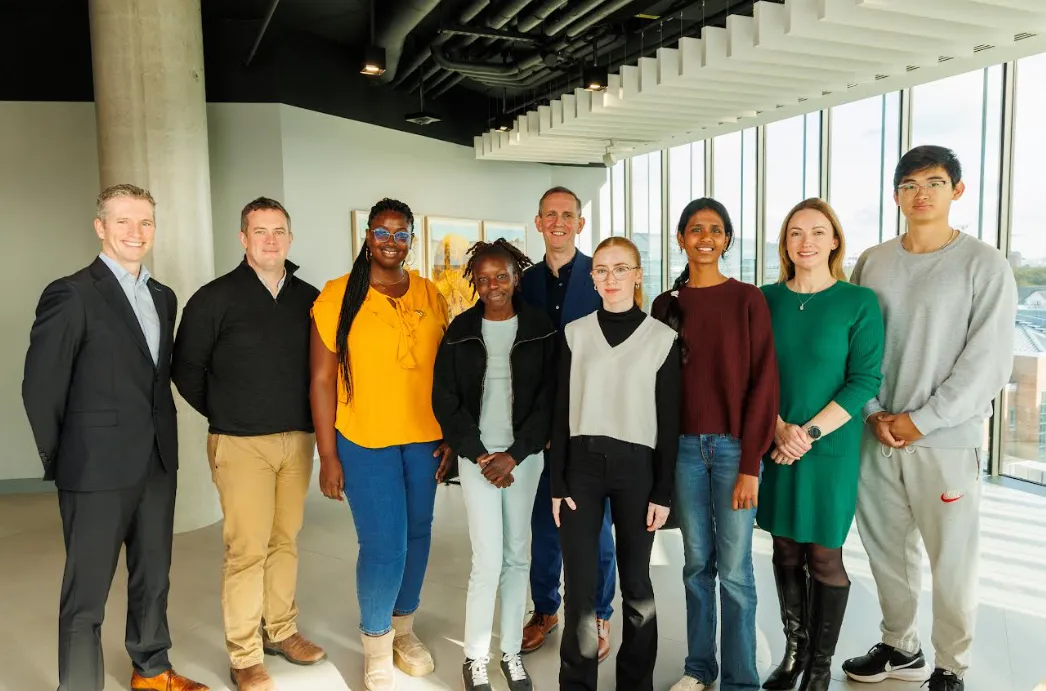
A new €5.7 million research initiative aimed at harnessing the power of artificial intelligence to combat climate change has been launched through a partnership between Research Ireland and Allied Irish Banks (AIB).
The initiative, known as Decarb-AI: AI-Powered Pathways to Climate Resilience, will establish a national research facility designed to explore how advanced artificial intelligence technologies can accelerate climate mitigation and adaptation strategies.
The programme will fund a new generation of international researchers and support interdisciplinary collaboration across several of Ireland’s leading universities. Its core objective is to develop data-driven tools and analytical systems capable of tackling complex climate challenges, ranging from renewable energy optimisation to biodiversity protection.
The centre represents a growing recognition that artificial intelligence could play a pivotal role in helping governments, industries, and communities transition toward low-carbon and climate-resilient economies.
Markets move fast; don’t get left behind. We’ve paired the Serrari Group Market Index with a curated Marketplace and a comprehensive Wealth Builder Course to ensure you have the data—and the skills—to act on it.
Building an AI Research Hub for Climate Solutions
The Decarb-AI national centre will operate as a collaborative research platform bringing together multiple higher education institutions across Ireland.
The project is led by University College Dublin, with participation from several other institutions, including:
- Trinity College Dublin
- Dublin City University
- Technological University Dublin
- University of Limerick
- University of Galway
- University College Cork
Through this network, researchers will combine expertise in data science, environmental science, engineering, finance, and climate research to develop solutions capable of addressing both immediate and long-term sustainability challenges.
The centre will also collaborate with the Irish Centre for High-End Computing (ICHEC) to support high-performance computing requirements for advanced AI modelling.
Training the Next Generation of Climate Innovators
One of the core components of the initiative is a major doctoral research programme designed to attract global talent.
The Decarb-AI centre will support 30 fully funded PhD researchers, known as iScholars, across three separate intakes.
These doctoral candidates will undertake four-year research programmes, working under the supervision of leading academic researchers across Ireland’s university system.
The first intake of eight iScholars has already begun their research. They come from a diverse range of countries including China, Ghana, India, the United Kingdom, France, Ireland, and Kenya, reflecting the programme’s international scope.
The research environment aims to blend academic rigour with real-world application, ensuring that solutions developed within the programme can be applied to industry, government policy, and environmental management.
Applications for the second cohort of researchers are expected to attract candidates with backgrounds in:
- Artificial intelligence and machine learning
- Data science and advanced analytics
- Environmental and climate sciences
- Engineering and technology
- Sustainable finance and economics
The programme forms part of the broader Innovate for Ireland initiative, which seeks to attract top global research talent to work on sustainability challenges.
Key Research Areas for Climate Innovation
The Decarb-AI research programme will focus on several key areas where artificial intelligence could significantly improve climate mitigation and adaptation strategies.
AI-Optimised Renewable Energy Systems
One major research focus involves improving the efficiency and performance of renewable energy systems.
Artificial intelligence tools can help optimize how energy is produced, stored, and distributed across renewable infrastructure such as wind farms and solar networks.
AI models can analyse vast datasets related to weather patterns, grid performance, and energy demand, enabling more efficient renewable energy integration into national electricity systems.
Data Centre Sustainability
Another major focus area is the environmental impact of data centres.
Data centres are becoming increasingly energy-intensive due to the rapid growth of cloud computing, artificial intelligence processing, and digital services.
Researchers will explore how AI can improve energy efficiency, cooling systems, and operational management to reduce the carbon footprint of these facilities.
Environmental Monitoring and Restoration
The centre will also examine how AI can support environmental restoration and monitoring.
Projects in this area will explore:
- Machine learning models for water quality forecasting
- AI tools for peatland restoration planning
- Satellite-based monitoring systems for biodiversity and land-use management
These technologies could help policymakers and environmental organisations track ecosystem health and implement more effective conservation strategies.
Sustainable Finance and Decision-Making Tools
In addition to environmental modelling, researchers will also focus on financial tools that support climate action.
AI-driven analytics could help businesses and financial institutions identify low-carbon investment opportunities, climate risks, and sustainable financing strategies.
This research could lead to the development of decision-support systems that help companies integrate sustainability considerations into investment and operational decisions.
Context is everything. While you follow today’s updates, use the Serrari Market Index and Marketplace to spot emerging shifts. Need to sharpen your edge? Our Wealth Builder Course turns these insights into a professional-grade strategy.
Industry and Finance Sector Collaboration
A key partner in the initiative is Allied Irish Banks, one of Ireland’s largest financial institutions.
Through its sustainability research division, AIB will contribute both financial support and industry expertise to the Decarb-AI programme.
According to Yvonne McCarthy, Head of Sustainability Research at AIB, the collaboration highlights the growing role financial institutions can play in accelerating climate innovation.
She noted that tackling climate change requires both technological advancement and strong collaboration between research institutions and industry.
McCarthy explained that supporting AI-driven tools for energy systems and sustainable finance could help unlock solutions that enable businesses and communities to make meaningful progress toward decarbonisation.
By partnering with the research community, financial institutions can help ensure that cutting-edge technologies are translated into real-world solutions capable of supporting economic growth while reducing environmental impact.
Strengthening Ireland’s Climate Research Leadership
The initiative also represents a strategic effort to strengthen Ireland’s position as a global hub for climate innovation and sustainability research.
Dr Diarmuid O’Brien, Chief Executive of Research Ireland, emphasised that combining artificial intelligence with climate science could unlock powerful new approaches to solving environmental challenges.
He noted that Decarb-AI has the potential to generate solutions that are both scientifically rigorous and nationally impactful, helping Ireland accelerate its transition to a low-carbon economy.
Beyond technological development, the programme is also designed to train a new generation of interdisciplinary leaders capable of bridging the gap between research, policy, and industry.
This focus on talent development reflects a broader recognition that achieving climate goals requires both technological breakthroughs and skilled professionals capable of implementing them.
Artificial Intelligence as a Climate Catalyst
Researchers involved in the project believe artificial intelligence could become a critical tool in addressing the complexity of climate challenges.
Professor Andrew Parnell, Professor of Data Science for Weather and Climate at University College Dublin and the centre’s lead principal investigator, highlighted the unique capabilities AI brings to climate research.
He described artificial intelligence as a “catalyst required to solve the multi-objective problems inherent in climate resilience.”
Climate challenges often involve balancing multiple competing priorities, such as reducing emissions while maintaining economic growth and protecting natural ecosystems.
AI technologies can process vast datasets and simulate complex environmental interactions, enabling scientists and policymakers to evaluate different strategies and outcomes.
Through Decarb-AI, researchers aim to develop scalable and industry-ready solutions that address these complex trade-offs.
Potential outputs from the programme could range from improved environmental monitoring systems to advanced financial modelling tools for sustainable investment.
Supporting Global Sustainability Innovation
The launch of the Decarb-AI centre also aligns with broader efforts to position Ireland as a global centre for sustainability research and innovation. As countries increasingly look for technology-driven solutions to climate challenges, initiatives like Decarb-AI are helping strengthen Ireland’s role in advancing climate science and sustainable innovation.
According to Simon Boucher, Chief Executive of Global Innovators Ireland, the initiative represents an important step toward achieving the vision of making Ireland a world-leading hub for sustainability innovation.
By bringing together academic institutions, industry partners, and international research talent, the programme aims to create an environment where new ideas and technologies can be developed and applied to real-world climate challenges.
By attracting international researchers and supporting interdisciplinary collaboration, the programme aims to produce solutions capable of addressing some of the world’s most pressing environmental challenges.
These collaborations also help strengthen Ireland’s global research network while encouraging knowledge exchange between scientists, policymakers, and industry leaders working on sustainability.
The initiative also reflects a broader trend in climate research, where advanced digital technologies such as artificial intelligence, machine learning, and big data analytics are increasingly integrated into environmental science.
These tools allow researchers to process complex climate data more efficiently and develop smarter systems for energy management, environmental monitoring, and long-term climate planning.
The Growing Role of AI in Climate Action
Globally, artificial intelligence is rapidly emerging as a powerful tool in climate science and sustainability planning.
AI technologies are already being used to:
- Improve climate modelling and weather forecasting
- Optimise renewable energy generation and grid management
- Monitor deforestation and biodiversity loss
- Enhance energy efficiency across industries
As climate challenges become more complex and data-intensive, the ability to analyse large datasets and identify patterns quickly is becoming increasingly important.
Initiatives like Decarb-AI demonstrate how technology, research, and finance can converge to accelerate climate solutions.
Outlook: AI at the Center of Future Climate Innovation
The €5.7 million investment in the Decarb-AI centre highlights growing recognition that artificial intelligence will play a central role in shaping the future of climate innovation.
By combining academic expertise, industry collaboration, and international research talent, the initiative aims to produce practical solutions capable of supporting both environmental sustainability and economic development.
As governments and businesses worldwide intensify their efforts to reduce emissions and adapt to climate change, AI-driven technologies could become a critical component of global climate strategies.
For Ireland, the Decarb-AI centre represents not only an investment in research but also a step toward establishing the country as a leader in technology-driven climate solutions.
Your financial future isn’t something you wait for—it’s something you build.
The real question is: when do you begin?
Move beyond simply staying informed.
Navigate the markets with clarity—track trends through the Serrari Group Market Index, uncover opportunities in the Serrari Marketplace, and build practical knowledge with our Curated Wealth Builder Course.
Stay connected to what truly matters.
Get daily insights on macro trends and financial movements across Kenya, Africa, and global markets—delivered through the Serrari Newsletter.
Growth opens doors.
Advance your career through professional programs including ACCA, HESI A2, ATI TEAS 7 , HESI EXIT , NCLEX – RN and NCLEX – PN, Financial Literacy!🌟—designed to move you forward with confidence.
See where money is flowing—clearly and in real time.
Track Money Market Funds, Treasury Bills, Treasury Bonds, Green Bonds, and Fixed Deposits, alongside global and African indexes, key economic indicators, and the evolving Crypto and stablecoin landscape—all within Serrari’s Market Index.