
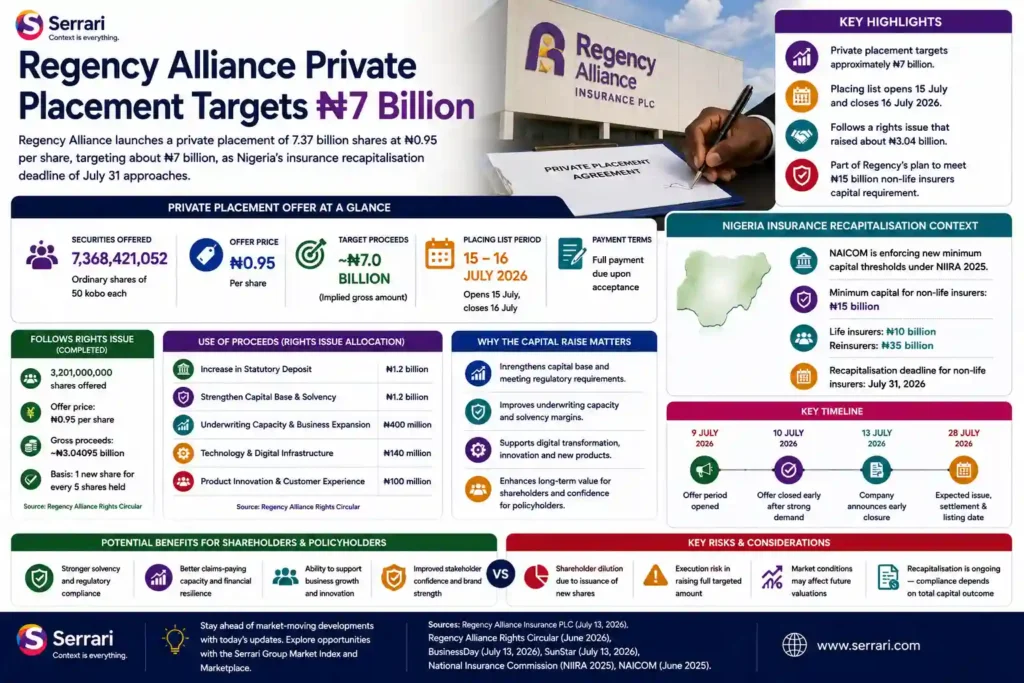
Nigeria insurance recapitalisation is forcing insurers to raise fresh capital, improve solvency and strengthen their claims-paying capacity before the regulatory deadline. Regency Alliance is responding through a multi-part capital plan that includes a statutory-deposit component, a rights issue and a private placement. The private placement targets approximately ₦7 billion through 7.37 billion new shares at ₦0.95 each. For shareholders, the transaction can improve the company’s capital base, underwriting capacity and technology investment, but it can also create dilution. For policyholders, stronger capital may improve claims confidence, but completion of the placement does not automatically prove full regulatory compliance.
Key Overview
- Regency Alliance is offering 7,368,421,052 ordinary shares through a private placement.
- The offer price is ₦0.95 per share, implying a gross target of about ₦7.0 billion.
- The placing list opens on 15 July and closes on 16 July 2026.
- The private placement follows a rights issue of 3.201 billion shares, also priced at ₦0.95 per share.
- The rights issue had gross proceeds of about ₦3.04 billion.
- Nigeria’s recapitalisation framework requires non-life insurers to reach a minimum capital threshold of ₦15 billion.
Regency Alliance Private Placement Targets ₦7 Billion
Private Placement Opens for Two Days
Regency Alliance has launched a private placement valued at approximately ₦7 billion as part of its capital-raising programme. The company’s official announcement says the offer covers 7,368,421,052 ordinary shares of 50 kobo each at 95 kobo per share, with payment due in full upon acceptance under the Regency Alliance private-placement announcement. (Regency Alliance Insurance PLC)
The timing is unusually tight. Regency says the placing list opens on 15 July 2026 and closes on 16 July 2026. That two-day window reinforces that this is an insurance private placement targeted at qualified or strategic investors, not a standard retail public offer.
The ₦7 Billion Figure Is Calculated
The implied proceeds are straightforward. Multiplying 7,368,421,052 shares by the ₦0.95 offer price gives approximately ₦7.0 billion. This should be described as the target or implied gross amount, not the final amount raised.
That distinction matters because the offer has not yet closed. Until Regency confirms subscription levels, allotment and regulatory completion, investors should not treat the ₦7 billion figure as completed capital.
Rights Issue Came First
The private placement follows Regency Alliance’s rights issue. The rights circular shows 3,201,000,000 ordinary shares of 50 kobo each offered at ₦0.95 per share, on the basis of one new ordinary share for every five ordinary shares held as of the qualification date. The circular places gross proceeds at ₦3.04095 billion under the Regency Alliance rights circular.
Nairametrics also reported that the rights issue was designed to strengthen Regency’s capital base, improve underwriting capacity, support digital infrastructure and fund new product development. The issue was presented as part of the company’s broader response to regulatory and market changes under the Nairametrics rights issue report.
Statutory Deposit Is a Separate Item
The rights circular also shows that part of the net issue proceeds was allocated to “Increase in Statutory Deposit,” with ₦1.2 billion assigned to that line item. That is important, but it should not be merged with paid-up capital or risk-based-capital calculations under the rights issue use-of-proceeds table.
Statutory deposits, paid-up share capital and risk-based-capital requirements are separate regulatory concepts. The capital raise may support compliance, but investors still need official confirmation of how NAICOM treats each component.
NAICOM Deadline Drives the Raise
Nigeria insurance recapitalisation is the main driver. NAICOM’s website highlights the NIIRA 2025 recapitalisation process and its role in protecting policyholders and strengthening market stability. TheCable reported that the minimum capital base for non-life insurers was raised to ₦15 billion, while life insurers require at least ₦10 billion and reinsurers ₦35 billion under the NAICOM capital-threshold report. (NAICOM –)
For Regency Alliance, that makes the private placement more than an ordinary capital raise. It is a race to improve capital before the deadline and reassure regulators, shareholders and policyholders.
Context is everything. Stay ahead of shifting trends with today’s market updates, and uncover emerging opportunities using the Serrari Group Market Index and Marketplace. Then, take control of your own financial future by exploring our Money & Life Reset Transformation Blueprint ™ to build stronger habits, create better systems, and design a path toward lasting wealth.
What the Capital Could Fund
BusinessDay reported that Regency’s board approved a multi-phased capital-raising programme including a private placement targeted at strategic investors. The company said the private placement is designed to strengthen its capital base, improve solvency margins, enhance underwriting capacity, support business expansion, and fund technology, product innovation and customer-experience investments under the BusinessDay private-placement report. (Businessday NG)
Those use cases matter for policyholders. A stronger capital position can support claims-paying capacity and allow the insurer to underwrite larger risks. For shareholders, however, the same capital raise can dilute ownership if they do not participate or if strategic investors receive a large allocation.
Dilution Is the Shareholder Risk
Regency Alliance shares are being issued in large numbers. The rights issue adds 3.201 billion shares if fully taken up. The private placement adds another 7.368 billion shares if completed as offered. Together, the two transactions represent a major increase in potential share count.
That does not automatically make the raise negative. If the new capital strengthens solvency, improves underwriting and supports profitable growth, it can create long-term value. But shareholders should assess whether the post-raise earnings base can support the larger number of shares.
Delayed Financials Reduce Visibility
The main investor concern is financial visibility. Regency has notified the market of delays in filing its audited 2025 financial statements and unaudited 2026 first-quarter financial statements. Its official notice says the delayed 2025 audited statements and Q1 2026 unaudited statements remained outstanding under NGX rules under the Regency delayed-financials notice. (Regency Alliance Insurance PLC)
That matters because investors are being asked to assess a capital raise while current financial information is incomplete. The placement may strengthen the balance sheet, but investors still need updated audited numbers to judge solvency, profitability, claims experience and capital adequacy.
Private Placement May Not Be Retail
The private-placement format is also important. A private placement is typically directed at selected or qualified investors, often strategic or institutional participants. Ordinary retail investors may not have access unless they are invited or meet the offer criteria.
That makes this different from the rights issue, where existing shareholders were offered shares in proportion to their holdings. The private placement can bring strategic capital, but it may also shift ownership and control depending on who subscribes.
What Investors Should Watch
Investors should watch five items. First, whether the private placement is fully subscribed. Second, whether the new shares are allotted and listed on NGX. Third, whether NAICOM confirms capital compliance. Fourth, whether delayed financial statements are released as expected. Fifth, whether the new capital translates into stronger underwriting, claims handling, technology and product expansion.
The recapitalisation story should not be read as automatic upside for Nigerian insurance stocks. Capital raises can strengthen companies, but they can also dilute shareholders and expose weak business models if new capital is not deployed efficiently.
Conclusion
Regency Alliance Private Placement is a high-stakes step in the company’s recapitalisation plan. The insurer is targeting approximately ₦7 billion through 7.368 billion shares at ₦0.95 each, after completing a ₦3.04 billion rights-issue phase and allocating funds toward statutory-deposit requirements.
For policyholders, stronger capital can support claims confidence and underwriting capacity. For shareholders, the key trade-off is dilution versus balance-sheet repair. The two-day window and the July recapitalisation deadline make the transaction urgent, but completion, regulatory treatment and updated financial disclosures remain the numbers to watch.
FAQs
1. What is the Regency Alliance Private Placement?
The Regency Alliance Private Placement is a capital-raising exercise through which Regency Alliance Insurance is offering 7,368,421,052 ordinary shares of 50 kobo each at ₦0.95 per share. The offer implies gross proceeds of about ₦7 billion and forms part of the company’s broader recapitalisation plan.
2. When does the private placement open and close?
The placing list opens on 15 July 2026 and closes on 16 July 2026. This gives investors only a two-day subscription window. Because it is a private placement, it may be targeted at strategic or qualified investors rather than ordinary retail investors.
3. How does this relate to the rights issue?
The private placement follows Regency Alliance’s rights issue of 3.201 billion ordinary shares at ₦0.95 per share, with gross proceeds of approximately ₦3.04 billion. The rights issue gave existing shareholders an opportunity to maintain their ownership, while the private placement is designed to bring in additional strategic capital.
4. Why does Nigeria insurance recapitalisation matter?
Nigeria insurance recapitalisation matters because insurers are required to meet higher capital thresholds under the NIIRA 2025 framework. For non-life insurers, the minimum capital requirement is ₦15 billion. Stronger capital can improve claims-paying capacity, underwriting limits and market confidence, but each insurer still needs regulatory confirmation of compliance.
5. What are the main risks for Regency Alliance investors?
The main risks are dilution, incomplete subscription, delayed financial reporting, regulatory-compliance uncertainty and execution risk. Raising capital does not automatically guarantee stronger profitability or full compliance. Investors should wait for final allotment details, updated financial statements and NAICOM confirmation before drawing firm conclusions.
Sources: Regency Alliance, BusinessDay, Nairametrics, NAICOM, TheCable
Your financial future isn’t something you wait for—it’s something you build.
The real question is: when do you begin?
Move beyond simply staying informed.
Navigate the markets with clarity—track trends through the Serrari Group Market Index, uncover opportunities in the Serrari Marketplace, and build practical knowledge with our Curated Wealth Builder Platform.
Stay connected to what truly matters.
Get daily insights on macro trends and financial movements across Kenya, Africa, and global markets—delivered through the Serrari Newsletter.
Growth opens doors.
Advance your career through professional programs including ACCA, HESI A2, ATI TEAS 7 , HESI EXIT , NCLEX – RN and NCLEX – PN, Financial Literacy!🌟—designed to move you forward with confidence.
See where money is flowing—clearly and in real time.
Track Money Market Funds, Treasury Bills, Treasury Bonds, Green Bonds, and Fixed Deposits, alongside global and African indexes, key economic indicators, and the evolving Crypto and stablecoin landscape—all within Serrari’s Market Index.