















The Nigerian Exchange recorded its steepest single-day decline of 2026 on Wednesday, June 24, as widespread profit-taking wiped ₦3.64 trillion, or roughly $2.6 billion at an exchange rate near ₦1,400 per dollar, from listed equities.
The NGX All-Share Index fell 2.35% to 235,074.54 points from 240,743.19, while market capitalisation dropped to ₦150.85 trillion. The correction ended a two-session rebound and was led by losses in heavyweight industrial and power stocks.
Key Overview
- The NGX All-Share Index lost 5,668.65 points, closing 2.35% lower.
- Market capitalisation declined from ₦154.48 trillion to ₦150.85 trillion.
- Trading volume fell 13.6% to about 488.1 million shares.
- Transaction value dropped 46.8% to ₦20.93 billion.
- Industrial goods stocks were the main drag, with the sector index falling 8.31%.
Heavyweight Stocks Trigger Broad Market Decline
The selloff was driven largely by sharp losses in highly capitalised shares. BUA Cement, Dangote Cement and Geregu Power were among the stocks identified as major contributors to the rout, according to a market breakdown of the session.
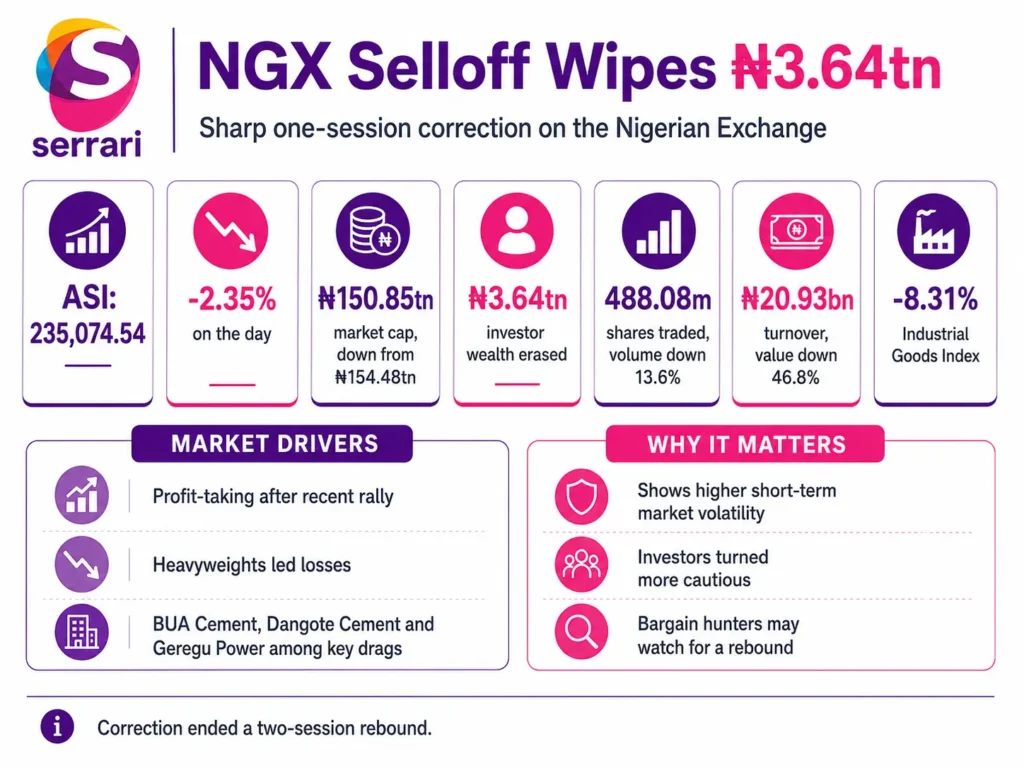
The Industrial Goods Index fell 8.31%, making it the weakest sector during the session. Because large companies carry substantial weight in the market-capitalisation-based index, steep declines in a small number of major counters can pull the wider benchmark down even when losses are not uniform across every listed stock.
The correction followed gains in the previous two sessions. On Tuesday, the market had advanced 1.06% to 240,743.19 points as renewed buying interest lifted blue-chip and insurance stocks. Wednesday’s reversal therefore erased the rebound and restored the cautious tone that had dominated much of June.
Context is everything. Stay ahead of shifting trends with today’s market updates, and uncover emerging opportunities using the Serrari Group Market Index and Marketplace. Then, take control of your own financial future by exploring our Money & Life Reset Transformation Blueprint ™ to build stronger habits, create better systems, and design a path toward lasting wealth.
Trading Activity Weakens as Investors Turn Cautious
Investor participation also slowed during the selloff. Total volume declined to approximately 488.1 million shares from 564.9 million shares in the preceding session, while the value of trades fell to ₦20.93 billion from ₦39.35 billion.
The number of transactions slipped to about 46,200 deals. A separate daily market summary similarly recorded the June 24 close at 235,074.54 points and confirmed the weaker trading session.
Lower turnover alongside falling prices suggests that many investors moved to protect earlier gains rather than aggressively repositioning portfolios. The decline also came after a strong advance earlier in 2026, leaving several shares vulnerable to profit-taking after valuations rose rapidly.
Strong Annual Gains Survive the Correction
Despite the one-day loss, the market remained substantially higher for the year. The selloff reduced the NGX’s 2026 return to about 51.1%, according to a review of the market decline.
The longer-term rally has been supported by domestic institutional participation, banking-sector recapitalisation activity and investors seeking assets that can preserve value during periods of elevated inflation and currency volatility. Recent NGX data showed that total market transactions rose to ₦1.94 trillion in May, with domestic investors continuing to dominate activity.
That backdrop may attract bargain hunters if prices stabilise. However, the scale of Wednesday’s decline shows that the market remains sensitive to concentrated selling in heavyweight stocks.
Investors Watch for Bargain Hunting and Earnings Signals
The immediate direction of the NGX will depend on whether buyers return to major industrial, banking and energy shares. Investors will also monitor corporate disclosures, earnings expectations and Nigeria’s broader interest-rate and currency environment.
A rebound could indicate that the selloff was a temporary correction after a strong rally. Continued weakness, especially with declining turnover, would suggest investors are becoming more selective and that further profit-taking may follow.
Sources: Nigerian Tribune / Nairametrics / Proshare / African Markets / The Guardian Nigeria
Your financial future isn’t something you wait for—it’s something you build.
The real question is: when do you begin?
Move beyond simply staying informed.
Navigate the markets with clarity—track trends through the Serrari Group Market Index, uncover opportunities in the Serrari Marketplace, and build practical knowledge with our Curated Wealth Builder Platform.
Stay connected to what truly matters.
Get daily insights on macro trends and financial movements across Kenya, Africa, and global markets—delivered through the Serrari Newsletter.
Growth opens doors.
Advance your career through professional programs including ACCA, HESI A2, ATI TEAS 7 , HESI EXIT , NCLEX – RN and NCLEX – PN, Financial Literacy!🌟—designed to move you forward with confidence.
See where money is flowing—clearly and in real time.
Track Money Market Funds, Treasury Bills, Treasury Bonds, Green Bonds, and Fixed Deposits, alongside global and African indexes, key economic indicators, and the evolving Crypto and stablecoin landscape—all within Serrari’s Market Index.