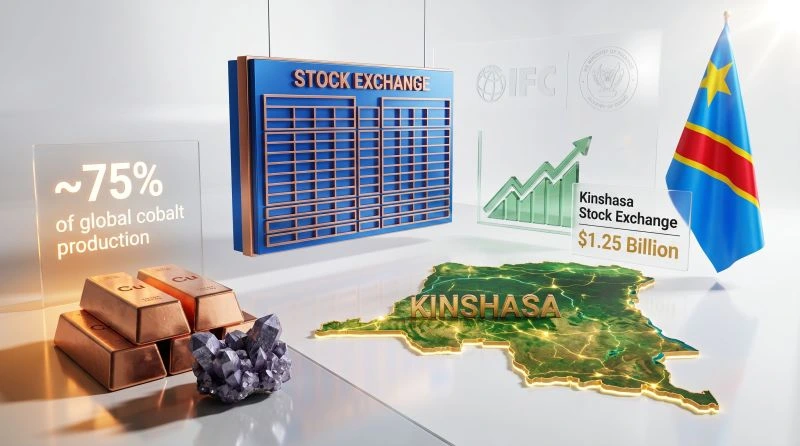
The proposed DRC stock exchange has received new momentum after the Democratic Republic of Congo signed a partnership agreement with the International Finance Corporation to support the development of the Kinshasa Stock Exchange.
Key Overview
- DRC and IFC signed an agreement to support the Kinshasa Stock Exchange.
- The initiative aims to strengthen capital markets and investment access.
- A legal framework for financial markets is progressing through Parliament.
- The project includes plans for a securities regulator and depository.
- The DRC recently raised $1.25 billion through its debut Eurobond.
- Companies currently have limited access to regional exchanges.
- The exchange could broaden financing options for local businesses.
- The country seeks to improve economic transparency and participation.
- Financial inclusion remains a major challenge in the DRC.
- The project forms part of broader financial sector reforms.
Kinshasa Stock Exchange Plans Gain IFC Backing
Plans to establish the Kinshasa Stock Exchange have taken a significant step forward after the Democratic Republic of Congo (DRC) and the International Finance Corporation (IFC) signed a partnership agreement aimed at supporting the development of the country’s future capital markets infrastructure.
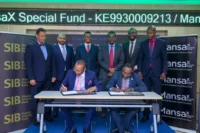
The agreement, signed in Kinshasa by Finance Minister Doudou Fwamba Likunde Li-Botayi and representatives from the IFC, seeks to lay the groundwork for a modern securities market capable of expanding investment opportunities, improving corporate financing, and strengthening economic transparency.
The initiative represents one of the most ambitious financial sector reforms undertaken by the DRC in recent years.
As one of Africa’s most resource-rich economies, the DRC has long faced challenges in mobilizing domestic investment and connecting businesses with formal capital markets.
The proposed stock exchange is expected to play a key role in addressing those challenges while creating new opportunities for both investors and companies.
DRC Stock Exchange Project Moves Forward
The planned DRC stock exchange is part of a broader strategy to modernize the country’s financial system and diversify funding sources for businesses.
Currently, companies operating in the DRC have limited access to organized capital markets. Businesses often rely heavily on bank financing or external funding sources, which can restrict growth opportunities.
The proposed exchange aims to provide an alternative channel for raising capital through public markets.
By creating a domestic securities market, authorities hope to encourage investment, improve corporate governance standards, and increase access to long-term financing.
The exchange would also allow investors to participate more directly in the country’s economic growth.
Officials believe that developing local capital markets can help reduce dependence on external financing while supporting private sector development.
The IFC partnership is expected to provide technical expertise and international experience to support the implementation process.
Democratic Republic of Congo Stock Market Vision
The future Democratic Republic of Congo stock market forms part of a wider economic transformation agenda championed by President Félix Antoine Tshisekedi Tshilombo.
Government officials have emphasized that the exchange will help mobilize investment, improve economic transparency, and broaden participation in the formal economy.
The vision extends beyond creating a trading platform.
Authorities aim to establish an entire capital markets ecosystem that includes a securities exchange, commodities exchange, market regulator, central securities depository, and settlement institutions.
Such infrastructure would create the foundation for a functioning investment market capable of supporting economic development.
Supporters argue that a domestic stock market could help unlock capital from both local and international investors while creating additional financing opportunities for businesses operating in key sectors of the economy.
Context is everything. Stay ahead of shifting trends with today’s market updates, and uncover emerging opportunities using the Serrari Group Market Index and Marketplace. Then, take control of your own financial future by exploring our Money & Life Reset Transformation Blueprint ™ to build stronger habits, create better systems, and design a path toward lasting wealth.
DRC Capital Markets Reform Gains Momentum
The establishment of the exchange is closely linked to broader DRC capital markets reforms currently under consideration.
Just days before signing the IFC agreement, Finance Minister Fwamba defended legislation before the Senate that would create the legal framework necessary for financial market operations.
The proposed legislation had already passed the National Assembly after receiving Cabinet approval.
If approved by the Senate, the framework would establish the legal foundations required to support the future exchange and associated institutions.
The legislation covers several critical areas, including market supervision, securities trading, investor protection, and settlement systems.
Although passage of the bill would not immediately launch the exchange, it would represent a major milestone in the country’s capital markets development journey.
The reforms are designed to create a transparent and credible market environment capable of attracting domestic and international investors.
IFC Investment DRC Partnership Supports Development
The new IFC investment DRC partnership highlights growing international support for the country’s financial sector development efforts.
As a member of the World Bank Group, the IFC brings extensive experience in capital market development across emerging economies.
The partnership is expected to provide technical assistance, advisory services, and strategic guidance throughout the development process.
International financial institutions often play a critical role in supporting emerging market exchanges by helping governments establish regulatory frameworks, governance standards, and operational structures.
The IFC’s involvement may also enhance investor confidence by signaling international support for the project.
By partnering with the DRC government, the organization aims to help create a market infrastructure capable of supporting long-term economic growth and private sector expansion.
The agreement reflects increasing recognition of the role capital markets can play in economic development.
Securities Exchange Development Faces Challenges
While the project presents significant opportunities, securities exchange development in the DRC also faces important challenges.
During parliamentary discussions, senators highlighted concerns regarding corporate governance, financial reporting standards, and the size of the country’s informal economy.
Many businesses may need to strengthen transparency and governance practices before becoming eligible for public listing.
The DRC also faces broader financial inclusion challenges.
According to World Bank estimates, fewer than four in ten adults have access to formal banking services.
This creates limitations on retail investor participation and highlights the need for broader financial sector development.
Building investor confidence, improving financial literacy, and strengthening regulatory oversight will all be important components of a successful exchange launch.
Addressing these issues will require sustained collaboration between policymakers, regulators, financial institutions, and development partners.
African Stock Exchanges Continue Expanding
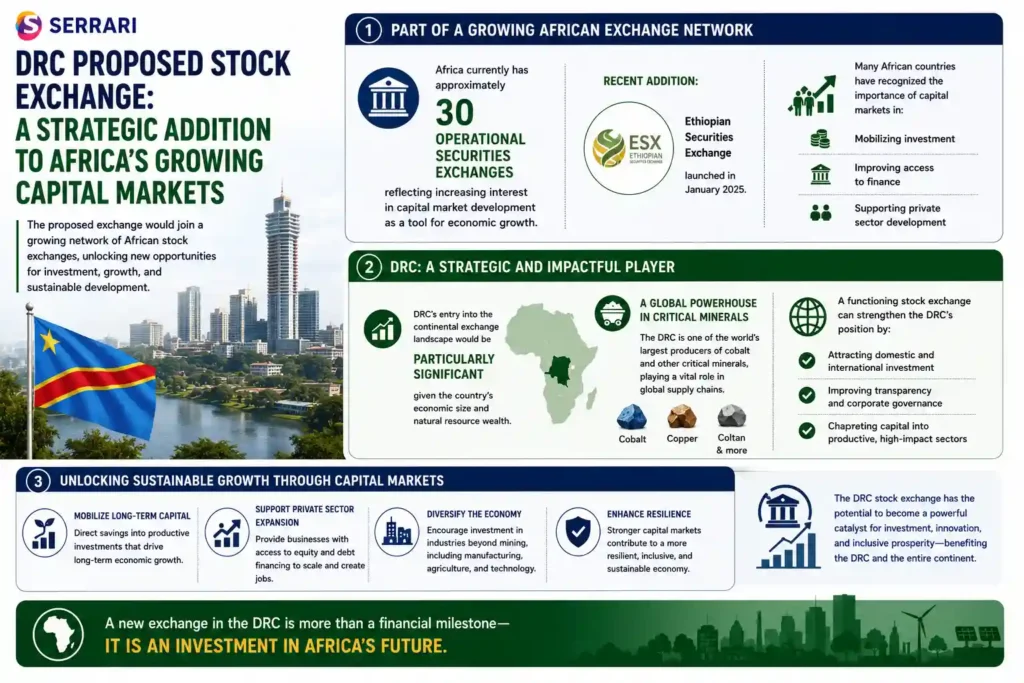
The proposed exchange would join a growing network of African stock exchanges across the continent.
Africa currently has approximately 30 operational securities exchanges, reflecting increasing interest in capital market development as a tool for economic growth.
One of the most recent additions was the Ethiopian Securities Exchange, which launched in January 2025.
Many African countries have recognized the importance of capital markets in mobilizing investment, improving access to finance, and supporting private sector development.
The DRC’s entry into this landscape would be particularly significant given the country’s economic size and natural resource wealth.
As one of the world’s largest producers of cobalt and other critical minerals, the DRC occupies a strategically important position within global supply chains.
A functioning stock exchange could help channel investment into sectors that support sustainable economic growth.
Why the Exchange Matters for the DRC Economy
The importance of the Kinshasa Stock Exchange extends beyond financial markets.
The DRC recently demonstrated growing access to international capital by raising $1.25 billion through its debut Eurobond issuance.
However, developing a domestic market could provide a more sustainable source of long-term financing.
A local exchange could support business expansion, encourage entrepreneurship, improve transparency, and create wealth-building opportunities for citizens.
It may also help reduce financing constraints faced by companies operating in sectors such as mining, agriculture, manufacturing, telecommunications, and infrastructure.
Over time, successful capital market development could contribute to economic diversification and stronger private sector growth.
For a country with significant natural resources but persistent development challenges, improving access to investment capital remains a critical priority.
Conclusion
The partnership between the Democratic Republic of Congo and the IFC marks an important step toward establishing the Kinshasa Stock Exchange and building a modern capital markets ecosystem. The initiative forms part of broader reforms aimed at improving investment access, strengthening economic transparency, and expanding financing opportunities for businesses.
While significant challenges remain, including financial inclusion and corporate governance improvements, the project represents a potentially transformative development for the DRC’s financial sector. If successfully implemented, the Kinshasa Stock Exchange could play a vital role in supporting long-term economic growth and attracting greater domestic and international investment.
FAQs
1. What is the Kinshasa Stock Exchange?
The Kinshasa Stock Exchange is a planned securities market being developed by the Democratic Republic of Congo. It aims to provide businesses with access to capital while offering investors opportunities to participate in the country’s economic growth.
2. Why is the IFC involved in the project?
The International Finance Corporation is supporting the project by providing technical expertise, advisory services, and capital market development experience. Its involvement is expected to help strengthen the exchange’s design and implementation process.
3. Does the DRC currently have a stock exchange?
No. The DRC currently does not operate a domestic stock exchange. Companies seeking public market access often face limited options and may rely on alternative financing channels or regional exchanges.
4. How could the exchange benefit the Congolese economy?
A stock exchange could improve access to capital for businesses, encourage investment, strengthen transparency, support private sector growth, and provide citizens with opportunities to invest directly in the country’s economic development.
Sources: Kenyan Wallstreet, Business Day Nigeria, Business Insider Africa, Africa Business Communities
Your financial future isn’t something you wait for—it’s something you build.
The real question is: when do you begin?
Move beyond simply staying informed.
Navigate the markets with clarity—track trends through the Serrari Group Market Index, uncover opportunities in the Serrari Marketplace, and build practical knowledge with our Curated Wealth Builder Platform.
Stay connected to what truly matters.
Get daily insights on macro trends and financial movements across Kenya, Africa, and global markets—delivered through the Serrari Newsletter.
Growth opens doors.
Advance your career through professional programs including ACCA, HESI A2, ATI TEAS 7 , HESI EXIT , NCLEX – RN and NCLEX – PN, Financial Literacy!🌟—designed to move you forward with confidence.
See where money is flowing—clearly and in real time.
Track Money Market Funds, Treasury Bills, Treasury Bonds, Green Bonds, and Fixed Deposits, alongside global and African indexes, key economic indicators, and the evolving Crypto and stablecoin landscape—all within Serrari’s Market Index.