South Africa: Hotter summer conditions and below-normal rainfall raise water security and food production concerns
South Africa’s summer outlook raises concerns over water supplies, agricultural production, household costs and heat exposure.
Reported · Published
SOUTH AFRICA'S 2026/27 SUMMER OUTLOOK
South Africa is expected to experience above-normal temperatures and below-normal rainfall across much of the country during the 2026/27 summer season, according to the South African Weather Service (SAWS).
The forecast points to a combination of conditions that could place pressure on water resources, agricultural production and public health. Reduced rainfall may affect the replenishment of dams, rivers and groundwater supplies, while higher temperatures could increase evaporation and water demand in households, businesses and industry.
The concern extends beyond water availability. Lower soil moisture and unreliable rainfall could affect crops and livestock, while prolonged high temperatures could increase the risk of dehydration, heat exhaustion and heatstroke.
Although the effects are expected to differ between regions, the combination of reduced rainfall and increased temperatures makes water security and preparedness important concerns for the coming months.
CLIMATE INDICATORS AND THE DEVELOPING EL NIÑO
A very strong El Niño event is raising concerns about changing weather patterns and hotter-than-usual conditions across Southern Africa between November 2026 and January 2027.
The World Meteorological Organization (WMO) has warned that the developing event could intensify existing climate pressures. According to the supplied reporting, the weather pattern has been developing since August 2026 and could become the strongest on record by December, with its effects expected to continue into early 2027.
Climate Reanalyzer data from the Climate Change Institute, as reported in the supplied source, shows temperatures in the Niño 3.4 region of the Pacific Ocean reaching 3.4°C above normal.
Key climate indicators
| Indicator | Reported figure or development |
|---|---|
| Niño 3.4 temperature anomaly | 3.4°C above normal |
| El Niño development | Developing since August 2026 |
| Potential peak | Could become the strongest on record by December 2026 |
| Expected continuation | Into early 2027 |
| Southern Africa seasonal outlook | Warmer conditions, November 2026–January 2027 |
| Global temperature anomaly | 1.47°C above pre-industrial levels, January–September 2026 |
| Global temperature records | Past 12 years were the warmest on record |
| Global ocean heat | Oceans absorb approximately 90% of the extra heat trapped by the planet |
| Global land-water conditions | Water stored on land has been falling since 2014 |
| Land areas with below-normal water | 42% of studied areas in 2025 |
The global temperature and land-water indicators describe the wider climate situation and should not be interpreted as measurements specific to South Africa.
WMO Secretary-General Celeste Saulo explained that El Niño does not add new heat to the planet but releases heat stored in the oceans. The WMO warning highlights the additional pressure this process could place on regions already exposed to rising temperatures and changing rainfall patterns.
WATER SECURITY: RISING DEMAND AND PRESSURE ON MUNICIPAL SUPPLIES
Water availability is one of the main concerns associated with the expected hotter and drier conditions.
Higher temperatures increase evaporation from rivers and dams, while below-normal rainfall could limit the replenishment of water resources. The combined effect could place additional pressure on dams, rivers, groundwater supplies and municipal distribution networks.
For households, this could mean increased water restrictions and interruptions to supply.
Pretoria illustrates existing supply pressures
In Pretoria, residents have been urged to reduce water consumption as rising temperatures and increased demand place pressure on the city's water distribution network.
Reporting by Rekord also highlights how electricity interruptions can affect pumping operations, creating additional challenges for water distribution.
Although Pretoria is a local example, the reported challenges point to wider concerns involving increased consumption, infrastructure constraints and unreliable supply.
These pressures could become more difficult to manage when temperatures rise and demand increases.
Household water conservation
The supplied reporting identifies several measures households can take to reduce consumption:
- Take shorter showers.
- Repair leaking taps and toilets.
- Turn off taps while brushing teeth.
- Use buckets instead of hosepipes when washing vehicles.
- Water gardens during cooler parts of the day.
- Use mulch to reduce evaporation.
- Choose indigenous plants that require less water.
- Follow municipal water restrictions and supply announcements.
Emergency drinking water requirements
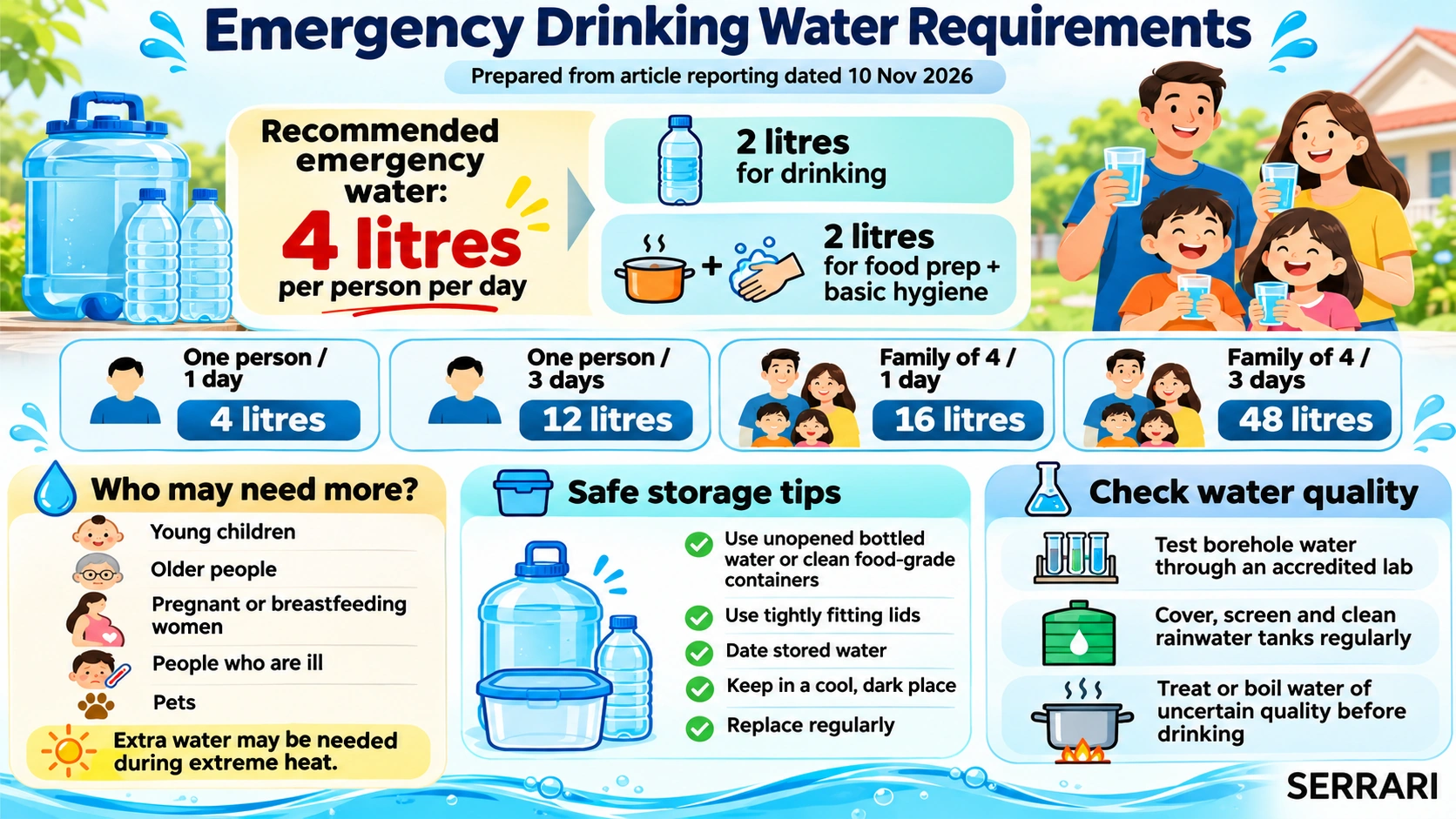
SANBWA chief executive Charlotte Metcalf has encouraged households to establish emergency drinking water supplies before shortages occur.
The international emergency guidelines cited in the supplied reporting recommend approximately four litres per person per day. This provides about two litres for drinking, with the remainder allocated to food preparation and basic hygiene.
| Household requirement | Recommended emergency water |
|---|---|
| One person per day | 4 litres |
| One person for three days | 12 litres |
| Family of four per day | 16 litres |
| Family of four for three days | 48 litres |
Additional supplies may be necessary during extreme heat, particularly for households with young children, older people, pregnant or breastfeeding women, people who are ill and pets.
Households can store unopened bottled water or use clean, sanitised, food-grade containers with tightly fitting lids. Stored water should be dated, kept in a cool, dark place and replaced regularly.
Borehole water should be tested by an accredited laboratory. Rainwater tanks should be covered, screened and cleaned regularly, while water of uncertain quality should be treated or boiled before consumption.
AGRICULTURE, FOOD SUPPLY AND THE COST OF LIVING
Reduced rainfall and higher temperatures could place agricultural production under pressure during the 2026/27 summer season.
Unreliable rainfall can affect crop growth, soil moisture and livestock health. Drought conditions can destroy crops, kill livestock and leave farmers with less food to sell.
The potential consequences extend beyond farms. When agricultural production declines and less food is available, prices can rise, increasing the cost of basic groceries for households.
The supplied reporting identifies several possible effects:
| Area | Potential impact |
|---|---|
| Crop production | Drought could destroy crops and reduce food available for sale |
| Livestock | Dry conditions and higher temperatures could affect animal health and contribute to livestock losses |
| Farmers | Crop failures could result in lower income |
| Food supply | Reduced production could limit the availability of food |
| Households | Higher food prices could increase pressure on household budgets |
| Shops | Suppliers could charge higher prices, increasing procurement costs |
| Water-dependent businesses | Shortages could make normal operations more difficult |
The cost-of-living concern is particularly important because weather-related pressure on food production can affect households through higher grocery expenses.
Businesses that depend on farming, food supplies and reliable water could also experience financial pressure. Farmers may lose income when crops fail, while shops could face higher supplier prices.
The extent of these effects will depend on how rainfall and temperature conditions develop during the season.
Context is everything. Stay ahead of shifting trends with today’s market updates, and uncover emerging opportunities using the Serrari Group Market Index and Marketplace. Then, take control of your own financial future by exploring our Money & Life Reset Transformation Blueprint ™ to build stronger habits, create better systems, and design a path toward lasting wealth.
EXTREME HEAT AND PUBLIC HEALTH RISKS
The expected above-normal temperatures present a public health concern, particularly for people who spend extended periods outdoors or have limited access to cooler environments.
The City of Ekurhuleni's Disaster and Emergency Management Services has warned that temperatures exceeding 35°C to 40°C could increase the risk of dehydration, heat exhaustion and heatstroke.
The groups identified as particularly vulnerable include:
- Outdoor workers, including construction workers, gardeners, farmers and informal traders.
- Young children.
- Older people.
- Individuals with existing health conditions.
Prolonged heat can make outdoor work, travelling to work and even sleeping more difficult.
Heat-related health risks and precautions
| Health concern | Reported symptoms or recommended action |
|---|---|
| Dehydration | Drink water regularly rather than waiting until thirsty |
| Heat exhaustion | Heavy sweating, headache, dizziness, nausea, weakness and muscle cramps |
| Heatstroke | Confusion, fainting, very hot skin and dangerously high body temperature |
| Outdoor heat exposure | Avoid strenuous outdoor activities between 11:00 and 15:00 |
| Personal protection | Seek shade, wear lightweight clothing, use a wide-brimmed hat and apply sunscreen |
Residents are also advised not to leave children and pets inside parked vehicles, even for a few minutes.
Families should check on older relatives and neighbours during heatwaves, especially those living alone.
Heatstroke is a medical emergency. Anyone showing signs of heatstroke should be moved to a cooler area and cooled with water or wet towels while emergency medical assistance is arranged. A person who is confused or unconscious should not be given anything to drink.
BUSINESS AND INFRASTRUCTURE EXPOSURE
The expected weather conditions could affect businesses through water shortages, higher supplier costs and disruption to infrastructure.
Businesses that depend on reliable water supplies may struggle to operate during shortages. Agricultural losses could affect suppliers and shops through reduced food availability and higher procurement prices.
The supplied reporting also identifies floods and severe storms as potential sources of business disruption. These events could damage shops, roads and other buildings, making it harder for businesses to maintain normal operations.
The wider economic exposure includes:
- Reduced income for farmers when crops fail.
- Higher supplier prices for shops.
- Operational challenges for water-dependent businesses.
- Potential infrastructure damage from floods and severe storms.
- Increased pressure on households through food costs and water interruptions.
The supplied sources do not provide a quantified estimate of the financial losses these developments could cause.
PREPARATION AND DEVELOPMENTS TO MONITOR
The potential combination of above-normal temperatures, below-normal rainfall and increased water demand makes preparation important for households, municipalities, farmers and businesses.
Households
- Reduce water consumption.
- Maintain an emergency supply of safe drinking water.
- Follow municipal water restrictions and supply announcements.
- Take precautions against heat exposure.
- Learn to recognise symptoms of heat exhaustion and heatstroke.
Municipalities
- Monitor water demand and distribution pressures.
- Communicate supply interruptions and restrictions.
- Prepare for increased demand during prolonged hot conditions.
- Consider the effects of infrastructure constraints and electricity interruptions on pumping operations.
Farmers and businesses
- Monitor changing weather conditions.
- Plan for the possibility of prolonged dry spells.
- Prepare for increased water demand.
- Consider potential disruption to agricultural production and water-dependent operations.
Key developments to monitor
- SAWS updates on rainfall and temperature conditions.
- Changes in the developing El Niño event.
- Water supply conditions and municipal announcements.
- Heat warnings and public health advisories.
South Africa's experience of El Niño will not be identical across all provinces. Rainfall patterns can vary significantly between regions, making continued monitoring of national forecasts and local announcements important.
OUTLOOK
South Africa's 2026/27 summer outlook presents a combination of weather-related pressures with implications for water security, food production, household expenditure and public health.
The SAWS forecast of above-normal temperatures and below-normal rainfall across much of the country is the central national indicator in the supplied reporting. Higher temperatures could increase evaporation and water demand, while reduced rainfall could affect the replenishment of water resources.
Agriculture is another area of exposure. Reduced rainfall could affect crops, livestock and soil moisture, with potential consequences for food availability, farm income and grocery prices.
The public health implications are also significant. Temperatures exceeding 35°C to 40°C could increase the risk of heat-related illness, particularly among outdoor workers, children, older people and individuals with existing health conditions.
The developing El Niño is expected to continue into early 2027, but its effects will vary between locations. The supplied sources do not establish that drought will occur across the entire country, nor do they provide a specific provincial rainfall breakdown.
For the coming months, water availability, rainfall conditions, temperature developments and agricultural production remain the key areas of concern.
SOURCES
- Scrolla Africa – https://scrolla.africa/extreme-heat-could-hit-south-africans-where-it-hurts-most/
- Newsnote – https://newsnote.co.za/southern-africa-faces-hotter-months-as-powerful-el-nino-raises-climate-concerns/
- The Citizen – https://www.citizen.co.za/network-news/lnn/article/el-nino-puts-south-africa-on-alert-for-hotter-drier-summer/
Your financial future isn’t something you wait for—it’s something you build. The real question is: when do you begin?
Move beyond simply staying informed. Navigate the markets with clarity—track trends through the Serrari Group Market Index, uncover opportunities in the Serrari Marketplace, and build practical knowledge with our Curated Wealth Builder Platform.
Stay connected to what truly matters. Get daily insights on macro trends and financial movements across Kenya, Africa, and global markets—delivered through the Serrari Newsletter.
Growth opens doors. Advance your career through professional programs including ACCA, HESI A2, ATI TEAS 7 , HESI EXIT , NCLEX - RN and NCLEX - PN, Financial Literacy!🌟—designed to move you forward with confidence.
See where money is flowing—clearly and in real time. Track Money Market Funds, Treasury Bills, Treasury Bonds, Green Bonds, and Fixed Deposits, alongside global and African indexes, key economic indicators, and the evolving Crypto and stablecoin landscape—all within Serrari’s Market Index.