















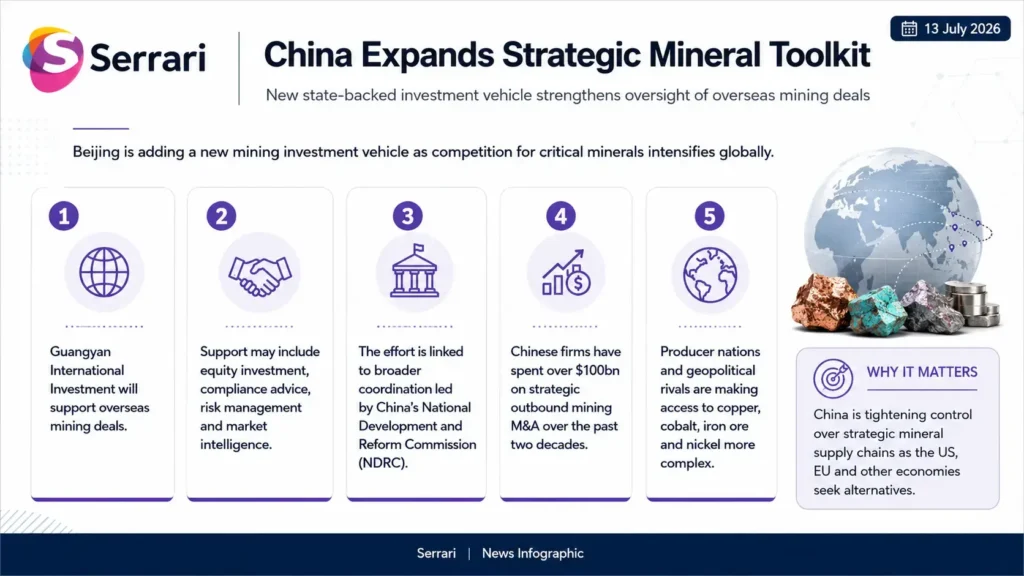
China is strengthening the machinery behind its overseas mineral investments as competition for critical resources intensifies. A relatively new state-backed company, Guangyan International Investment, also known as Vast Rock International Investment, is expected to support Chinese mining companies with equity investment, compliance guidance, risk management and market analysis.
The initiative forms part of a broader effort led by China’s National Development and Reform Commission to improve oversight and coordination of overseas mining transactions. The move comes as resource-producing countries demand more domestic processing and economic benefits, while the United States and its partners pursue alternative critical-mineral supply chains.
Key Overview
- Guangyan International Investment is expected to help coordinate and support Chinese overseas mining investments.
- Its functions are reported to include direct equity investment, compliance advice, risk management and market intelligence.
- Beijing is encouraging companies to share project risks with investment partners rather than always pursuing full ownership.
- Producer countries are increasingly imposing export restrictions or demanding local processing.
- The US and other economies are expanding strategic partnerships intended to diversify mineral supply chains away from heavy dependence on China.
Beijing Adds Another Layer to Its Resource Strategy
China has spent decades building an extensive position across global mining and mineral processing. The creation of Guangyan adds another institutional tool to that strategy at a time when international mining investments are becoming more politically and financially complex.
According to reporting on the new investment vehicle, Guangyan is expected to operate within a broader initiative led by the National Development and Reform Commission, China’s powerful economic planning agency.
The company is expected to offer Chinese miners support ranging from direct investment to advice on compliance, market conditions and project risks. The broader objective appears to be a more standardized approach to international mining deals, giving authorities greater visibility over projects while helping companies manage increasingly complicated regulatory and geopolitical environments.
Participation is not reported to be mandatory. However, some Chinese companies are being encouraged to communicate overseas investment plans so that potential risks can be assessed.
This approach could also result in more consortium-based investments. Rather than taking complete ownership of complex mining projects, Chinese companies may increasingly be encouraged to bring in partners and distribute financial and political exposure.
China’s Overseas Mining Footprint Faces New Pressures
Chinese companies have been major investors in overseas mining for more than two decades, targeting resources ranging from copper and cobalt to iron ore and gold.
Over that period, Chinese companies have completed more than $100 billion in strategic outbound mining acquisitions, according to Bain & Co figures cited in reporting on Guangyan.
That investment strategy helped Chinese companies establish influential positions in several major mineral-producing regions. Chinese investment has been particularly significant in the Democratic Republic of Congo’s copper and cobalt industries, Indonesia’s nickel sector and large-scale iron ore developments.
However, governments in mineral-rich countries are becoming more assertive about how their natural resources are developed.
The Democratic Republic of Congo, the world’s dominant cobalt producer, moved from an export suspension to a quota system beginning in October 2025. The country established annual cobalt export limits of 96,600 tonnes for both 2026 and 2027 as part of efforts to manage supply.
Guinea is also seeking greater domestic value addition around the Simandou iron ore development. Companies involved in the project have been required to examine options including a steel mill or iron ore pellet plant.
Zimbabwe, meanwhile, is preparing to prohibit lithium concentrate exports from January 2027 as it pushes mining companies to develop more local processing capacity. Lithium producers have sought additional time to complete the necessary facilities.
Together, these policies illustrate a wider shift: access to mineral deposits increasingly comes with expectations for local refining, industrial development, employment and greater government revenue.
Context is everything. Stay ahead of shifting trends with today’s market updates, and uncover emerging opportunities using the Serrari Group Market Index and Marketplace. Then, take control of your own financial future by exploring our Money & Life Reset Transformation Blueprint ™ to build stronger habits, create better systems, and design a path toward lasting wealth.
Mineral Competition Becomes More Geopolitical
China’s latest institutional push also comes as Western governments accelerate efforts to secure alternative mineral supplies.
The United States has expanded its strategic engagement with the Democratic Republic of Congo, including arrangements designed to give US-linked investors greater opportunities in the country’s mineral sector. Under the evolving partnership, the DRC has committed to mechanisms offering US participants access to mineral offtake opportunities.
The competition extends far beyond individual mining projects. Critical minerals are increasingly being treated as strategic assets because of their importance to electric vehicles, renewable energy systems, advanced manufacturing and defence technologies.
China already possesses a major advantage because its influence extends beyond mine ownership into processing and refining. Western countries therefore face the more difficult task of building entire supply chains rather than simply financing new mines.
Beijing is also strengthening coordination in individual commodity markets. China Mineral Resources Group, established in 2022, has become more active in centralizing iron ore purchasing and strengthening the bargaining position of Chinese steelmakers. Its growing influence has been visible in negotiations with major international suppliers, with the state-backed buyer using increasingly assertive purchasing tactics to seek better commercial terms.
A More Coordinated Phase of Chinese Resource Investment
Guangyan’s emergence signals that China’s overseas mining strategy is moving beyond the era in which large companies simply pursued assets individually.
Future projects are likely to require more structured assessments of political risk, financing, compliance requirements and relationships with host governments. The rising cost and complexity of major mines also make partnerships and shared ownership more attractive.
For China, the goal is not merely to acquire additional mineral deposits. It is to protect the resilience of supply chains that underpin industries ranging from steel and batteries to advanced manufacturing.
For rival economies and mineral-producing countries, the development also raises the stakes. Competition for resources is increasingly being shaped by state-backed financing, industrial policy, trade restrictions and demands for domestic value creation.
Guangyan therefore represents more than another investment company. It is part of a broader shift toward increasingly coordinated state involvement in the global contest for strategic minerals.
Sources: Bloomberg / The Edge Singapore / Mining Weekly / Reuters / International Energy Agency / Ecofin Agency
Your financial future isn’t something you wait for—it’s something you build.
The real question is: when do you begin?
Move beyond simply staying informed.
Navigate the markets with clarity—track trends through the Serrari Group Market Index, uncover opportunities in the Serrari Marketplace, and build practical knowledge with our Curated Wealth Builder Platform.
Stay connected to what truly matters.
Get daily insights on macro trends and financial movements across Kenya, Africa, and global markets—delivered through the Serrari Newsletter.
Growth opens doors.
Advance your career through professional programs including ACCA, HESI A2, ATI TEAS 7 , HESI EXIT , NCLEX – RN and NCLEX – PN, Financial Literacy!🌟—designed to move you forward with confidence.
See where money is flowing—clearly and in real time.
Track Money Market Funds, Treasury Bills, Treasury Bonds, Green Bonds, and Fixed Deposits, alongside global and African indexes, key economic indicators, and the evolving Crypto and stablecoin landscape—all within Serrari’s Market Index.