CD rates July 2026 remain competitive, but the decision to lock in has become genuinely two-sided. Savers can still find certificates of deposit APYs above 4%, with several trackers showing top rates between about 4.10% and 4.50%. The complication is the Federal Reserve. June meeting minutes showed that a few policymakers saw a case for raising rates, while markets are watching Tuesday’s CPI report for confirmation of whether inflation is still sticky. If CPI is hot, deposit rates could stay firm or even move higher. If CPI cools, today’s CD rates may look more attractive as lock-in opportunities.
Key Overview
- Yahoo Finance showed Marcus by Goldman Sachs offering 4.10% APY on a 14-month CD as of July 8.
- NerdWallet’s July table showed top CD rates reaching 4.30%, including Connexus Credit Union and NASA Federal Credit Union.
- Fortune/Curinos reported top CD rates of 4.40% APY on July 7, led by Morgan Stanley 3-year, 4-year and 5-year CDs.
- Forbes Advisor said the highest CD rates reach 4.50% APY, although its main July page headline showed up to 4.10%.
- Bankrate says the best CD rates still earn around 4% APY, while its 7.50% headline rate should be treated as a promotional outlier.
- Existing-home sales fell 2.4% in June to a 4.09 million annualized rate, showing housing remains rate-sensitive.
Best CD Rates Hold Near 4.4% as June CPI Day Looms Tuesday
CD Rates Still Top 4%
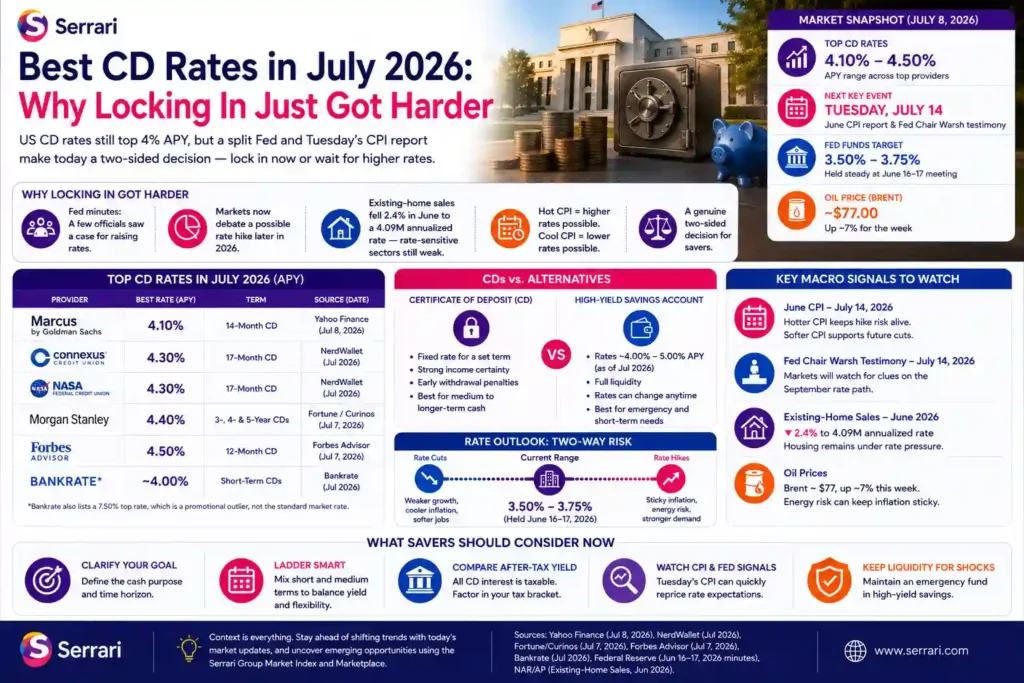
US savers still have access to competitive CD yields. Yahoo Finance reported that Marcus by Goldman Sachs was offering 4.10% APY on a 14-month CD on July 8, keeping short-to-medium maturity offers above the 4% mark under the Yahoo Finance July CD update.
Other trackers show a similar range. NerdWallet said the best CD rates remain around 4%, with the highest listed rate of 4.30% offered across selected terms by Newtek Bank, Connexus Credit Union and NASA Federal Credit Union under the NerdWallet best CD rates table. Fortune, using Curinos data, said the most competitive CDs reached 4.40% APY as of July 7, with Morgan Stanley’s 3-year, 4-year and 5-year CDs leading its table under the Fortune Curinos CD rate report.
Forbes and Bankrate Show the Range
Forbes Advisor’s July page showed a headline of up to 4.10% APY, but its rate table and CD-rate note also referenced higher listed offers, including CDs around 4.50% APY. Forbes warned that banks change yields frequently depending on market conditions under the Forbes Advisor CD rate guide.
Bankrate’s July page is more complicated. It carries a headline rate of up to 7.50%, but the page itself says the best CD rates still earn around 4% APY and are highest on short-term CDs under the Bankrate July CD rate table. That makes the 7.50% figure useful to note, but not the clean benchmark for national CD pricing.
CPI Makes the Decision Two-Sided
The reason locking in got harder is Tuesday’s June CPI print. If inflation cools, savers who lock in now may protect a strong APY before banks lower rates later. If inflation surprises higher, the Fed could stay hawkish and banks may keep deposit rates firm.
This is the inversion of the old savings playbook. “Lock in before cuts” assumed cuts were the next move. But the current setup includes a CPI report, a split Fed and renewed debate around whether a rate hike could still be needed. That makes the opportunity cost of locking in more important.
Fed Minutes Revive Hike Risk
The Fed held the federal funds target range at 3.50% to 3.75% at its June 16–17 meeting. The official minutes said “a few participants” saw a case for raising the target range, even though those participants supported holding rates steady at that meeting under the Federal Reserve June meeting minutes.
For savers, this matters because CD rates tend to move with expectations for short-term rates. If the market begins to price a September or later-year hike more seriously, banks may have less reason to cut CD offers quickly. That is why Tuesday’s CPI and Fed Chair Kevin Warsh’s testimony matter for cash investors, not just stock traders.
Housing Pushes Against a Hike
The counter-signal is housing. NAR said existing-home sales fell 2.4% in June, while AP and Trading Economics placed the annualized sales rate at 4.09 million. AP also reported that the median existing-home sales price rose to $440,600, a record level under the AP housing market report.
This matters because housing is one of the clearest parts of the economy affected by interest rates. If housing keeps weakening, the Fed may hesitate to tighten policy further. That gives savers a genuine trade-off: inflation may support higher deposit rates, but soft housing argues for caution.
Context is everything. Stay ahead of shifting trends with today’s market updates, and uncover emerging opportunities using the Serrari Group Market Index and Marketplace. Then, take control of your own financial future by exploring our Money & Life Reset Transformation Blueprint ™ to build stronger habits, create better systems, and design a path toward lasting wealth.
High-Yield Savings Still Competes
High-yield savings accounts remain a strong alternative for cash that needs liquidity. Fortune said many competitive savings accounts offer APYs in the 4.00% to 5.00% range, which means savers do not have to lock every dollar into a CD to earn a meaningful cash return under the Fortune high-yield savings comparison.
The trade-off is access versus certainty. A CD locks the APY for a fixed term but usually penalizes early withdrawal. A high-yield savings account offers flexibility, but the rate can change whenever the bank adjusts pricing.
The CD Curve Favors Short Terms
The CD curve is still tilted toward shorter maturities. NerdWallet said the best short-term CDs, including three-month to one-year terms, still offer the highest rates across CD terms under the NerdWallet short-term CD note.
That makes shorter CDs useful for savers who want yield without giving up flexibility for too long. Longer CDs may still make sense for investors who value income certainty, but the rate gap means the maturity decision should be tied to actual cash needs.
CD Ladder Strategy Reduces Timing Risk
A CD ladder can help in a two-sided rate environment. Instead of putting all cash into one maturity, a saver can split funds across several terms, such as six months, one year, two years and three years.
If rates rise, the shorter CDs mature sooner and can be reinvested at better rates. If rates fall, the longer CDs preserve some income. This approach is especially useful when CPI and the Fed can move rate expectations within days.
July 14 and July 29 Are Key
The next major date is July 14, when June CPI lands and Warsh testifies. Those two events will help shape whether the Fed rate hike odds conversation intensifies or cools.
The next FOMC decision is scheduled for July 28–29, according to the Fed’s calendar referenced in the June meeting materials. Until then, savers should watch CPI, Treasury yields, bank CD-rate tables and high-yield savings offers.
Conclusion
Best CD rates remain attractive in July 2026, but the decision is no longer simple. Rates above 4% APY are still available, and some trackers show selected offers around 4.30% to 4.50%. But Tuesday’s CPI could change the market’s view within 48 hours.
For savers, the answer is not automatically “lock in before cuts.” The better approach is to match the CD term to the purpose of the money. Emergency cash needs liquidity. Planned expenses may fit short CDs. Longer CDs may suit investors who value certainty and can tolerate limited access before maturity.
FAQs
1. What are the best CD rates in July 2026?
The best CD rates in July 2026 generally remain above 4% APY among competitive providers. Yahoo Finance showed Marcus at 4.10% APY for a 14-month CD, NerdWallet showed top rates of 4.30%, Fortune/Curinos listed top rates of 4.40%, and Forbes referenced offers reaching 4.50%. Rates change frequently, so savers should confirm the latest APY, minimum deposit and early withdrawal penalty before opening a CD.
2. Why did locking in a CD get harder?
Locking in got harder because the rate outlook is no longer clearly pointing toward cuts. The Fed minutes showed that a few policymakers saw a case for raising rates, and Tuesday’s CPI could strengthen or weaken that argument. If inflation is hot, waiting may preserve the chance to capture higher rates later. If inflation cools, locking in today’s rates may look better.
3. Should savers choose a CD or high-yield savings account?
A CD may be better for money that can stay untouched until maturity because it locks in a fixed APY. A high-yield savings account may be better for emergency funds or near-term spending because it allows easier access. In July 2026, both options remain competitive, so the choice depends on liquidity needs, timing and comfort with early withdrawal penalties.
4. What is a CD ladder?
A CD ladder is a strategy where savers divide money across multiple CD maturities. For example, they may use six-month, one-year, two-year and three-year CDs. This creates regular maturity dates and reduces the risk of locking all money at the wrong time. It can work well when inflation and Fed decisions make the rate outlook uncertain.
5. How does CPI affect CD rates?
CPI affects CD rates because it influences expectations for Federal Reserve policy. A higher CPI reading can make a Fed rate hike more likely, which may support higher deposit rates. A softer CPI reading can make rate cuts or a longer pause more likely, which may lead banks to lower CD offers over time.
Sources: Yahoo Finance, NerdWallet, Fortune Curinos, Forbes Advisor, Bankrate July CD Rate Table, Federal Reserve, NAR, AP Housing market report
Your financial future isn’t something you wait for—it’s something you build.
The real question is: when do you begin?
Move beyond simply staying informed.
Navigate the markets with clarity—track trends through the Serrari Group Market Index, uncover opportunities in the Serrari Marketplace, and build practical knowledge with our Curated Wealth Builder Platform.
Stay connected to what truly matters.
Get daily insights on macro trends and financial movements across Kenya, Africa, and global markets—delivered through the Serrari Newsletter.
Growth opens doors.
Advance your career through professional programs including ACCA, HESI A2, ATI TEAS 7 , HESI EXIT , NCLEX – RN and NCLEX – PN, Financial Literacy!🌟—designed to move you forward with confidence.
See where money is flowing—clearly and in real time.
Track Money Market Funds, Treasury Bills, Treasury Bonds, Green Bonds, and Fixed Deposits, alongside global and African indexes, key economic indicators, and the evolving Crypto and stablecoin landscape—all within Serrari’s Market Index.