
Kenya's KSh 13.5 Trillion Debt Test: Strong Bond Demand, but Little Budget Room
Investors still want government bonds. The hard question is whether Kenya can keep paying interest while funding growth and public services · Serrari Analyst Desk · Research as of 27 November 2026
Gross public debt reached KSh 13.53tn at end-September 2026 (57.5% domestic) and interest took KSh 1.07tn in FY 2025/26 — more than development spending. The 18 November bond auction drew KSh 85.55bn of bids against KSh 50bn offered at accepted yields of 12.62% and 13.59%. Funding access is not the same as fiscal space.
Kenya's KSh 13.5 Trillion Debt Test
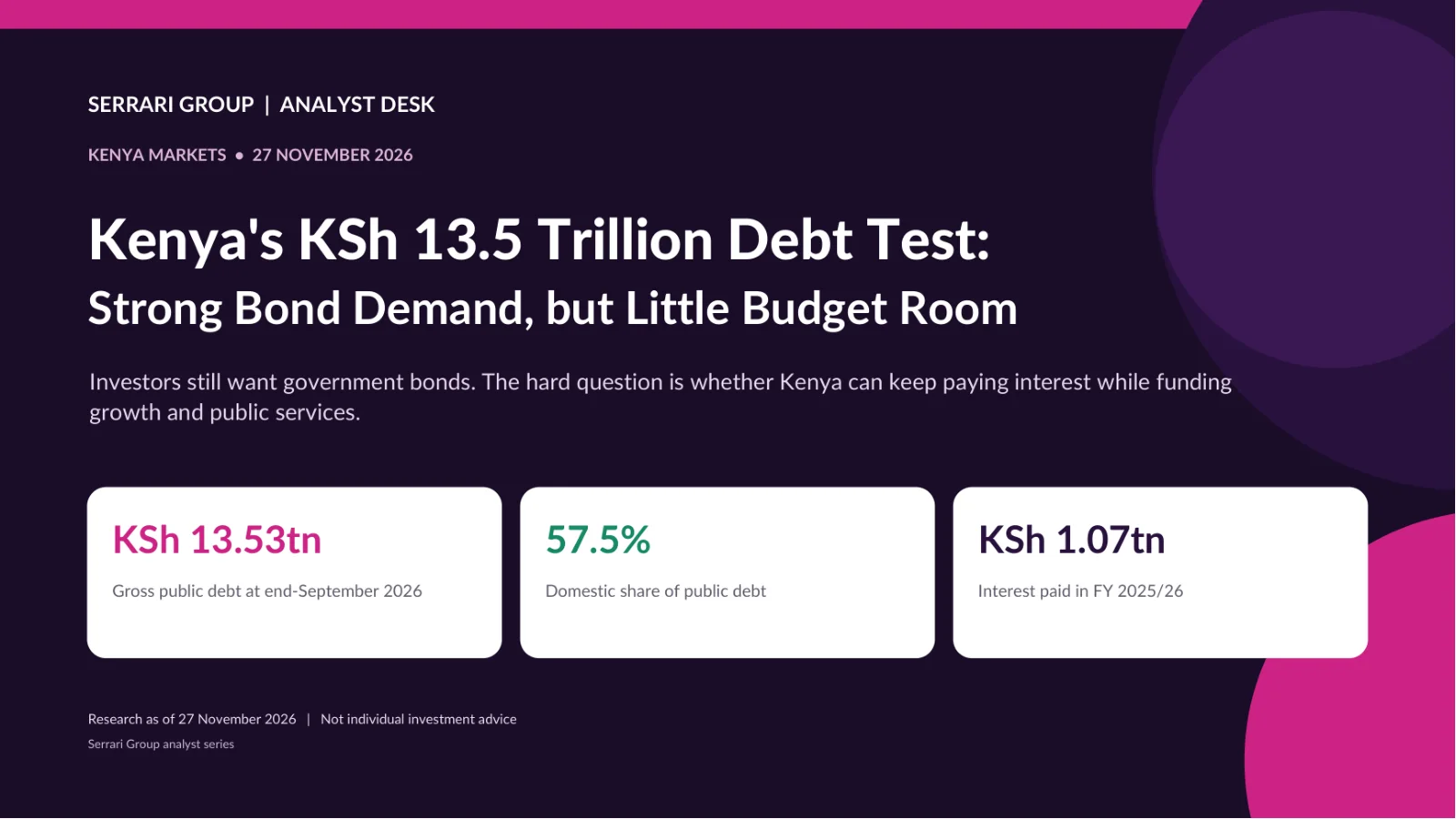
SERRARI GROUP | ANALYST DESK — KENYA MARKETS • 27 NOVEMBER 2026
Strong Bond Demand, but Little Budget Room. Investors still want government bonds. The hard question is whether Kenya can keep paying interest while funding growth and public services.
KSh 13.53tn — Gross public debt at end-September 2026
57.5% — Domestic share of public debt
KSh 1.07tn — Interest paid in FY 2025/26
Research as of 27 November 2026 | Not individual investment advice
Executive take
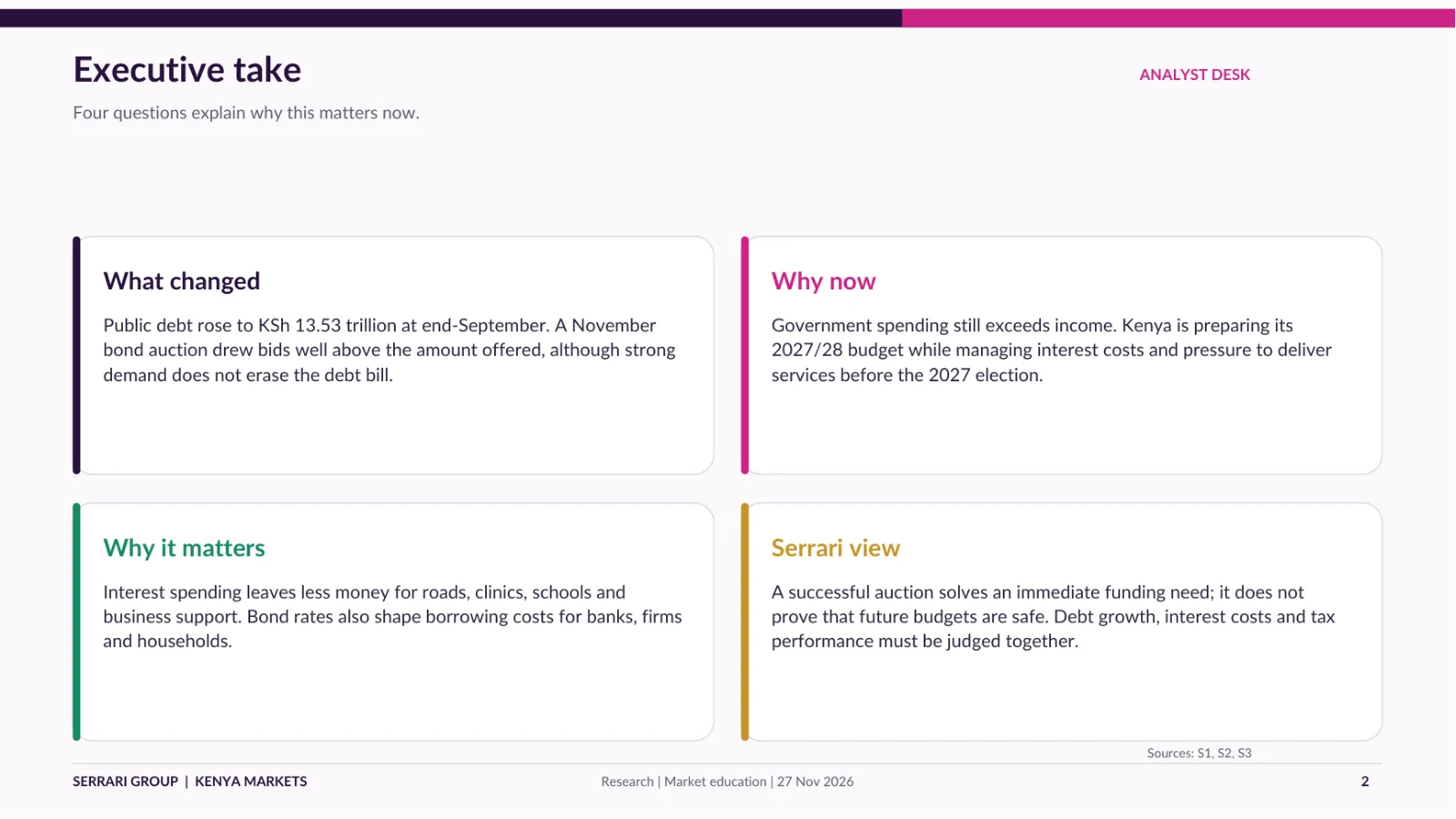
Four questions explain why this matters now.
What changed
Public debt rose to KSh 13.53 trillion at end-September. A November bond auction drew bids well above the amount offered, although strong demand does not erase the debt bill.
Why now
Government spending still exceeds income. Kenya is preparing its 2027/28 budget while managing interest costs and pressure to deliver services before the 2027 election.
Why it matters
Interest spending leaves less money for roads, clinics, schools and business support. Bond rates also shape borrowing costs for banks, firms and households.
Serrari view
A successful auction solves an immediate funding need; it does not prove that future budgets are safe. Debt growth, interest costs and tax performance must be judged together.
Three numbers describe Kenya's debt position
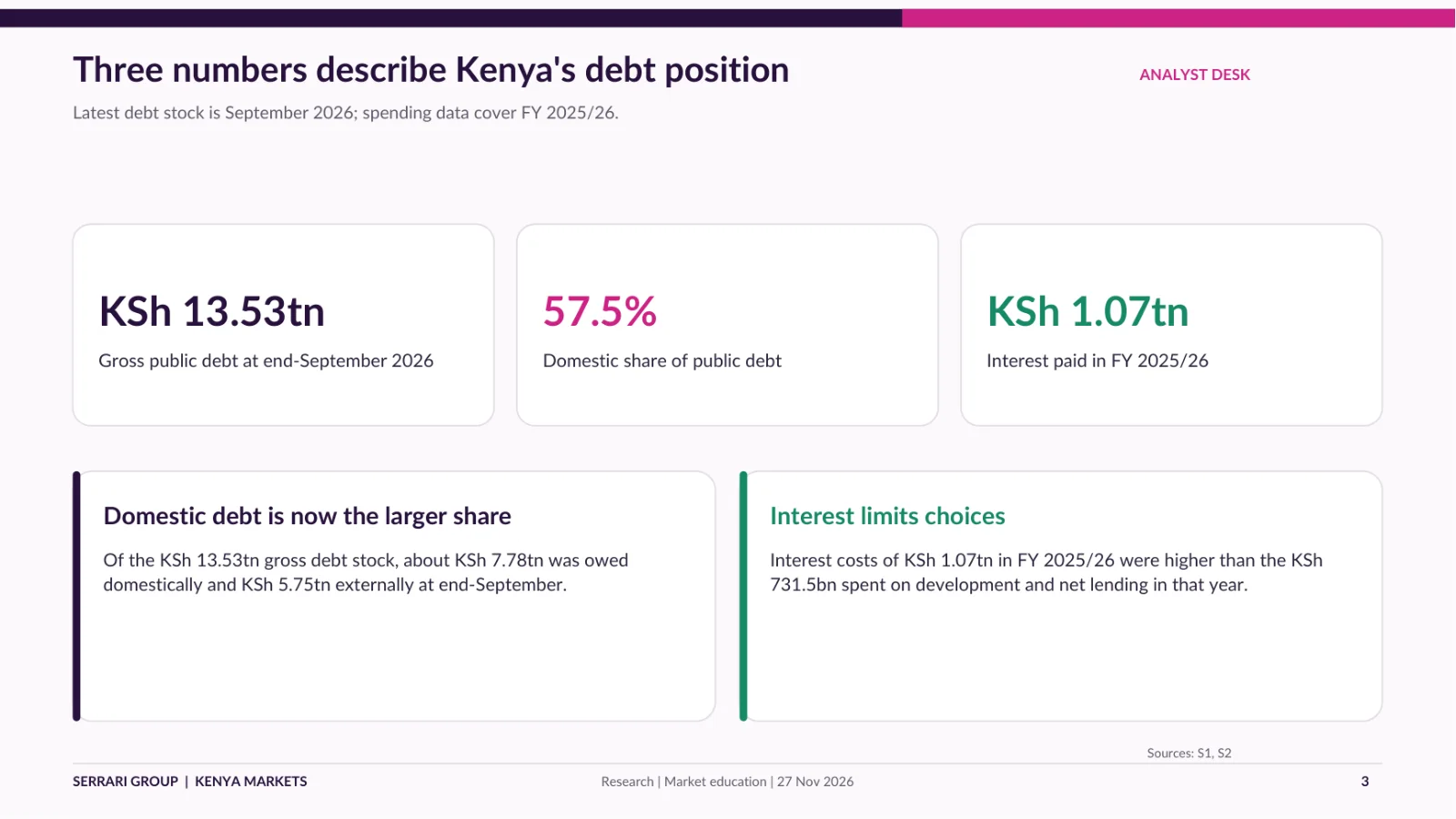
Latest debt stock is September 2026; spending data cover FY 2025/26.
KSh 13.53tn — Gross public debt at end-September 2026
57.5% — Domestic share of public debt
KSh 1.07tn — Interest paid in FY 2025/26
Domestic debt is now the larger share
Of the KSh 13.53tn gross debt stock, about KSh 7.78tn was owed domestically and KSh 5.75tn externally at end-September.
Interest limits choices
Interest costs of KSh 1.07tn in FY 2025/26 were higher than the KSh 731.5bn spent on development and net lending in that year.
Kenya's total public debt has kept rising
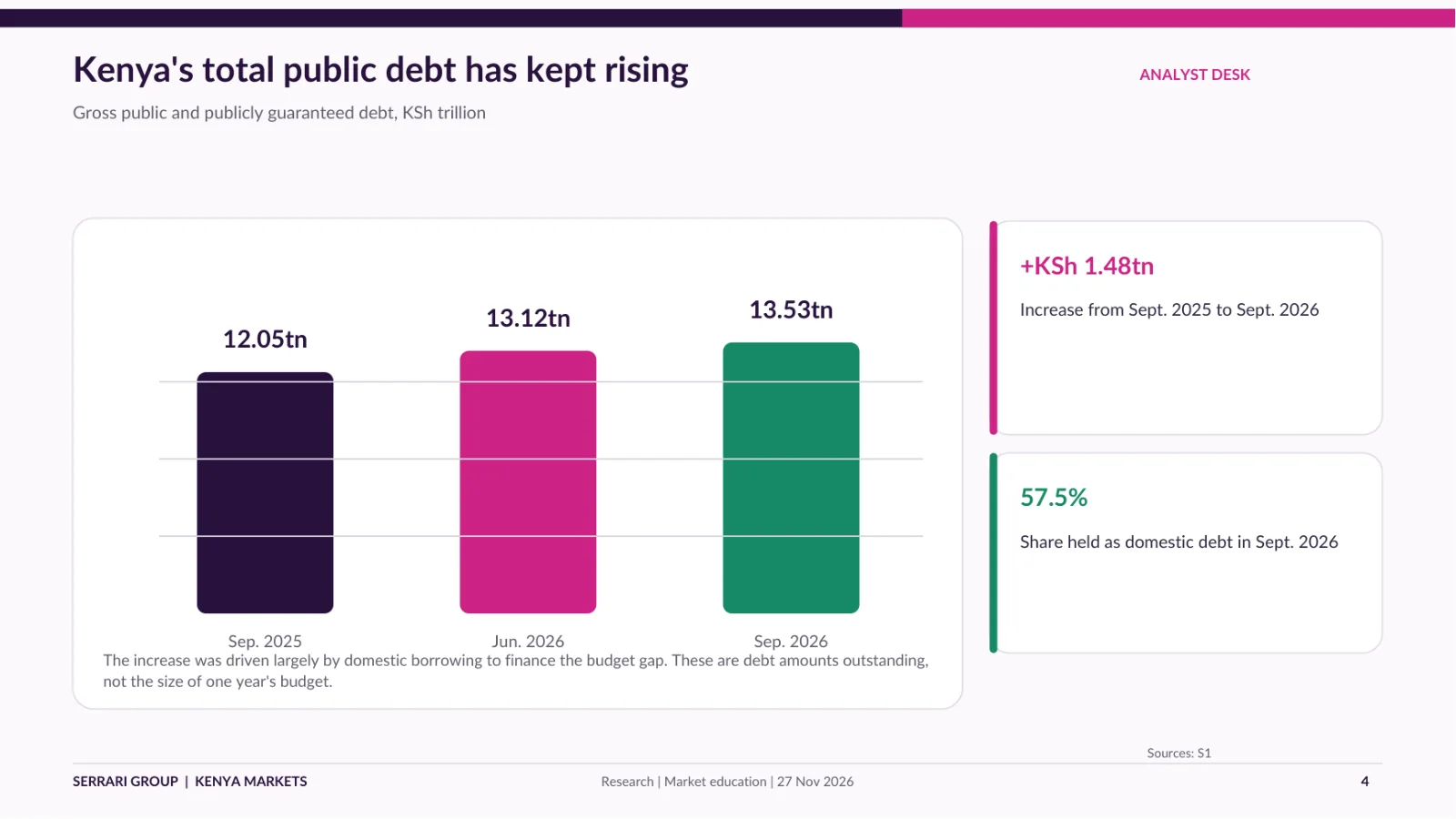
Gross public and publicly guaranteed debt, KSh trillion: Sep. 2025 — 12.05tn; Jun. 2026 — 13.12tn; Sep. 2026 — 13.53tn.
The increase was driven largely by domestic borrowing to finance the budget gap. These are debt amounts outstanding, not the size of one year's budget.
+KSh 1.48tn — Increase from Sept. 2025 to Sept. 2026
57.5% — Share held as domestic debt in Sept. 2026
Why Kenya keeps needing fresh borrowing
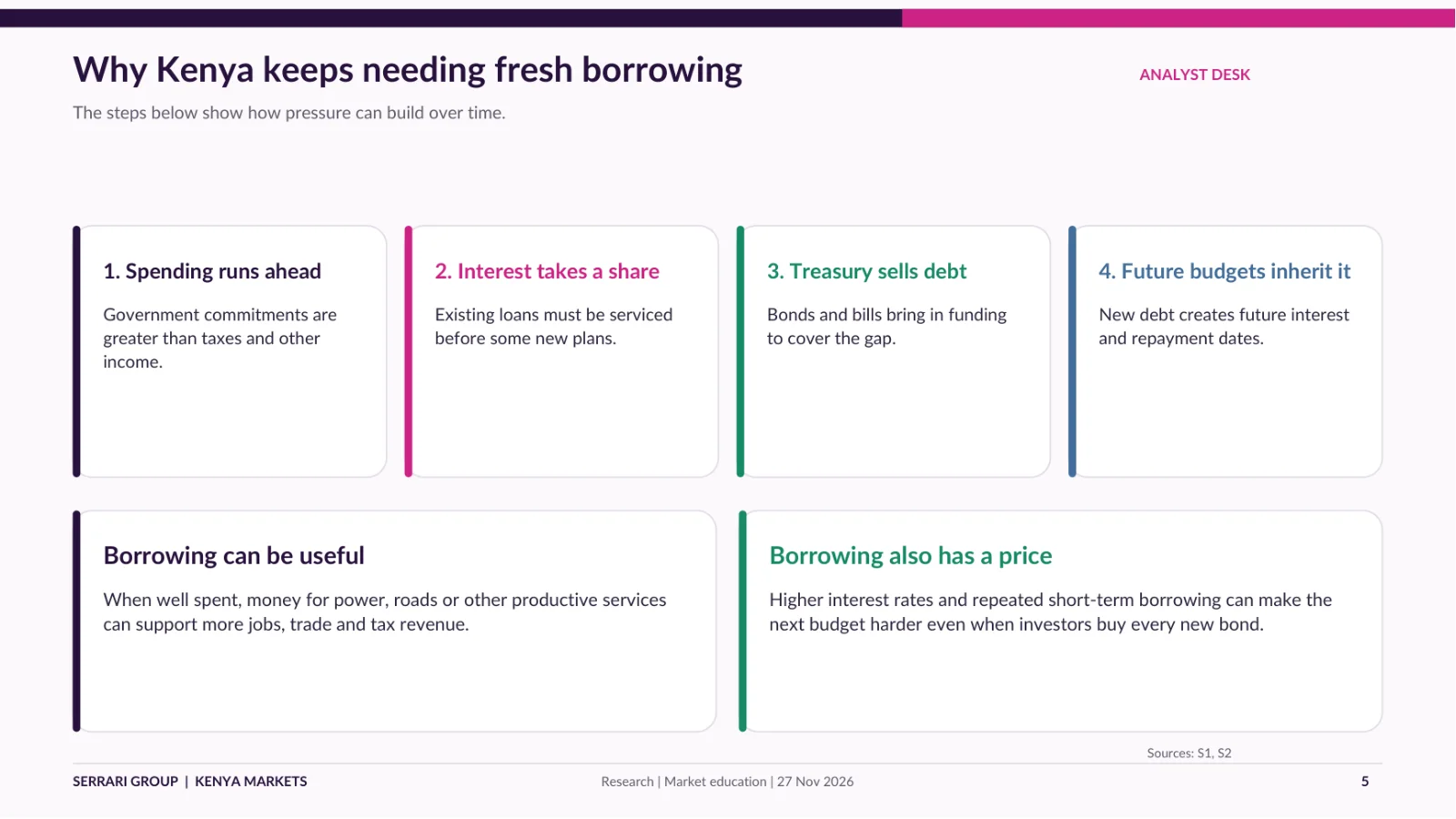
The steps below show how pressure can build over time.
1. Spending runs ahead — Government commitments are greater than taxes and other income.
2. Interest takes a share — Existing loans must be serviced before some new plans.
3. Treasury sells debt — Bonds and bills bring in funding to cover the gap.
4. Future budgets inherit it — New debt creates future interest and repayment dates.
Borrowing can be useful
When well spent, money for power, roads or other productive services can support more jobs, trade and tax revenue.
Borrowing also has a price
Higher interest rates and repeated short-term borrowing can make the next budget harder even when investors buy every new bond.
How government bonds affect the rest of Kenya
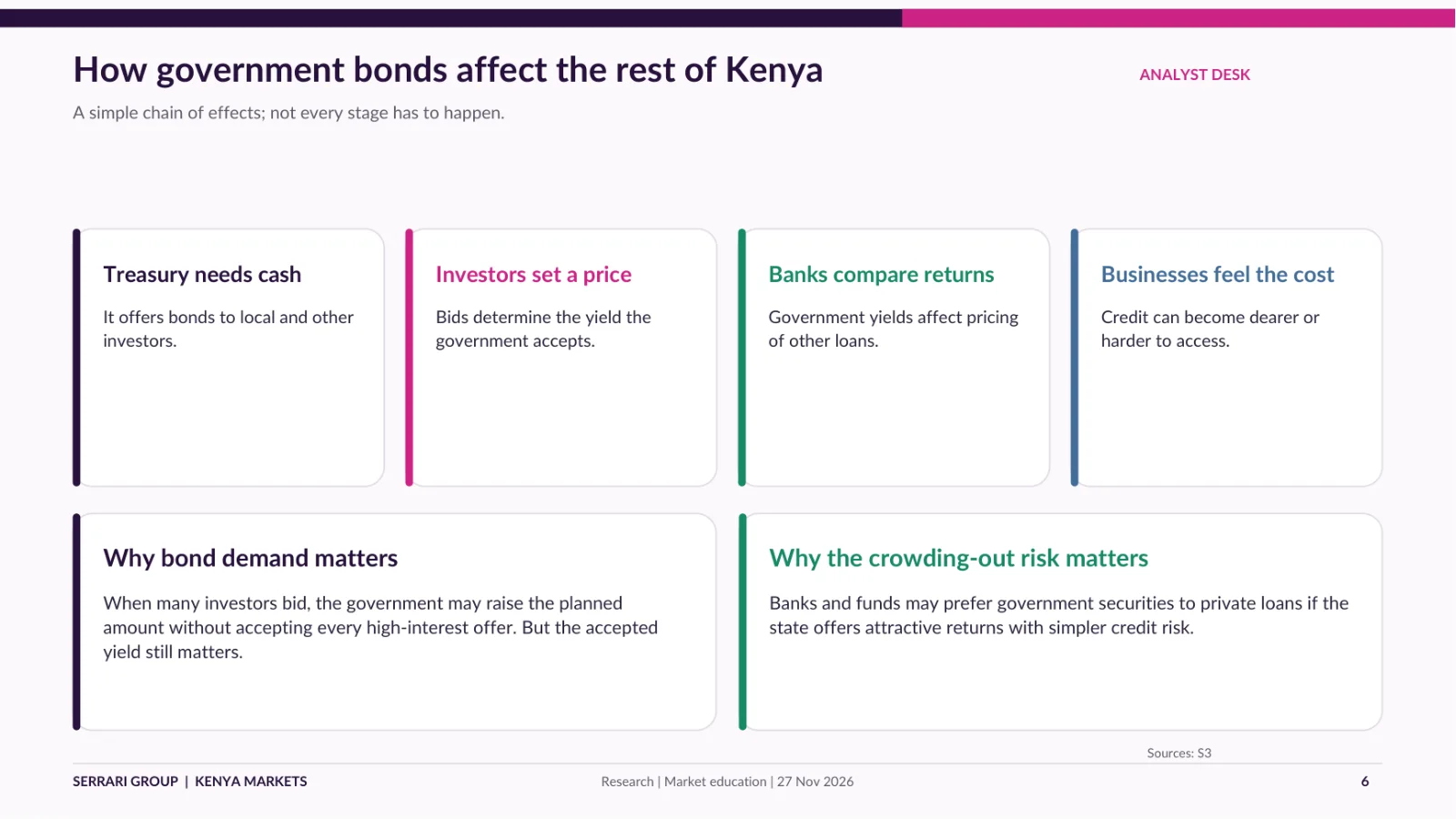
A simple chain of effects; not every stage has to happen.
Treasury needs cash — It offers bonds to local and other investors.
Investors set a price — Bids determine the yield the government accepts.
Banks compare returns — Government yields affect pricing of other loans.
Businesses feel the cost — Credit can become dearer or harder to access.
Why bond demand matters
When many investors bid, the government may raise the planned amount without accepting every high-interest offer. But the accepted yield still matters.
Why the crowding-out risk matters
Banks and funds may prefer government securities to private loans if the state offers attractive returns with simpler credit risk.
What the debt debate means for Kenyans
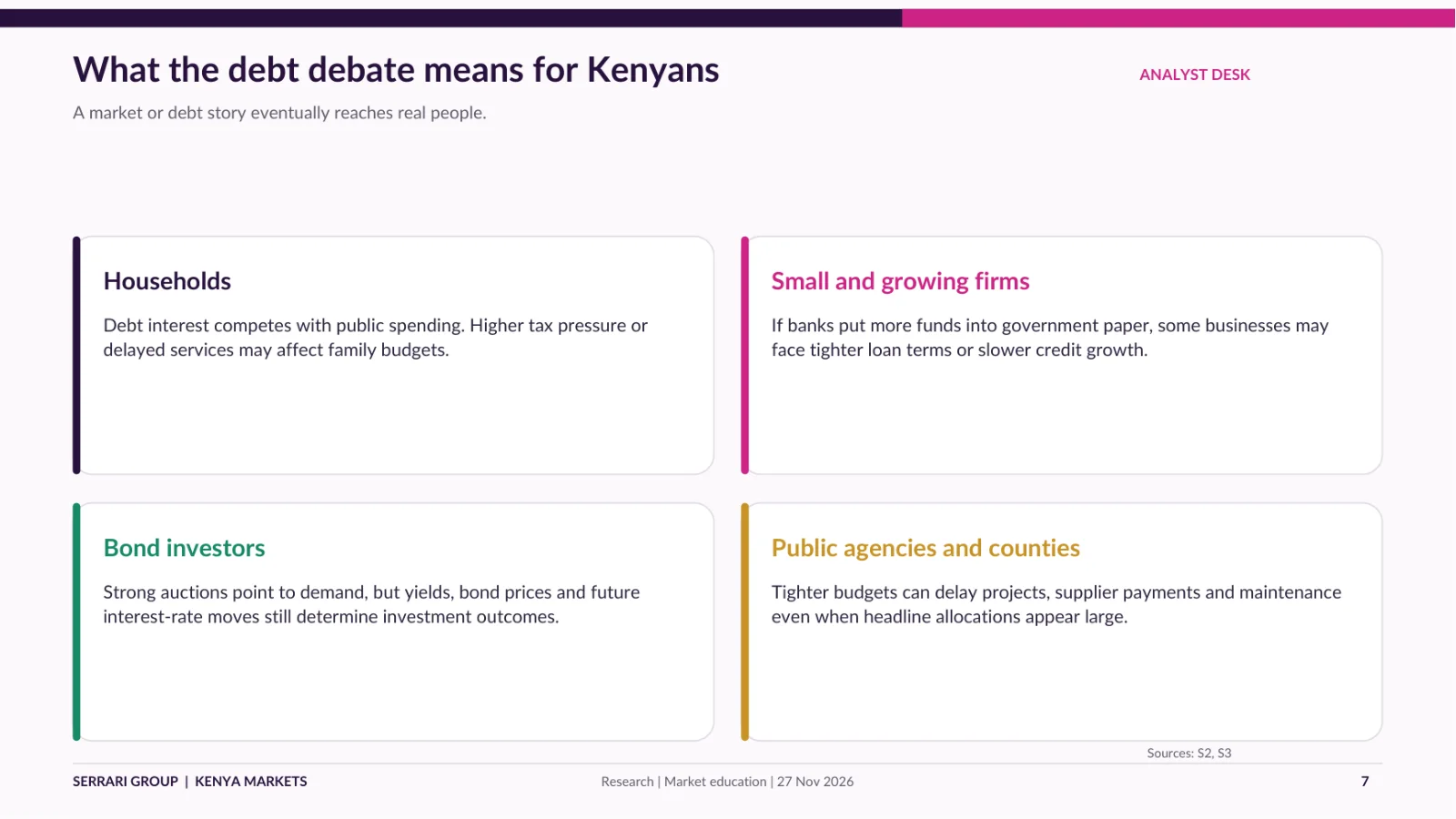
A market or debt story eventually reaches real people.
Households
Debt interest competes with public spending. Higher tax pressure or delayed services may affect family budgets.
Small and growing firms
If banks put more funds into government paper, some businesses may face tighter loan terms or slower credit growth.
Bond investors
Strong auctions point to demand, but yields, bond prices and future interest-rate moves still determine investment outcomes.
Public agencies and counties
Tighter budgets can delay projects, supplier payments and maintenance even when headline allocations appear large.
Investors bid above the November bond target
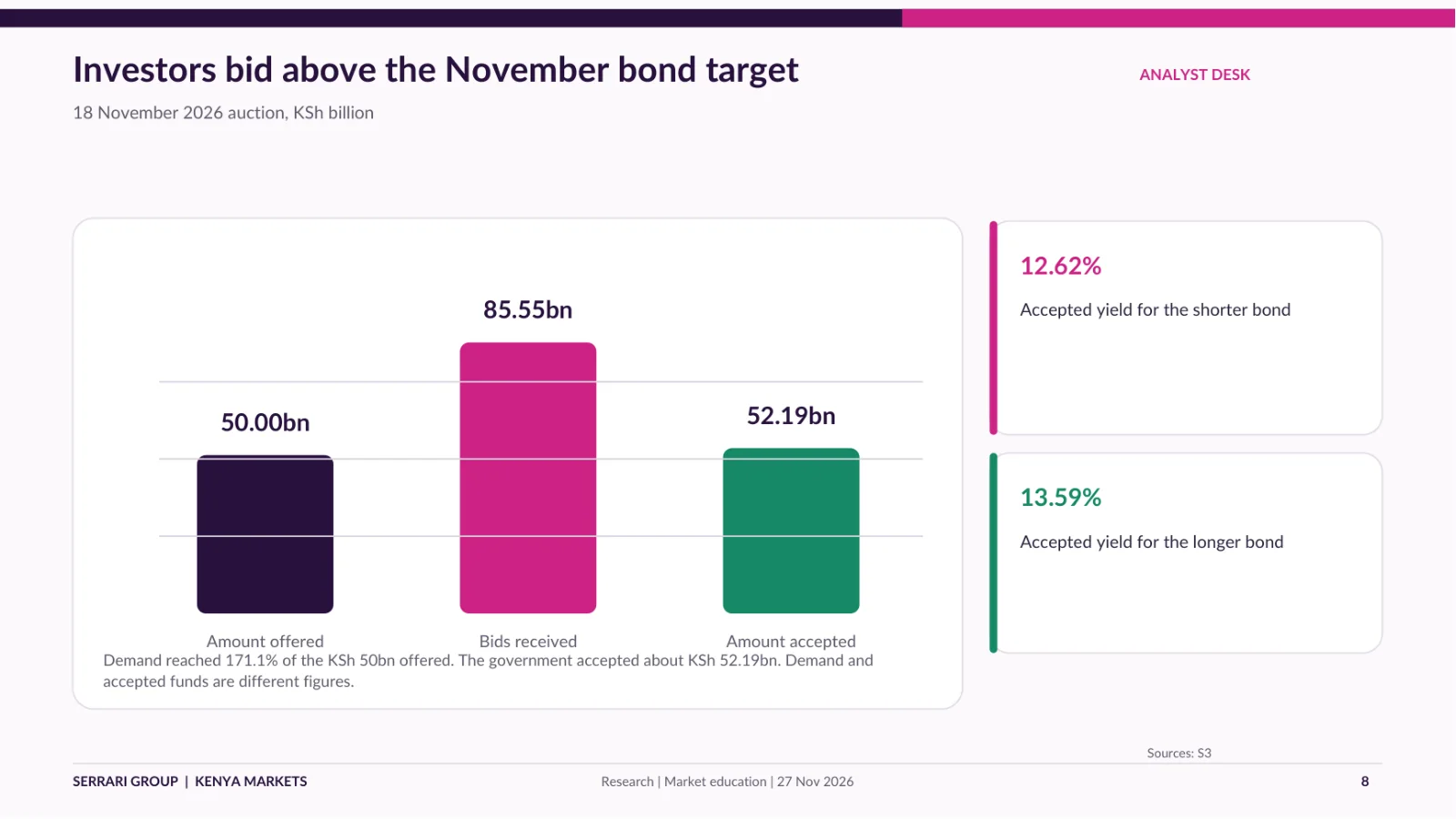
18 November 2026 auction, KSh billion: Amount offered — 50.00bn; Bids received — 85.55bn; Amount accepted — 52.19bn.
Demand reached 171.1% of the KSh 50bn offered. The government accepted about KSh 52.19bn. Demand and accepted funds are different figures.
12.62% — Accepted yield for the shorter bond
13.59% — Accepted yield for the longer bond
Why strong auctions do not remove fiscal risk
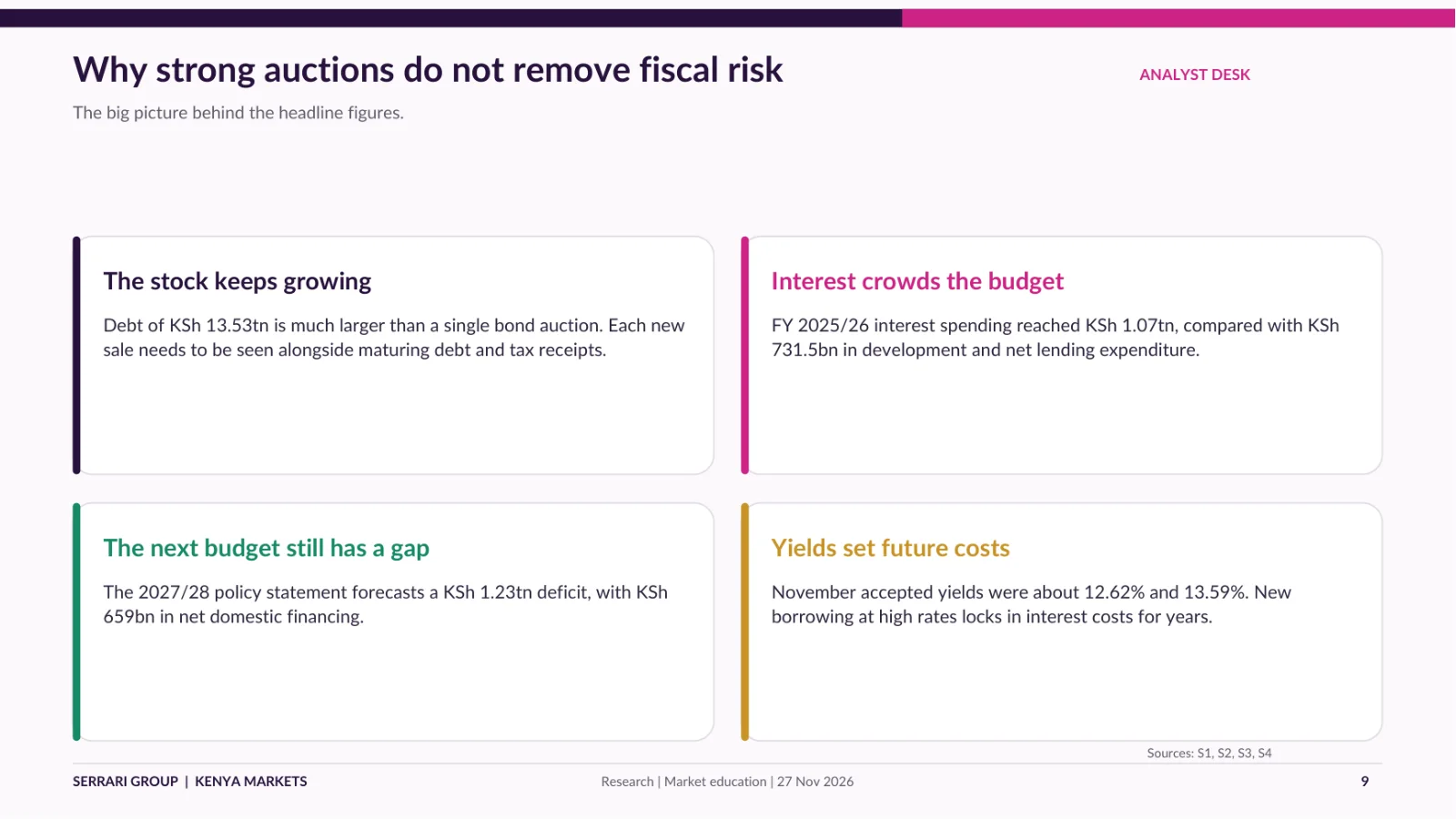
The big picture behind the headline figures.
The stock keeps growing
Debt of KSh 13.53tn is much larger than a single bond auction. Each new sale needs to be seen alongside maturing debt and tax receipts.
Interest crowds the budget
FY 2025/26 interest spending reached KSh 1.07tn, compared with KSh 731.5bn in development and net lending expenditure.
The next budget still has a gap
The 2027/28 policy statement forecasts a KSh 1.23tn deficit, with KSh 659bn in net domestic financing.
Yields set future costs
November accepted yields were about 12.62% and 13.59%. New borrowing at high rates locks in interest costs for years.
Risk map: where pressure could build
These are analytical judgments, not measured chances or price forecasts.
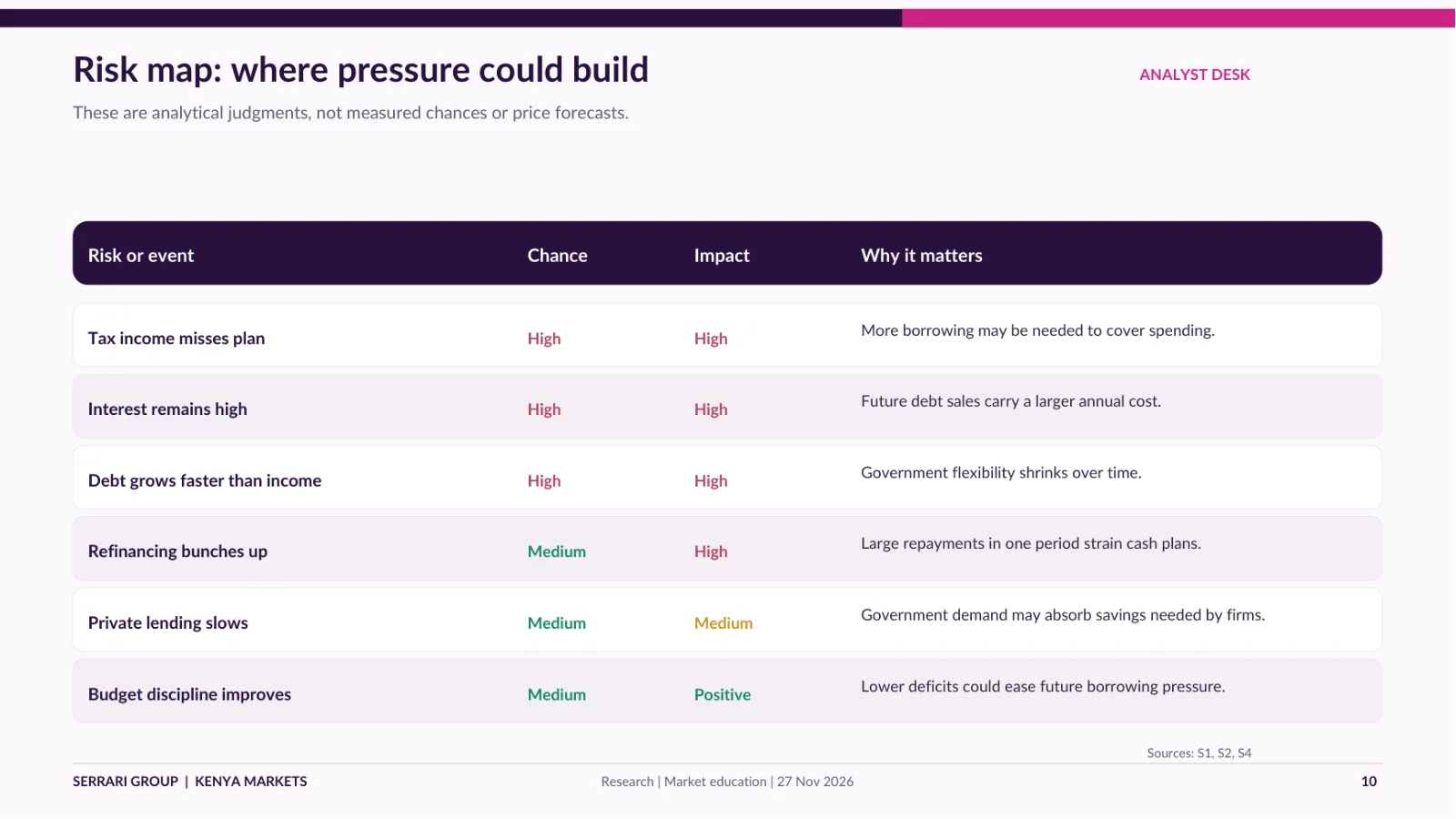
| Risk or event | Chance | Impact | Why it matters |
|---|---|---|---|
| Tax income misses plan | High | High | More borrowing may be needed to cover spending. |
| Interest remains high | High | High | Future debt sales carry a larger annual cost. |
| Debt grows faster than income | High | High | Government flexibility shrinks over time. |
| Refinancing bunches up | Medium | High | Large repayments in one period strain cash plans. |
| Private lending slows | Medium | Medium | Government demand may absorb savings needed by firms. |
| Budget discipline improves | Medium | Positive | Lower deficits could ease future borrowing pressure. |
These are analytical judgments, not measured chances or price forecasts.
Figure: Risk map — where pressure could build.
Three ways this could develop
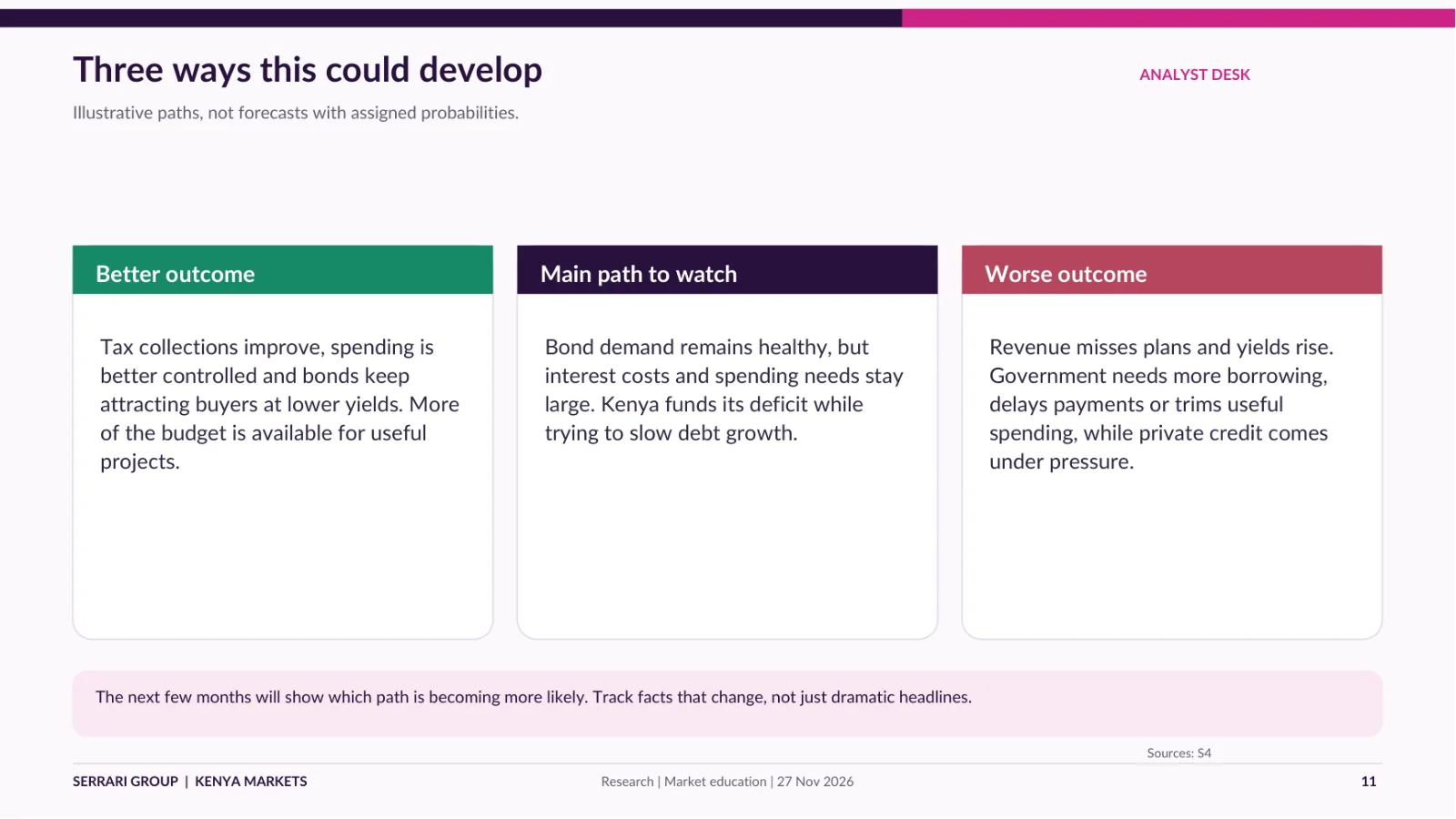
Illustrative paths, not forecasts with assigned probabilities.
Better outcome
Tax collections improve, spending is better controlled and bonds keep attracting buyers at lower yields. More of the budget is available for useful projects.
Main path to watch
Bond demand remains healthy, but interest costs and spending needs stay large. Kenya funds its deficit while trying to slow debt growth.
Worse outcome
Revenue misses plans and yields rise. Government needs more borrowing, delays payments or trims useful spending, while private credit comes under pressure.
The next few months will show which path is becoming more likely. Track facts that change, not just dramatic headlines.
What would strengthen Kenya's position?
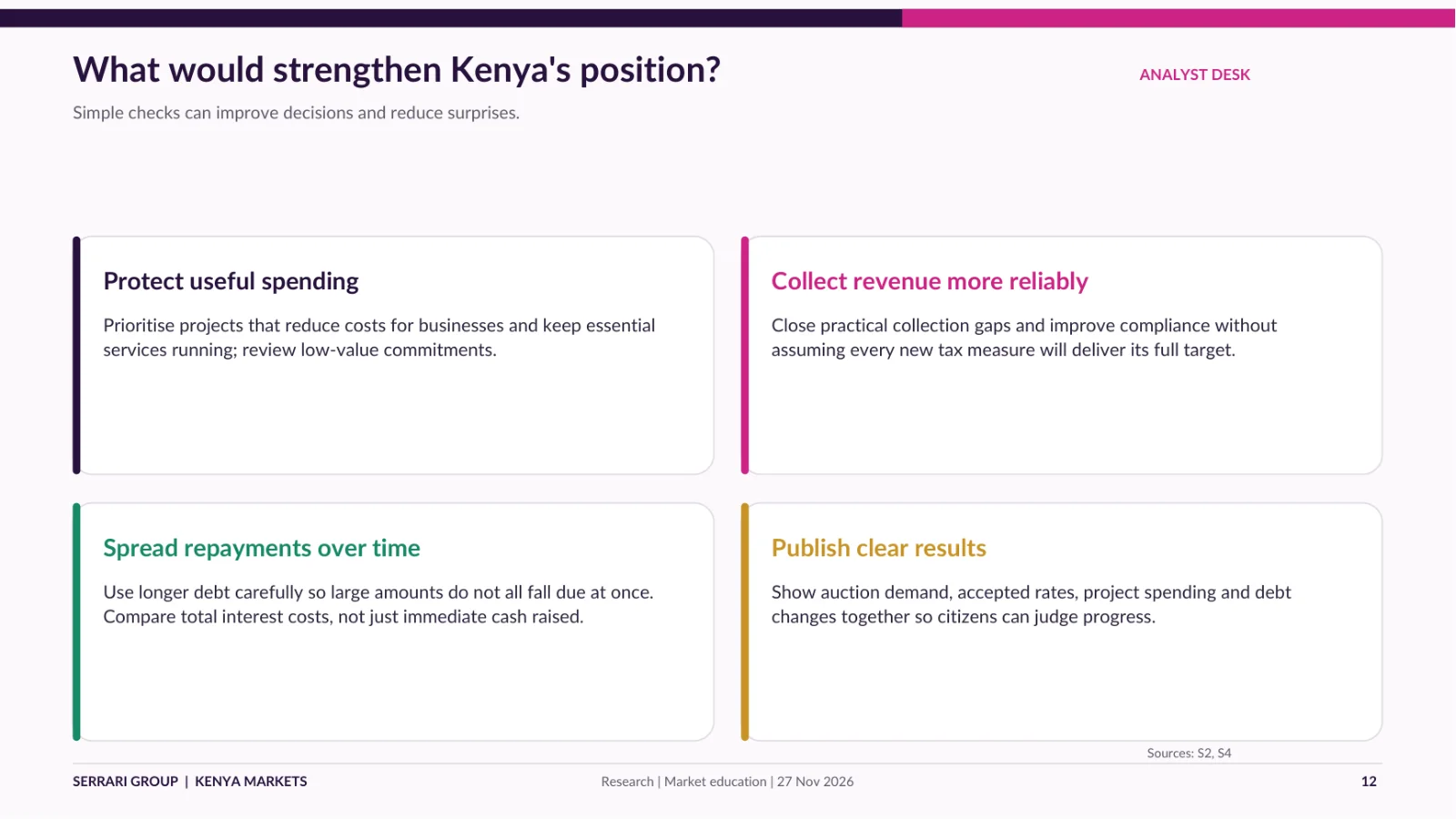
Simple checks can improve decisions and reduce surprises.
Protect useful spending
Prioritise projects that reduce costs for businesses and keep essential services running; review low-value commitments.
Collect revenue more reliably
Close practical collection gaps and improve compliance without assuming every new tax measure will deliver its full target.
Spread repayments over time
Use longer debt carefully so large amounts do not all fall due at once. Compare total interest costs, not just immediate cash raised.
Publish clear results
Show auction demand, accepted rates, project spending and debt changes together so citizens can judge progress.
Market dashboard: what to watch next
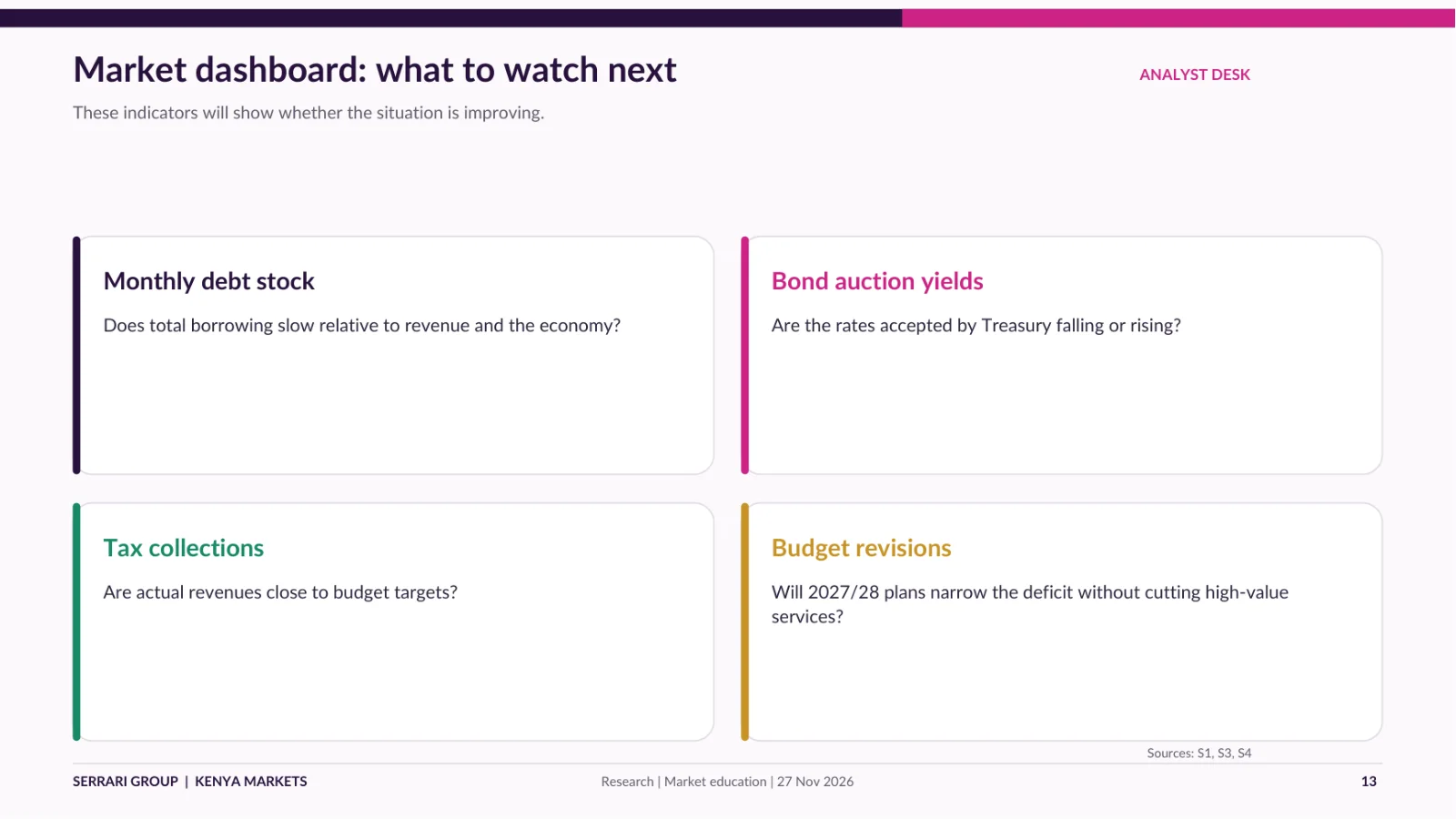
These indicators will show whether the situation is improving.
Monthly debt stock — Does total borrowing slow relative to revenue and the economy?
Bond auction yields — Are the rates accepted by Treasury falling or rising?
Tax collections — Are actual revenues close to budget targets?
Budget revisions — Will 2027/28 plans narrow the deficit without cutting high-value services?
Serrari assessment: funding access is not the same as fiscal space
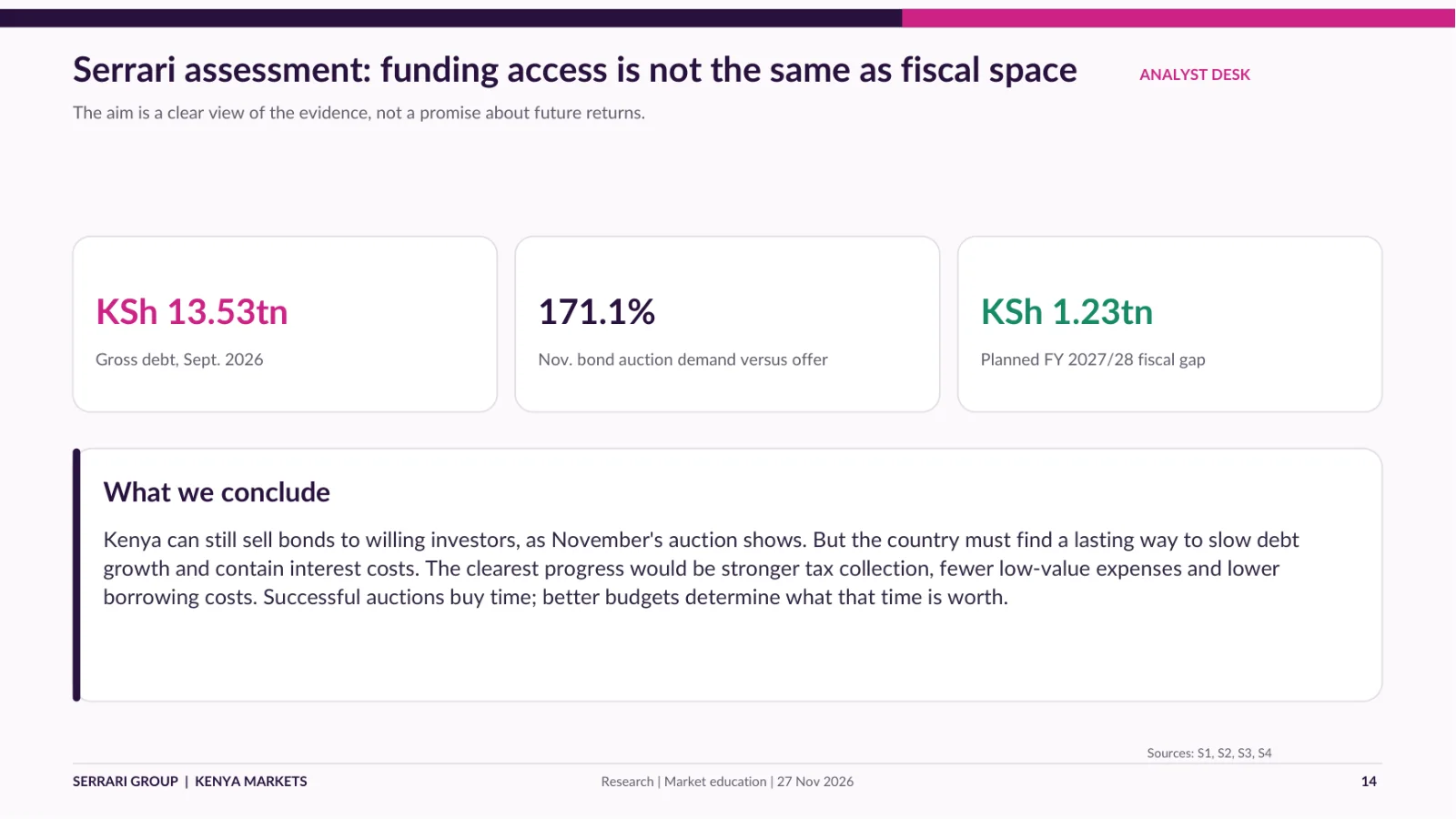
The aim is a clear view of the evidence, not a promise about future returns.
KSh 13.53tn — Gross debt, Sept. 2026
171.1% — Nov. bond auction demand versus offer
KSh 1.23tn — Planned FY 2027/28 fiscal gap
What we conclude
Kenya can still sell bonds to willing investors, as November's auction shows. But the country must find a lasting way to slow debt growth and contain interest costs. The clearest progress would be stronger tax collection, fewer low-value expenses and lower borrowing costs. Successful auctions buy time; better budgets determine what that time is worth.
Conclusion, method and source links
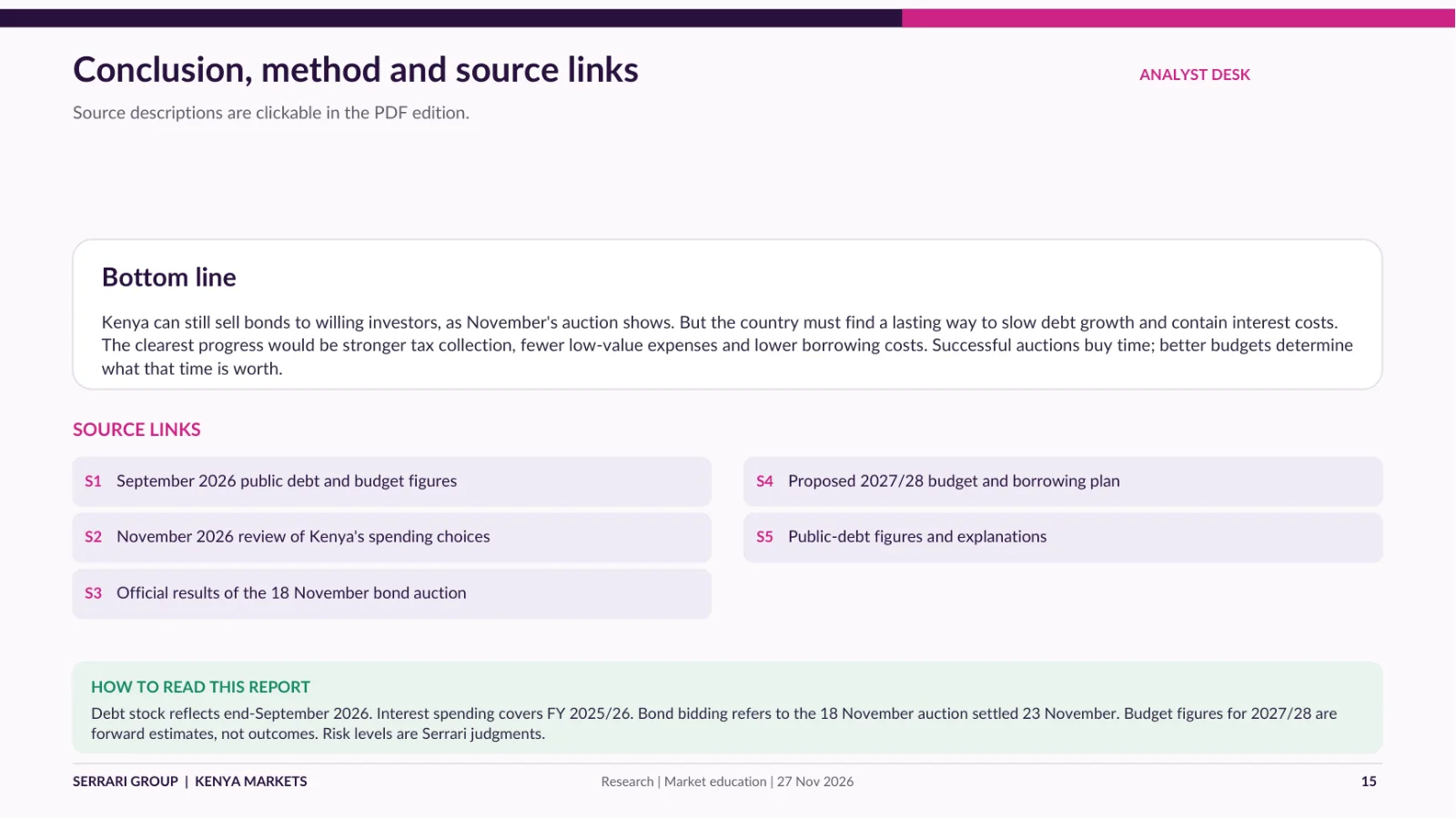
Bottom line
Kenya can still sell bonds to willing investors, as November's auction shows. But the country must find a lasting way to slow debt growth and contain interest costs. The clearest progress would be stronger tax collection, fewer low-value expenses and lower borrowing costs. Successful auctions buy time; better budgets determine what that time is worth.
Source links
S1 — September 2026 public debt and budget figures
S2 — November 2026 review of Kenya's spending choices
S3 — Official results of the 18 November bond auction
S4 — Proposed 2027/28 budget and borrowing plan
S5 — Public-debt figures and explanations
How to read this report
Debt stock reflects end-September 2026. Interest spending covers FY 2025/26. Bond bidding refers to the 18 November auction settled 23 November. Budget figures for 2027/28 are forward estimates, not outcomes. Risk levels are Serrari judgments.