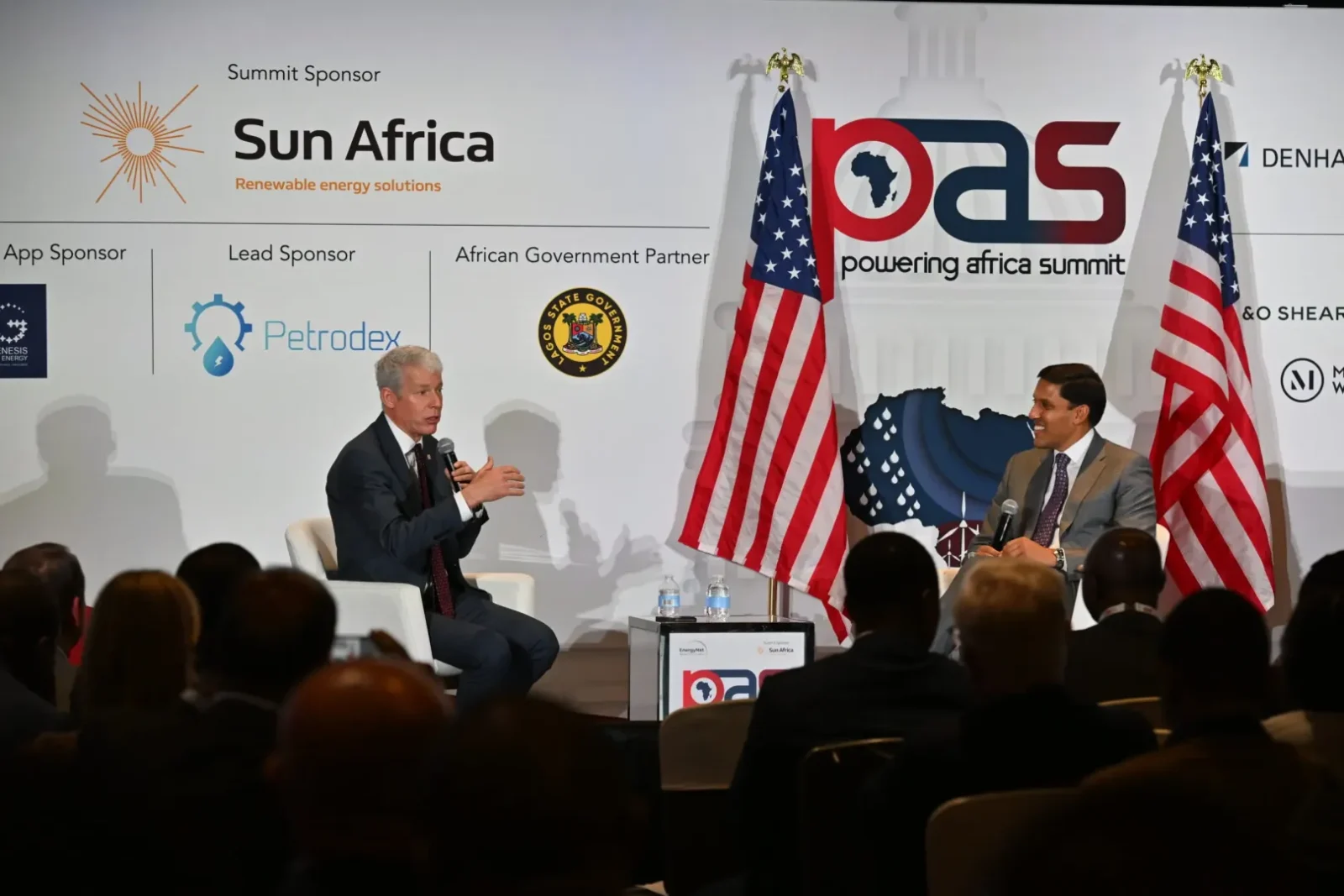
When the Rockefeller Foundation and the Global Energy Alliance for People and Planet made their first joint pledge of $10 million toward Africa’s electricity crisis in September 2024, the figure was modest relative to the scale of the problem. Nineteen months later, that commitment has multiplied more than tenfold. At the Powering Africa Summit in Washington, D.C. on March 19, 2026, both organisations announced a combined investment of over $100 million in Mission 300 — the World Bank Group and African Development Bank’s flagship initiative to connect 300 million people across Africa to electricity by the end of the decade.
The announcement, made during a fireside chat between Rockefeller Foundation President Dr. Rajiv Shah and US Energy Secretary Chris Wright, signals far more than a financial milestone. It reflects a sharpening conviction in development and philanthropic circles that electricity access is not merely an infrastructure problem — it is the most direct and measurable route out of extreme poverty for hundreds of millions of people on the African continent.
Markets move fast; don’t get left behind. We’ve paired the Serrari Group Market Index with a curated Marketplace and a comprehensive Wealth Builder Course to ensure you have the data—and the skills—to act on it.
The Scale of the Problem
To understand why a $100 million commitment carries weight, it helps to first grasp the depth of Africa’s energy deficit. According to data from the International Energy Agency, 730 million people worldwide still lack access to electricity, with Sub-Saharan Africa accounting for more than 80% of that total. As of 2024, approximately 590 million people in the region remained without power — a figure that has barely moved in over a decade despite consistent new connections, because population growth has consistently outpaced electrification rates.
The SDG7 Energy Progress Report published by the World Bank found that while 35 million new people in Sub-Saharan Africa gained electricity access in 2023, rapid population growth meant the net reduction in the access gap was only 5 million people. That dynamic — running hard to stand still — is precisely the structural failure that Mission 300 was designed to disrupt.
The consequences of energy poverty reach far beyond the inconvenience of darkness. According to the Oxford Poverty and Human Development Initiative, lack of electricity is the single greatest predictor of extreme poverty — ahead of income, education, or access to water. Without power, healthcare facilities cannot refrigerate vaccines, children cannot study after dark, entrepreneurs cannot run modern businesses, and economies cannot industrialise at scale. The IEA has separately warned that reaching universal electricity access will require annual investments of $30 billion through 2030, of which around $20 billion would need to be directed into Sub-Saharan Africa. Against that backdrop, $100 million in philanthropic capital is better understood as catalytic and crowd-in funding rather than a standalone solution.
What Mission 300 Actually Does
Mission 300 was launched by the World Bank and African Development Bank in April 2024 as a multi-stakeholder coordination mechanism designed to translate high-level political commitments into on-the-ground connections. It operates through a combination of national policy reform, institutional capacity building, private sector mobilisation, and blended finance — recognising that no single instrument or funding source can solve the problem alone.
A cornerstone of the initiative is the National Energy Compact system. Since Mission 300’s inception, compacts have been launched in 30 countries, establishing country-specific investment targets, policy reform commitments, and implementation timelines. These compacts are government-owned documents — not donor-driven plans — which is a deliberate design choice intended to ensure that African countries lead the process rather than receive instructions from multilateral lenders.
The results so far are significant. Since the World Bank and African Development Bank launched the initiative, approximately 44 million people across Africa have been connected to electricity, with a pipeline of tens of millions more expected by the end of 2026. Speaking at the Powering Africa Summit, African Development Bank Vice President for Power, Energy, Climate, and Green Growth Dr. Kevin Kariuki described the initiative as being “fundamentally about delivery, and turning ambition into results at scale,” adding that philanthropic capital plays a “critical role in strengthening government delivery capacity, de-risking investments, and accelerating projects that can mobilise much larger flows of public and private finance.”
How the $100 Million Is Being Deployed
The $100 million commitment is split roughly 47% from the Rockefeller Foundation and its public charity arm, RF Catalytic Capital, with 53% from the Global Energy Alliance. The funding spans 23 countries to date: Benin, Burkina Faso, Democratic Republic of Congo, Chad, Côte d’Ivoire, Ethiopia, Kenya, Lesotho, Liberia, Madagascar, Malawi, Mauritania, Mozambique, Niger, Nigeria, Republic of Congo, Rwanda, Senegal, Sierra Leone, Somalia, Togo, Uganda, and Zambia.
The deployment spans several distinct workstreams, each targeting a different bottleneck in the electrification pipeline.
Compact Delivery and Monitoring Units (CDMUs): A significant portion of the funding goes toward technical assistance for more than a dozen national CDMUs. These units are embedded within government ministries and are responsible for coordinating implementation, monitoring progress, and ensuring accountability against compact targets. Without this kind of institutional infrastructure, even well-funded compacts can stall at the procurement or coordination stage. The Rockefeller Foundation has confirmed that CDMUs are now operational or being supported in Nigeria, Côte d’Ivoire, Senegal, Malawi, Liberia, and more than a dozen other countries.
Mission 300 Fellowships: The funding supports 18 Mission 300 Fellowships, a program in which selected African professionals are embedded within CDMUs for two-year deployments. These fellows — chosen from over 3,000 applicants from nearly every African country — provide targeted technical support on electrification challenges specific to their assigned markets. The Rockefeller Foundation has indicated that the fellowship program is being expanded in collaboration with nonprofit impact accelerator CoAction Global to reach at least 18 African countries, with an additional cohort of Clean Cooking Fellows being recruited.
Investment in Zafiri: Among the most structurally significant elements of the funding is an investment in Zafiri, Mission 300’s permanent capital fund originated by the World Bank and African Development Bank. Zafiri is structured as a permanent capital vehicle with a targeted capitalisation of $1 billion, designed to provide long-term equity to distributed renewable energy companies — mini-grid developers, solar home system providers, and clean cooking enterprises — that are essential for last-mile access but have historically been underfinanced by mainstream capital markets. The African Development Bank alone has committed $40 million in equity to Zafiri, with Inspired Evolution appointed as investment manager. Over its lifespan, Zafiri aims to facilitate electricity connections and clean cooking access for more than 30 million people.
Productive Use Financing Facility (PUFF): The commitment also funds an expansion of the Global Energy Alliance and CLASP’s Productive Use Financing Facility, which provides grants, subsidies, and technical assistance to suppliers and distributors of clean, energy-efficient appliances. This stream recognises a critical insight: connecting homes to electricity is only valuable if people can afford devices that make meaningful use of that power. PUFF targets small businesses, farmers, and households with affordable appliances that generate income and improve quality of life beyond simply switching on a light.
Context is everything. While you follow today’s updates, use the Serrari Market Index and Marketplace to spot emerging shifts. Need to sharpen your edge? Our Wealth Builder Course turns these insights into a professional-grade strategy.
Clean Cooking: The Forgotten Half of the Energy Crisis
Buried within the energy access conversation — and often underfunded relative to electricity grid expansion — is the challenge of clean cooking. In sub-Saharan Africa, approximately 70% of households still rely on charcoal or wood for cooking, generating toxic indoor smoke that causes respiratory illness, contributing to deforestation, and placing a disproportionate burden on women and children who spend hours gathering fuel. The IEA has warned that nearly 1.8 billion people globally will still lack clean cooking access by 2030 without urgent intervention, with the majority concentrated in Africa.
To address this, the Rockefeller Foundation, Global Energy Alliance, Clean Cooking Alliance, and Energy Corps have jointly launched a Clean Cooking Accelerator Initiative, including the recruitment of Clean Cooking Fellows to strengthen institutional capacity for developing investable projects within CDMUs. A dedicated Clean Cooking Delivery Unit is being piloted in Kenya, which could serve as a replicable model for wider rollout across the continent. The inclusion of clean cooking within Mission 300’s mandate represents a meaningful broadening of what the initiative considers “energy access” — moving beyond grid connections toward a more holistic view of household energy adequacy.
The Political and Financial Architecture Behind the Push
What gives Mission 300 its unusual credibility among development initiatives is the breadth and quality of the coalition behind it. Beyond the Rockefeller Foundation and the Global Energy Alliance, the initiative draws support from the Alliance’s Global Leadership Council — a coalition of nearly three dozen global finance, clean energy, and philanthropy leaders co-chaired by Norwegian Prime Minister Jonas Gahr Støre and Dr. Rajiv Shah. The presence of a sitting head of government as co-chair signals political engagement at the highest level — a deliberate strategy to make energy access a cross-partisan diplomatic priority rather than a niche development concern.
The announcement was made in the presence of US Energy Secretary Chris Wright, adding Washington’s implicit endorsement to the effort and underscoring the cross-partisan political appeal that electricity access has developed in development policy circles. The Global Energy Alliance itself, founded in 2021 by the Rockefeller Foundation, IKEA Foundation, and Bezos Earth Fund, works across more than 30 countries in Africa, Asia, Latin America, and the Caribbean with an ambition to reach 1 billion people with clean electricity, prevent 4 billion tonnes of carbon emissions, and create or improve 150 million jobs.
The financial architecture also makes sophisticated use of blended finance instruments. Beyond Zafiri, Mission 300 draws on the World Bank’s DARES initiative in West and Central Africa and the African Development Bank’s Sustainable Energy Fund for Africa (SEFA) — vehicles designed to blend concessional capital with commercial investment and de-risk projects sufficiently to attract private sector participation at scale.
Remaining Challenges and the Road to 2030
Despite the momentum, sober assessment is warranted. The Tracking SDG7 report noted that even with 35 million new connections in 2023, the net reduction in Africa’s electricity gap was just 5 million — a clear illustration of how difficult it is to outpace demographic growth. Sub-Saharan Africa now accounts for 85% of the world’s unelectrified population, up from 50% in 2010. The direction of travel is the wrong one in population terms, even as absolute connection numbers rise.
The 2030 deadline is five years away and the gap between Mission 300’s 300-million target and the current pace of connections is significant. High debt levels across many African governments continue to constrain public investment in energy infrastructure, while many multilateral financial institutions remain cautious about financing natural gas or other transitional fuels even where they would accelerate access. The CSIS has noted that Africa received only 2.4% of global renewable energy investment between 2010 and 2020 — a deeply disproportionate share for a region with some of the world’s highest solar irradiance and fastest-growing populations.
The Global Energy Alliance CEO Woochong Um was direct about the challenge at the Powering Africa Summit: “Reliable, affordable, abundant electricity is essential for jobs, prosperity, and resilience.” The emphasis on affordability is deliberate — a connection that costs more to use than it generates in economic value is, in the long run, not a solution.
What This Moment Represents
For the Rockefeller Foundation, the $100 million commitment to Mission 300 is not just its largest-ever energy investment — it is a philosophical statement. As Dr. Shah put it, the foundation has made its “biggest-ever bet on connecting people to electricity as the single best pathway out of large-scale poverty,” adding that the investment reflects a commitment to “putting countries in the lead, harnessing frontier technology, and focusing relentlessly on achievable, measurable goals.”
The Rockefeller Foundation has invested $30 billion over its 113-year history to promote human wellbeing globally. Concentrating an unprecedented share of its current philanthropic firepower on sub-Saharan electricity access reflects a hard-nosed calculation about where institutional capital can have the greatest marginal impact in 2026. The question is no longer whether the world’s development institutions can articulate a plan for universal energy access. The question — and it remains open — is whether they can execute it fast enough, at sufficient scale, before demographic momentum renders the 2030 targets permanently out of reach.
Your financial future isn’t something you wait for—it’s something you build.
The real question is: when do you begin?
Move beyond simply staying informed.
Navigate the markets with clarity—track trends through the Serrari Group Market Index, uncover opportunities in the Serrari Marketplace, and build practical knowledge with our Curated Wealth Builder Course.
Stay connected to what truly matters.
Get daily insights on macro trends and financial movements across Kenya, Africa, and global markets—delivered through the Serrari Newsletter.
Growth opens doors.
Advance your career through professional programs including ACCA, HESI A2, ATI TEAS 7 , HESI EXIT , NCLEX – RN and NCLEX – PN, Financial Literacy!🌟—designed to move you forward with confidence.
See where money is flowing—clearly and in real time.
Track Money Market Funds, Treasury Bills, Treasury Bonds, Green Bonds, and Fixed Deposits, alongside global and African indexes, key economic indicators, and the evolving Crypto and stablecoin landscape—all within Serrari’s Market Index.