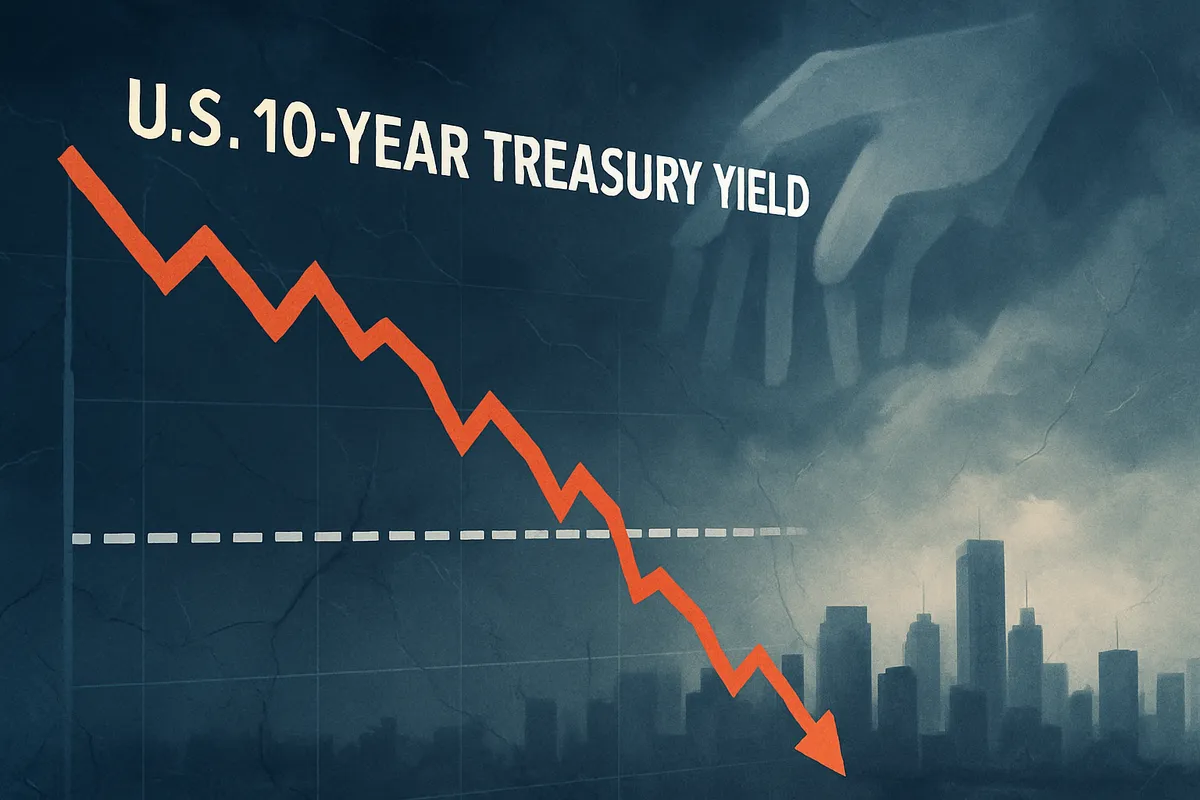












Standard Chartered has projected that the global stablecoin market could expand to $2 trillion by the end of 2028 — a forecast that, if realized, would not merely represent growth in digital assets, but a structural transformation in the U.S. Treasury market itself.
According to analysts Geoffrey Kendrick, the bank’s Global Head of Digital Assets Research, and John Davies, U.S. Rates Strategist, stablecoin issuers could generate between $0.8 trillion and $1 trillion in incremental demand for U.S. Treasury bills (T-bills) over the next three years. Such a shift would position stablecoin reserve managers among the largest buyers of short-term U.S. government debt.
The implications stretch far beyond crypto.
If stablecoins reach $2 trillion in market capitalization — up from roughly $309 billion today — they would represent nearly 30% of the $6–7 trillion T-bill market. At that scale, even passive reserve allocation decisions could begin influencing Treasury yields, funding conditions, and issuance strategy.
What appears at first glance as a digital asset growth forecast is, in reality, a macro liquidity story.
Build the future you deserve. Get started with our top-tier Online courses: ACCA, HESI A2, ATI TEAS 7, HESI EXIT, NCLEX-RN, NCLEX-PN, and Financial Literacy. Let Serrari Ed guide your path to success. Enroll today.
Stablecoins: From Crypto Infrastructure to Macro Player
Stablecoins were originally designed to serve as liquidity bridges within the crypto ecosystem. Pegged primarily to the U.S. dollar, they enable seamless transfers between exchanges and blockchain networks without exposure to volatility.
Over time, however, their role expanded.
Stablecoins now function as:
- Settlement rails for cross-border payments
- Collateral in decentralized finance (DeFi)
- Store-of-value alternatives in emerging markets
- Liquidity tools for institutional crypto funds
As regulatory clarity increases — particularly in the United States — the sector is maturing from a loosely supervised digital instrument to a quasi-money-market ecosystem.
Most major dollar-backed stablecoins hold reserves in:
- Short-term U.S. Treasury bills
- Reverse repo facilities
- Cash and cash equivalents
That reserve composition directly links stablecoin growth to front-end Treasury demand.
The $2 Trillion Scenario: Scale and Mechanics
Standard Chartered’s projection suggests that stablecoin market capitalization will rise from approximately $309 billion to $2 trillion by 2028.
That expansion would require roughly $1.7 trillion in additional assets.
However, the bank estimates that $0.8–1 trillion of fresh demand would flow specifically into T-bills, accounting for:
- Diversified reserve composition
- Regulatory liquidity requirements
- Operational cash buffers
This projection builds on earlier estimates that as much as $500 billion in traditional bank deposits could migrate into stablecoins by 2028.
If deposit displacement accelerates — particularly in emerging markets or under regulatory clarity — reserve demand could exceed base projections.
Treasury Market Impact: Why $1 Trillion Matters
The U.S. Treasury market exceeds $30 trillion in total outstanding debt.
However, the T-bill segment — short-term maturities under one year — totals roughly $6–7 trillion.
An incremental $1 trillion in demand concentrated in that segment is not marginal.
It could:
- Compress bill yields
- Increase auction oversubscription
- Shift Treasury issuance patterns
- Alter front-end funding spreads
Geoffrey Kendrick notes that such excess demand could create approximately $0.9 trillion of incremental appetite if issuance patterns remain unchanged.
At that magnitude, stablecoin issuers would rival:
- Foreign central banks
- Money market funds
- Sovereign wealth funds
In effect, crypto-native entities would become systemic participants in sovereign debt markets.
Federal Reserve Interaction: Compounding Demand
Standard Chartered also highlights potential additional pressure from the Federal Reserve.
Analysts estimate:
- $500–600 billion in additional T-bill demand via Reserve Management Purchases
- Similar scale from replacement of maturing mortgage-backed securities (MBS)
If the Fed adjusts its balance sheet composition while stablecoin reserves expand simultaneously, front-end demand could exceed $1.5 trillion.
Such synchronized demand may influence:
- Repo market liquidity
- Short-term interest rate spreads
- Treasury issuance strategy
The interplay between private digital asset demand and central bank portfolio adjustments is unprecedented.
Issuance Strategy: Could 30-Year Bonds Be Paused?
One of the more striking suggestions from the report is that the U.S. Treasury could prioritize short-term issuance in response to strong bill demand.
This is a bold implication.
Historically, Treasury issuance strategy balances:
- Cost of borrowing
- Maturity profile
- Investor base diversification
- Interest rate risk management
If stablecoin issuers generate sustained bill demand, Treasury officials may lean into short-term funding to exploit lower yields.
However, increasing reliance on short-term debt introduces rollover risk.
The decision would therefore carry structural implications for U.S. fiscal management.
Historical Comparison: Who Were the Marginal Buyers Before?
In previous cycles, marginal buyers of T-bills included:
- Foreign central banks (China, Japan)
- Global reserve managers
- U.S. money market funds
- Corporate treasury desks
Following the 2008 financial crisis, money market funds became dominant players in front-end demand.
In the 2010s, foreign reserve accumulation drove sustained bill purchases.
Now, a new category emerges: blockchain-based reserve managers.
Unlike central banks, stablecoin issuers are profit-seeking entities operating in competitive environments.
Unlike money funds, they provide 24/7 liquidity and global transferability.
The profile of marginal demand is evolving.
One decision can change your entire career. Take that step with our Online courses in ACCA, HESI A2, ATI TEAS 7, HESI EXIT, NCLEX-RN, NCLEX-PN, and Financial Literacy. Join Serrari Ed and start building your brighter future today.
Yield Sensitivity and Funding Markets
Lee’s analysis notes that at $2 trillion in stablecoin capitalization — roughly 30% of the T-bill market — even passive allocation decisions could “start to matter at the margin.”
Specifically:
- Bill yields may become sensitive to reserve flows
- Funding conditions could tighten during redemptions
- Treasury issuance mix may require adjustment
During stress-driven redemptions, stablecoin issuers may need to liquidate T-bills quickly.
Such dynamics could introduce volatility into front-end markets during crisis periods.
The 2020 Treasury market stress episode demonstrated how even deep markets can experience temporary liquidity strain.
Stablecoin scale amplifies both stabilizing and destabilizing potential.
Deposit Migration: Banking System Implications
If $500 billion in bank deposits migrate into stablecoins, the banking system could experience:
- Reduced funding base
- Lower deposit liquidity
- Increased competition for short-term funding
Banks may respond by:
- Raising deposit rates
- Issuing more wholesale funding
- Lobbying for regulatory adjustments
The interaction between stablecoins and traditional bank deposits may reshape funding models.
This is not merely a crypto story — it is a financial intermediation story.
Regulatory Framing: Structural Legitimization
The regulatory maturation of stablecoins under frameworks such as the GENIUS Act is central to this forecast.
Institutional adoption depends on:
- Clear reserve requirements
- Custodial oversight
- Audit transparency
- Legal classification
Without regulatory clarity, stablecoin growth would likely plateau below systemic scale.
With clarity, institutional participation could accelerate.
Standard Chartered’s projection assumes regulatory normalization rather than regulatory constraint.
Risks to Monitor
While the $2 trillion forecast is structurally plausible, several risks remain.
1. Regulatory Delay or Restriction
Stricter-than-expected capital requirements could slow growth.
2. Stablecoin Concentration Risk
Market dominance by a few issuers may introduce systemic fragility.
3. Redemption Shock Dynamics
Mass redemption events could pressure short-term markets.
4. Interest Rate Decline
Lower short-term yields may reduce stablecoin attractiveness relative to deposits.
5. Treasury Supply Response
Increased issuance could offset demand compression effects.
Long-Term Outlook: Structural Integration
If the forecast materializes, by 2028:
- Stablecoin issuers could rank among top T-bill holders
- Digital reserve managers could influence front-end yield curves
- Treasury funding strategy may adapt structurally
- Deposit competition may intensify
The convergence between digital finance and sovereign debt markets would become institutionalized.
Stablecoins would shift from crypto infrastructure to macro liquidity intermediaries.
Why This Matters
At $2 trillion, stablecoins would represent:
- A new class of shadow banking liquidity
- A systemic participant in sovereign debt markets
- A bridge between decentralized finance and traditional finance
The implications extend to:
- Monetary policy transmission
- Fiscal funding costs
- Banking system structure
- Global dollar demand
What began as a blockchain experiment could become one of the largest buyers of U.S. government debt.
Conclusion
Standard Chartered’s projection of a $2 trillion stablecoin market cap by 2028 is not simply a growth forecast.
It is a thesis about structural capital flows.
If stablecoin adoption accelerates under regulatory clarity, issuers could generate up to $1 trillion in new T-bill demand — reshaping front-end Treasury markets, influencing issuance strategy, and altering funding dynamics.
Whether this development enhances stability or introduces new risks will depend on:
- Regulatory oversight
- Issuer behavior
- Treasury response
- Federal Reserve coordination
But one thing is clear: the intersection between digital assets and sovereign debt markets is no longer theoretical.
It is becoming systemic.
Ready to take your career to the next level? Join our Online courses: ACCA, HESI A2, ATI TEAS 7 , HESI EXIT , NCLEX – RN and NCLEX – PN, Financial Literacy!🌟 Dive into a world of opportunities and empower yourself for success. Explore more at Serrari Ed and start your exciting journey today! ✨
Track GDP, Inflation and Central Bank rates for top African markets with Serrari’s comparator tool.
See today’s Treasury bonds and Money market funds movement across financial service providers in Kenya, using Serrari’s comparator tools.
photo source: Google
By: Elsie Njenga
26th February,2026
Article, Financial and News Disclaimer
The Value of a Financial Advisor
While this article offers valuable insights, it is essential to recognize that personal finance can be highly complex and unique to each individual. A financial advisor provides professional expertise and personalized guidance to help you make well-informed decisions tailored to your specific circumstances and goals.
Beyond offering knowledge, a financial advisor serves as a trusted partner to help you stay disciplined, avoid common pitfalls, and remain focused on your long-term objectives. Their perspective and experience can complement your own efforts, enhancing your financial well-being and ensuring a more confident approach to managing your finances.
Disclaimer: This article is for informational purposes only and does not constitute financial advice. Readers are encouraged to consult a licensed financial advisor to obtain guidance specific to their financial situation.
Article and News Disclaimer
The information provided on www.serrarigroup.com is for general informational purposes only. While we strive to keep the information up to date and accurate, we make no representations or warranties of any kind, express or implied, about the completeness, accuracy, reliability, suitability, or availability with respect to the website or the information, products, services, or related graphics contained on the website for any purpose. Any reliance you place on such information is therefore strictly at your own risk.
www.serrarigroup.com is not responsible for any errors or omissions, or for the results obtained from the use of this information. All information on the website is provided on an as-is basis, with no guarantee of completeness, accuracy, timeliness, or of the results obtained from the use of this information, and without warranty of any kind, express or implied, including but not limited to warranties of performance, merchantability, and fitness for a particular purpose.
In no event will www.serrarigroup.com be liable to you or anyone else for any decision made or action taken in reliance on the information provided on the website or for any consequential, special, or similar damages, even if advised of the possibility of such damages.
The articles, news, and information presented on www.serrarigroup.com reflect the opinions of the respective authors and contributors and do not necessarily represent the views of the website or its management. Any views or opinions expressed are solely those of the individual authors and do not represent the website's views or opinions as a whole.
The content on www.serrarigroup.com may include links to external websites, which are provided for convenience and informational purposes only. We have no control over the nature, content, and availability of those sites. The inclusion of any links does not necessarily imply a recommendation or endorsement of the views expressed within them.
Every effort is made to keep the website up and running smoothly. However, www.serrarigroup.com takes no responsibility for, and will not be liable for, the website being temporarily unavailable due to technical issues beyond our control.
Please note that laws, regulations, and information can change rapidly, and we advise you to conduct further research and seek professional advice when necessary.
By using www.serrarigroup.com, you agree to this disclaimer and its terms. If you do not agree with this disclaimer, please do not use the website.
www.serrarigroup.com, reserves the right to update, modify, or remove any part of this disclaimer without prior notice. It is your responsibility to review this disclaimer periodically for changes.
Serrari Group 2025