










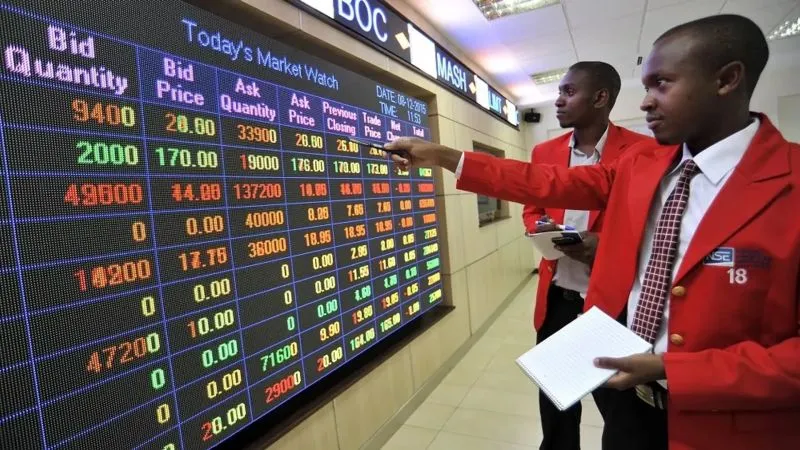
Kenya’s stock market continued its measured ascent on March 19, 2026, with the NSE All Share Index (NASI) rising 0.18% to push deeper into positive territory for the year. Safaricom Plc (NSE: SCOM) remained the exchange’s defining counter, trading at KSh 30.70 and retaining its status as the most traded stock on the Nairobi Securities Exchange over the past three months, having moved a total volume of 444 million shares in that period. The day’s session added another chapter to what is shaping up to be one of the most eventful years in Kenya’s capital markets — a period marked by a landmark state privatisation, rising bank profits, and the structural transformation of the exchange’s most dominant company.
Markets move fast; don’t get left behind. We’ve paired the Serrari Group Market Index with a curated Marketplace and a comprehensive Wealth Builder Course to ensure you have the data—and the skills—to act on it.
NASI Builds on a Strong Year-to-Date Run
Today’s 0.18% gain may appear modest in isolation, but it is part of a larger story. As of the March 18 session, the NASI had posted a year-to-date gain of 13.24%, a figure that underscores the broad-based optimism that has characterised Kenyan equities in 2026. The NSE 10 Share Index added 14.85% year-to-date, while the NSE 20 Share Index climbed 17.43% and the NSE 25 Share Index was up 16.12% over the same period. The NSE Banking Sector Index has been one of the standout performers, gaining 20.38% year-to-date as bank stocks rally on the back of improving credit conditions and falling non-performing loans.
Looking at the broader twelve-month view, the scale of gains becomes even more striking. Kenya’s stock market has climbed approximately 67% over the past year, with analysts projecting that listed company earnings will grow by 15% annually going forward. The market’s price-to-earnings ratio has moved to 7.9x, above its three-year average of 5.7x, signalling that investors are now pricing in a rosier growth outlook than they were during the downturn period of 2023 and early 2024.
The Nairobi bourse’s current market capitalisation stands at KSh 3.53 trillion, a figure that has been significantly bolstered by the recent debut of Kenya Pipeline Company — Kenya’s largest IPO since Safaricom’s own listing in 2008. That single event fundamentally altered the composition and scale of the exchange.
Safaricom: The Linchpin of the NSE
No stock captures the soul of the Nairobi Securities Exchange quite like Safaricom. The company accounts for a roughly 40% share of total NSE market capitalisation, meaning its daily price movements have an outsized effect on headline index readings. When Safaricom trades flat or edges lower, the NASI tends to lag; when it rallies, the index follows. Today’s trading at KSh 30.70 marks a mild recovery from recent pressure — the stock had lost approximately 8.6% over the prior month amid profit-taking, even as it has gained nearly 7% year-to-date from a January opening price of KSh 28.35.
The stock’s 52-week range of KSh 17.10 to KSh 33.95 tells a vivid story of recovery. A year ago, Safaricom was still trading near multi-year lows as investors weighed the mounting losses coming from its Ethiopian expansion. Today, those same investors have largely been won over by improving fundamentals and a growing earnings trajectory. TradingView analysts have set a maximum price estimate of KSh 44.00 and a minimum estimate of KSh 31.91 for SCOM, suggesting that at KSh 30.70, the stock may still have room to run if earnings momentum continues.
Safaricom’s weight on the NSE also reflects the structural reality that Kenya’s stock market remains concentrated. The top five companies — Safaricom, Equity Group, KCB Group, EABL, and now Kenya Pipeline Company — account for the bulk of trading activity and market capitalisation. For index-level NASI movements to be meaningful and sustained, Safaricom’s participation is not optional — it is essential.
Safaricom’s Fundamentals: A Business in Transition
Behind the share price, Safaricom is a company in the midst of a profound business model transformation. Its half-year profit for FY2026 jumped 52.1% to a record KSh 42.8 billion, driven primarily by the continued rise of M-PESA and the maturation of mobile data as a core revenue line. Total group revenue crossed the KSh 200 billion mark for the first time in a half-year period, reaching KSh 204.7 billion.
The most significant operational shift is the emergence of data as Safaricom’s primary revenue driver. For the first time in the company’s history, mobile data revenue surpassed voice revenue, with data bringing in KSh 44.4 billion against voice’s KSh 41.1 billion. This crossover is not a blip — it reflects structural changes in how Kenyan consumers communicate, pay, and access services. Data usage per subscriber has grown consistently, driven by wider 4G device penetration and a 55.9% growth in 5G-enabled devices on the network.
M-PESA, however, remains the group’s crown jewel. The mobile money platform generated KSh 88.1 billion in H1 FY2026, a 14.1% increase year-on-year, and now accounts for over 40% of total service revenue. The platform processed 21.9 billion transactions in the six months to September 2025, a 26.5% year-on-year increase. Lipa Na M-PESA merchants grew 32.2% to 870,700 active tills, while Pochi la Biashara tills surged 72.6% to 1.5 million — signals of deepening integration into everyday commerce.
M-PESA’s total annual revenue means it generates more than Kenya’s GDP contribution per sector, a testament to its extraordinary penetration. The platform now serves more than 30 million active users in Kenya and has become the backbone of the country’s digital payments infrastructure.
Ethiopia: From Drag to Catalyst?
Safaricom’s most watched strategic bet — its foray into Ethiopia — is evolving from an investor concern into a potential catalyst. The Ethiopian operation has been a significant drag on group financials since its 2022 launch, with losses compounded by the depreciation of the Ethiopian birr. However, H1 FY2026 showed unmistakable progress: the Ethiopian unit’s service revenue more than doubled year-on-year to KSh 6.19 billion, while the group’s reported loss from the Ethiopian subsidiary fell to KSh 13.3 billion from KSh 28.2 billion a year earlier.
By Q3 FY2026, Safaricom Ethiopia had crossed 12 million three-month active customers, a 71.7% year-on-year increase, with 4G coverage expanding to 57.1% of the population across 3,483 active sites. Service revenue from Ethiopia in Q3 FY2026 alone reached KSh 9.68 billion, a 54.2% year-on-year jump.
Management has guided for Ethiopia to reach EBIT breakeven by FY2027. If achieved, that inflection point would unlock significant upside for the group’s bottom line and could push Safaricom’s consolidated profit toward the KSh 150 billion target that analysts have flagged as a realistic outcome given current trajectories. As Renaissance Capital Africa noted in its sector outlook, the Ethiopian unit could add up to KSh 20 billion to Safaricom’s bottom line once it reaches profitability.
Context is everything. While you follow today’s updates, use the Serrari Market Index and Marketplace to spot emerging shifts. Need to sharpen your edge? Our Wealth Builder Course turns these insights into a professional-grade strategy.
KPC’s Landmark Debut Reshapes the NSE
Beyond Safaricom, no single event has had a greater structural impact on the NSE in 2026 than the listing of Kenya Pipeline Company (KPC). The state-owned energy company officially debuted on the Nairobi Securities Exchange on March 10, 2026, following an IPO that was oversubscribed at 105.7%, raising KSh 112.374 billion — making it Kenya’s largest IPO since Safaricom’s own listing 18 years ago.
The offer, which ran from January 19 to February 24, 2026, attracted more than 70,000 ordinary Kenyan investors, with investors applying for 12.49 billion shares against an offer of 11.81 billion at KSh 9 per share. KPC shares opened their first trading day at KSh 9.30, an instant 3.3% premium over the IPO price, and quickly secured a position among the NSE’s top ten largest companies by market capitalisation.
The IPO proceeds have been earmarked for Kenya’s newly established National Infrastructure Fund. As Treasury Cabinet Secretary John Mbadi explained, the government will only accept the targeted KSh 106.3 billion — a statement of fiscal discipline that investors noted positively. The KPC listing is also significant because it marks the first privatisation of a state enterprise since 2008 and the first fully electronic IPO in Kenya’s history, where all applications were submitted online — a milestone for digital capital market infrastructure.
Local institutional investors, including the National Social Security Fund, secured the largest allocation, becoming the biggest shareholders in KPC with a 41% stake. The government retains 35%, while East African investors — including the Government of Uganda — hold the remainder. Their participation turns KPC into a genuinely regional corporate with geopolitical significance in East Africa’s petroleum supply chain.
Banking Stocks and Broader Market Dynamics
The NSE Banking Sector Index’s 20.38% year-to-date gain is another major theme in Kenya’s equity story. Improved credit conditions, falling non-performing loans, and a rate-cut cycle by the CBK have combined to boost investor sentiment toward Kenyan lenders. Following the CBK’s February 2026 decision to lower the Central Bank Rate to 8.75%, commercial banks began transmitting lower funding costs to borrowers, supporting both loan growth and net interest margins.
East African Breweries PLC (EABL) also made headlines recently when it soared 5.4% in a single session following solid H1 FY2026 results that showed a 37% growth in net earnings to KSh 11.2 billion, supported by strong income growth, operational efficiencies, and lower finance costs, including a KSh 4.00 interim dividend.
Daily trading activity on the NSE has evolved meaningfully. In the March 18 session immediately preceding today’s, 19,674,312 shares changed hands in 14,096 deals across 57 listed equities, with 26 gainers and 19 losers. Flame Tree Group Holdings led that day’s gainers at 5.93%, while Kenya Airways recorded the highest volume at 10.1 million shares traded. Kenya’s NSE 20 Share Index had risen 64.29% over the past 12 months as of mid-March 2026, a figure that reflects genuine multi-sector recovery — not just a Safaricom effect.
New Investor Access: Ziidi Trader via M-PESA
One of the most consequential developments for the long-term depth of Kenya’s equity market is Safaricom’s integration of NSE trading directly into the M-PESA app via a platform called Ziidi Trader. From January 2026, investors can trade shares on the Nairobi Securities Exchange via M-PESA, enabling users to buy and sell equities, track portfolio performance, and move funds seamlessly through their mobile money wallets. The platform dramatically lowers the barrier to entry for retail investors — the same user base that subscribed to the KPC IPO in their tens of thousands is now a click away from daily equity trading. If adoption scales as expected, Ziidi Trader could prove to be the most significant structural change to retail investor participation at the NSE since the exchange introduced its automated trading system over two decades ago.
Outlook: Fundamentals Support Continued Momentum
Kenya’s equity market enters the second quarter of 2026 with several tailwinds intact. Inflation remains below the CBK’s 5% midpoint target, the shilling has been stable near KSh 129 to the dollar, and GDP growth is projected at 5.5% for 2026 and 5.6% for 2027. Private sector credit growth reached 6.4% in January 2026, reversing a contraction that had weighed on corporate earnings in 2024 and 2025. Earnings forecasts for listed companies project 15% annual growth, a rate that, if delivered, would justify current valuations and could push the NASI meaningfully higher by year-end.
The April 8 MPC meeting looms as the next major macro catalyst. A further rate cut — potentially extending the easing streak to eleven consecutive reductions — would likely provide a fresh lift to rate-sensitive sectors like banking and real estate on the NSE. For Safaricom investors specifically, the next major event is the full-year FY2026 earnings release scheduled for around May 7, 2026, where Ethiopia’s trajectory and Kenya’s M-PESA momentum will once again take centre stage.
As Safaricom trades near KSh 30.70 and the NASI continues its measured climb, Kenya’s capital markets are sending a clear message: investor confidence is returning, new participants are entering the market, and the bourse’s structural depth is improving. Whether today’s 0.18% gain is a pause before a larger move — or a sign of consolidation after a strong YTD run — will depend on how these multiple narratives resolve over the coming weeks.
Your financial future isn’t something you wait for—it’s something you build.
The real question is: when do you begin?
Move beyond simply staying informed.
Navigate the markets with clarity—track trends through the Serrari Group Market Index, uncover opportunities in the Serrari Marketplace, and build practical knowledge with our Curated Wealth Builder Course.
Stay connected to what truly matters.
Get daily insights on macro trends and financial movements across Kenya, Africa, and global markets—delivered through the Serrari Newsletter.
Growth opens doors.
Advance your career through professional programs including ACCA, HESI A2, ATI TEAS 7 , HESI EXIT , NCLEX – RN and NCLEX – PN, Financial Literacy!🌟—designed to move you forward with confidence.
See where money is flowing—clearly and in real time.
Track Money Market Funds, Treasury Bills, Treasury Bonds, Green Bonds, and Fixed Deposits, alongside global and African indexes, key economic indicators, and the evolving Crypto and stablecoin landscape—all within Serrari’s Market Index.
Photo Source: Google
By: Montel Kamau
Serrari Financial Analyst
19th March, 2026
Article, Financial and News Disclaimer
The Value of a Financial Advisor
While this article offers valuable insights, it is essential to recognize that personal finance can be highly complex and unique to each individual. A financial advisor provides professional expertise and personalized guidance to help you make well-informed decisions tailored to your specific circumstances and goals.
Beyond offering knowledge, a financial advisor serves as a trusted partner to help you stay disciplined, avoid common pitfalls, and remain focused on your long-term objectives. Their perspective and experience can complement your own efforts, enhancing your financial well-being and ensuring a more confident approach to managing your finances.
Disclaimer: This article is for informational purposes only and does not constitute financial advice. Readers are encouraged to consult a licensed financial advisor to obtain guidance specific to their financial situation.
Article and News Disclaimer
The information provided on www.serrarigroup.com is for general informational purposes only. While we strive to keep the information up to date and accurate, we make no representations or warranties of any kind, express or implied, about the completeness, accuracy, reliability, suitability, or availability with respect to the website or the information, products, services, or related graphics contained on the website for any purpose. Any reliance you place on such information is therefore strictly at your own risk.
www.serrarigroup.com is not responsible for any errors or omissions, or for the results obtained from the use of this information. All information on the website is provided on an as-is basis, with no guarantee of completeness, accuracy, timeliness, or of the results obtained from the use of this information, and without warranty of any kind, express or implied, including but not limited to warranties of performance, merchantability, and fitness for a particular purpose.
In no event will www.serrarigroup.com be liable to you or anyone else for any decision made or action taken in reliance on the information provided on the website or for any consequential, special, or similar damages, even if advised of the possibility of such damages.
The articles, news, and information presented on www.serrarigroup.com reflect the opinions of the respective authors and contributors and do not necessarily represent the views of the website or its management. Any views or opinions expressed are solely those of the individual authors and do not represent the website's views or opinions as a whole.
The content on www.serrarigroup.com may include links to external websites, which are provided for convenience and informational purposes only. We have no control over the nature, content, and availability of those sites. The inclusion of any links does not necessarily imply a recommendation or endorsement of the views expressed within them.
Every effort is made to keep the website up and running smoothly. However, www.serrarigroup.com takes no responsibility for, and will not be liable for, the website being temporarily unavailable due to technical issues beyond our control.
Please note that laws, regulations, and information can change rapidly, and we advise you to conduct further research and seek professional advice when necessary.
By using www.serrarigroup.com, you agree to this disclaimer and its terms. If you do not agree with this disclaimer, please do not use the website.
www.serrarigroup.com, reserves the right to update, modify, or remove any part of this disclaimer without prior notice. It is your responsibility to review this disclaimer periodically for changes.
Serrari Group 2025